Stack up against Monzo

Compare Your Deck

Monzo's 2016 Pitch Deck

Fintech
Stage: Crowdfunding
Raised: $2.4M
Year: 2016
Slides: 16
Outcome: Valued at $4.5B

Pitch Deck

1 / 16
Slide 1
Click to expand

Deck Analysis

This deck presents Monzo’s 2016 crowdfunding pitch: a consumer-focused challenger bank positioning itself as a mobile-first financial control centre. It combines storytelling (community, product delight) with quantified traction (users, card spend, viral mechanics), technology claims (95% built in-house, ML for fraud), and regulatory milestones (UK banking licence). Notable for its clean visual design, clear metrics, and emphasis on community-driven growth, the deck shows how a fintech can use product experience, transparency and data to win both users and investors.

The Opening: Brand and Mission

The Opening: Brand and Mission

Slide 1 (cover) and slide 2 set a strong emotional and mission-driven tone: they open with the Monzo brand and a bold ambition — to provide a financial control centre to 1 billion people worldwide. The visuals (celebratory crowd, app icon) and short declarative copy establish identity and aspiration immediately, making it easy for investors to understand what Monzo aims to become beyond a single product. This is effective because it leads with vision rather than detail, which helps frame the rest of the deck as steps toward that outcome.

Founders can learn the value of starting with a concise mission and strong branding. It orients the audience and primes investors to interpret traction and technical claims as progress toward a large, relatable goal. Use a simple, high-level ambition early to give later metrics context and to make the story cohesive.
Key Takeaway: Start decks with a crisp mission and visual identity to frame all subsequent traction and technical detail as progress toward a bold, investable outcome.
Product: Mobile-first, delightful user experience

Product: Mobile-first, delightful user experience

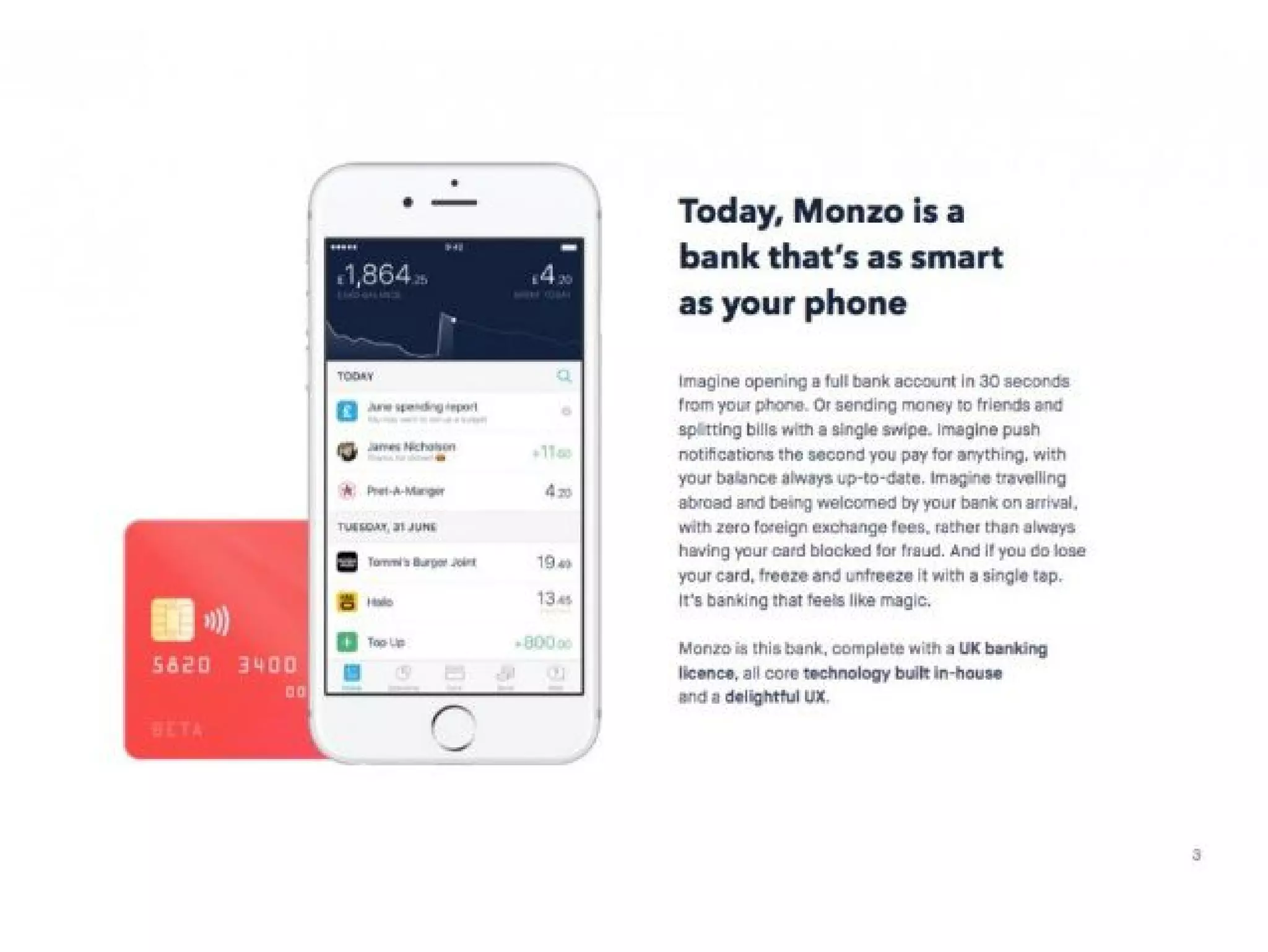
Slide 3 presents the product: an elegant mobile app and card with a short paragraph explaining fast onboarding, instant notifications, and user controls like freezing a lost card. The copy focuses on tangible user benefits rather than tech jargon — opening an account in 30 seconds, push notifications, zero FX fees — which helps investors quickly grasp product-market fit. The pairing of app UI imagery and concise bullets demonstrates a product that is both usable and differentiated on experience.

This approach is effective because consumer fintech is a trust-and-experience business; showing exactly what users see and feel reduces abstraction. For founders, include real screenshots and direct user benefits rather than long lists of features, and highlight the onboarding and retention mechanics that make the product sticky.

Key Takeaway: Use real product visuals and short benefit-driven copy to show how the product delivers a superior user experience that drives retention and referrals.
Traction: Clear, simple growth charts

Traction: Clear, simple growth charts

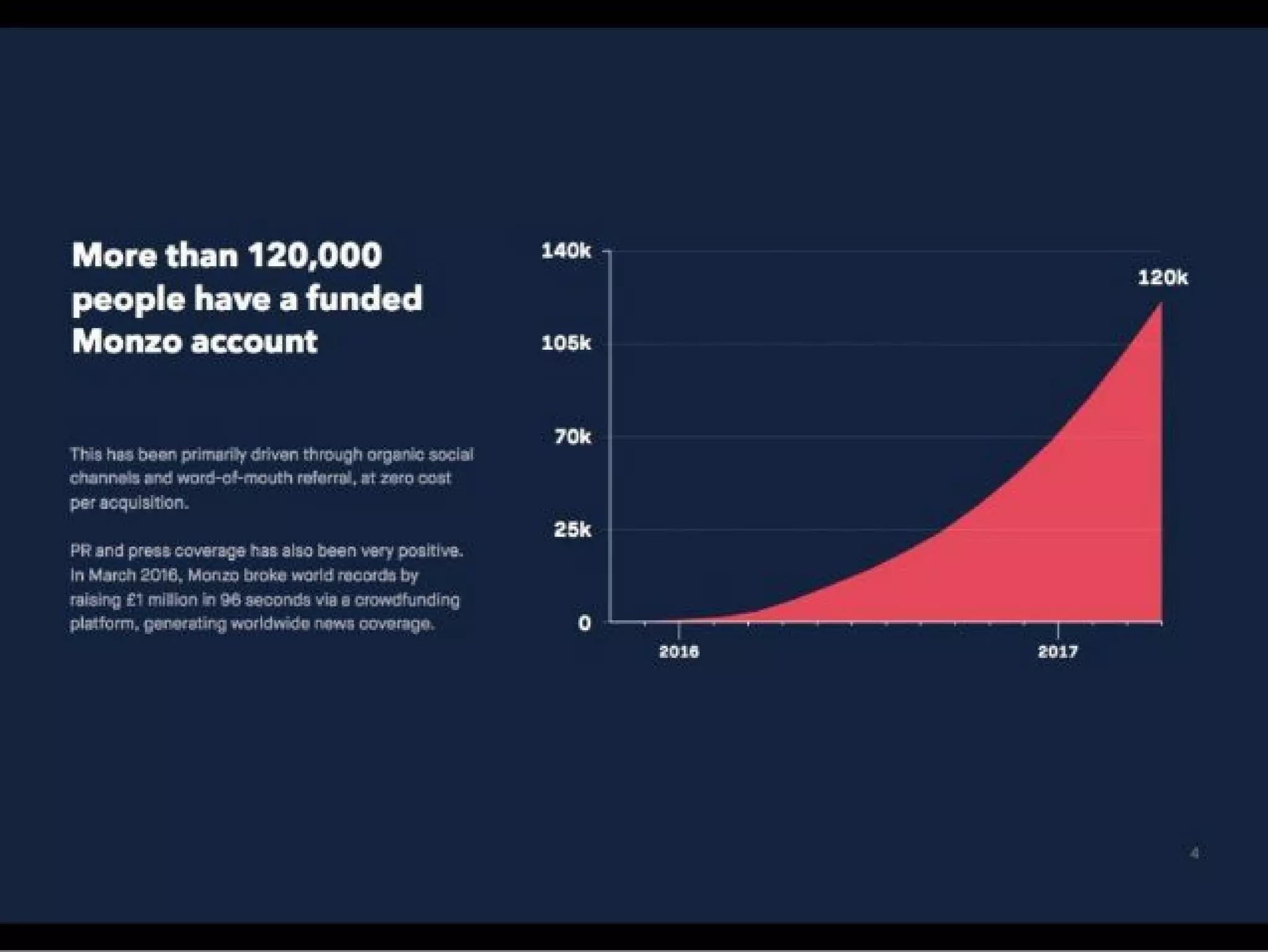
Slide 4 uses a single large chart and one headline: more than 120,000 people have a funded Monzo account. The graph shows rapid exponential growth, and the supporting copy attributes it to organic social channels and word-of-mouth, with a PR milestone (raising £1m in 96 seconds) that proves viral momentum. The visual emphasis on one compelling number keeps the message focused: traction is strong and accelerating.

Investors respond to clean, credible evidence of demand; Monzo’s slide avoids clutter and ties the chart to acquisition channels and viral events. Founders should highlight one or two headline traction metrics visually and explain the mechanism behind growth (organic channels, product virality, PR moments), so investors understand sustainability, not just raw numbers.

Key Takeaway: Display one dominant traction metric with a clear growth curve and explain the acquisition channels that produced it to prove both momentum and repeatability.
Customer Metrics: Depth over vanity numbers

Customer Metrics: Depth over vanity numbers

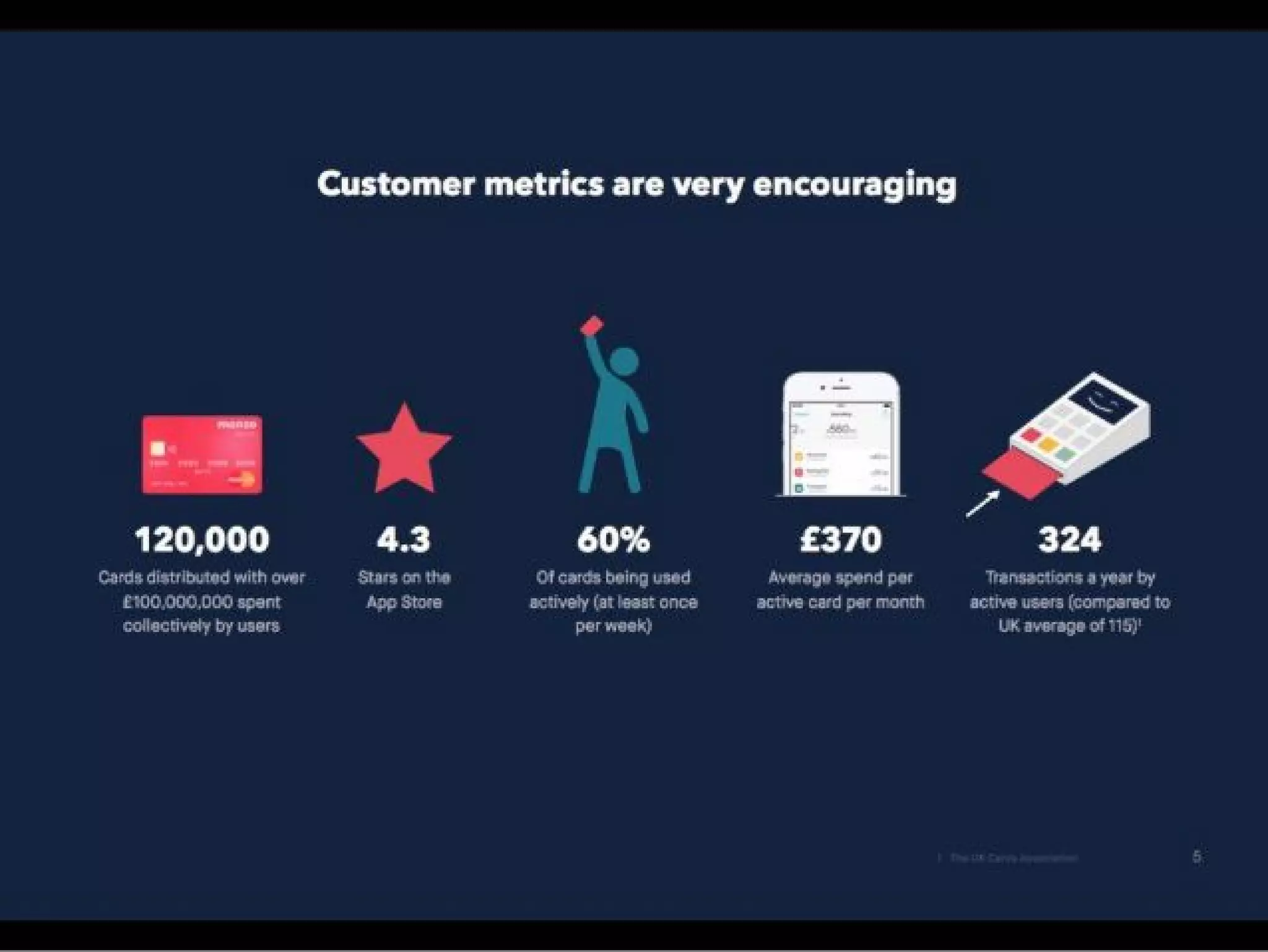
Slide 6 lists granular customer metrics — 120,000 cards distributed, 4.3 App Store rating, 60% active card usage weekly, average spend £370 per active card per month, and 324 transactions per year per active user. These are meaningful product-health indicators that speak to engagement and revenue potential rather than just user signups. The combination of NPS-like signals (app rating), usage frequency, and monetizable behavior (spend per card) gives investors a rounded view of unit economics and long-term value.

This is effective because it shows Monzo understands which metrics matter for a consumer banking business. Founders should choose KPIs that connect directly to monetization and retention and present them together so investors can quickly infer LTV, engagement and adoption quality rather than being distracted by raw download counts.

Key Takeaway: Show engagement and monetization-focused KPIs that directly connect product usage to future revenue, not just user acquisition statistics.
Viral Growth Mechanics and Community

Viral Growth Mechanics and Community

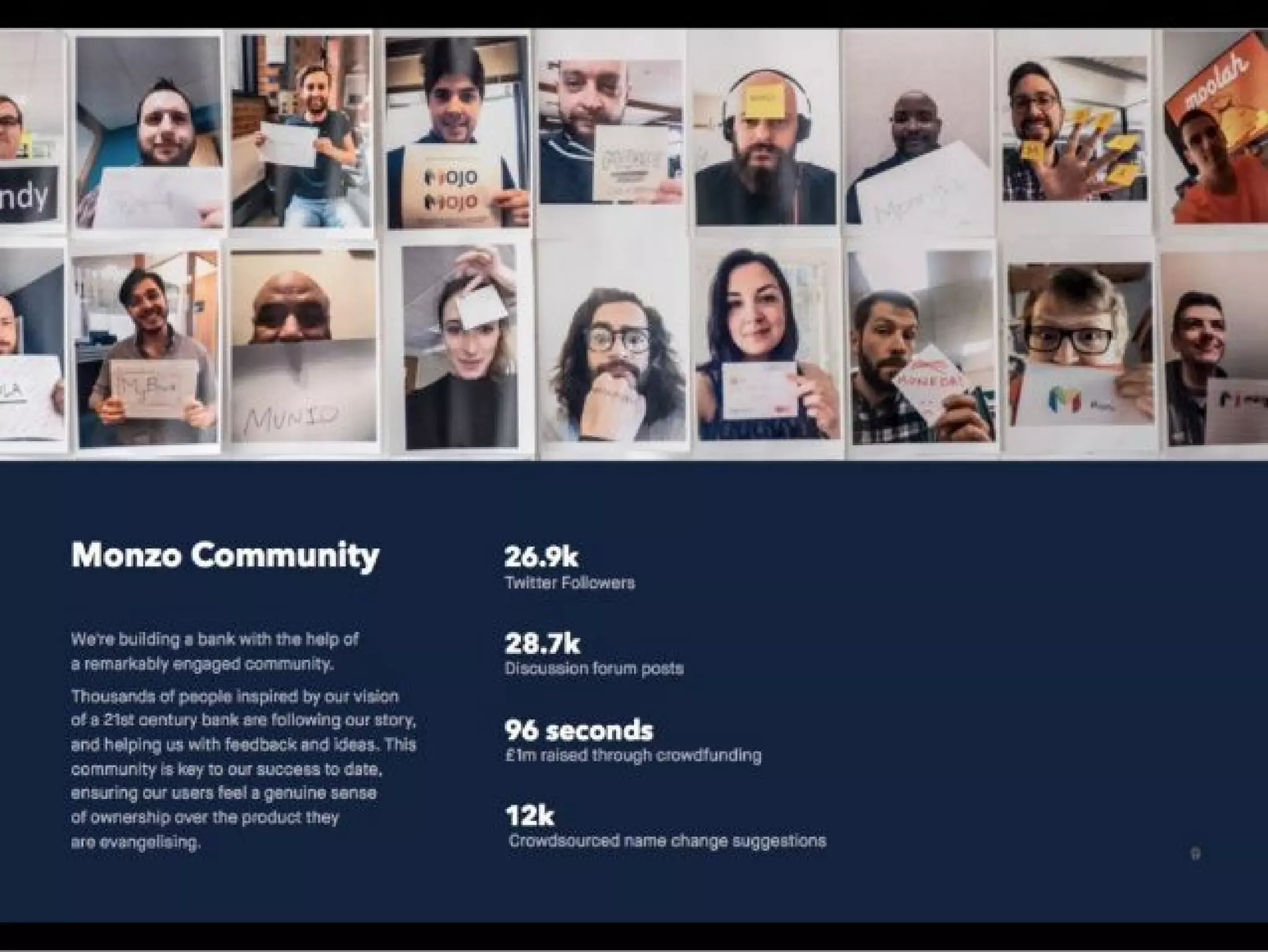
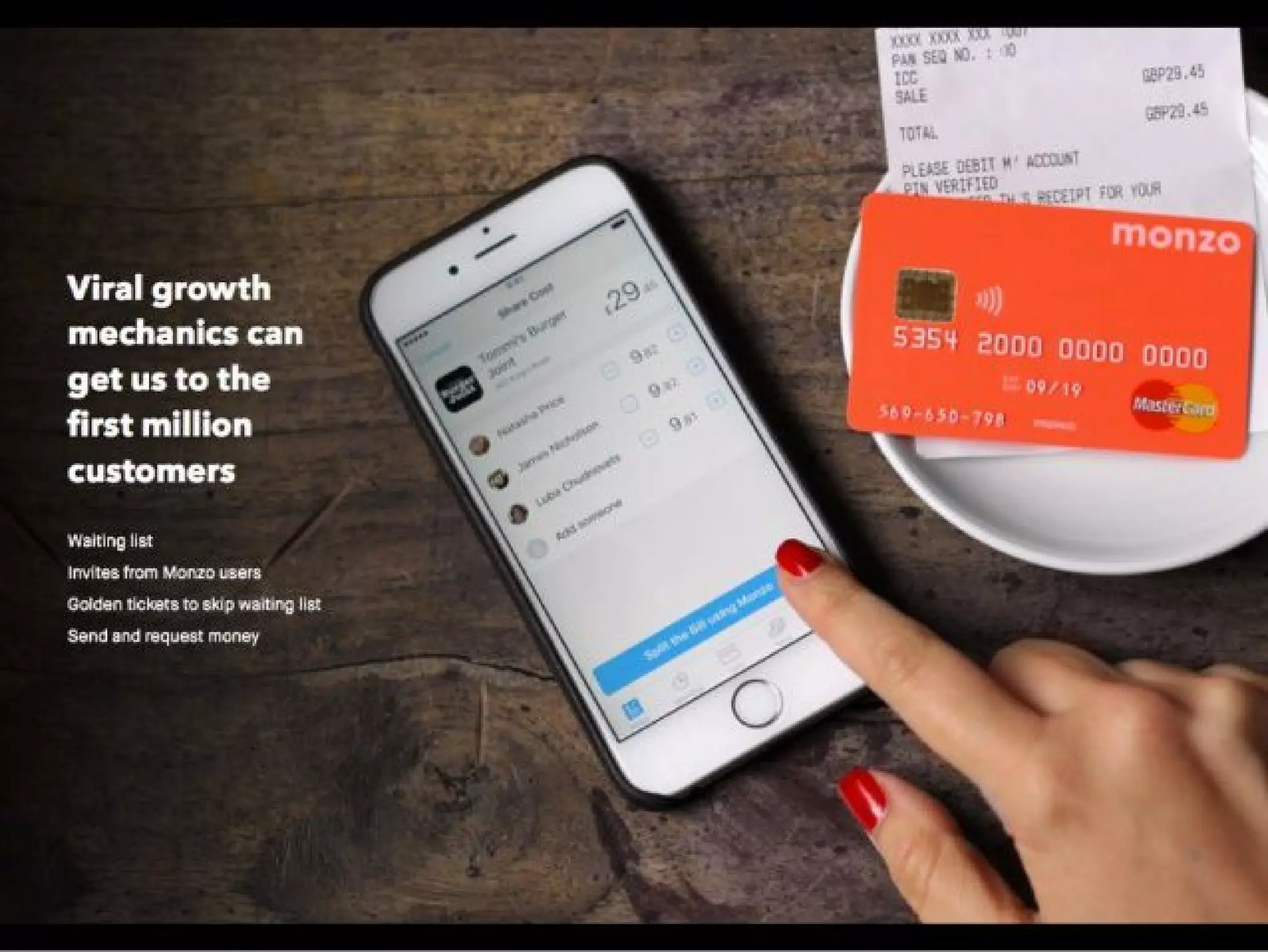
Slide 9 highlights concrete viral mechanics — waiting lists, invites, 'golden tickets' to skip queues, and peer-to-peer send/request features — while slide 10 emphasizes community stats (Twitter followers, forum posts, 96 seconds to raise £1m). Monzo ties product features to social distribution and demonstrates they leveraged scarcity and referral to scale acquisition at near-zero cost. The imagery of the card and app alongside the callouts makes the viral loops tangible for investors.

This section works because it shows product-led growth design rather than accidental virality. Founders should intentionally bake referral and scarcity mechanics into onboarding and surface community metrics to demonstrate ownership-driven growth. Outline the exact features that create viral loops and present community engagement numbers to show that the virality is real and measurable.

Key Takeaway: Design and call out the exact product mechanics that create viral loops and back them up with community engagement metrics to prove sustainable, low-cost acquisition.
Technology & Scale: Machine learning and in-house stack

Technology & Scale: Machine learning and in-house stack

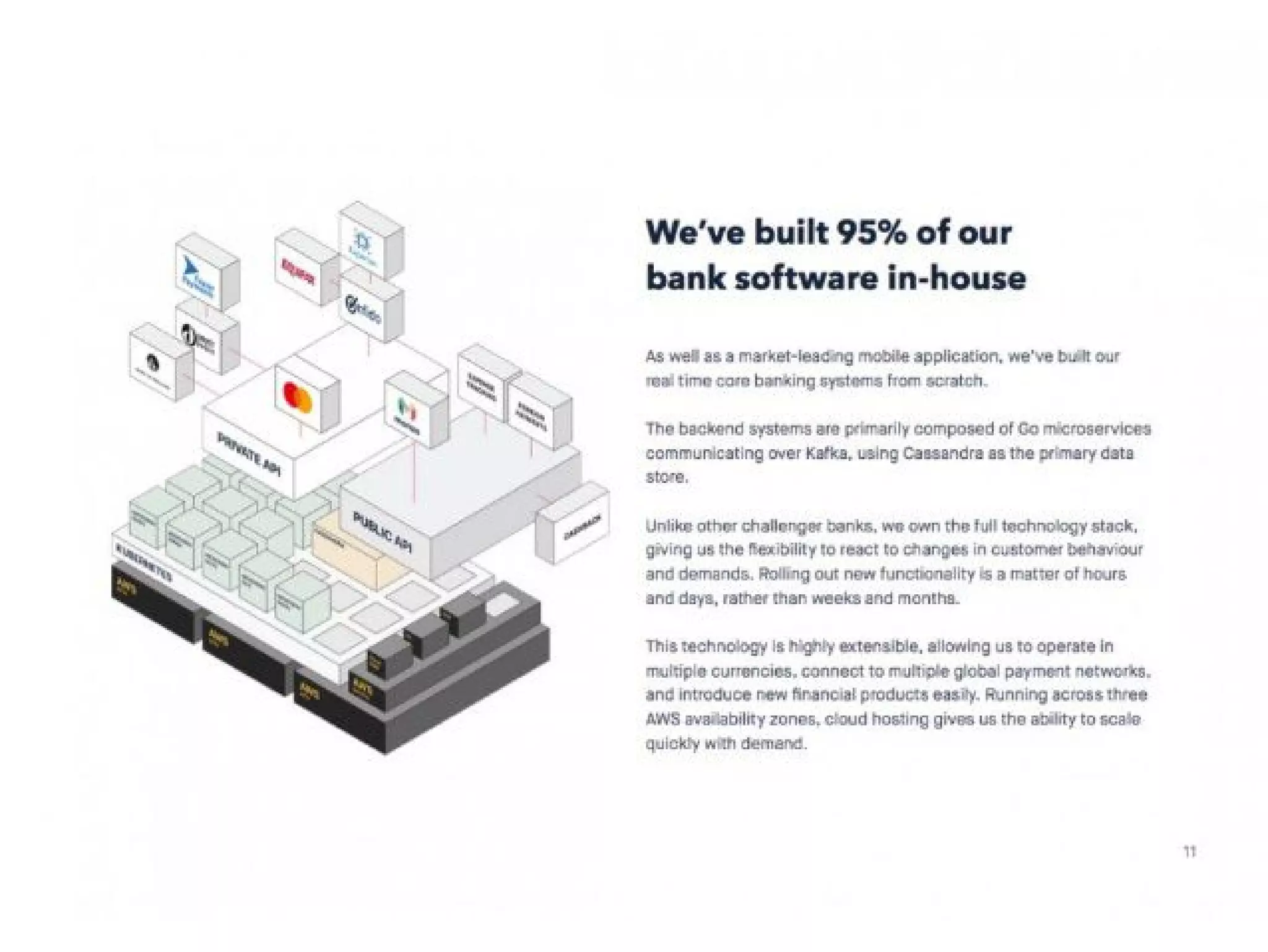
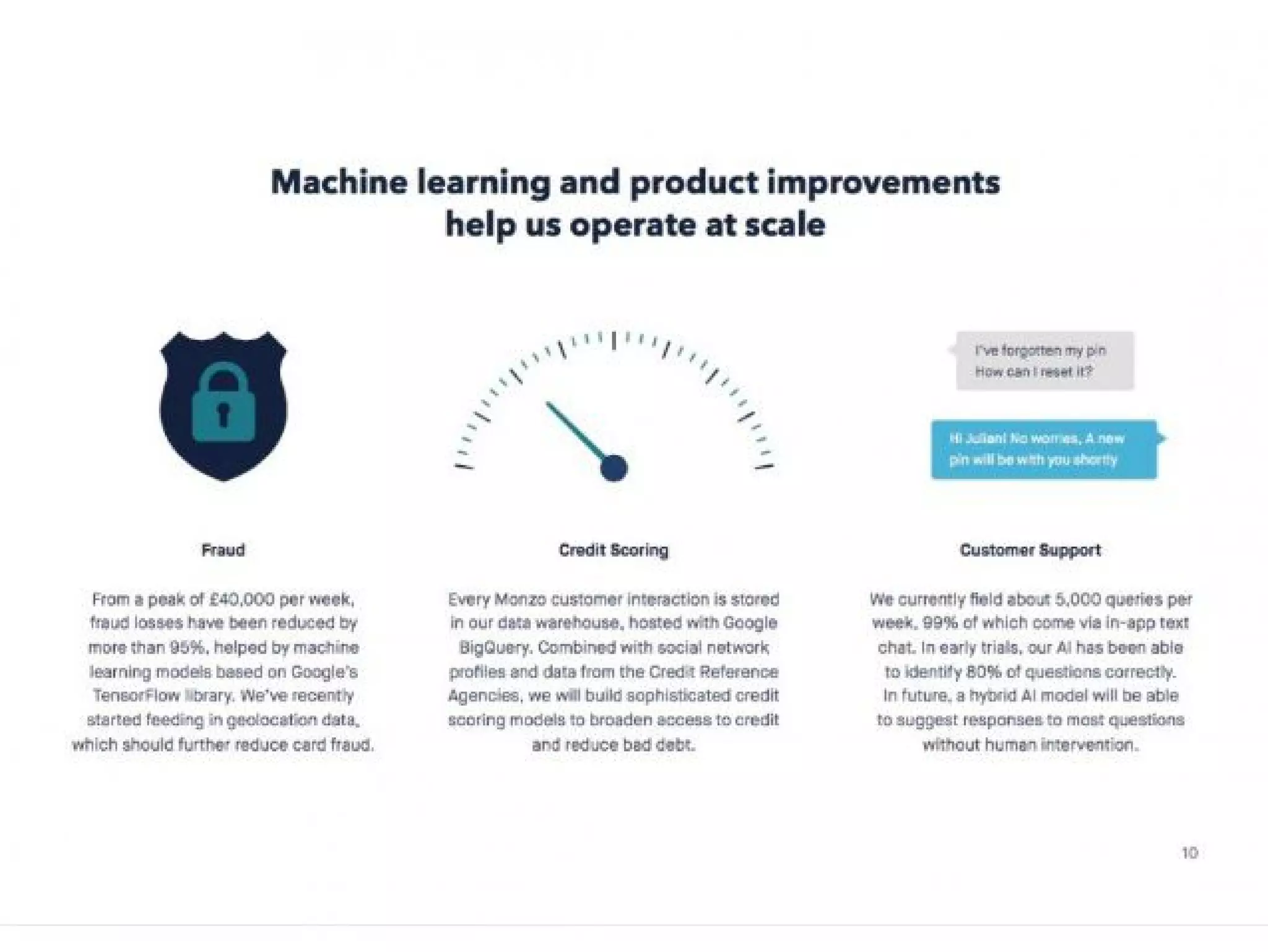
Slides 11 and 12 explain how machine learning and owning the technology stack enable Monzo to operate at scale: ML for fraud reduction, data-driven credit scoring, AI-assisted customer support, and a backend built from scratch (Go microservices, Kafka, Cassandra). The deck quantifies the impact (fraud reduced >95% from a £40k/week peak) and emphasizes speed of iteration as a competitive advantage. This positions Monzo as not just a nice app but a defensible tech-first bank.

Investors in fintech care about risk, reliability and scalability; demonstrating control over your stack and showing real outcomes from ML models directly addresses those concerns. Founders should explain the architecture at a high level, quantify operational improvements from technical work, and highlight how owning core tech reduces vendor risk and accelerates product launches.

Key Takeaway: Explain how tech choices materially reduce risk and cost (fraud, support) and accelerate product iterations — quantify impacts, not just technologies used.
Regulatory Milestone: Banking licence and expansion plans

Regulatory Milestone: Banking licence and expansion plans

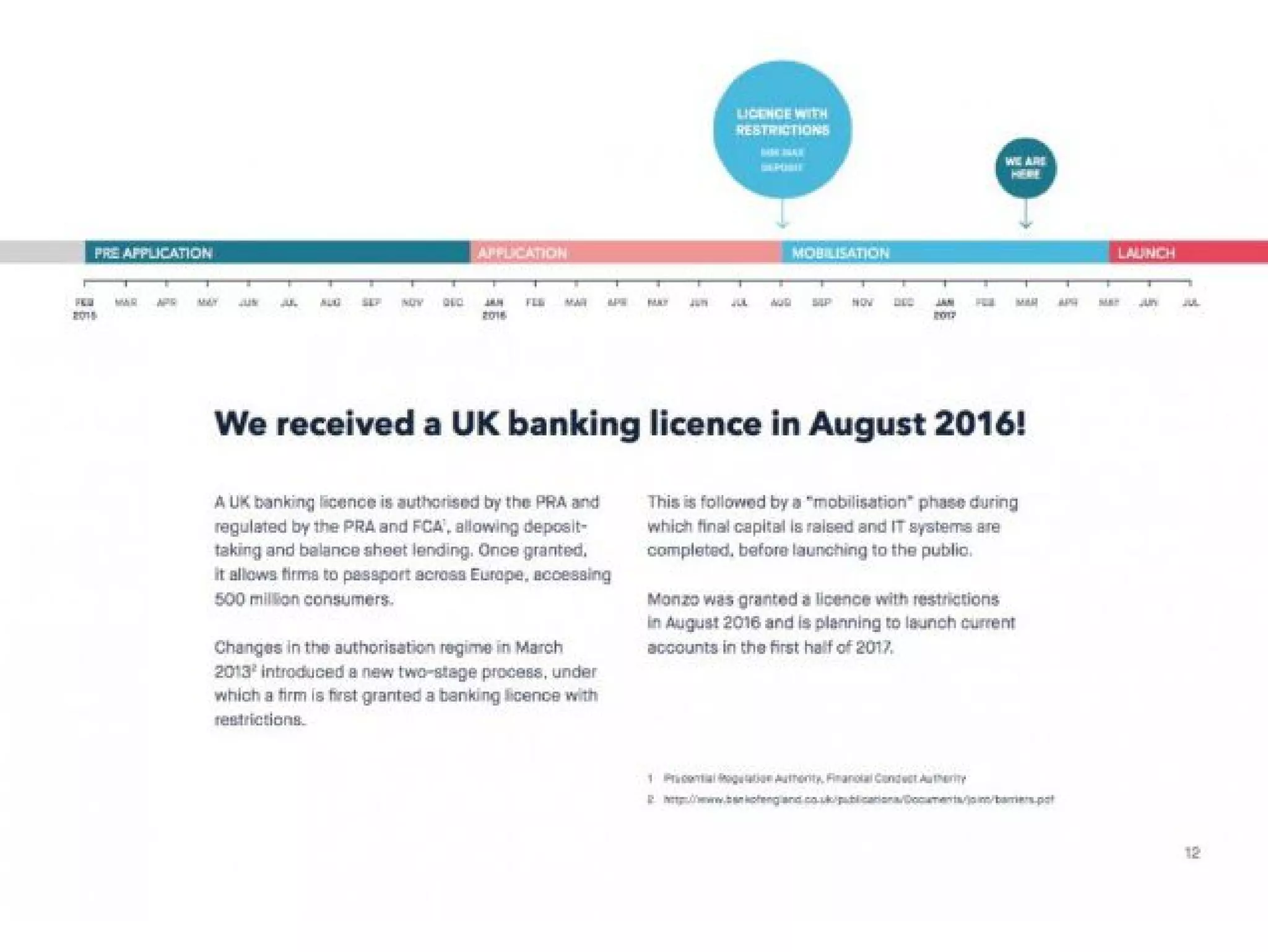
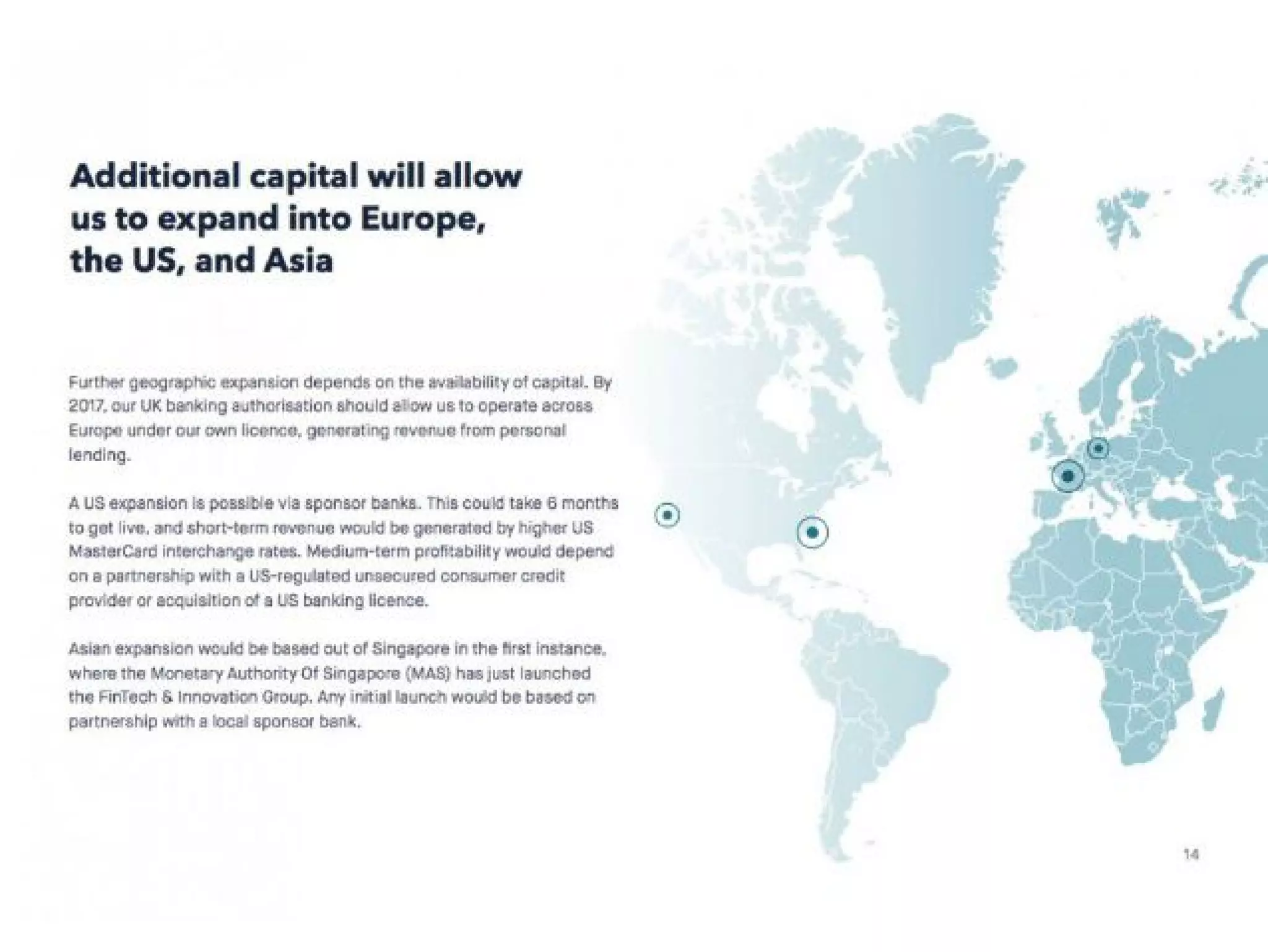
Slide 13 announces receipt of a UK banking licence in August 2016 and explains what that licence enables (deposit-taking, passporting across Europe) plus a timeline showing mobilisation and launch. Later slides (14 and 15) outline monetization (lending and affiliate revenue) and geographic expansion (Europe, US via sponsor banks, Asia via Singapore). This demonstrates maturity and reduces a major execution risk for a bank: regulatory approval.

For fintech founders, showcasing regulatory progress and realistic next steps is crucial; it transforms a product story into a scalable financial services business with legal ability to accept deposits and lend. Be explicit about the regulatory state, what it permits, and how it enables your business model and market expansion — and connect that to capital needs and timelines so investors can assess runway and timing.

Key Takeaway: Clearly communicate regulatory milestones and how they unlock revenue and expansion opportunities; investors must see legal runway as well as product traction.

Conclusion: Key Lessons

Monzo’s crowdfunding deck succeeds by balancing vision, product empathy, clear traction, community-driven growth mechanics, and technical/regulatory credibility. Strengths include strong visuals and mission, selected high-signal KPIs (engagement and spend), explicit viral mechanics tied to product features, and quantified technical wins (fraud reduction) that demonstrate operational competence. Together these create a coherent narrative: delightful product → engaged community → sustainable growth → regulatory and technical foundation for scale.

Actionable advice for founders: lead with a concise mission and product visuals; pick 3–5 metrics that map directly to monetization and retention; describe the exact product mechanisms that drive viral growth; quantify the impact of technical work on business outcomes; and clearly state regulatory or legal milestones and how they unlock the business model. That combination builds credibility with investors by showing both demand and the capacity to scale safely.