Stack up against Mint

Compare Your Deck

Mint's 2007 Pitch Deck

Fintech
Stage: Pre-launch
Raised: Seed
Year: 2007
Slides: 16
Outcome: Acquired by Intuit for $170M

Pitch Deck

1 / 16
Slide 1
Click to expand

Deck Analysis

This deck is an early seed presentation for Mint (2007), a consumer fintech startup that built a simple, visually-driven personal finance dashboard and monetized through referrals and targeted advertising. The deck is notable for its product-first storytelling: clean branding, a tangible product mock-up, a clear go-to-market plan, and unit economics that tie user benefits to revenue. It foreshadows why Mint became attractive to acquirers — strong UX, defensible tooling around data and categorization, and a crisp monetization plan aligned with user value.

Opening: Clear brand and positioning

Opening: Clear brand and positioning

The title slide is minimal and impeccably on-brand: a succinct logo, the tagline “TAKE BACK YOUR WALLET,” the founding team and date. It sets expectations for a consumer-focused product that promises control and simplicity. By keeping the design uncluttered, the slide communicates confidence and product-first thinking rather than premature fundraising minutiae.

Founders can learn from how the slide uses a strong tagline to immediately communicate value and a clean layout to establish credibility. A title slide is an opportunity to telegraph the company’s mission and tone — Mint uses it to prime the audience for a UX-focused fintech play.

Key Takeaway: Start with a single, memorable promise and a calm, professional visual tone that reflects your product’s user experience.
Product demo: Show the product and benefits early

Product demo: Show the product and benefits early

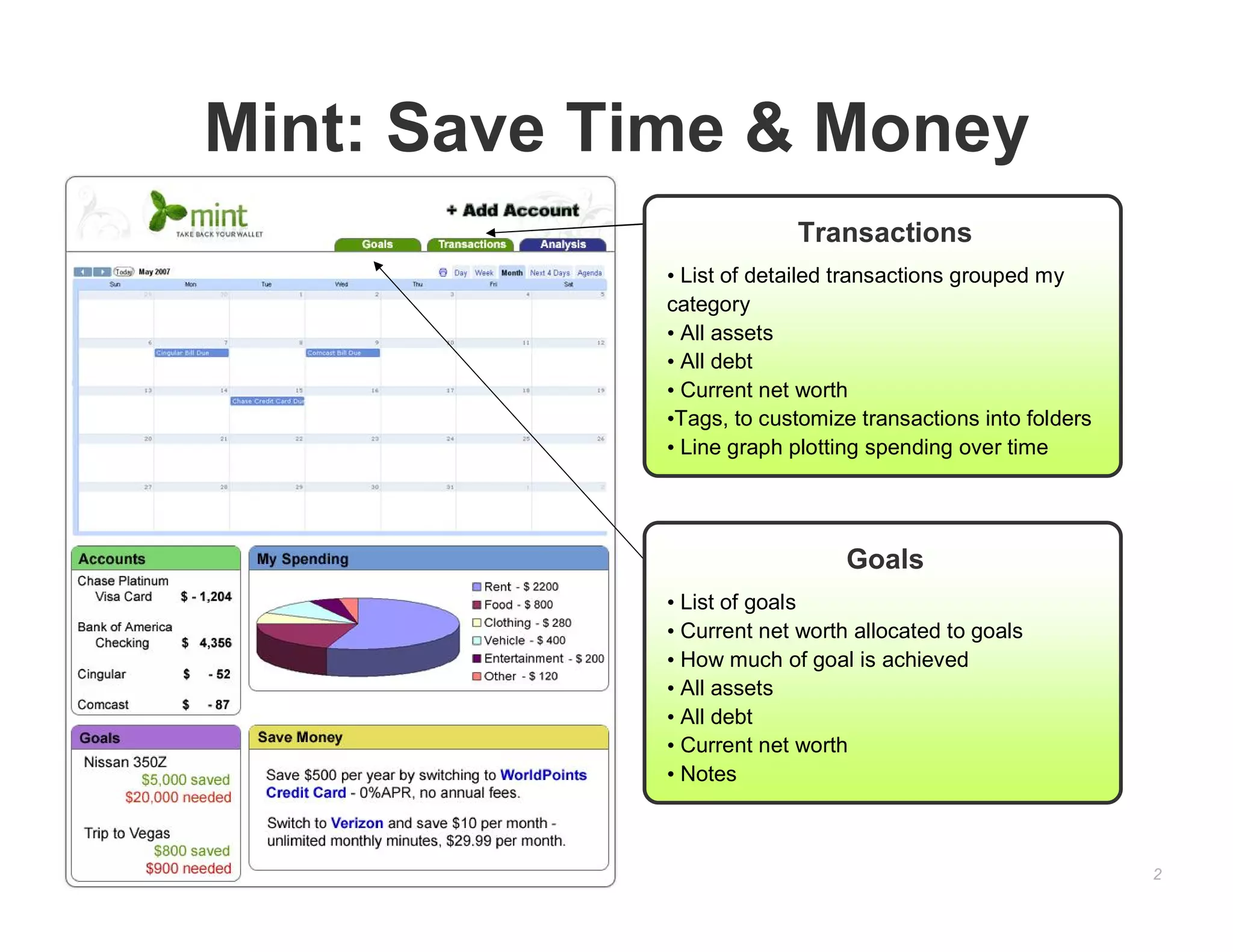
Slide 2 places the product front-and-center with a dashboard mockup and annotated callouts for key features (transactions, goals, accounts, saving suggestions). The visual demonstration of the interface plus short bullet lists of what each area does bridges the gap between concept and experience. It’s an effective use of space: investors instantly see how a user interacts with Mint and what immediate value it delivers (time/money savings, organization, goal tracking).

This slide teaches founders that showing is better than telling — a single screenshot can convey UX, complexity, and clarity of purpose faster than paragraphs. Accompany product images with concise annotations focused on benefits (not just features) to make it crystal clear why users will care.

Key Takeaway: Lead with a real product view and annotate it to highlight concrete user benefits — show the experience, don’t just describe it.
Team & credibility: Present complementary skills and advisors

Team & credibility: Present complementary skills and advisors

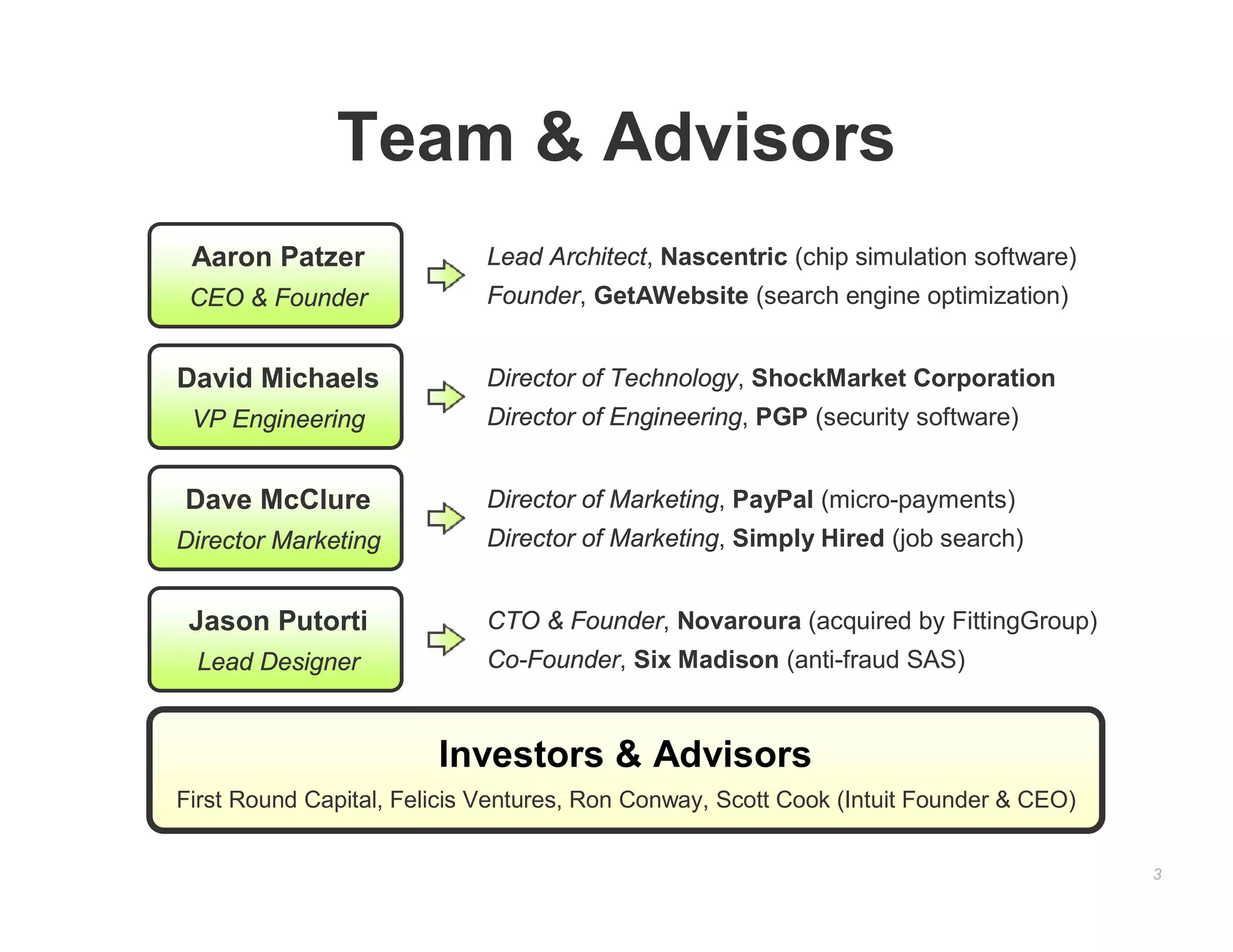
The team slide lays out roles (CEO/founder, VP engineering, marketing lead, lead designer) and pairs each with prior, relevant experience. It also lists investors and advisors from respected firms and industry founders, signaling credibility and network access. The format emphasizes complementary skill sets and external validation rather than listing bios at length.

For founders, this underlines the importance of showing both technical chops and go-to-market credibility. Investors look for teams that can build, market, and scale — presenting succinct role/experience pairs and credible advisors is a compact, persuasive way to communicate that balance.

Key Takeaway: Show how the founding team’s backgrounds cover product, engineering, design and growth — and include a few credible advisors or investors to signal external validation.
Market sizing & unit economics: Be specific and conservative

Market sizing & unit economics: Be specific and conservative

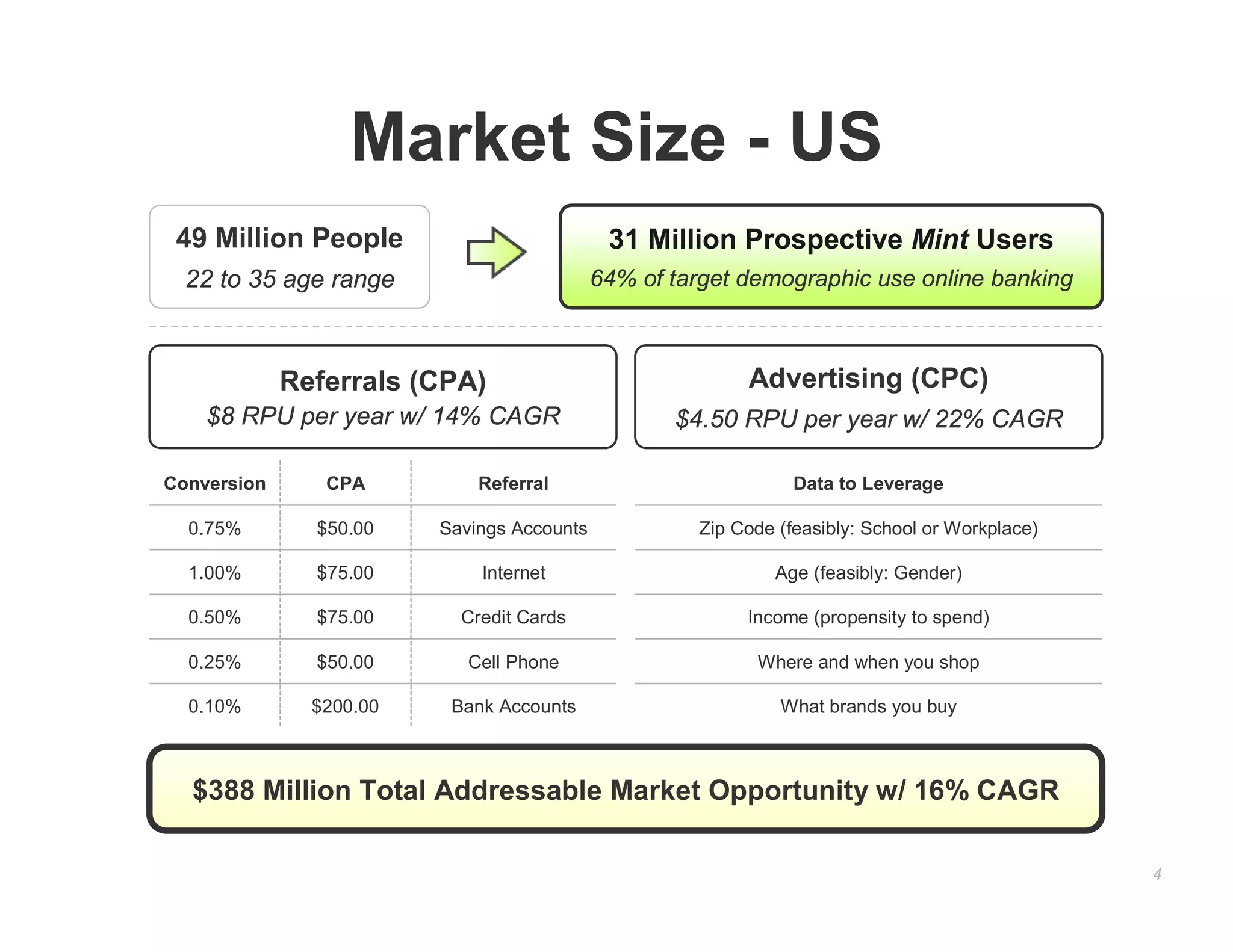
The market slide breaks down addressable users (22–35 demo), filters to prospective Mint users and then models monetization via two revenue streams (referrals/CPA and advertising/CPC) with RPU estimates and CAGR assumptions. It culminates in a quantified TAM ($388M) and growth expectation — a compact path from population to dollars that investors can follow.

This approach is instructive: combine demographic sizing with realistic conversion assumptions and per-user economics. Founders should present the funnel (users → conversions → revenue per user) transparently and be ready to defend each assumption; conservative, well-documented unit economics are far more persuasive than optimistic multipliers without a clear link to customer behavior.

Key Takeaway: Convert a top-down market number into bottom-up unit economics (conversion rates + RPU) so investors can evaluate your pathway to revenue.
Competitive positioning and defensibility

Competitive positioning and defensibility

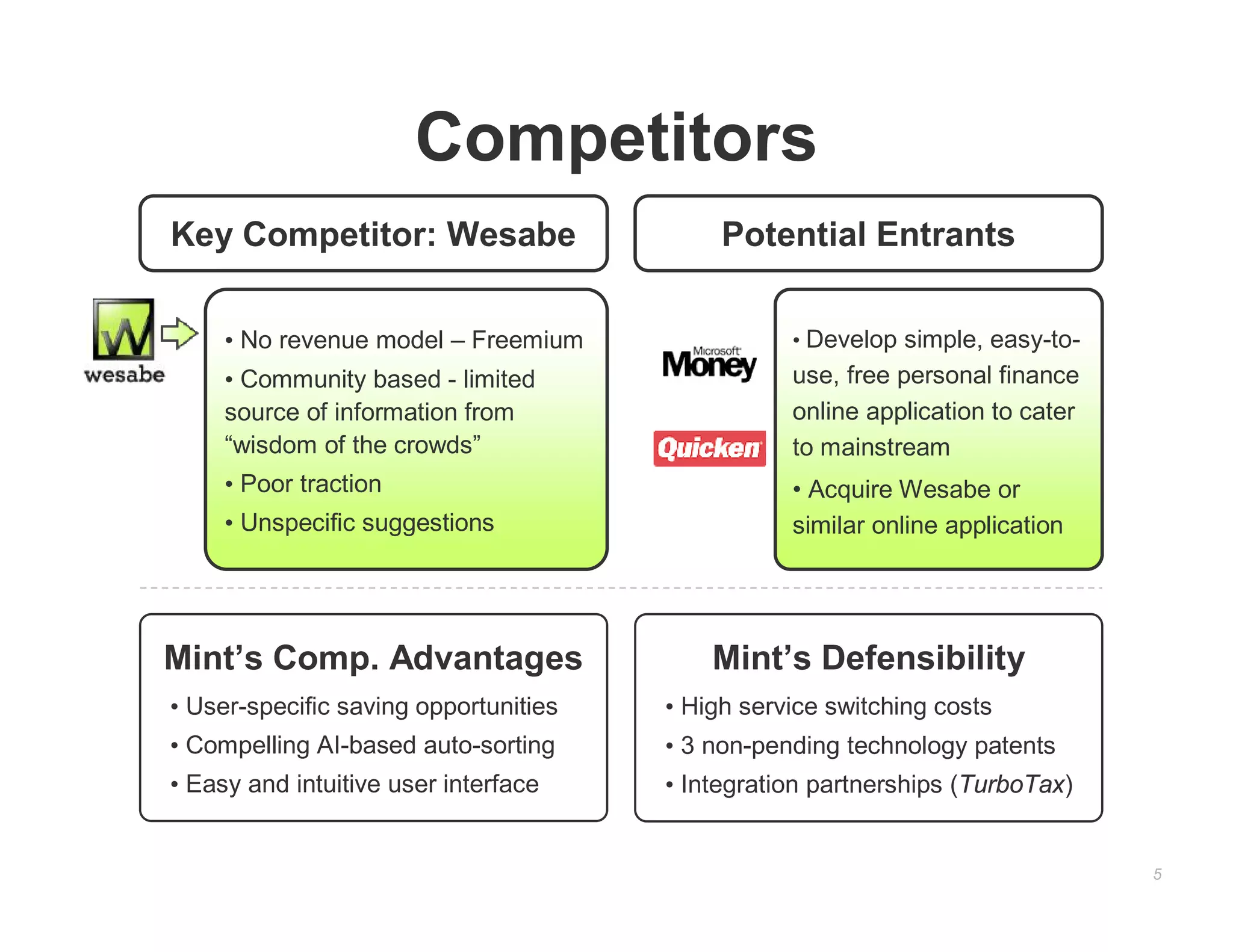
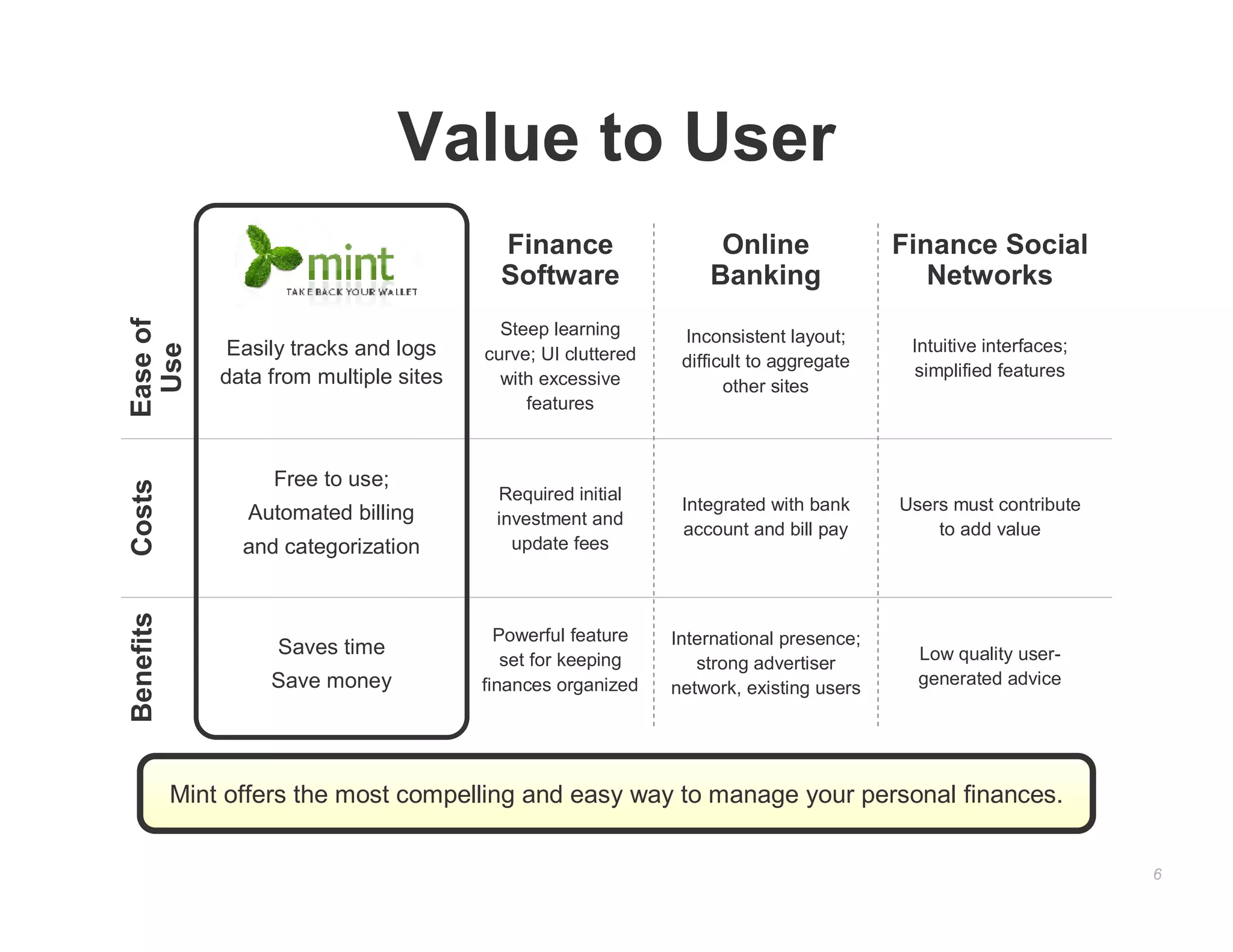
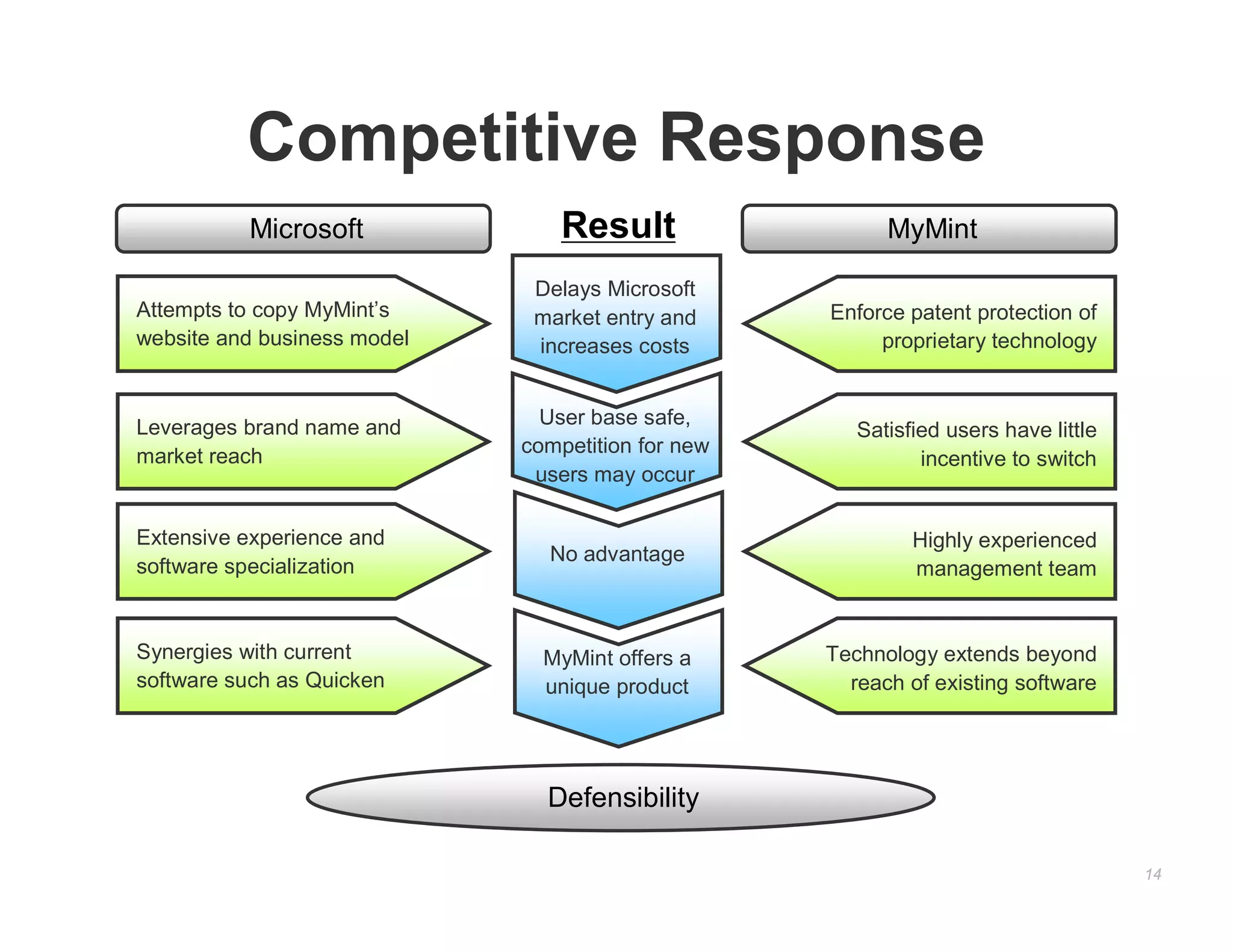
The competitor slide candidly calls out the main rival (a community-driven player) and potential entrants (big incumbents), then lists Mint’s advantages (user-specific savings, AI auto-sorting, intuitive UI) and defensibility (switching costs, patents, partnerships). The honesty about threats paired with practical defenses shows maturity: the team understands both what will attract users and what will attract competitors.

Founders should emulate this balance — openly acknowledge obvious competitors and show concrete, contestable differentiators (patents, data advantage, integrations, user experience). Framing defensibility as a portfolio (patents + partnerships + UX) is stronger than relying on a single claim.

Key Takeaway: Be explicit about threats and then tie your defensibility to concrete assets (data, tech, partnerships, UX) rather than vague assertions.
Business model: Align monetization with user value

Business model: Align monetization with user value

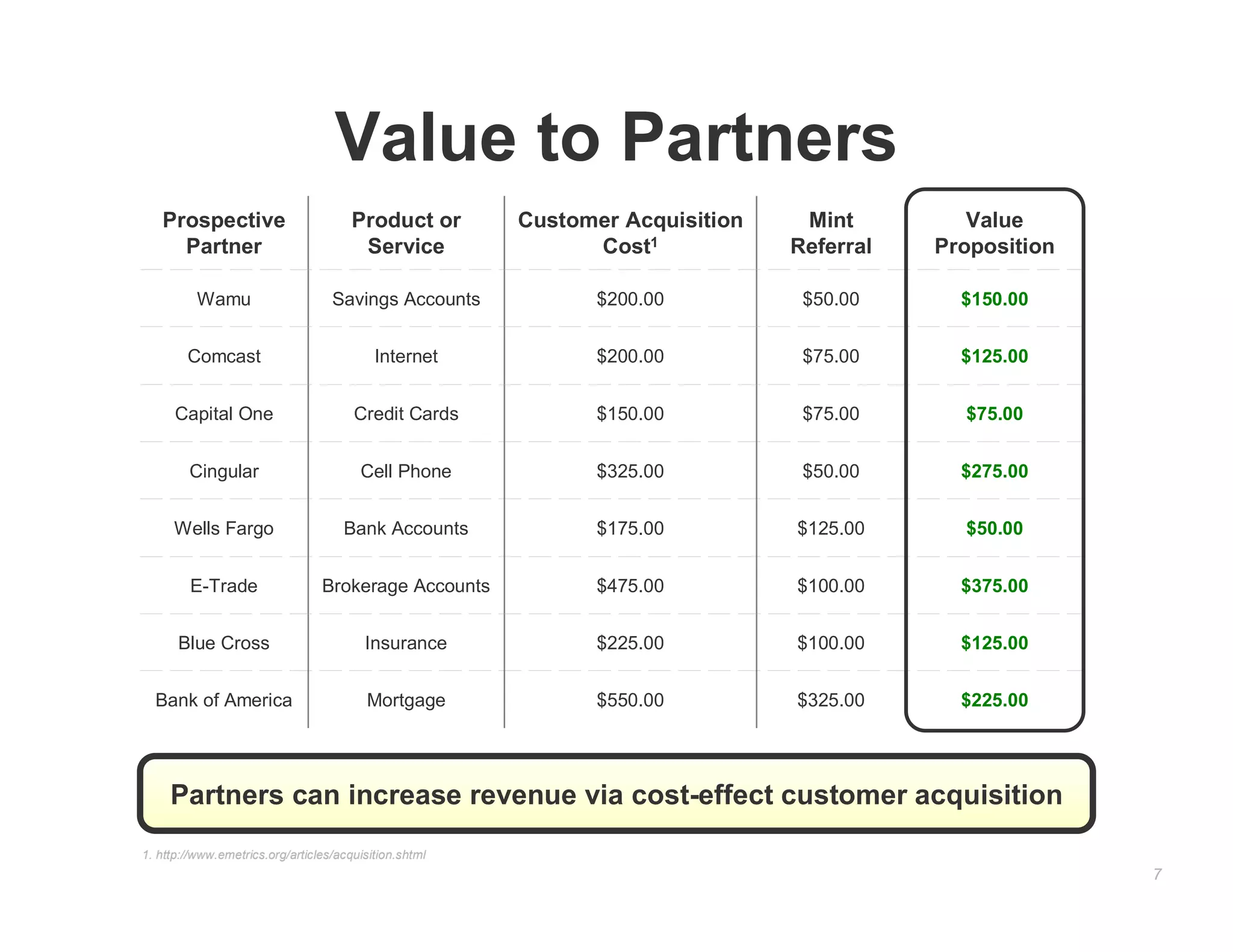
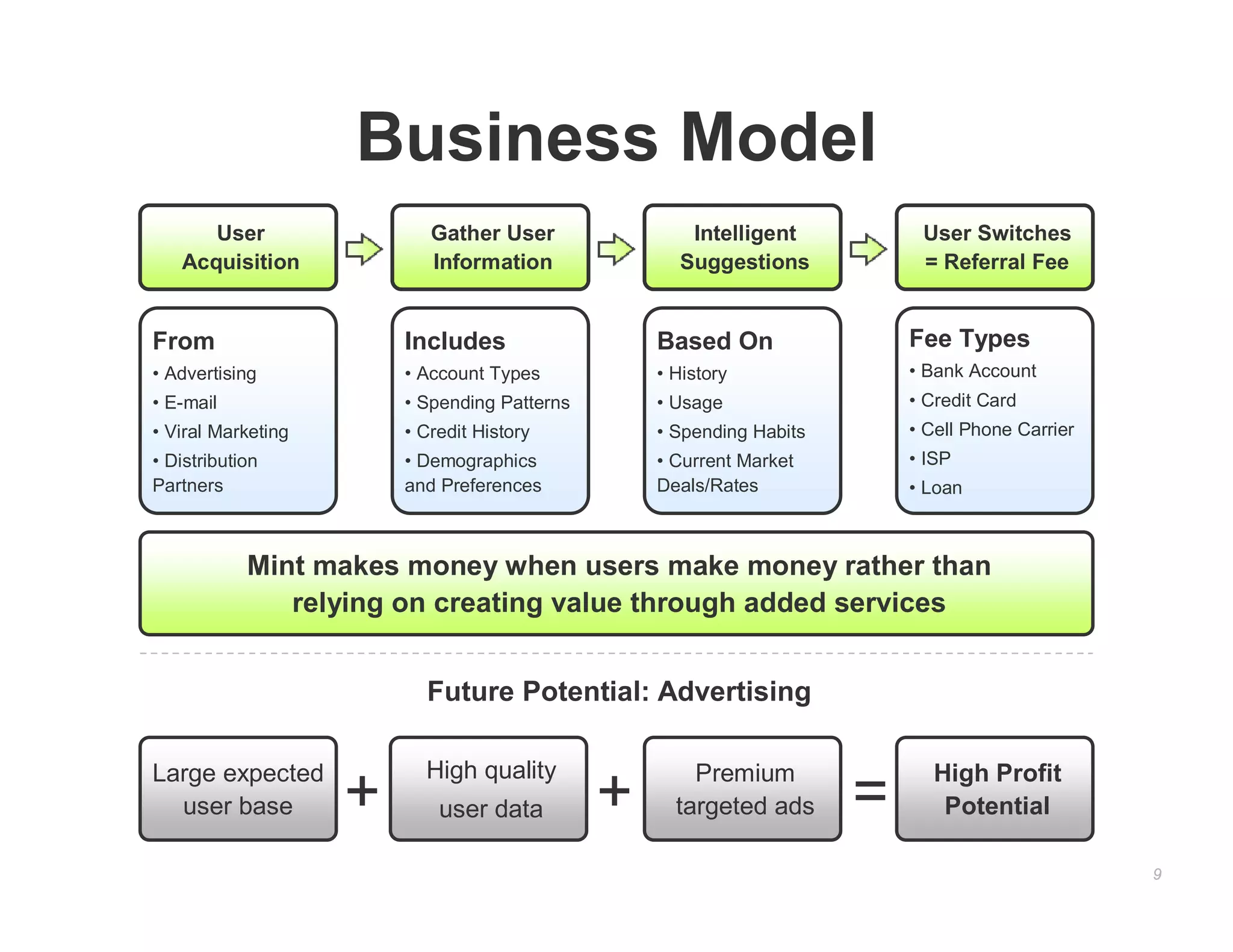
The business model slide lays out a simple conversion funnel: acquire users, gather data, offer intelligent suggestions, then monetize when users switch (referral fees), plus future advertising upside. The slide is compelling because the revenue flow is directly tied to user outcomes — Mint only profits when users save or switch, which aligns incentives and reduces the perception of exploitative monetization.

This demonstrates a smart monetization principle: design business models where customer success drives revenue. For founders, the lesson is to make the linkage explicit in the pitch — if your model depends on user behavior, map how product interactions lead to monetizable events and quantify those events where possible.

Key Takeaway: Show how product actions create monetizable events and prefer business models where user benefit and company revenue are aligned.
Financials & projections: Present clear assumptions and scenarios

Financials & projections: Present clear assumptions and scenarios

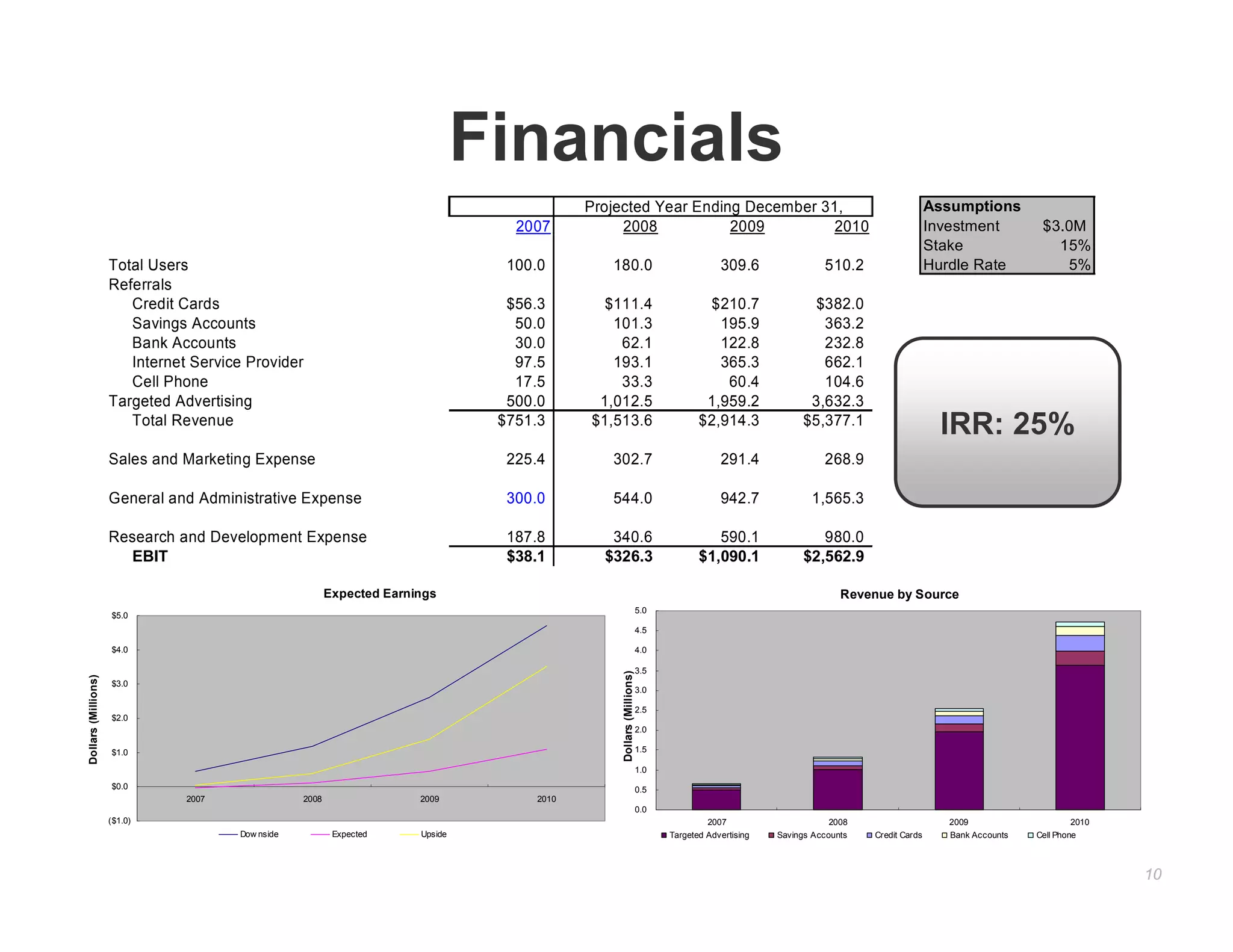
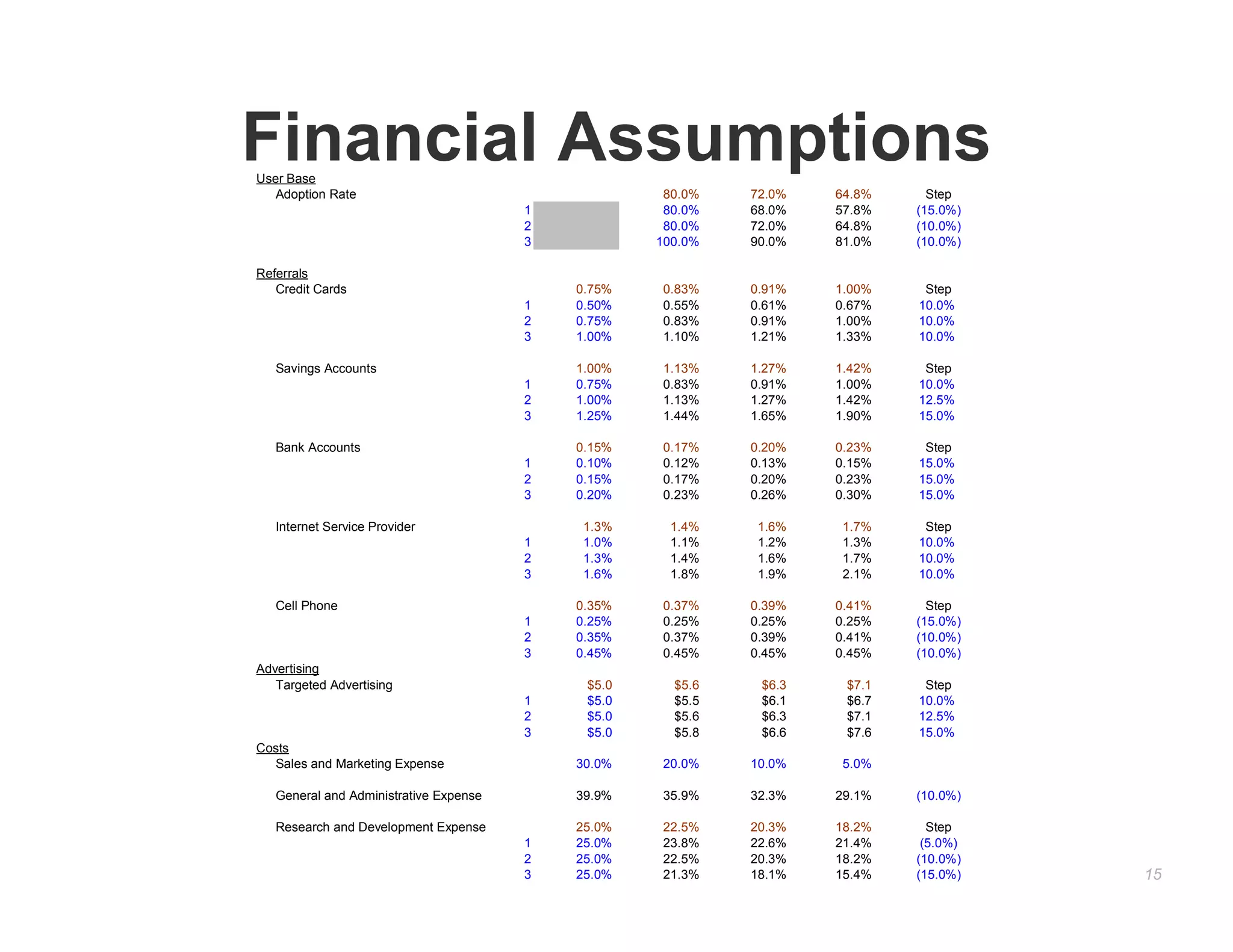
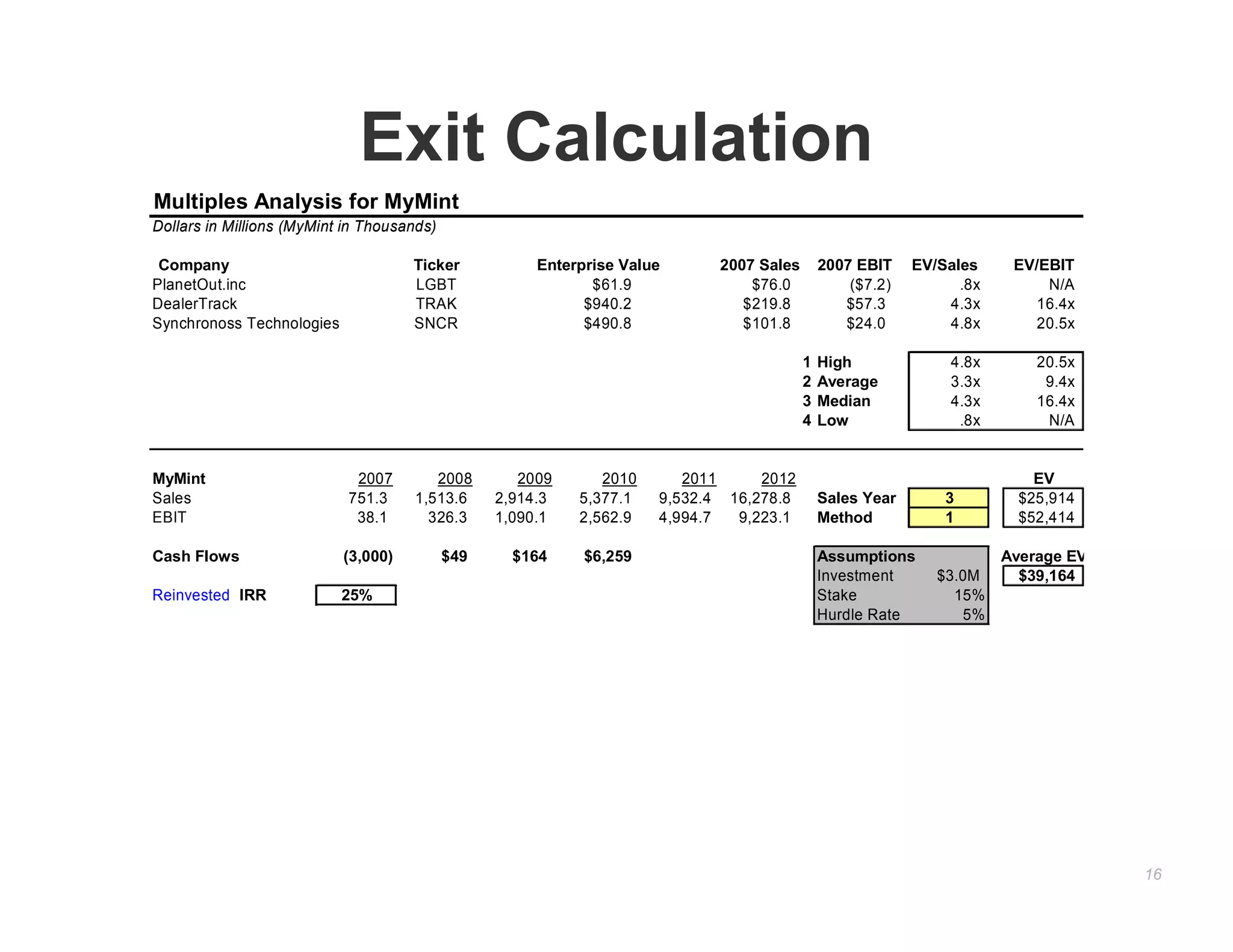
The financials slide provides projected users, revenue line items (referrals by product type and targeted advertising), expense categories, and charts with upside/expected/downside scenarios. It also states investment/assumption boxes (investment size, stake, hurdle) and highlights an IRR. By tying forecasts to specific revenue sources and showing visual growth trajectories, the slide invites scrutiny while appearing grounded.

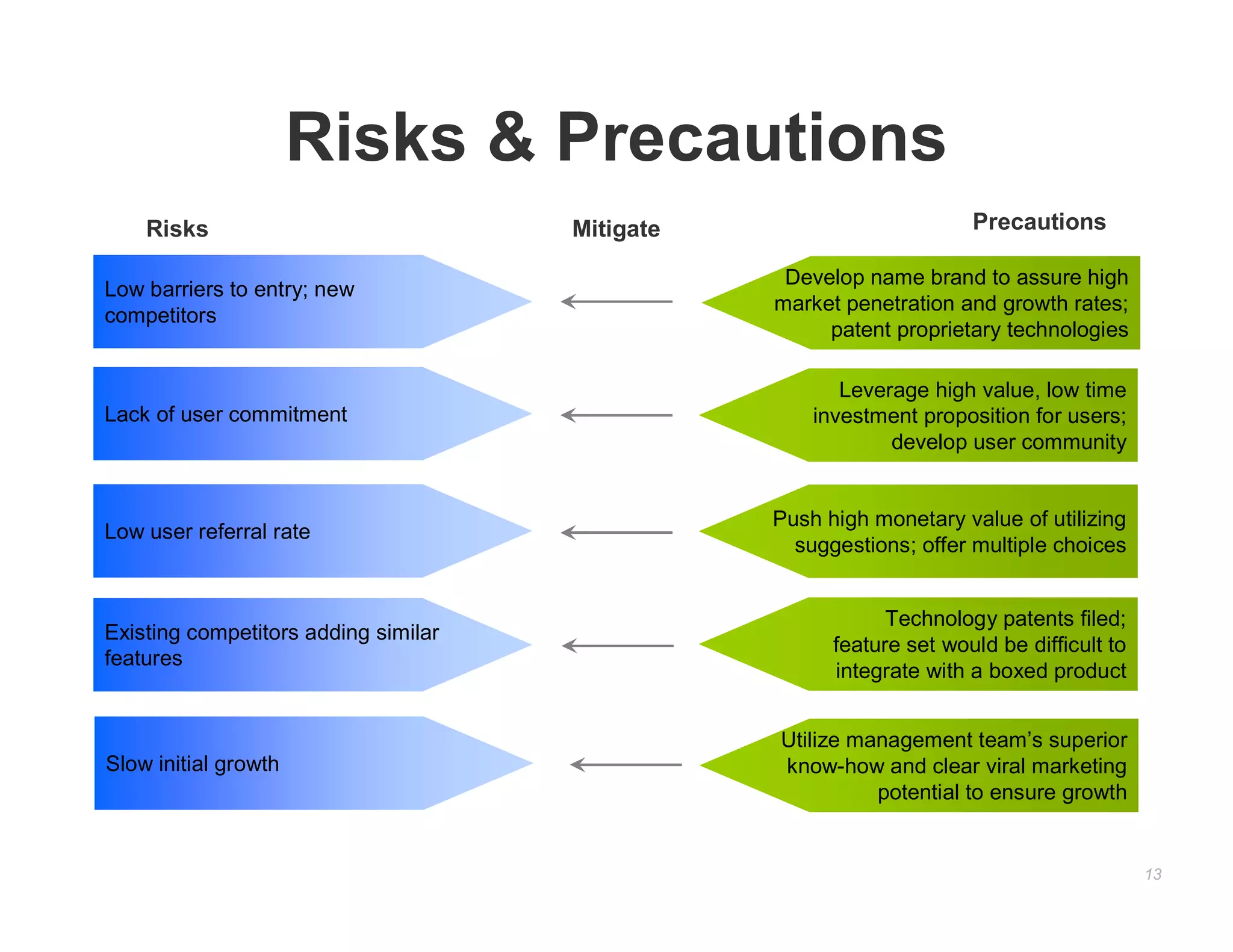
Founders should include clear assumptions and multiple scenarios so investors can test sensitivity. Avoid over-precision: instead, make the key drivers obvious (user growth, conversion rates, RPU, CAC) and provide charts for visibility. Also call out the primary risks and which levers will most change outcomes.

Key Takeaway: Make your financial model transparent: show the key drivers, multiple scenarios, and the assumptions behind projected returns.

Conclusion: Key Lessons

Mint’s seed deck succeeds because it pairs a crisp product demonstration and brand promise with concrete unit economics and a realistic go-to-market plan. The team emphasizes user experience first, then demonstrates how that experience fuels monetization — a model that both users and acquirers can understand. The deck balances optimism with defensibility by calling out competitors, quantifying the market, and tying revenue to measurable user actions.

Actionable advice for founders: 1) Lead with product and clear user benefits (show screenshots and annotated value). 2) Translate market size into bottom-up unit economics (conversion rates and RPU). 3) Present a tightly aligned business model where customer gains drive monetization. 4) Be candid about competition and back defensibility with tangible assets. 5) Include transparent financial assumptions and scenarios so investors can evaluate risk. These elements create a narrative that is easy to follow, hard to dismiss, and attractive for strategic acquirers.