Stack up against Coinbase

Compare Your Deck

Coinbase's 2012 Pitch Deck

Fintech
Stage: Seed
Raised: Seed round
Year: 2012
Slides: 11
Outcome: IPO at $86B valuation

Pitch Deck

1 / 11
Slide 1
Click to expand

Deck Analysis

This deck is Coinbase's 2012 seed presentation positioning the company as a hosted Bitcoin wallet and payments network. It combines a simple product pitch with market education (what Bitcoin is and why it matters), a clear problem statement (existing tools are too hard), a straightforward solution (hosted wallet accessible on web and mobile), and early traction metrics. The deck is notable for how it educates investors new to crypto while simultaneously demonstrating product-market fit with rapid signups and transaction volume.

The Opening: Clear Branding and Positioning

The Opening: Clear Branding and Positioning

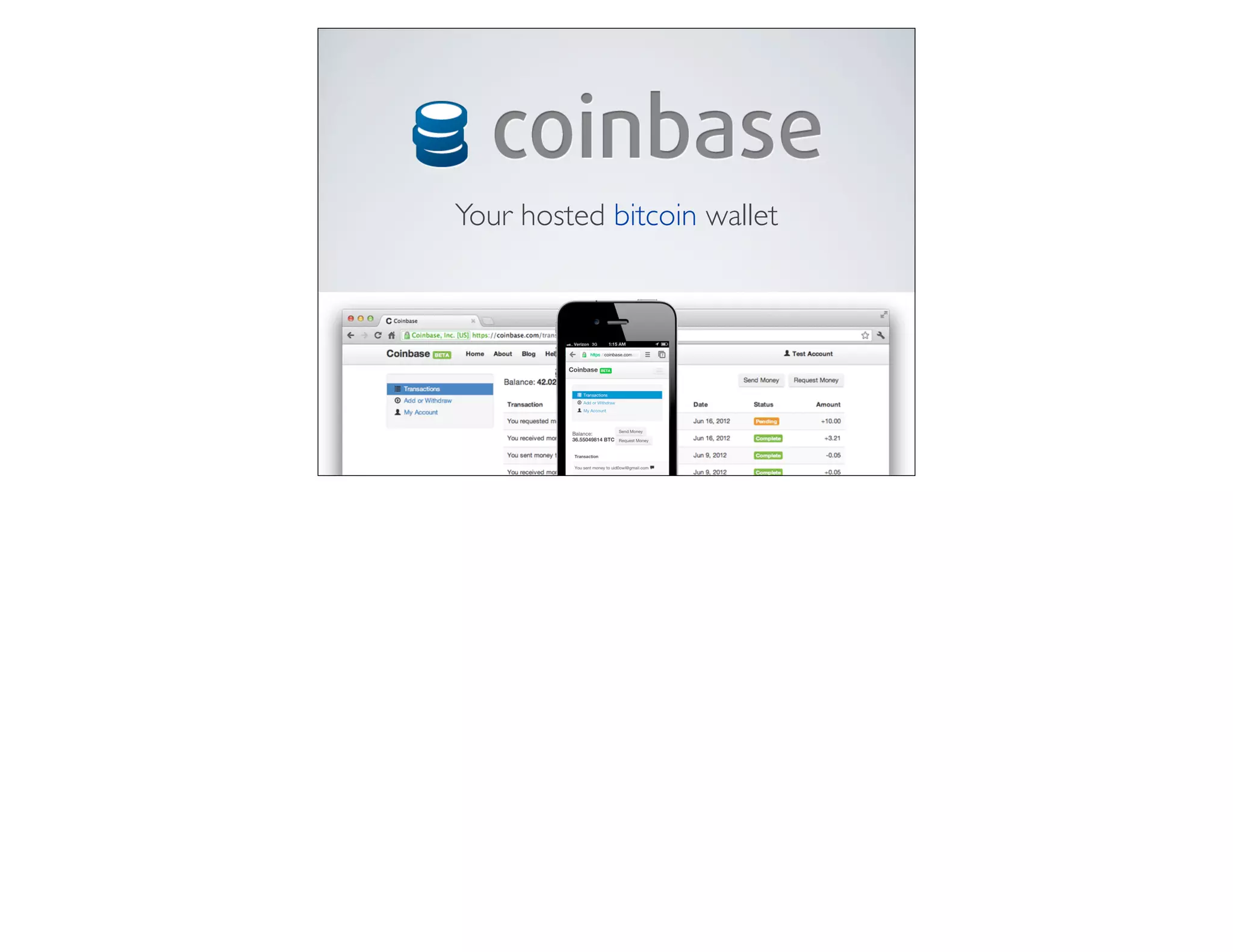
The cover slide presents the Coinbase name, logo, and the short, declarative tagline “Your hosted bitcoin wallet.” It uses a clean visual hierarchy: large brand mark at top, concise value proposition, and a visual of the product on multiple devices. This immediately tells the audience what the company does and suggests credibility (a polished UI and mobile presence) without needing technical explanation.

Founders can learn from the focus and simplicity here. The slide avoids jargon and uses the product image to convey trust and usability, which is especially important for a finance product. The visual cue of both desktop and mobile screens signals that Coinbase is a real product, not just an idea, which helps set expectations for the rest of the deck.
Key Takeaway: Start with a one-line value proposition backed by a concrete product visual to communicate credibility and focus instantly.
Market Education: Explain the Technology and Opportunity

Market Education: Explain the Technology and Opportunity

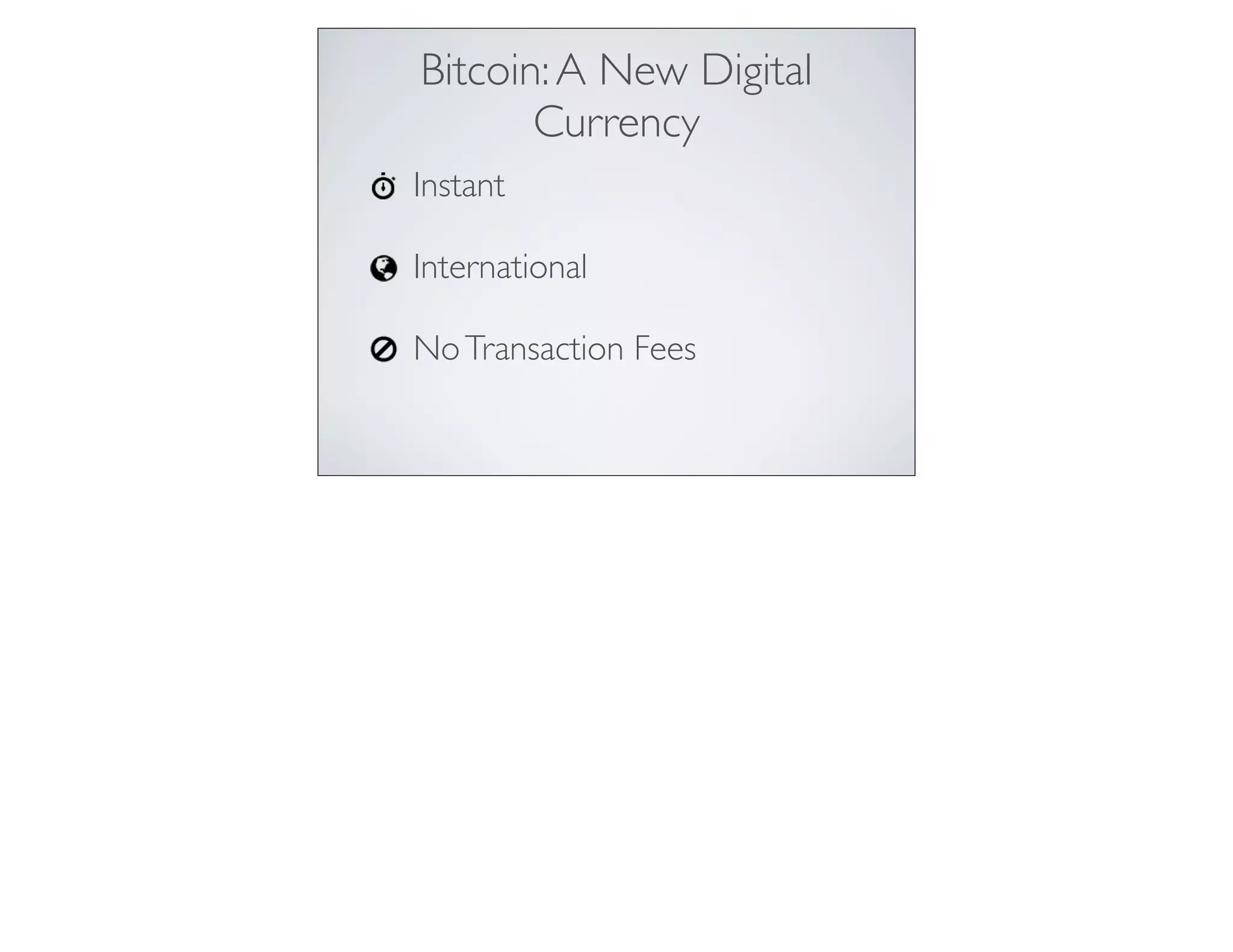
Early slides explain Bitcoin as a new digital currency, listing key attributes (instant, international, no transaction fees) and showing a globe visualization of activity. For 2012 investors who likely had little exposure to cryptocurrencies, these slides teach why Bitcoin could be transformative and what inherent benefits drive adoption. They concisely establish the market opportunity and why a simpler user experience is needed.

This dual approach—educating the audience and illustrating global momentum—reduces friction for investors unfamiliar with the underlying protocol. Founders introducing novel technology should similarly include short, clear education that ties technical advantages to real user value, so the rest of the pitch (product, traction, monetization) lands more effectively.

Key Takeaway: When your product relies on a new technology, briefly teach the core benefits and connect them directly to your product’s value.
Market Momentum: Use Data to Validate Demand

Market Momentum: Use Data to Validate Demand

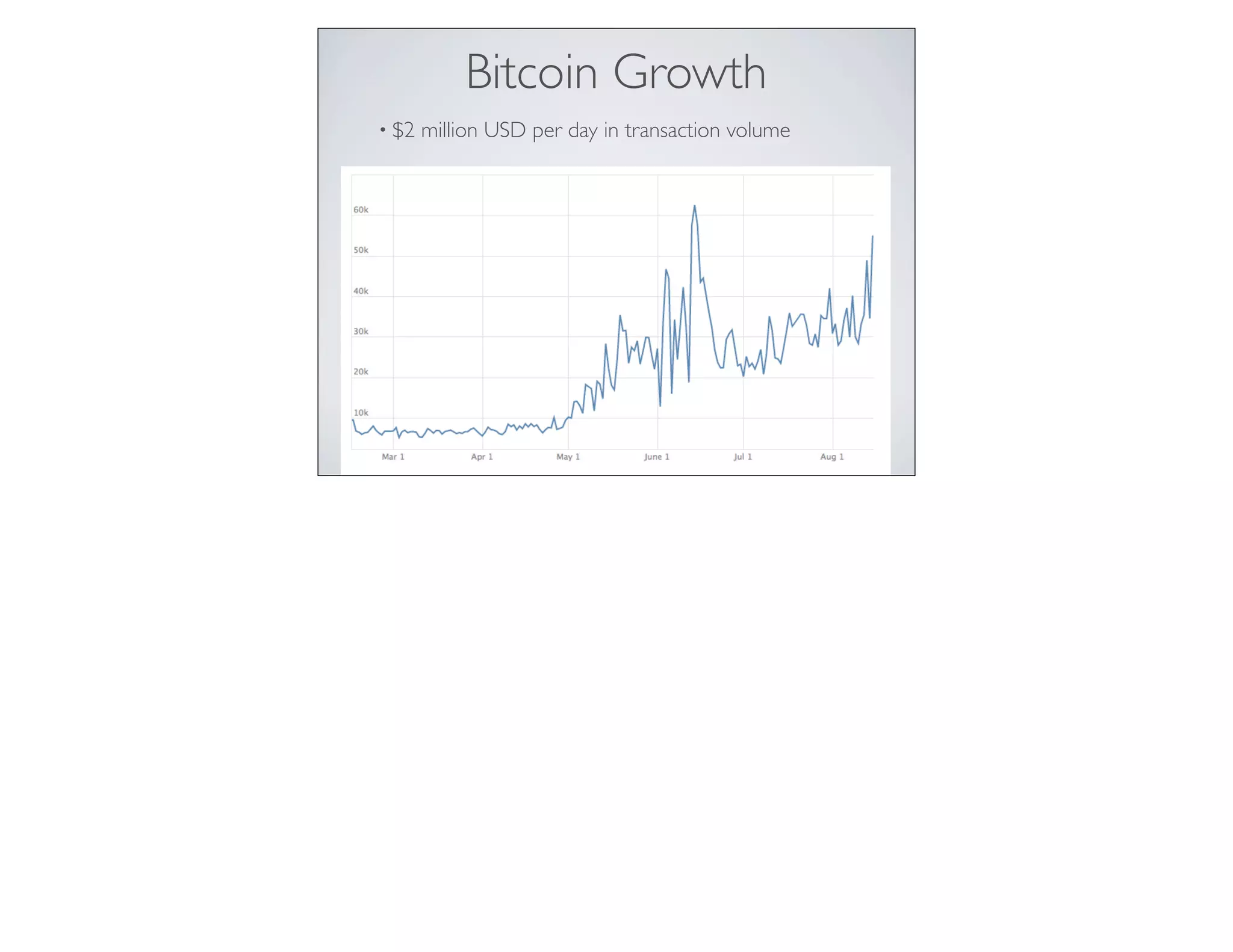
The Bitcoin growth slide presents a time series chart showing increasing daily transaction volume, with a short bullet noting $2M USD/day. This quantitative signal validates the market thesis established earlier: Bitcoin is growing rapidly and is becoming meaningful in economic terms. The graph creates urgency—there is an emergent network and the startup is aiming to capture early-in market share.

Quantitative market metrics are persuasive because they convert an abstract trend into hard evidence of demand. Founders should include simple, relevant market graphs that highlight growth velocity or size while keeping the interpretation explicit (a one-line annotation is enough). That bridges the gap between concept and opportunity for investors.

Key Takeaway: Support your market story with a simple, clearly labeled growth metric that demonstrates real, accelerating demand.
The Problem: Point to Real Friction

The Problem: Point to Real Friction

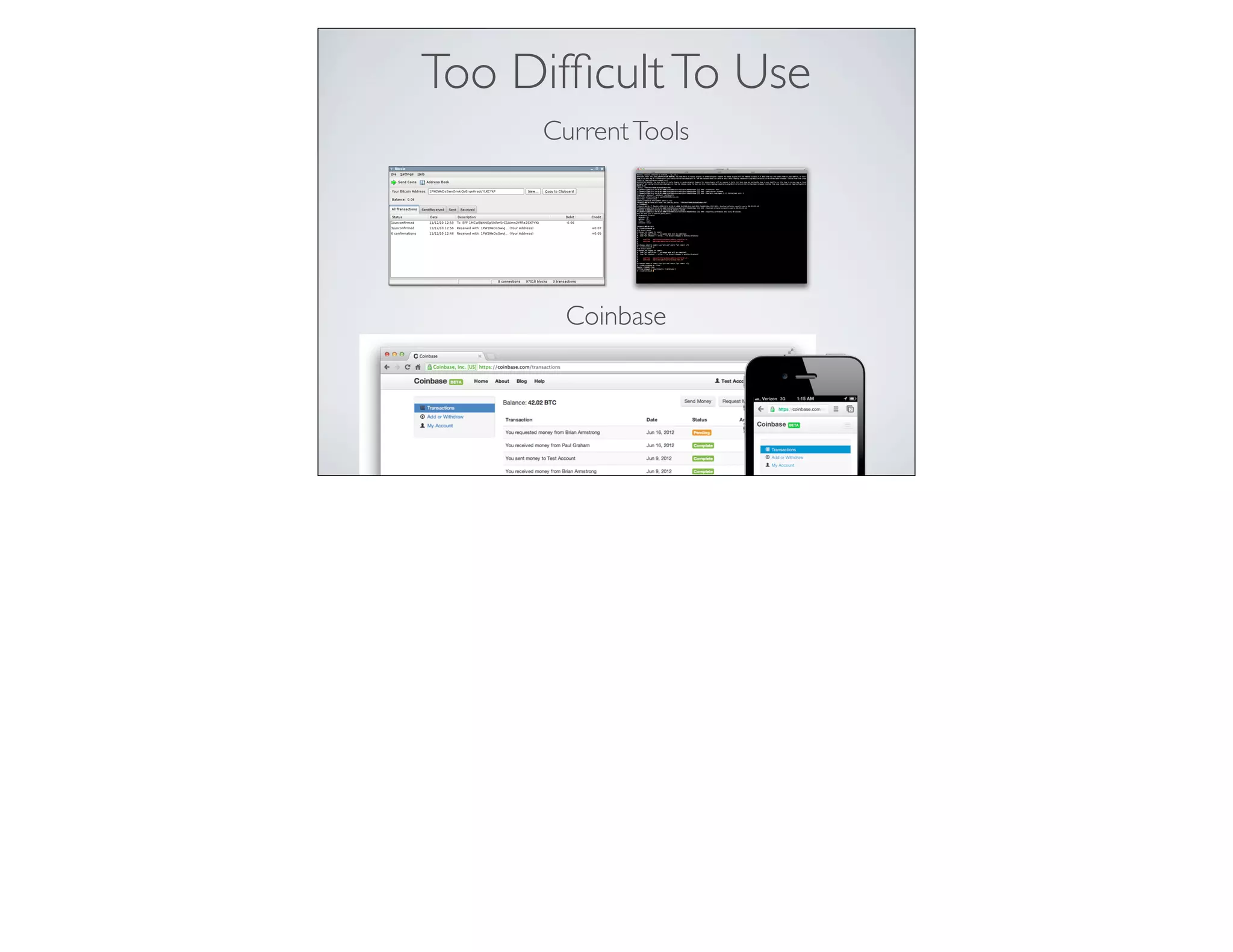
Slide 6 states the problem plainly: existing Bitcoin tools are ‘Too Difficult To Use,’ and it contrasts command-line or complex wallet clients with Coinbase’s simpler web and mobile UI. This is a classic pain-point slide that pairs a concise thesis with visual examples of the incumbent experience. It frames the company’s offering as a usability and trust layer atop a powerful but inaccessible protocol.

Founders should emulate this clarity: define the specific user pain and show how incumbents fail. Concrete contrasts—screens of intimidating tools vs. your friendly UI—make the problem visceral and the solution obvious. This slide makes it easy for investors to understand why people would switch and adopt a hosted solution.

Key Takeaway: Demonstrate the incumbent pain with concrete visuals and a crisp statement so your product’s advantage becomes obvious.
The Solution: Product as Trust and Simplicity

The Solution: Product as Trust and Simplicity

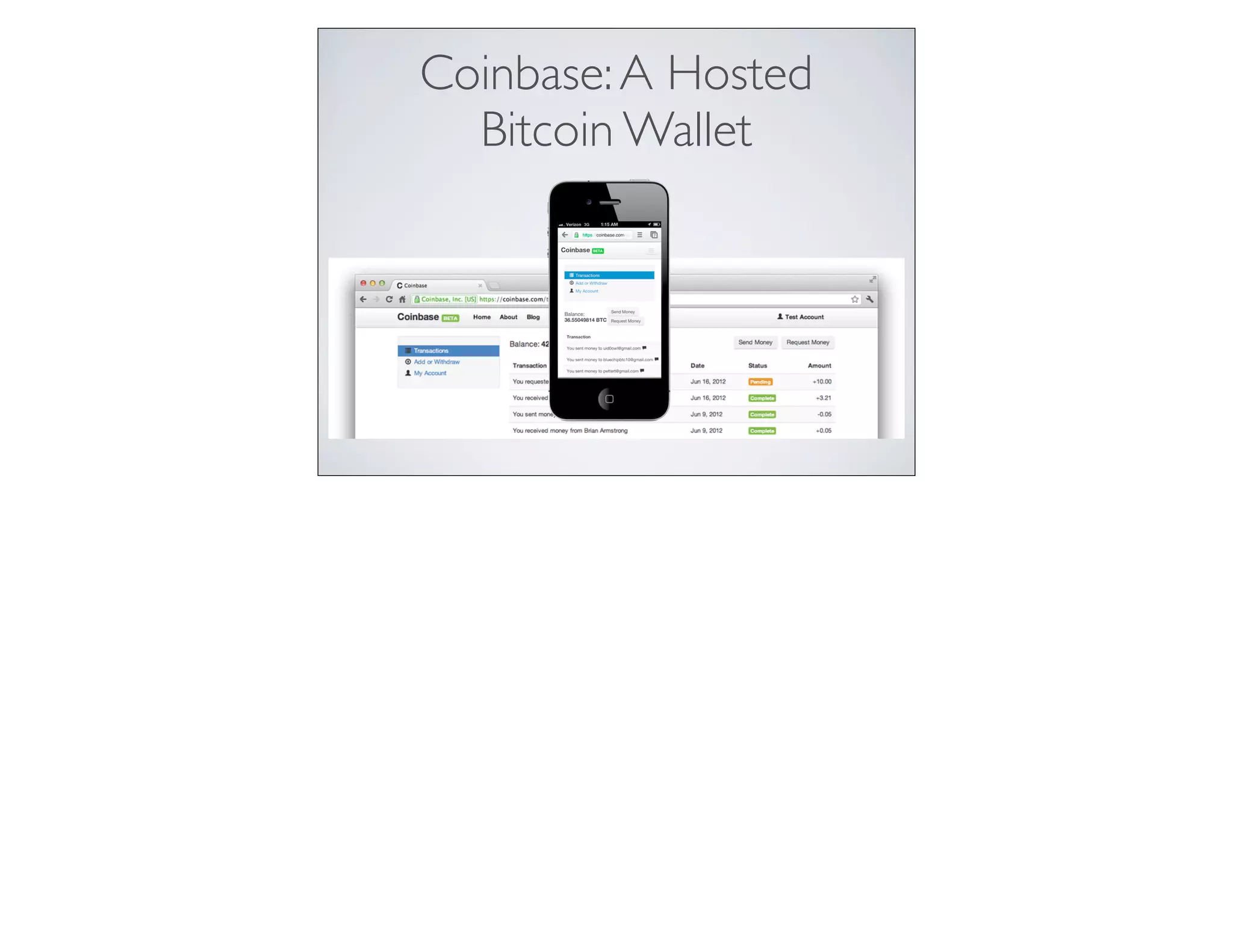
Slide 7 positions Coinbase as a hosted Bitcoin wallet and showcases the product across devices. The imagery emphasizes ease of use, with the mobile interface front-and-center and the desktop view showing clear transaction statuses. The framing is: Bitcoin’s complexity solved via a trusted, accessible service that handles the hard parts for users.

For fintech founders, this slide demonstrates how product design is part of the value proposition—security, simplicity, and cross-platform access are central trust signals. When building financial products, highlight UI elements and flows that reassure users (balances, transaction statuses, familiar web/mobile screens) because trust is a primary adoption hurdle.

Key Takeaway: Show the product in the context users care about (mobile + web) and highlight UI cues that build trust and lower the adoption barrier.
Traction: Rapid User Growth

Traction: Rapid User Growth

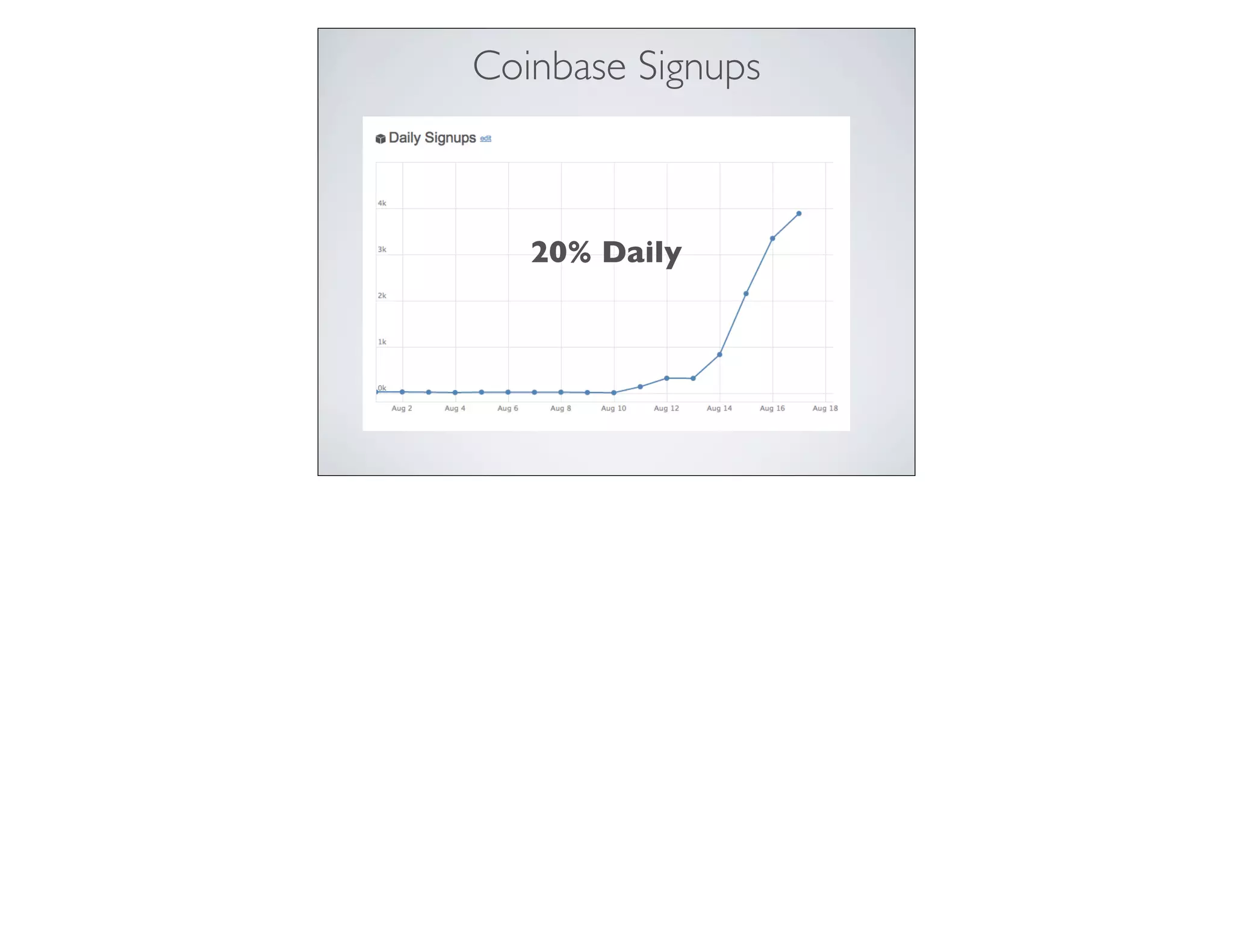
Slide 9 presents a daily signups chart with an annotation of “20% Daily,” showing a dramatic inflection point and clear viral or demand-driven uptake. This is a strong traction narrative: not only are users signing up, but growth is accelerating rapidly. The visual makes the momentum undeniable and ties back to the product-market fit implied earlier.

Founders should use straightforward metrics like signups with growth rates to tell a traction story. Where possible, annotate charts with percent growth or key milestones to help investors immediately grasp the rate of adoption. Traction slides are especially powerful when paired with concrete user acquisition channels or anecdotes, but even a simple, steep growth curve communicates strong momentum.

Key Takeaway: Use clear growth charts with a single annotated metric (e.g., % daily growth) to make momentum obvious and memorable.
Business Momentum: Transaction Volume as Proof of Value

Business Momentum: Transaction Volume as Proof of Value

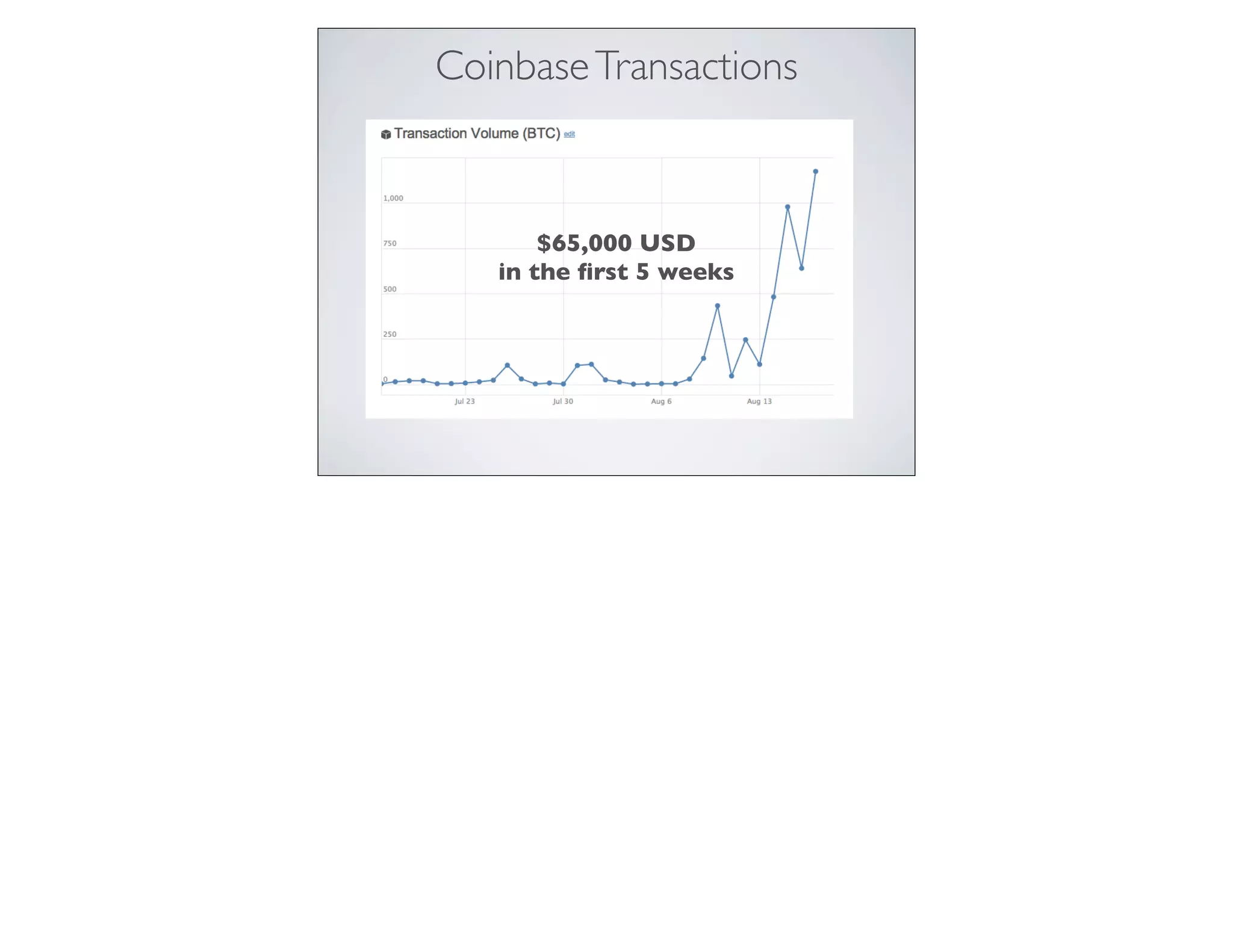
Slide 10 shows transaction volume with a callout: "$65,000 USD in the first 5 weeks." This translates signups into economic activity and validates that users are not only registering but transacting. For a payments business, transaction volume is a direct proxy for future revenue and network effects, making this a crucial slide to include early in a fintech pitch.

Founders should translate user activity into economic terms—highlight transaction volume, average revenue per user, or conversion rates—so investors can model monetization and scalability. Concrete dollar amounts and time-bound windows (first 5 weeks) help quantify early traction and reduce ambiguity about whether usage is meaningful.

Key Takeaway: Convert user growth into monetary activity with clear transaction volume figures to demonstrate immediate economic value.

Conclusion: Key Lessons

Coinbase’s seed deck is a model of clarity: teach the market, define the pain, present a simple product solution, and back it with early traction metrics that translate into economic activity. The deck balances education (Bitcoin basics), product trust signals (clean UI across devices), and quantifiable momentum (signups and transaction volume), which together reduce investor risk and make the opportunity tangible.

Actionable advice for founders: lead with a one-line value prop and product visual, succinctly educate investors unfamiliar with your tech, show the incumbent pain with concrete contrasts, and prioritize simple, annotated metrics that demonstrate both user growth and monetary activity. These elements together create a compelling, low-friction narrative that invites investor confidence.