Stack up against Brex

Compare Your Deck

Brex's 2019 Pitch Deck

Fintech
Stage: Series C
Raised: $125M
Year: 2019
Slides: 19
Outcome: Valued at $12B

Pitch Deck

1 / 19
Slide 1
Click to expand

Deck Analysis

This deck from Brex presents a tightly focused pitch for a corporate card built specifically for startups and fast-growing technology companies. It combines a clear problem statement (traditional banks and cards exclude early-stage companies or provide poor controls), a crisp product solution (data-driven underwriting, instant signup, higher limits, virtual cards, receipt capture and ERP integrations), examples of early traction, and unit-economic evidence. Notable elements include strong founder / investor signals, an emphasis on product-led viral acquisition and retention (what they call "negative churn"), and concrete economics and metrics that make the growth story credible to Series C investors.

Team and investor credibility

Team and investor credibility

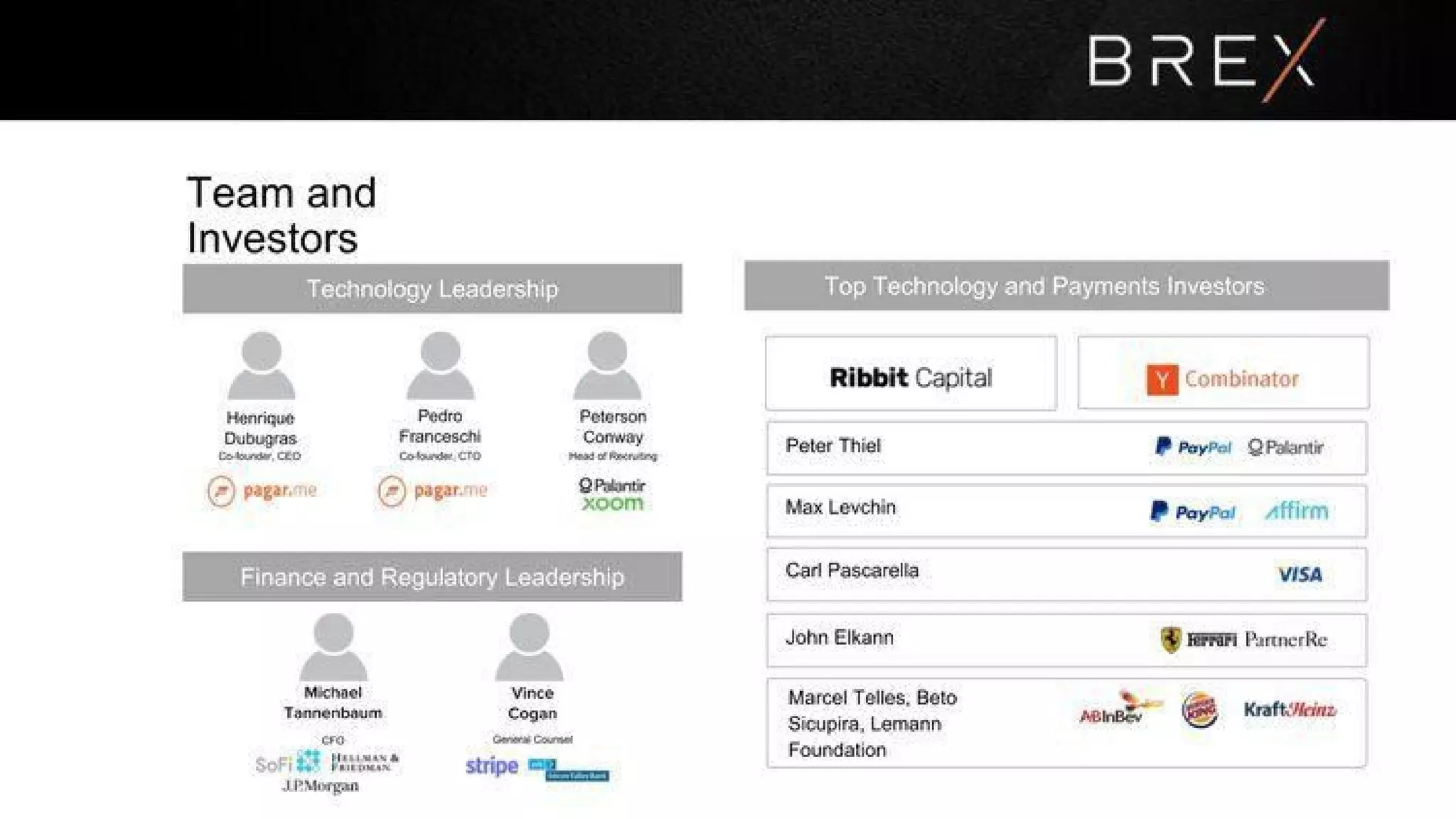
Slide 2 opens with the leadership and investor roster, a classic trust-building move for a capital-intensive fintech. The slide calls out the founders' payments and technology backgrounds and places high-profile payments and fintech investors (Ribbit, YC, Peter Thiel, Max Levchin, Visa, etc.) on the right — this signals both domain expertise and strong syndicate validation. For investors evaluating risk in a regulated, partner-dependent business like corporate cards, this visual shorthand reduces friction: it shows the company has both product/technical chops and access to payments and regulatory advice.

Founders can learn from the economy of this slide: place credibility up front if your business depends on partnerships, regulatory relationships, or non-obvious domain expertise. Use logos and succinct role callouts rather than long bios — it’s faster to absorb and helps anchor later claims about underwriting, bank relationships, and operations.
Key Takeaway: Put concise founder expertise and top-tier investor/partner logos near the front to build immediate credibility for capital- and partner-dependent businesses.
Problem framing: startups are underserved by traditional cards

Problem framing: startups are underserved by traditional cards

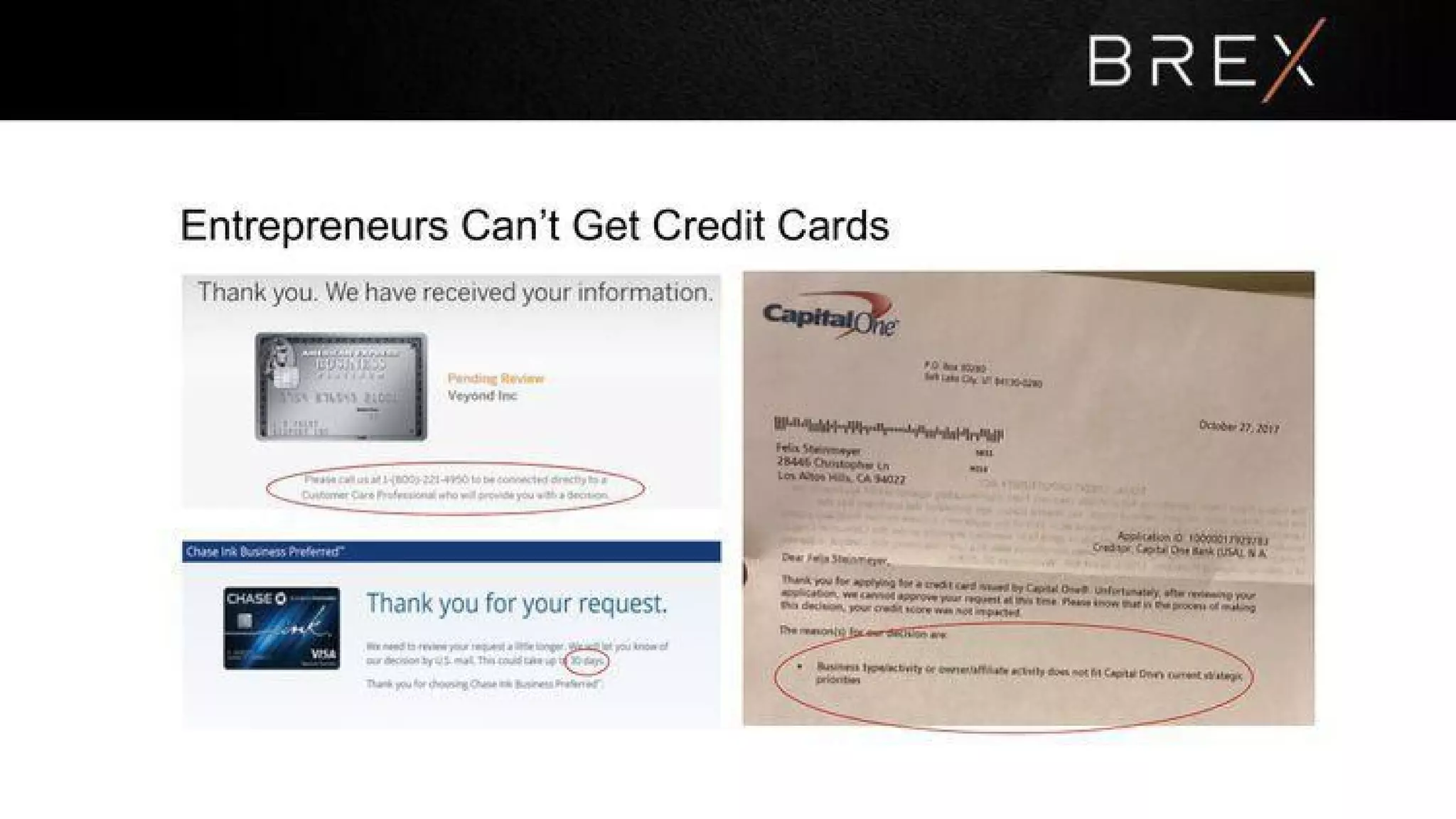
Slide 3 makes a simple, visceral case: entrepreneurs can’t get credit cards. The imagery of denial letters and 'pending review' pages conveys friction and exclusion — a strong emotional hook for founders and investors who have lived the pain. The slide implies both the market injustice and a growth opportunity: many high-potential customers are locked out or poorly served.

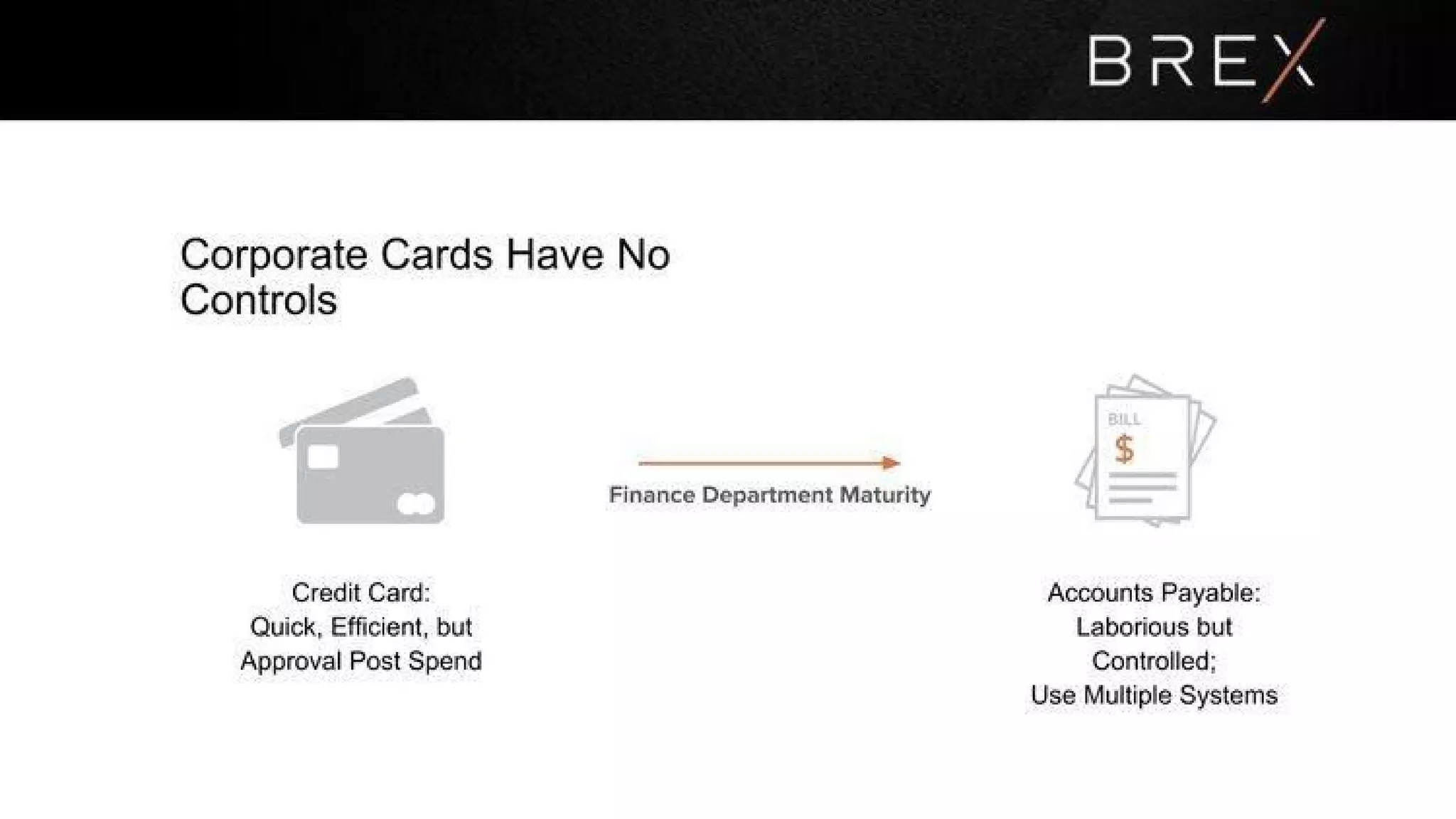
The deck doubles-down on the problem with slide 4 (corporate cards have no controls), positioning Brex to attack two related but distinct issues: access and control. By splitting the narrative into access (who gets a card) and functionality (how cards are managed), Brex frames a product roadmap that addresses acquisition and retention simultaneously. Founders should emulate this separation when the problem has multiple dimensions — call them out explicitly so your solution can be scoped to each dimension.

Key Takeaway: Frame the problem in two dimensions (access + control) to make it clear why the market both needs and will retain your solution.
Market sizing and where you start matters

Market sizing and where you start matters

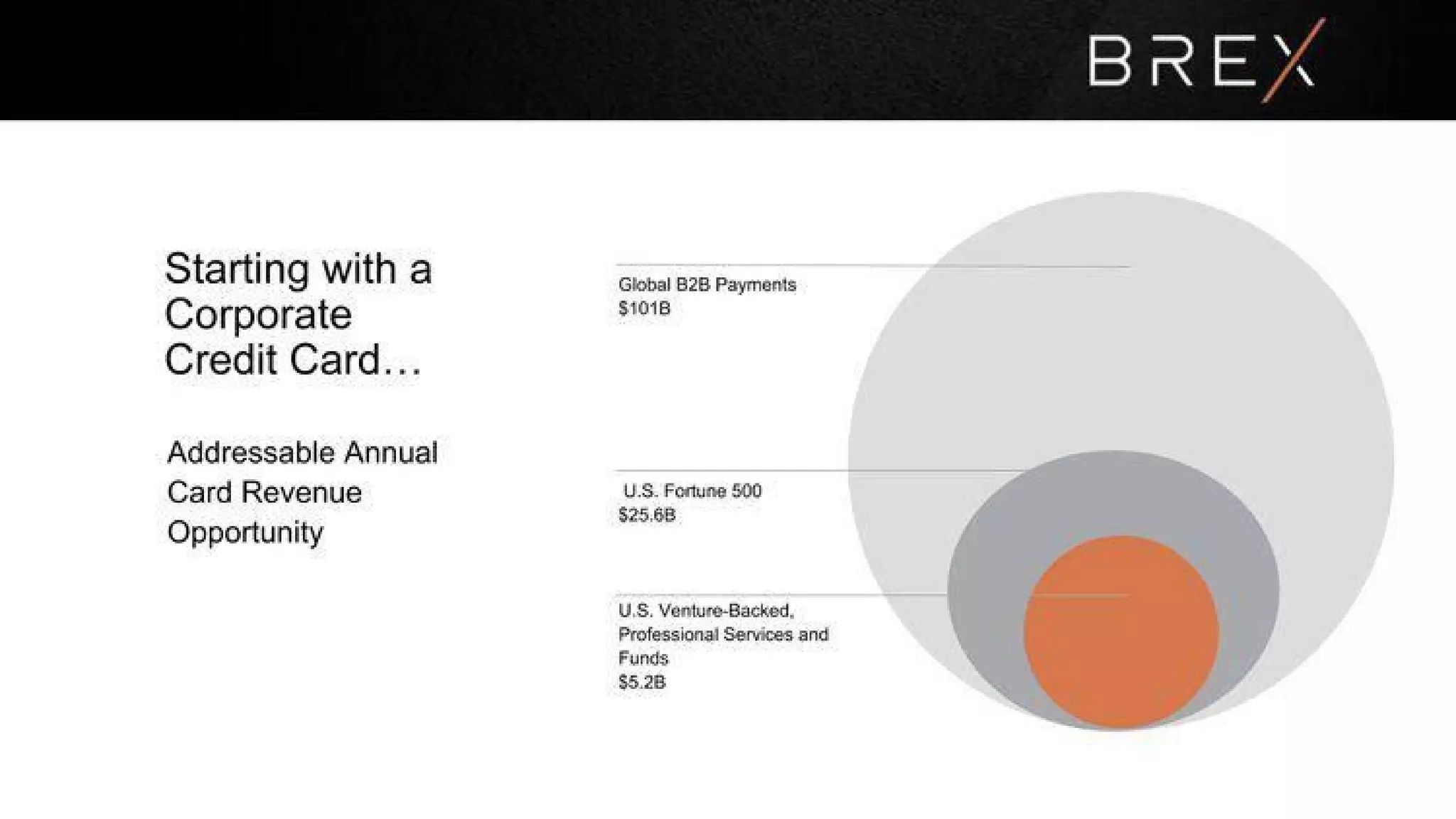
Slide 7 uses concentric circles to show the addressable card revenue opportunity: from global B2B payments down to the specific segment Brex targets (venture-backed and professional services). This communicates two things: the total market is massive, and the initial beachhead is tight and high-value. That focused entry point (venture-backed startups with predictable spending patterns) makes go-to-market and underwriting easier while leaving a large expansion runway.

The slide is effective because it balances ambition with realism — investors see a big TAM and a credible first step. Founders should similarly map their market from large TAM to sensible, defendable beachhead, and explicitly explain why that segment is the best initial traction source (e.g., homogeneous spend patterns, network effects, or ease of underwriting).

Key Takeaway: Show both the large long-term market and a narrowly defined, defensible initial beachhead to demonstrate scale and focus at once.
Acquisition hooks: immediate, compelling value at signup

Acquisition hooks: immediate, compelling value at signup

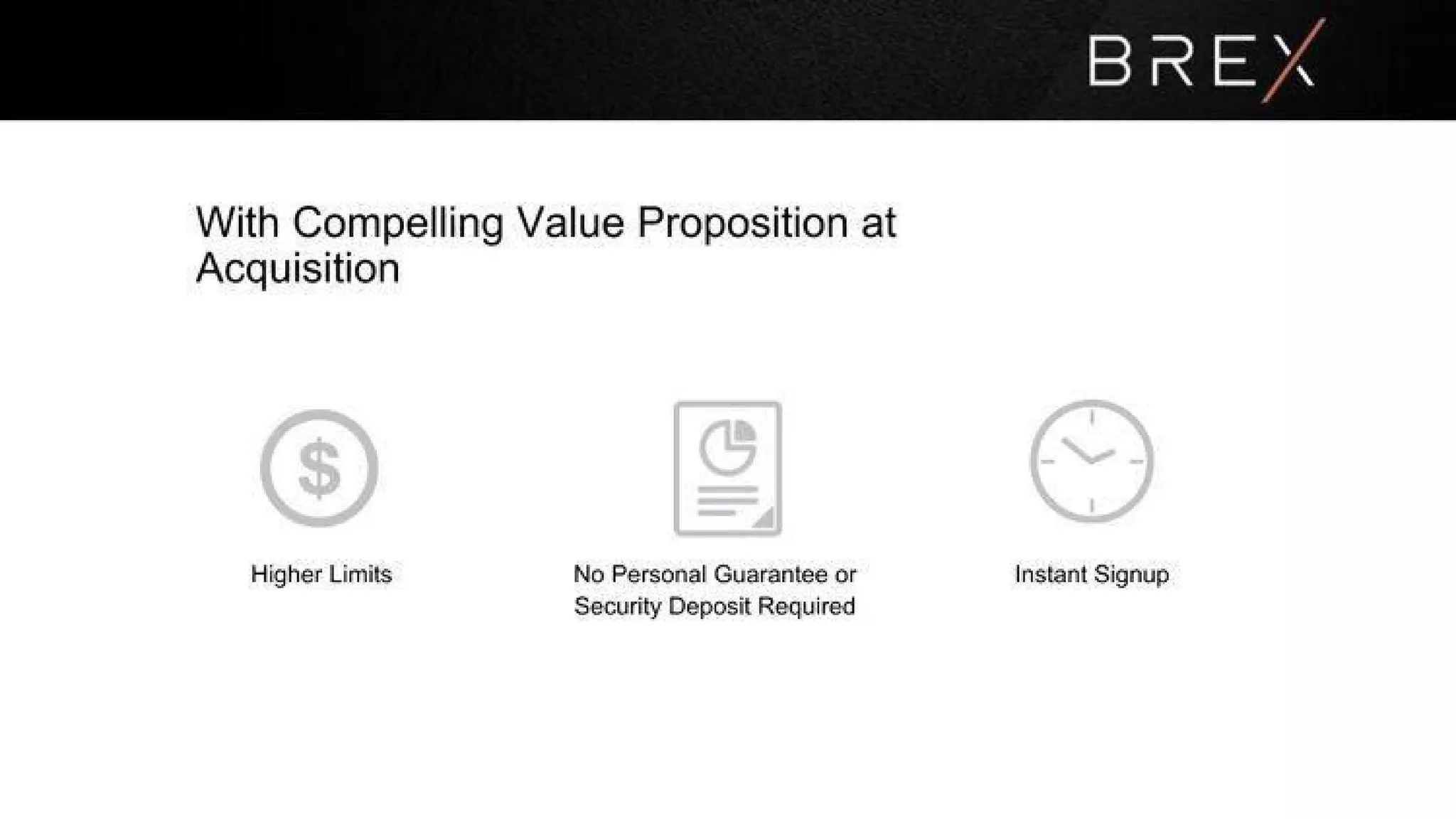
Slide 9 (With Compelling Value Proposition at Acquisition) succinctly lists the acquisition levers Brex uses: higher limits, no personal guarantee, and instant signup. These are high-impact benefits for startups — removing personal liability and providing immediate capital access solves acute pain and drives rapid adoption. The slide’s clarity helps investors understand why conversion is high when a product aligns closely to customer pain points.

The lesson for founders is to front-load acquisition benefits that feel transformational to your customer. Make the primary landing proposition concrete and tangible: what single pain is relieved at signup? If you can make the initial experience materially better than incumbents (time saved, friction removed, risk shifted), you’ll see strong organic conversion and referrals.

Key Takeaway: Lead with immediate, transformational benefits at signup — remove a real, specific pain (time, risk, limit) to drive conversion and referrals.
Product differentiation: data, controls, and receipts

Product differentiation: data, controls, and receipts

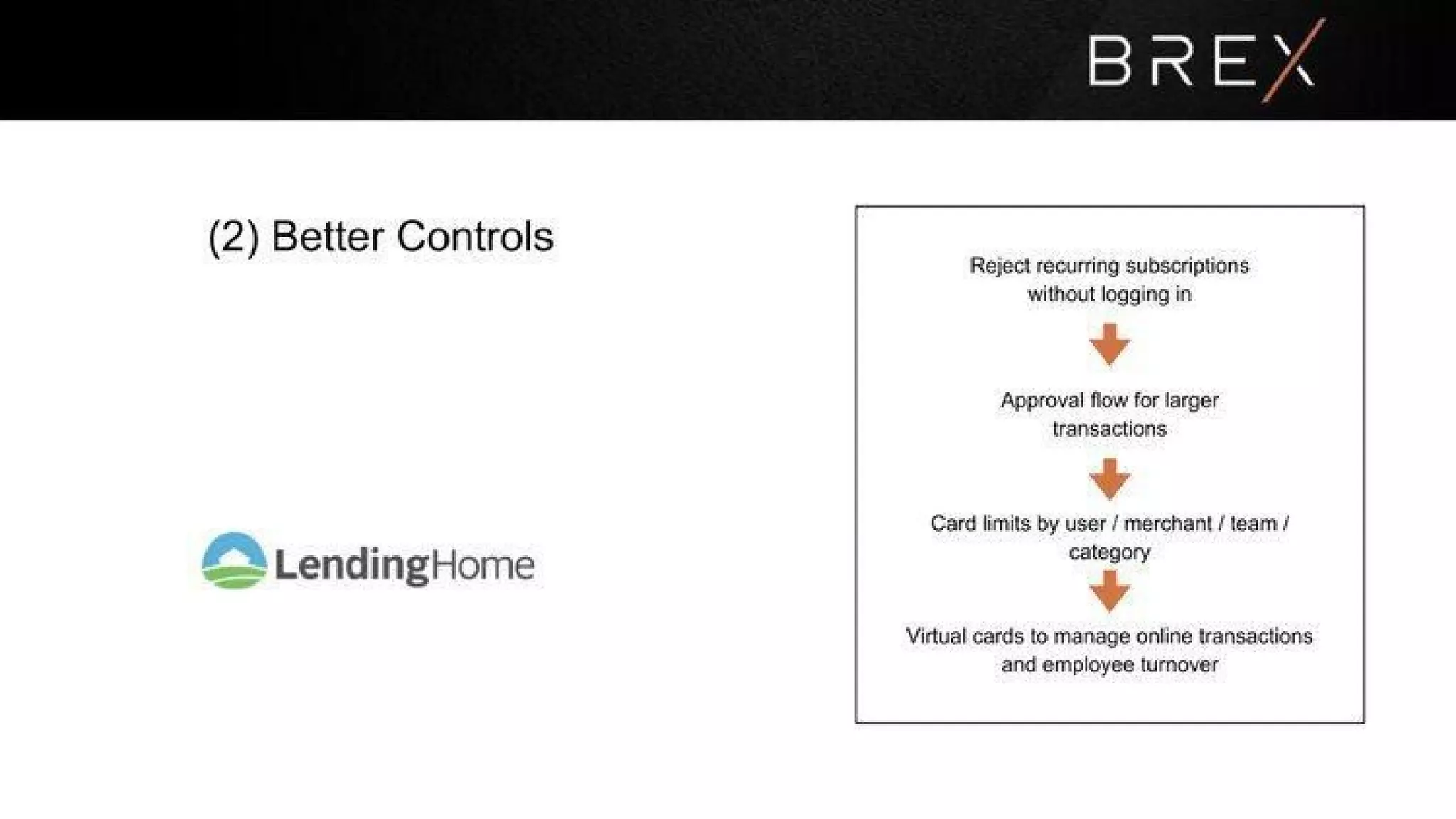
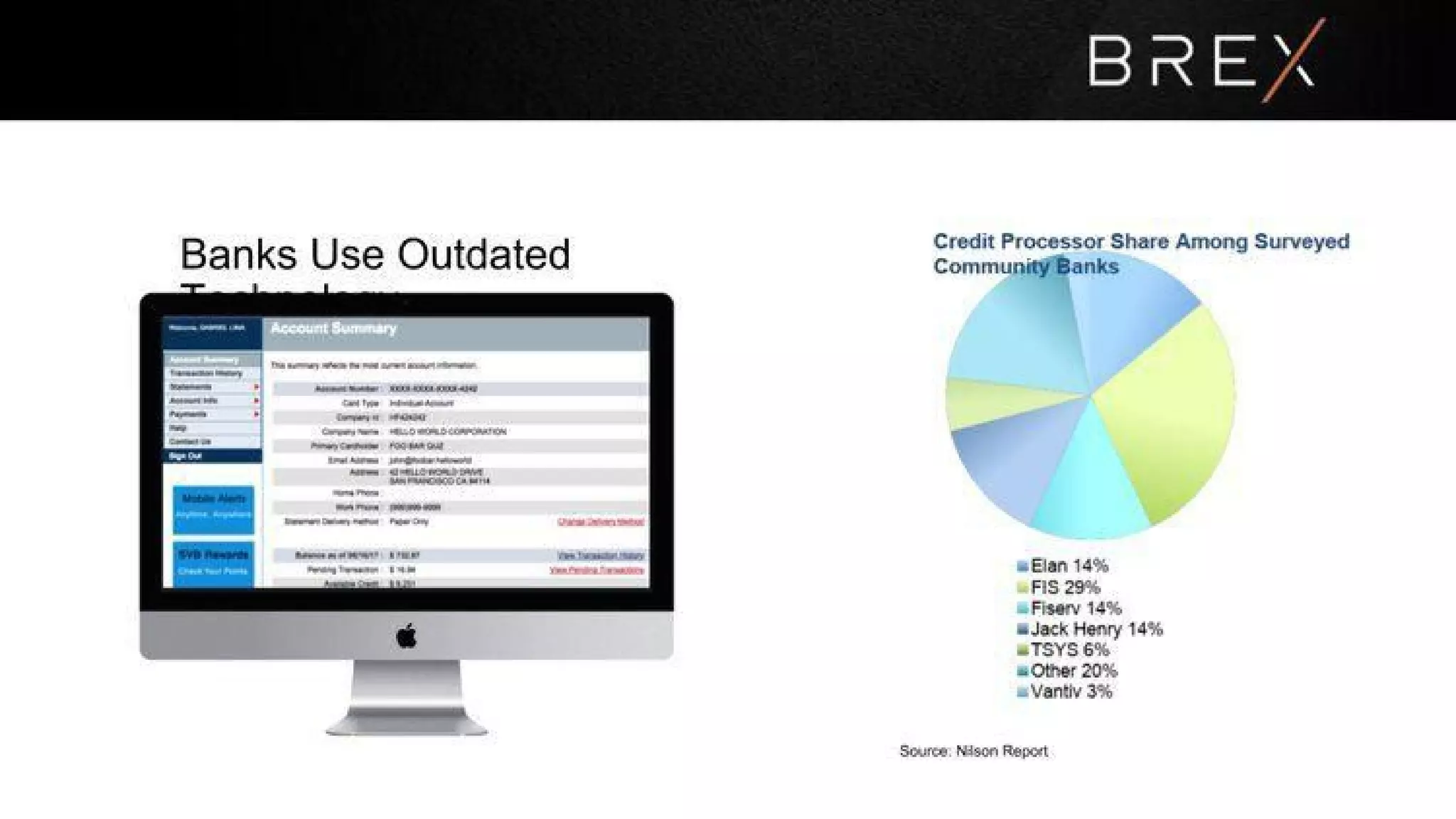
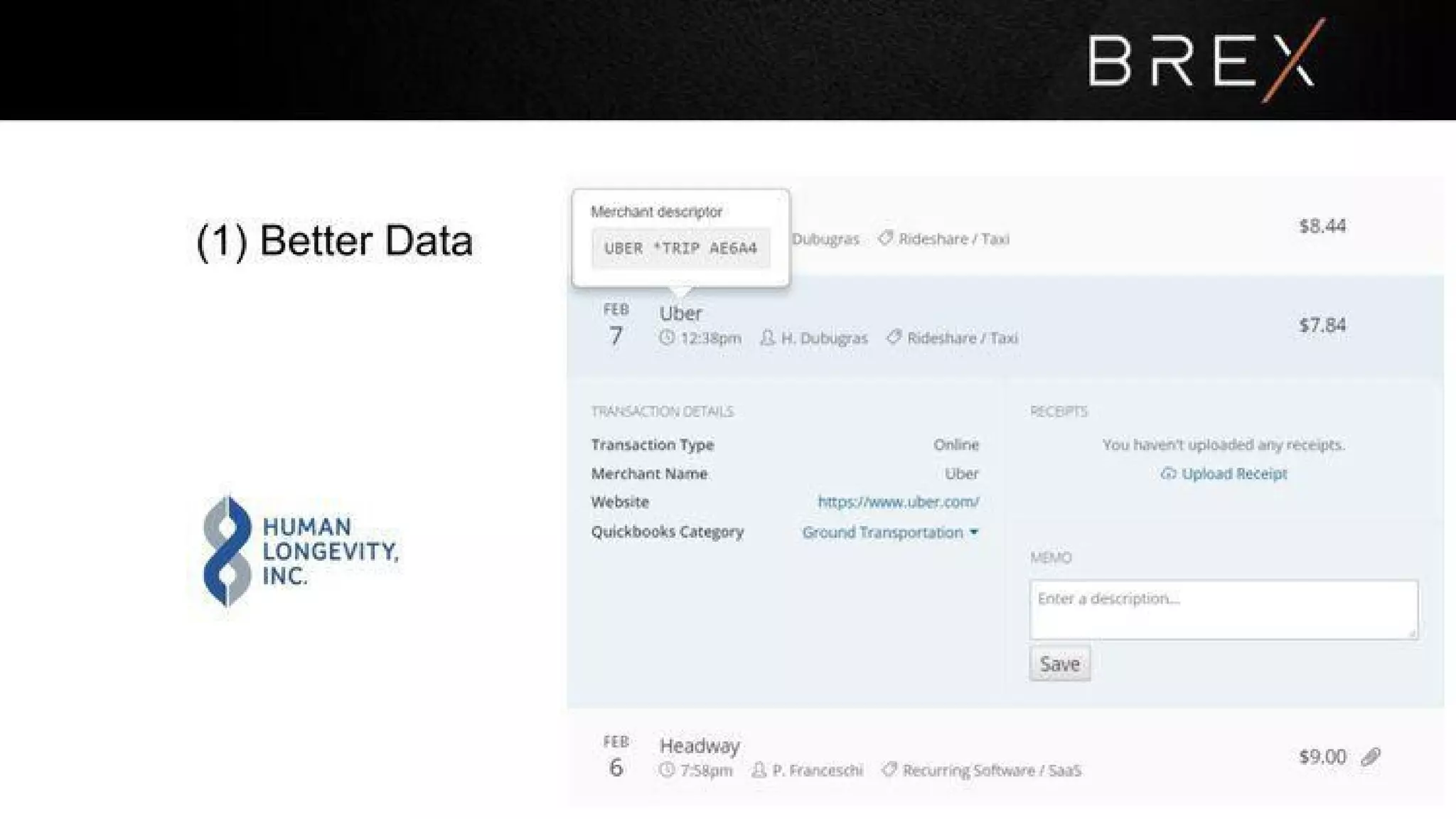
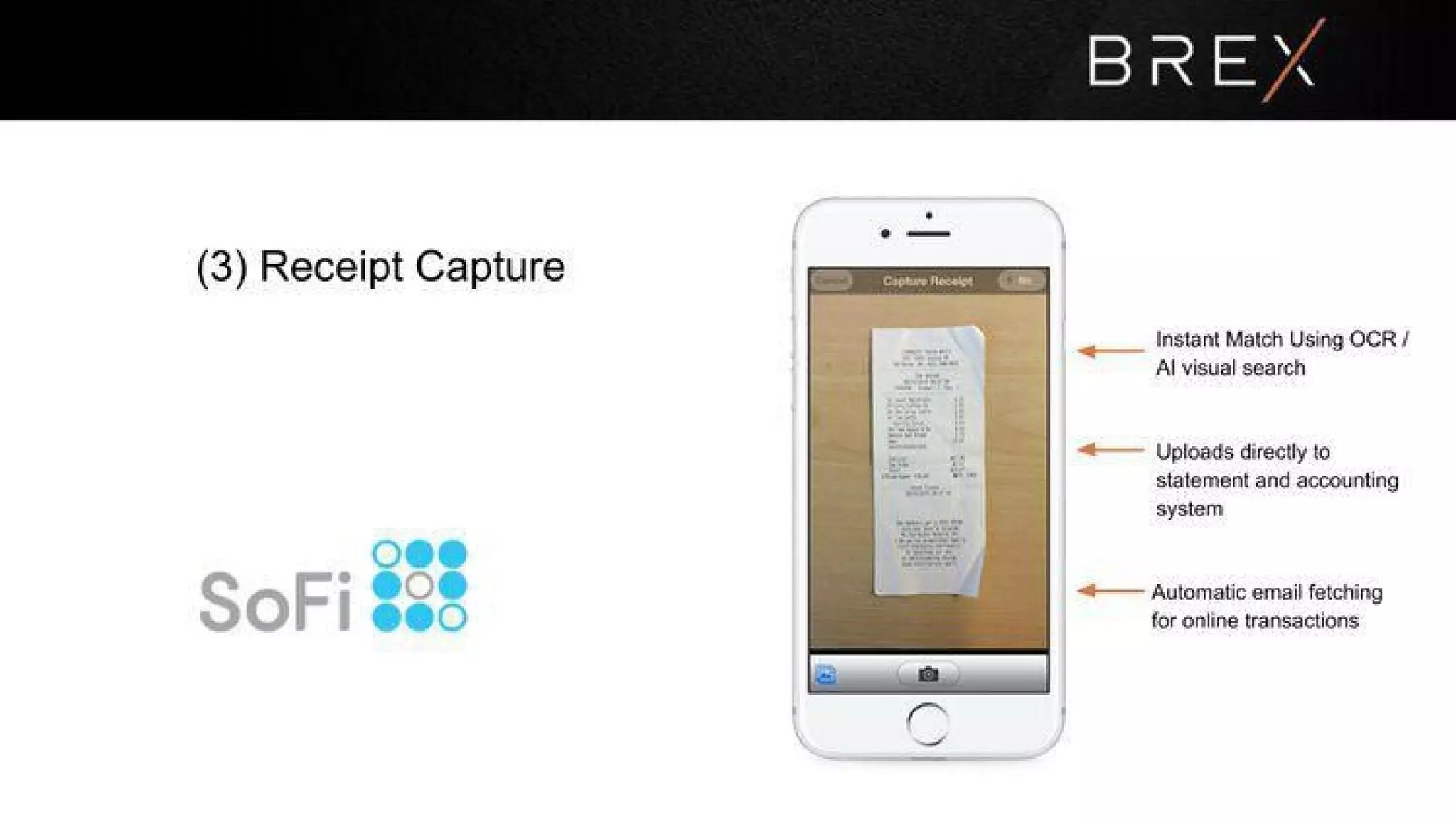
Slide 11 (Better Data) along with slides 12 and 13 show the product stack that creates durable differentiation: merchant-level transaction data and categorization, granular approval and merchant/user/category limits, virtual cards for online transactions, and mobile receipt capture with OCR and email fetching. These features are not just polish — they collectively enable superior underwriting (less risk), tighter expense control (less fraud/leakage), and a much smoother finance workflow (lower AP overhead). That combination both improves unit economics and raises switching costs as finance teams embed Brex into their ERP and workflows.

For founders, the takeaway is to layer features that compound each other. Data improves underwriting which enables better credit terms; controls and virtual cards reduce fraud and operational cost; receipt capture and ERP integrations reduce accounting friction and deepen product reliance. Each feature should be presented not as isolated functionality but as part of a system that increases retention and LTV.

Key Takeaway: Build feature layers that compound: data enables pricing, controls lower cost and risk, integrations lock customers in — design the product as an operating system for the customer’s workflow.
Traction: referral-driven growth and accelerating volume

Traction: referral-driven growth and accelerating volume

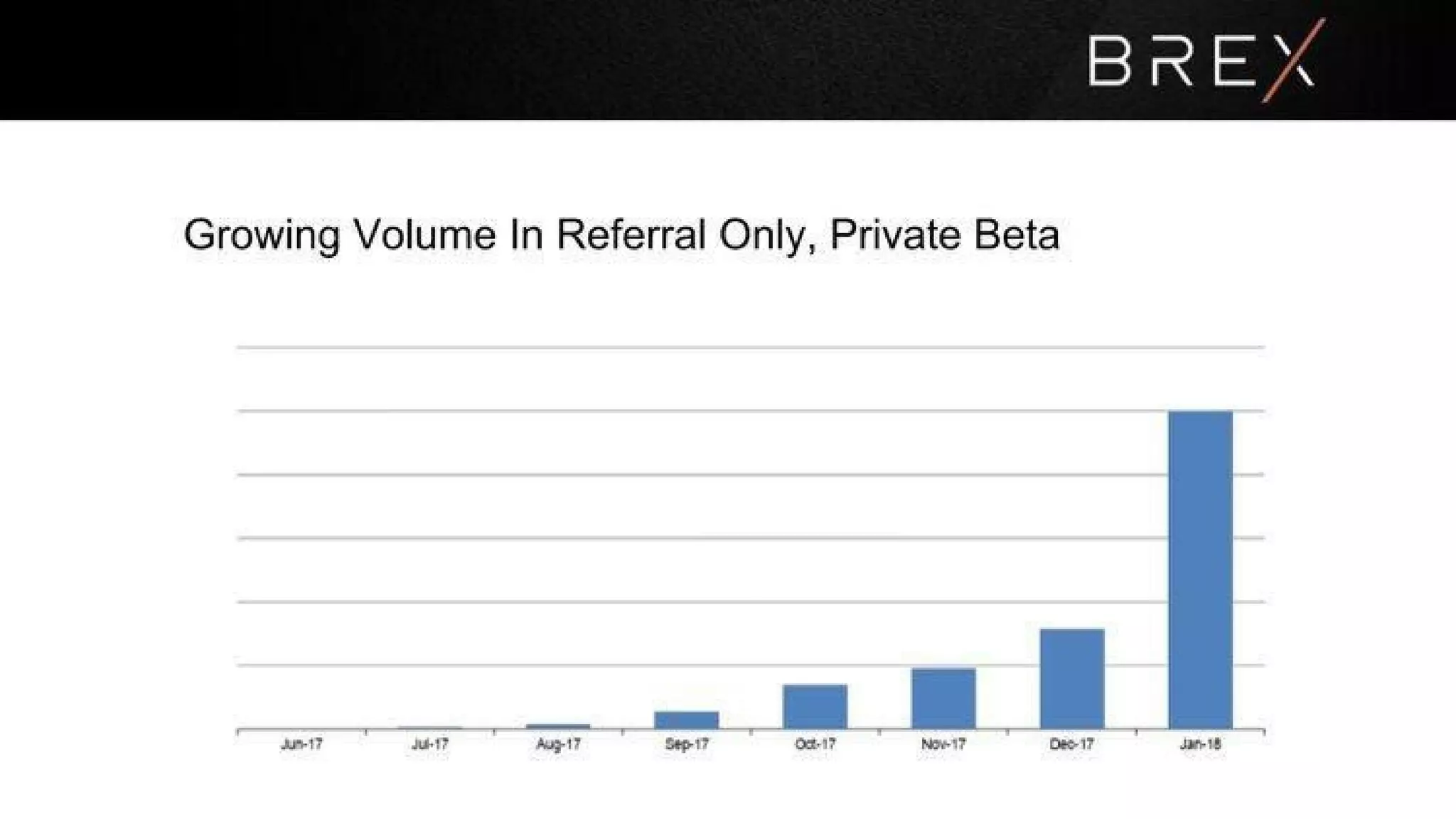
Slide 16 presents a simple bar chart showing referral-only private beta growth accelerating dramatically over a six-month period. This visual is effective because it pairs the narrative of product-led, word-of-mouth expansion with concrete numbers — a strong sign of product-market fit, especially for a financial product where trust and integration often slow organic growth. The chart implies low-cost customer acquisition and scalable distribution.

Founders should show not just raw growth but how growth was achieved (channels, conversion mechanics). If your growth is referral or product-led, highlight that explicitly and provide the leading indicators (viral coefficient, time-to-value, referral rates) that investors can use to project scaled growth.

Key Takeaway: If growth is organic or referral-driven, make that the headline and show the short funnel/metrics that prove the channel scales with low CAC.
Economics and retention: negative churn and LTV clarity

Economics and retention: negative churn and LTV clarity

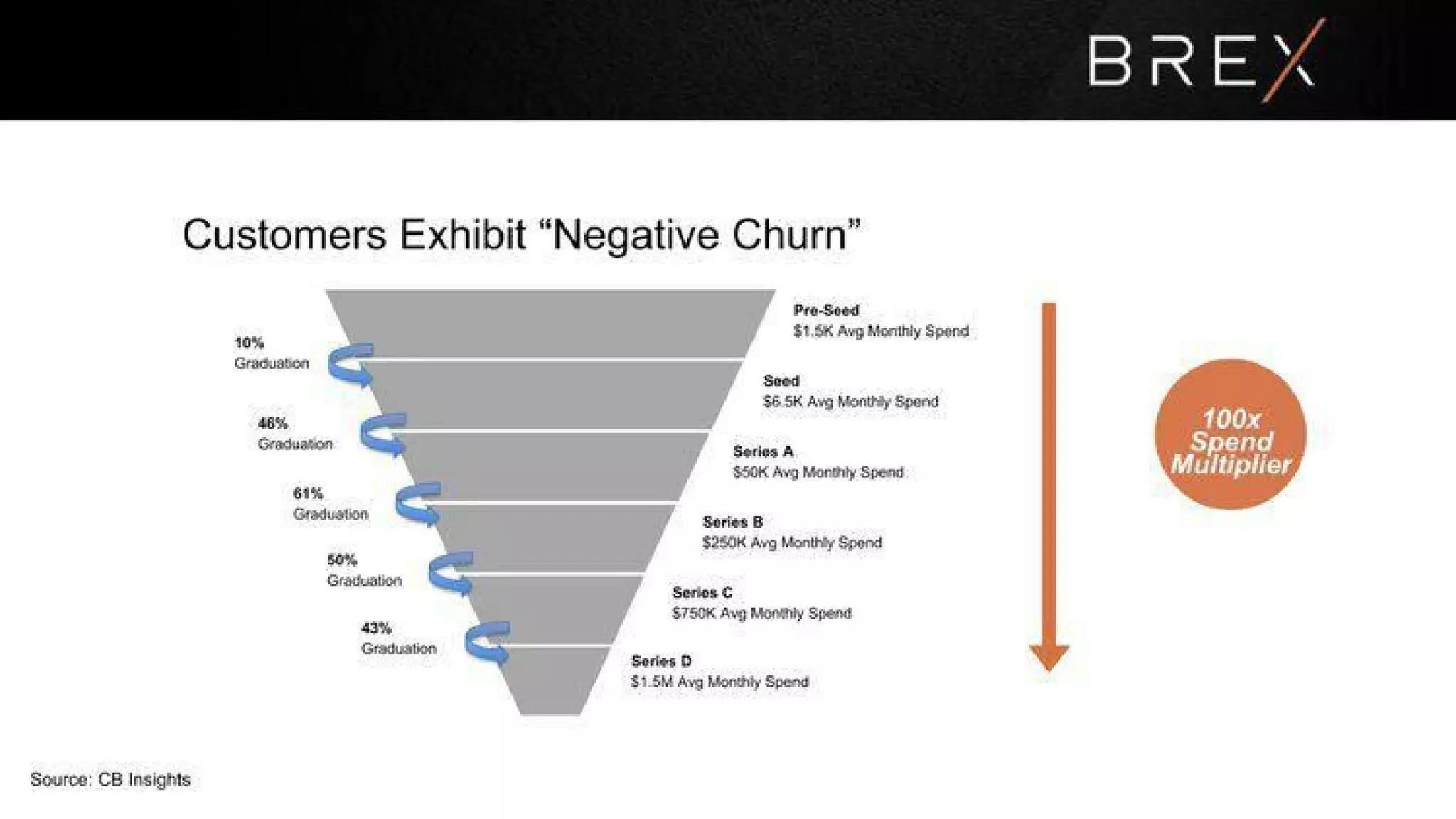
Slide 18 and slide 17 (the funnel showing "negative churn") present unit economics and an expansion story: as startups mature (pre-seed → Series D) their monthly card spend multiplies dramatically, producing a very large expected LTV per customer. The deck quantifies monthly spend tiers, annual revenue and gross profit, and expected LTV with churn assumptions — giving investors the math to justify customer acquisition investments. The negative churn concept (customers spend more as they grow) is a powerful retention narrative for enterprise-adjacent products.

Founders should emulate this by presenting both cohort progression and concrete LTV math. Show how initial customers expand over time, include realistic churn/upgrade rates, and tie those projections to unit economics that demonstrate payback period and scalable ROI on marketing spend. Concrete numbers beat vague claims every time.

Key Takeaway: Quantify how customers expand over time and tie it to LTV/payback math — investors need the cohort progression and unit-economic proof to underwrite growth investments.

Conclusion: Key Lessons

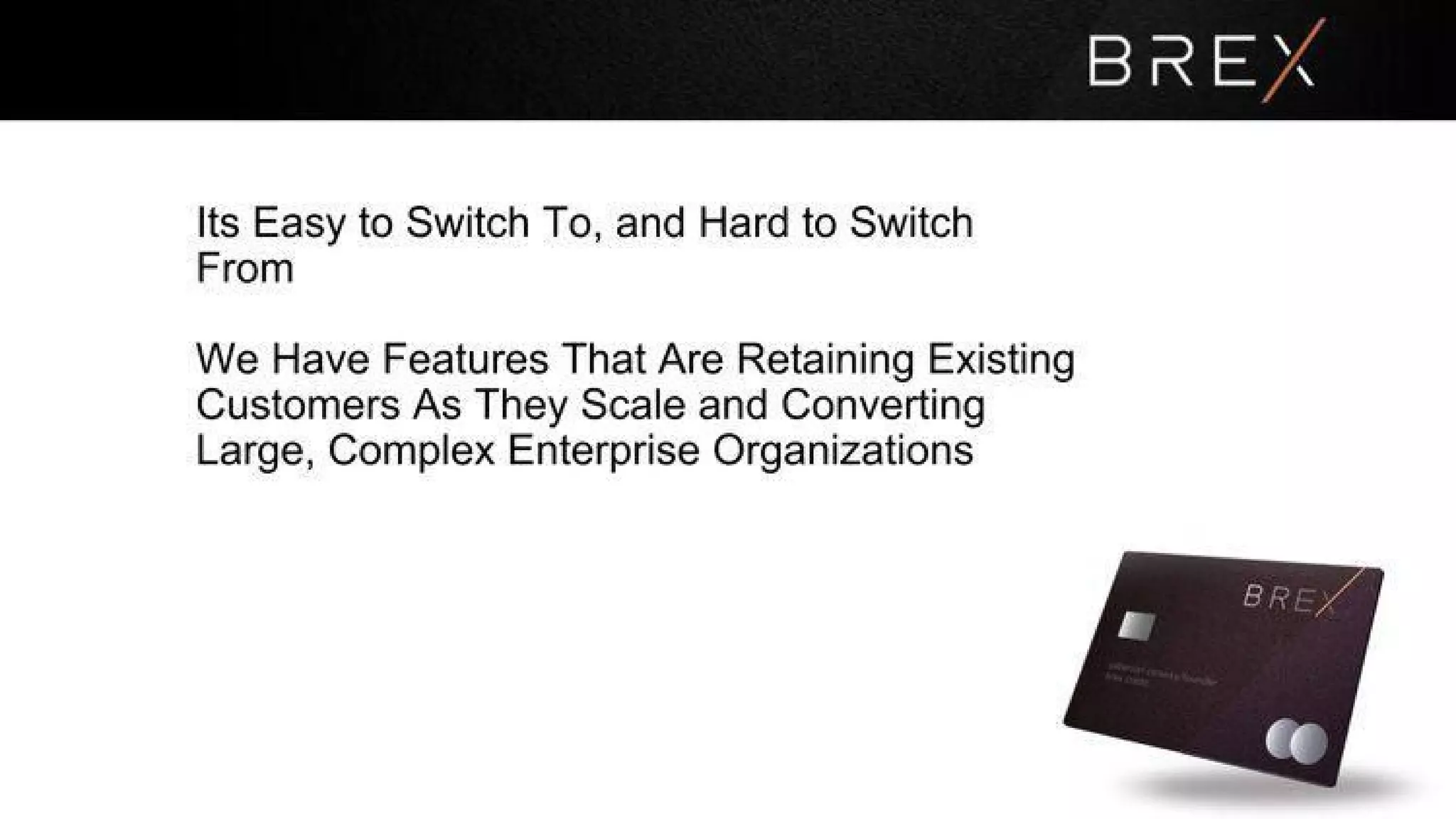
Brex’s Series C pitch is a strong example of product-led fintech storytelling: it pairs a crisp, empathy-driven problem statement with a defensible beachhead, clear product differentiation (data + controls + integrations), early organic traction, and transparent unit economics. Strengths include concise credibility up front, an acquisition proposition that solves an immediate pain at signup, and a layered product that increases retention and LTV. The deck also succeeds at showing how technical capabilities (merchant-level data, OCR, virtual cards) translate into commercial advantages.

Actionable advice for founders: start with a narrow, high-value beachhead and explain why it’s defensible; lead with immediate customer value at acquisition; present product features as an integrated system that raises switching costs; and provide cohort-based LTV and expansion math so investors can model scale. Finally, if your business depends on partnerships or regulatory execution, put proof of those relationships and relevant team expertise early in the deck to remove a major investor friction point.