Stack up against Shopify

Compare Your Deck

Shopify's 2013 Pitch Deck

SaaS
Stage: Investor Deck
Raised: $122.3M total
Year: 2013
Slides: 27
Outcome: IPO, valued at $100B+

Pitch Deck

1 / 27
Slide 1
Click to expand

Deck Analysis

This investor deck from Shopify (circa 2013) presents a crisp, product-led SaaS story: a simple, scalable commerce platform aimed at small and growing merchants, anchored by clear traction metrics, an expanding partner ecosystem, and accelerating revenue/G MV growth. What makes this deck notable is how it blends storytelling (founder origin/store example), market sizing, business model clarity, network effects (apps/themes/partners), and strong financial charts — all with consistent visual design. The result is an investor-ready narrative showing both adoption and monetization momentum, with a repeatable playbook founders can learn from.

Opening & Proof of Traction

Opening & Proof of Traction

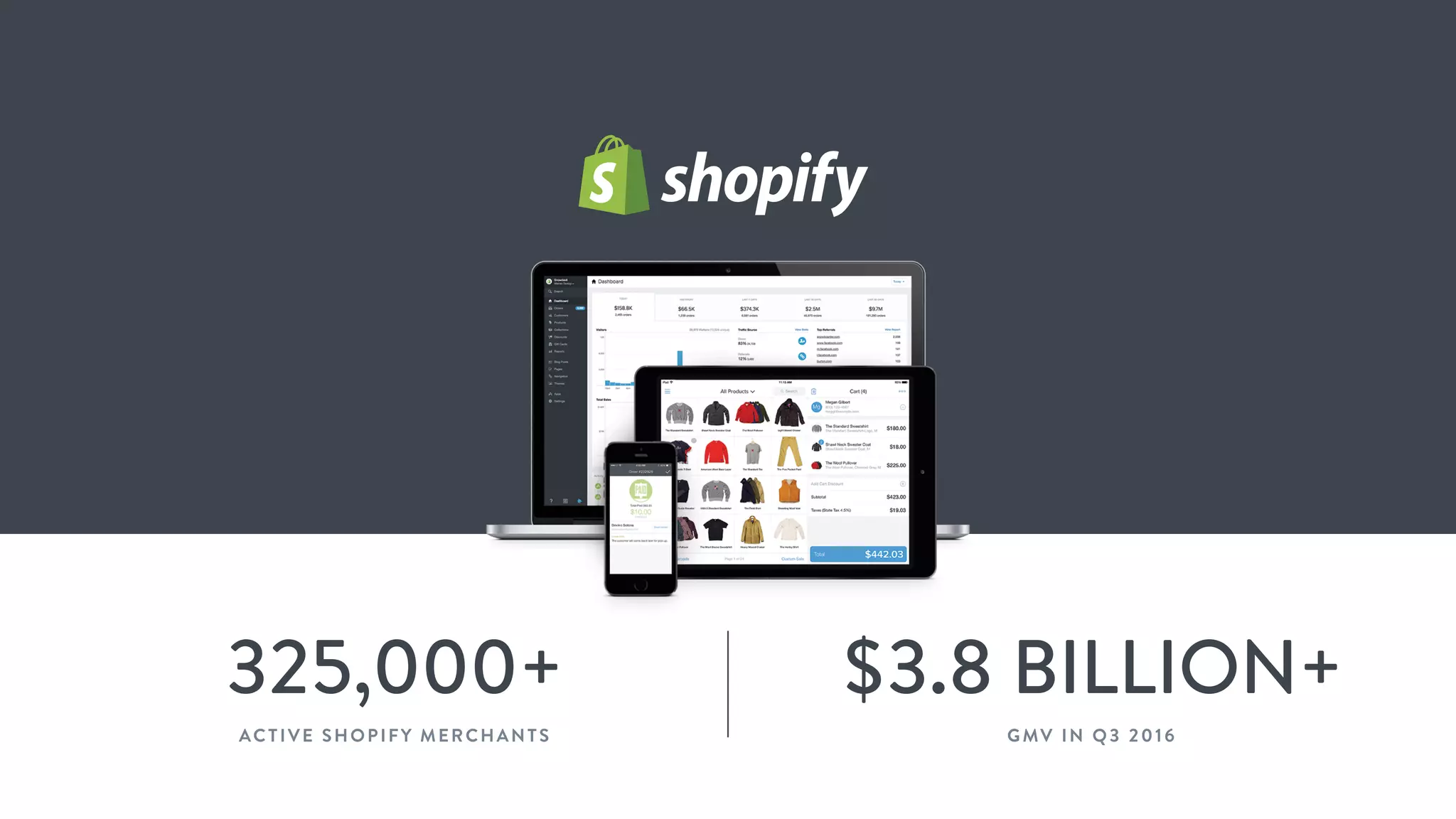
The first slide (branding + headline metrics) leads with the Shopify logo and immediately surfaces two high-impact stats: 325,000+ active merchants and $3.8B+ GMV in Q3 2016. This is classic social-proof-first framing: before diving into product details, the deck demonstrates market validation and scale. It signals to investors that the company has already achieved meaningful usage and a large economic flywheel, shifting the conversation from speculative product/market fit to scaling and monetization.

Visually the slide is restrained and professional — large numbers, large whitespace, and an aspirational product shot. Founders can learn to front-load the most compelling evidence of traction (user counts, GMV/revenue milestones) so investors immediately understand where the business sits in its lifecycle. The use of concrete, verifiable metrics builds credibility and primes the audience for deeper metrics later in the deck.
Key Takeaway: Lead with the single most compelling metric (or two) that prove demand; use large, clear typography and a product image to make an immediate credibility statement.
Customer Story & Product Context (Store Origin)

Customer Story & Product Context (Store Origin)

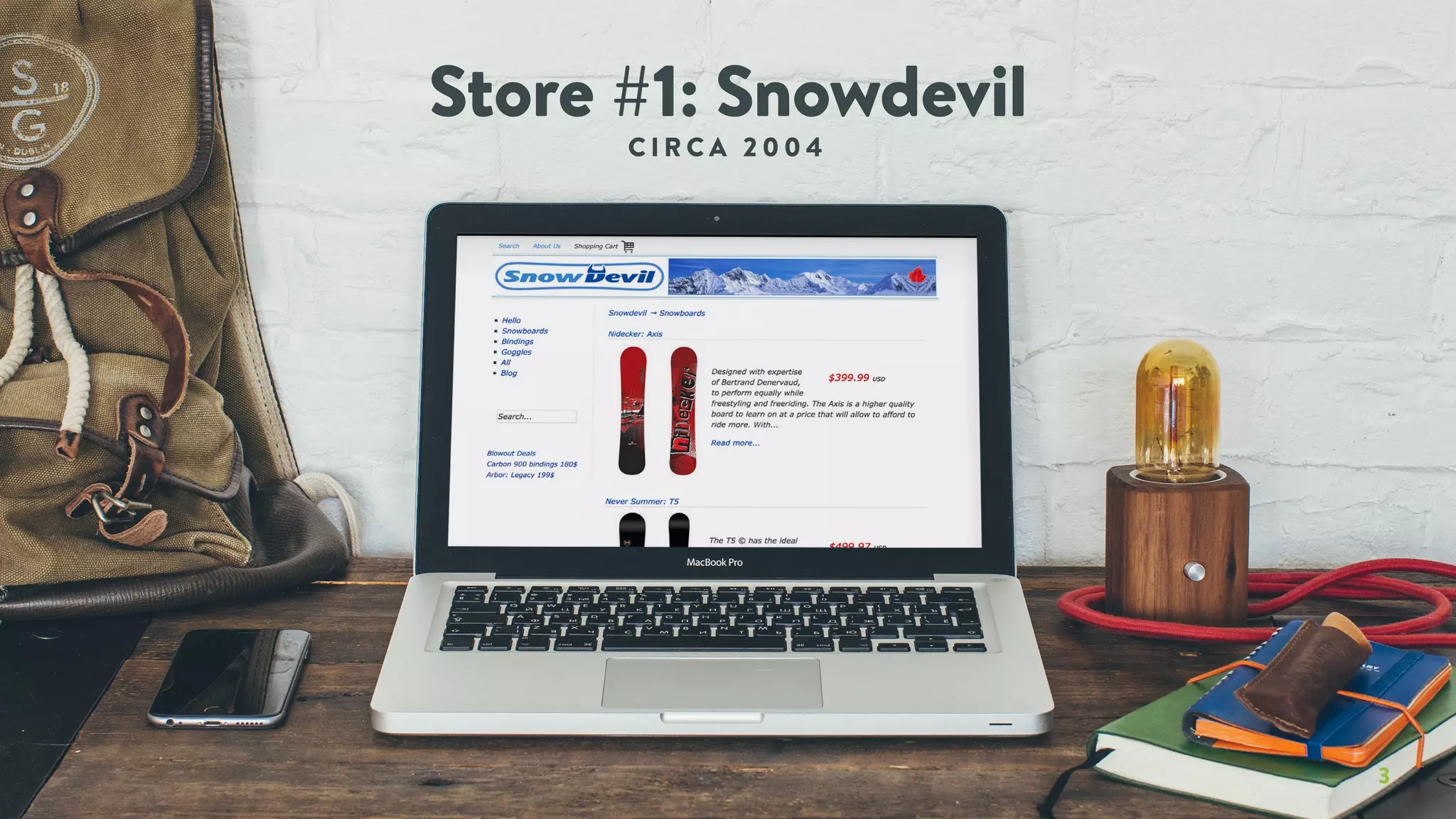
Early in the deck Shopify uses a nostalgic customer example (Store #1: Snowdevil) paired with a lifestyle photo of a laptop on a desk. This humanizes the product and shows the real-world problem being solved: enabling independent merchants to sell online. The narrative technique — showing a concrete early customer/website — converts abstraction into a relatable entrepreneurial use case, which helps investors understand the target user and the product’s role in their workflow.

Founders should note the power of a short origin or use-case slide: it clarifies the customer archetype and demonstrates product-market fit without heavy technical detail. Instead of lengthy feature lists, this slide uses imagery and a concise label to show who benefits and why. It’s a particularly effective approach when you’re selling tools for small businesses or consumer-facing SMBs where empathy and context matter.

Key Takeaway: Quickly humanize your product with one concrete customer story or archetype to show who benefits and why — pictures and a one-line caption beat long feature lists.
Platform & Omnichannel Positioning

Platform & Omnichannel Positioning

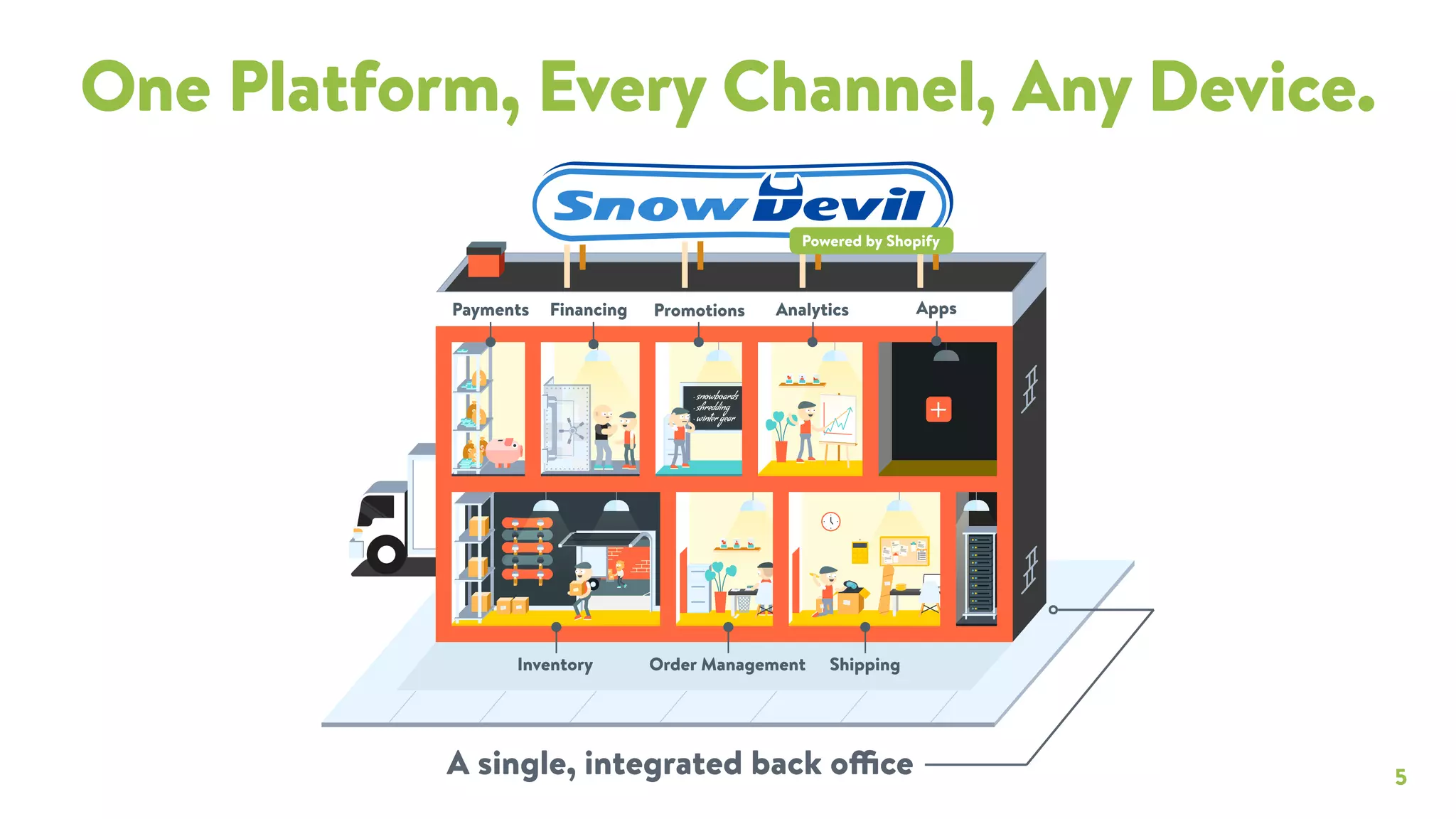
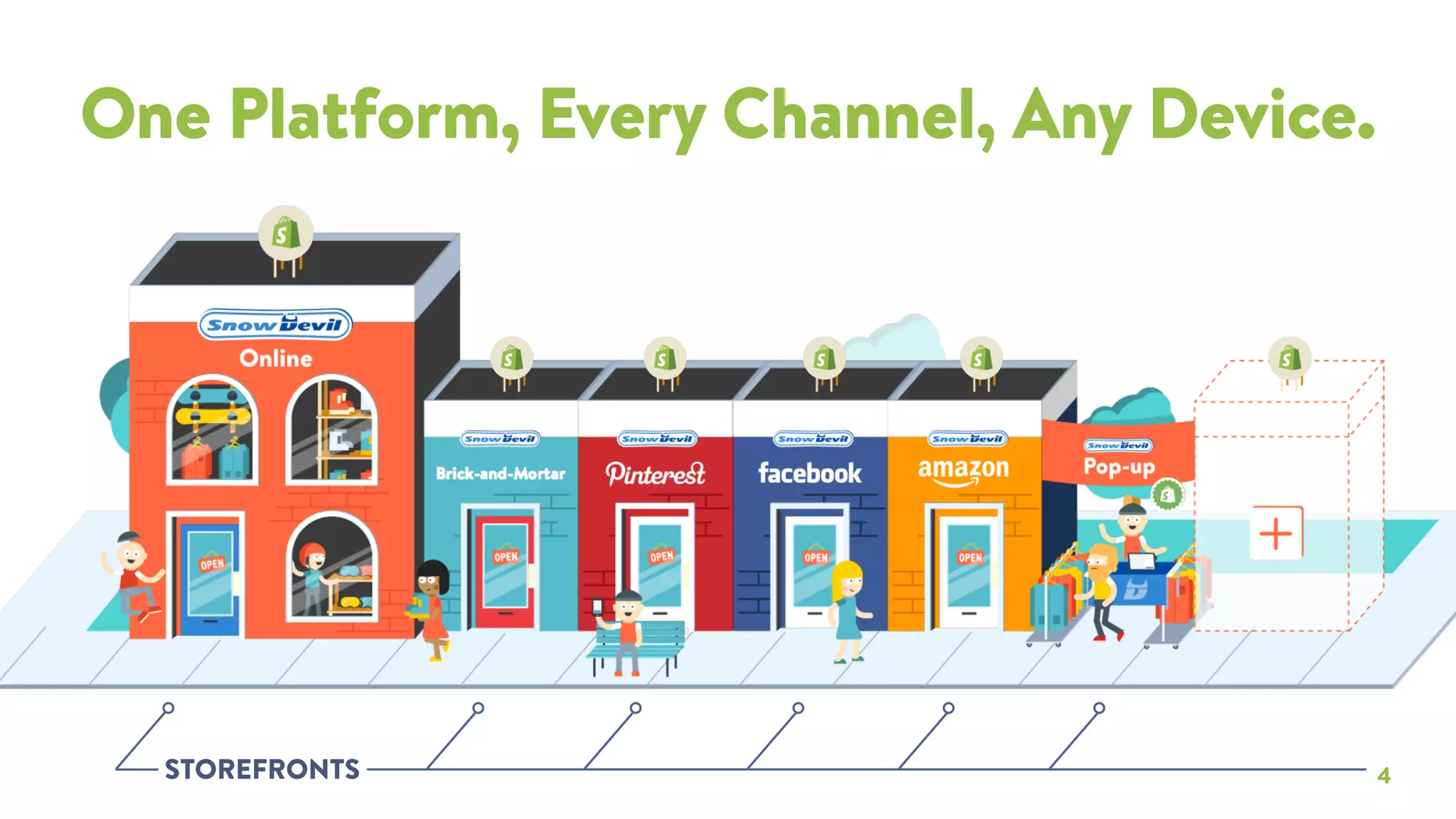
Slides that declare 'One Platform, Every Channel, Any Device' and show storefronts (brick-and-mortar, Pinterest, Facebook, Amazon, pop-up) communicate Shopify’s strategic position: not just a website builder but a single backend powering many sales channels. The colorful storefront illustration makes a complex multi-channel product easy to grasp and highlights the core value prop: unify sales, inventory, and fulfillment across channels.

This framing teaches founders the importance of positioning: identify the universal problem your product solves (fragmented sales channels and backend complexity) and depict the ecosystem clearly. The visual metaphor of storefronts is particularly effective because it maps digital channels to a physical, familiar concept — making the technical benefit accessible to non-technical investors and merchant buyers alike.

Key Takeaway: Use a simple visual metaphor to show how your product removes complexity across channels — make the ecosystem tangible so investors can quickly grasp the strategic value.
Market Segments & Pricing Ladder

Market Segments & Pricing Ladder

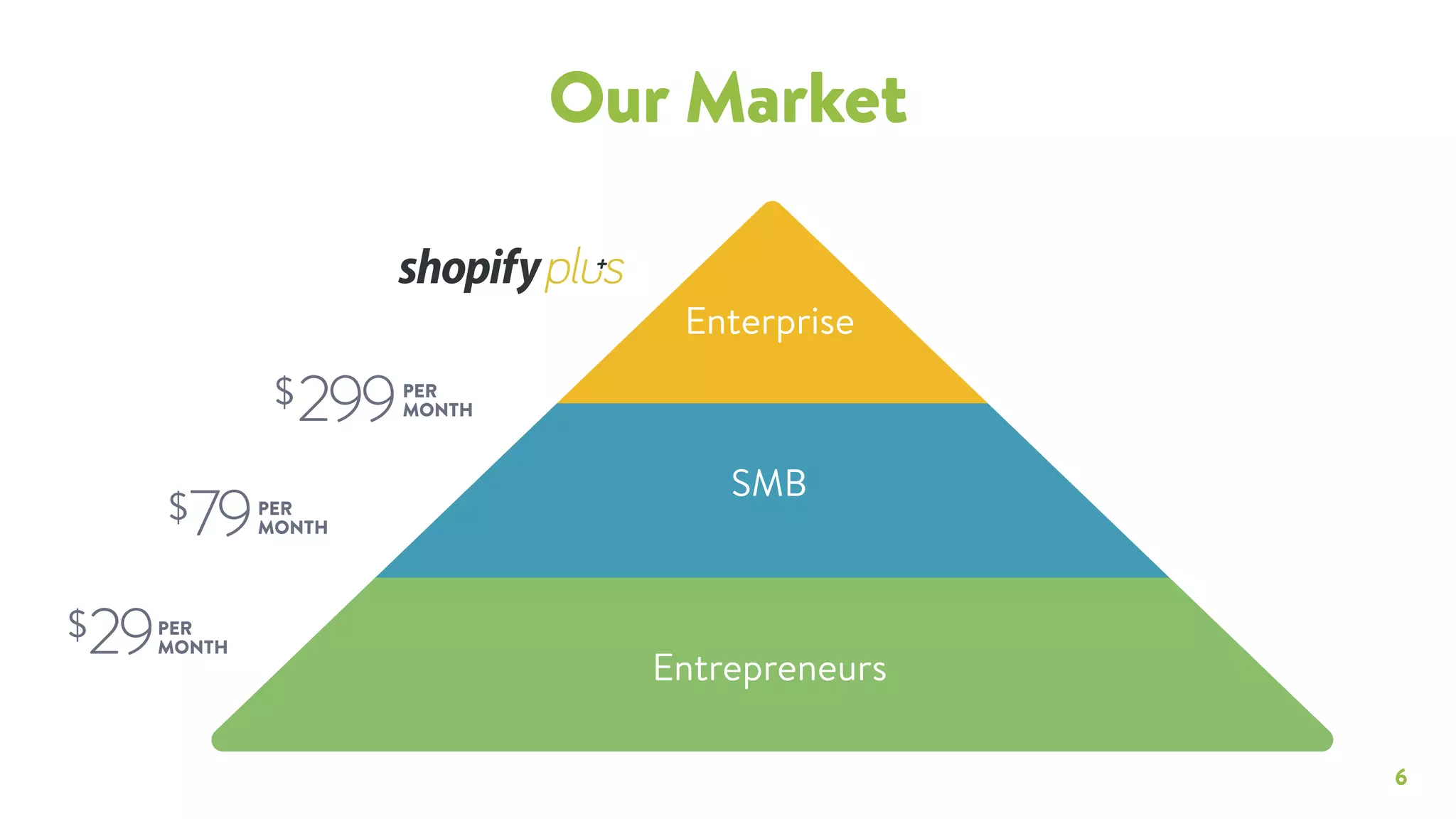
The market pyramid (Entrepreneurs / SMB / Enterprise) with price points ($29 / $79 / $299) succinctly communicates Shopify’s go-to-market segmentation and revenue model. It signals a broad funnel: large base of entrepreneurs, rising ARPU for established SMBs, and customized enterprise offerings. This slide clarifies how the company captures value at multiple levels and hints at a clear upgrade path for customers as they grow.

For founders, this is an essential lesson in linking pricing to customer segmentation — show not just TAM but how you expect customers to climb your value ladder. Simultaneously presenting price points and market layers helps investors model ARR/MRR growth and churn assumptions, so be explicit and simple about tiers and who each tier serves.

Key Takeaway: Map pricing tiers directly to customer segments and show the upgrade path — investors need to see how customers progress and how ARPU increases across segments.
Ecosystem & Strategic Partnerships

Ecosystem & Strategic Partnerships

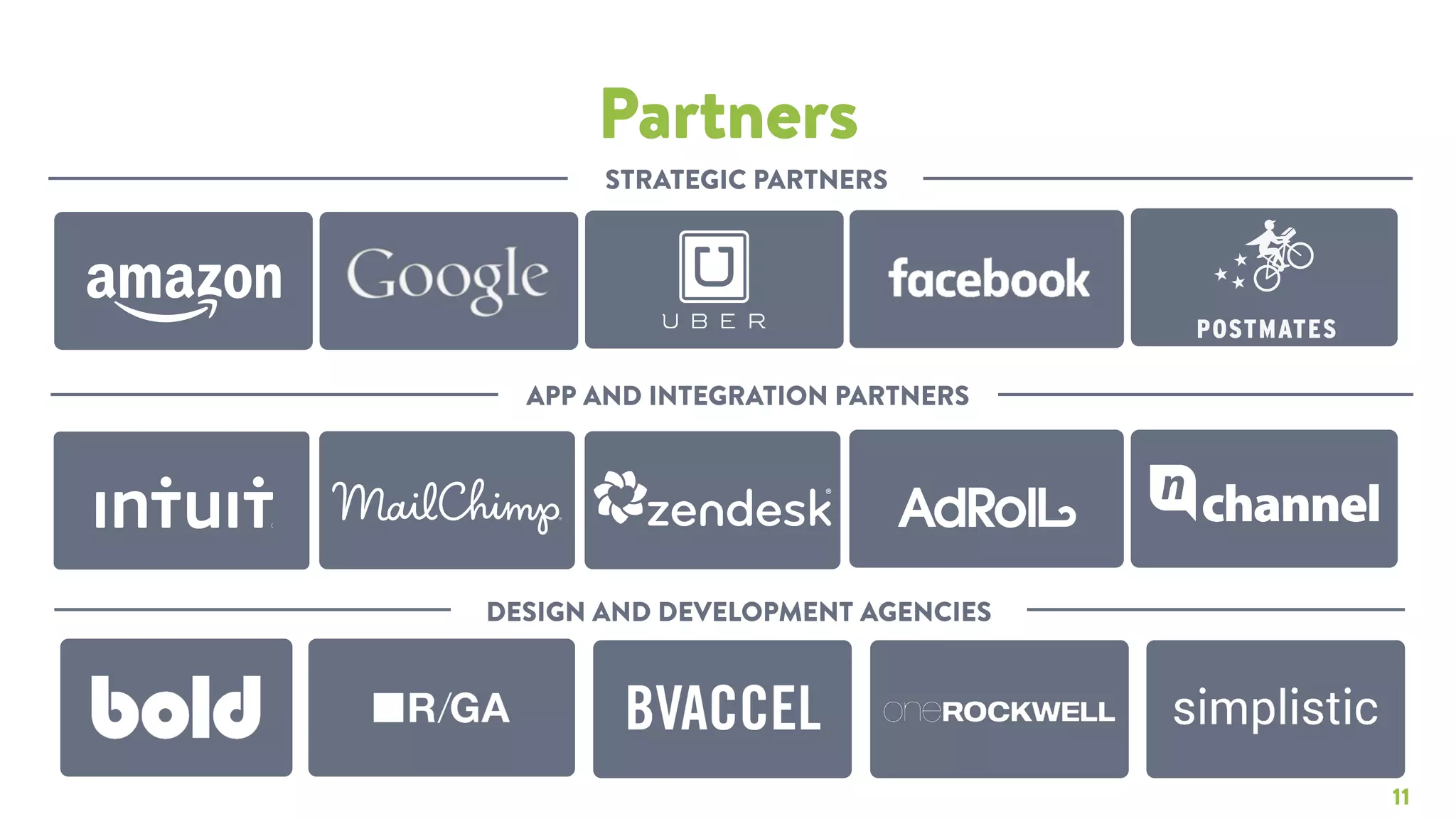
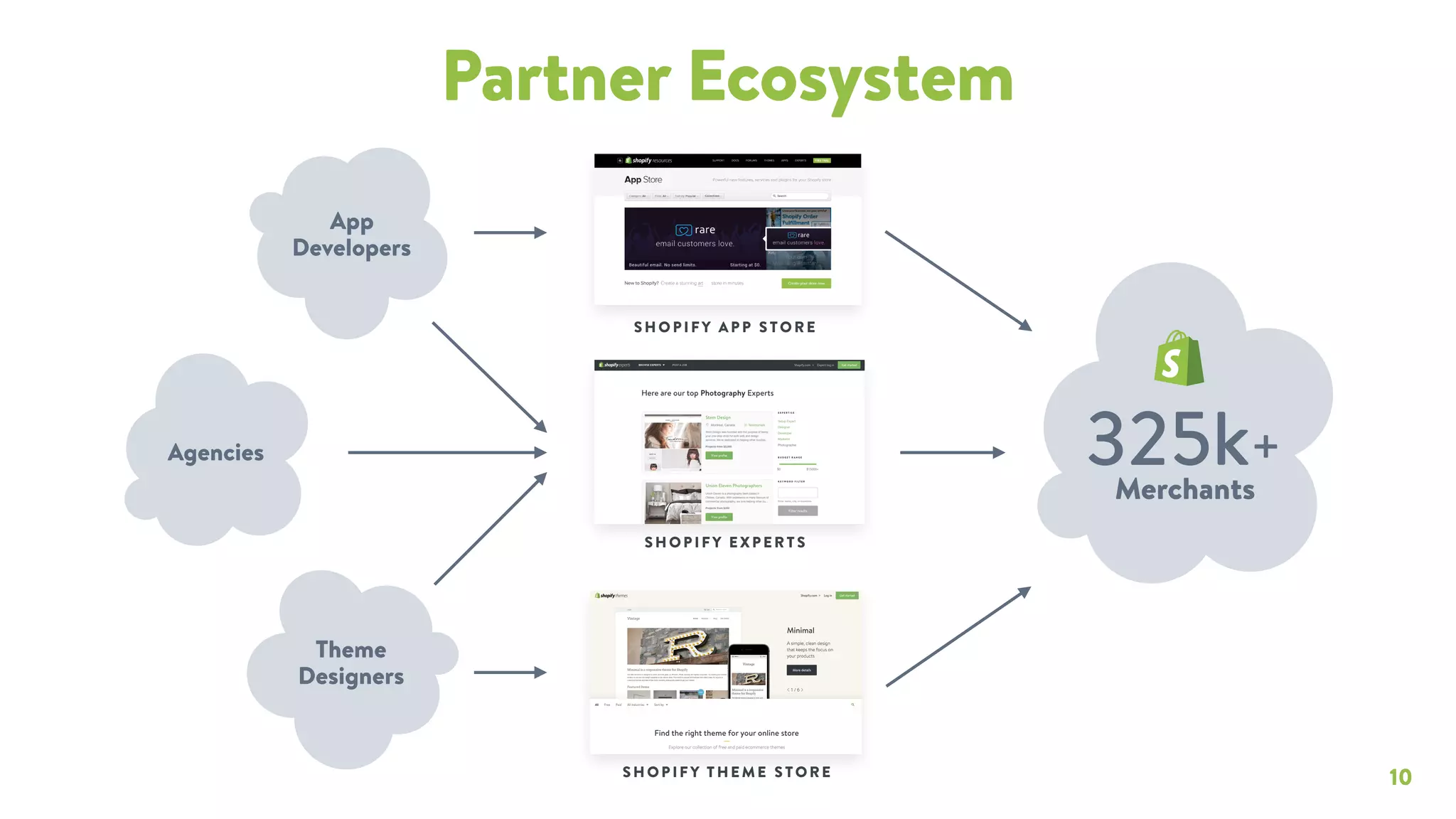
Multiple slides emphasize Shopify’s partner ecosystem: apps, themes, agencies, and strategic partners like Amazon, Google, Facebook, and Uber. The partner ecosystem slide shows feeds from app developers, theme designers and experts into a merchant pool of 325k+ stores. Another slide lists logo-level strategic partners and integration partners. This combination demonstrates a two-sided network effect — partners build for the platform and merchants benefit, creating stickiness and distribution.

Founders should prioritize proving ecosystem dynamics early if their product benefits from third-party integration (marketplaces, APIs, plugins). Highlight not only who your partners are but how they contribute to growth (distribution, feature breadth, trust). Logos are powerful social proof; pairing them with a diagram of flows (partners → product → merchants) makes the mechanism clear to investors.

Key Takeaway: Show how third parties (apps, themes, strategic partners) create distribution and stickiness — use logos plus a simple flow diagram to explain the network effect.
Traction & Financial Momentum (Revenue, MRR, GMV)

Traction & Financial Momentum (Revenue, MRR, GMV)

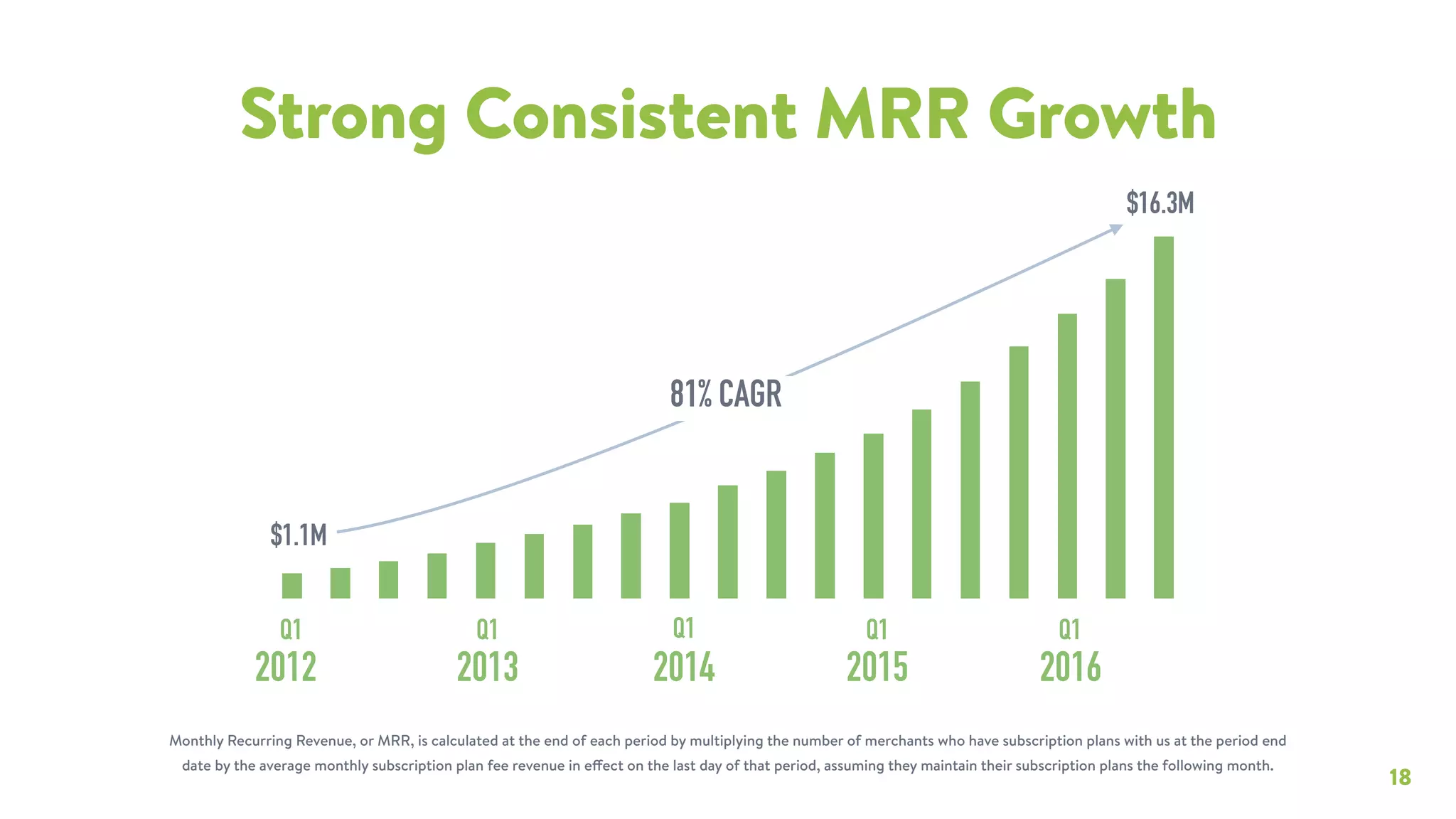
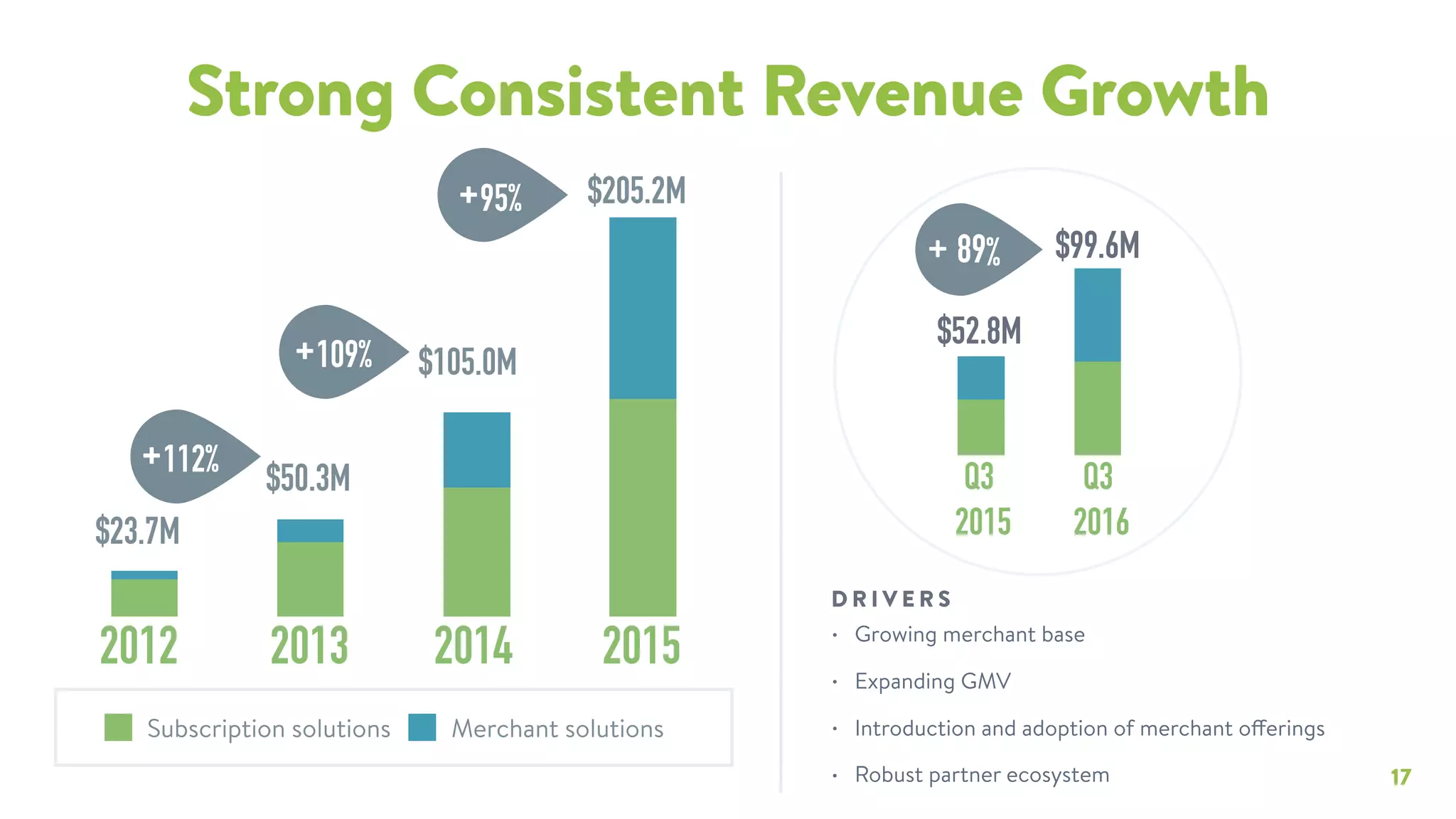
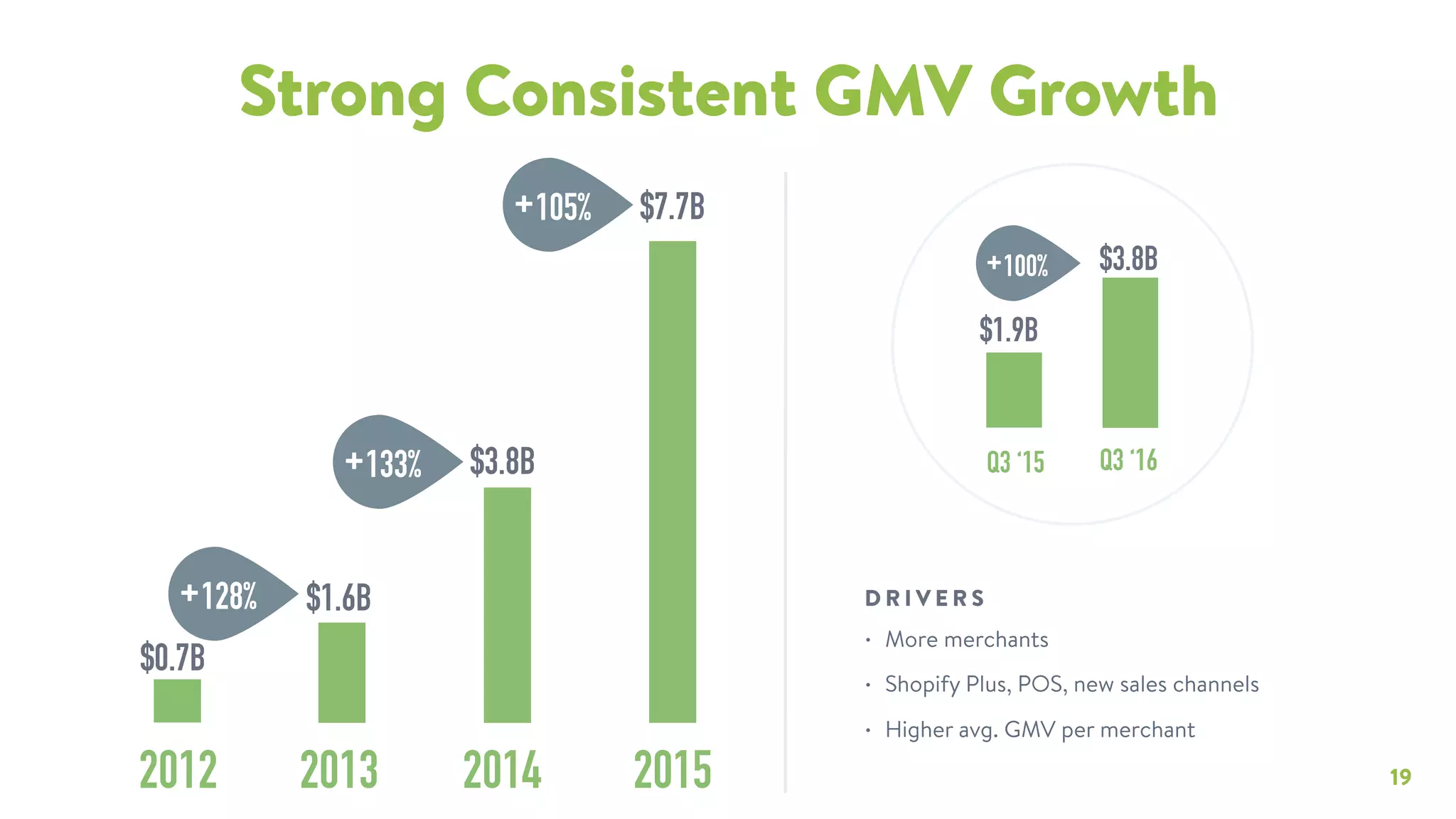
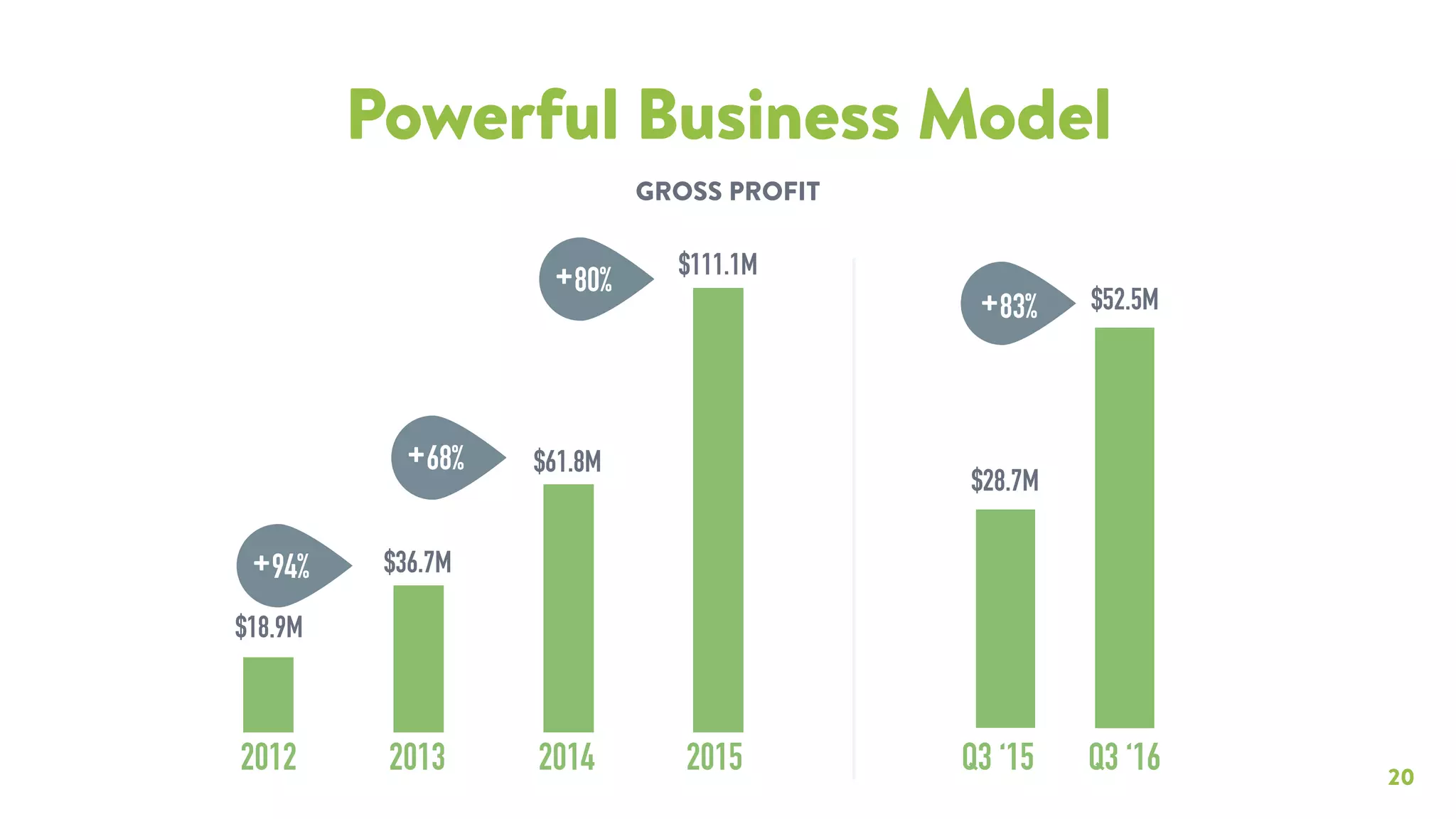
Shopify devotes several slides to concrete financial momentum: multi‑year revenue bars, MRR growth with CAGR highlighted, and GMV expansion from $0.7B to $7.7B over a few years. These are not just raw numbers — the charts call out year-over-year % growth and separate subscription vs merchant solutions revenue, enabling investors to see both recurring base and success-based monetization. The visual clarity (stacked bars, labeled percentages) allows quick modeling of unit economics and growth drivers.

Founders must learn to present growth in multiple complementary metrics (MRR, revenue, GMV) and to separate revenue streams so investors can assess scalability and margins. Highlighting CAGR and YoY growth percentages contextualizes the story: high growth plus predictable recurring revenue is far more compelling than one-off spikes. Also, annotate drivers (growing merchant base, new channels, Shopify Plus) so the deck links strategy to results.

Key Takeaway: Present multiple growth metrics (MRR, revenue, GMV) with clear segmentation and percent growth callouts — connect the metrics to specific growth drivers to make results actionable for investors.
Operating Leverage & Investment Roadmap

Operating Leverage & Investment Roadmap

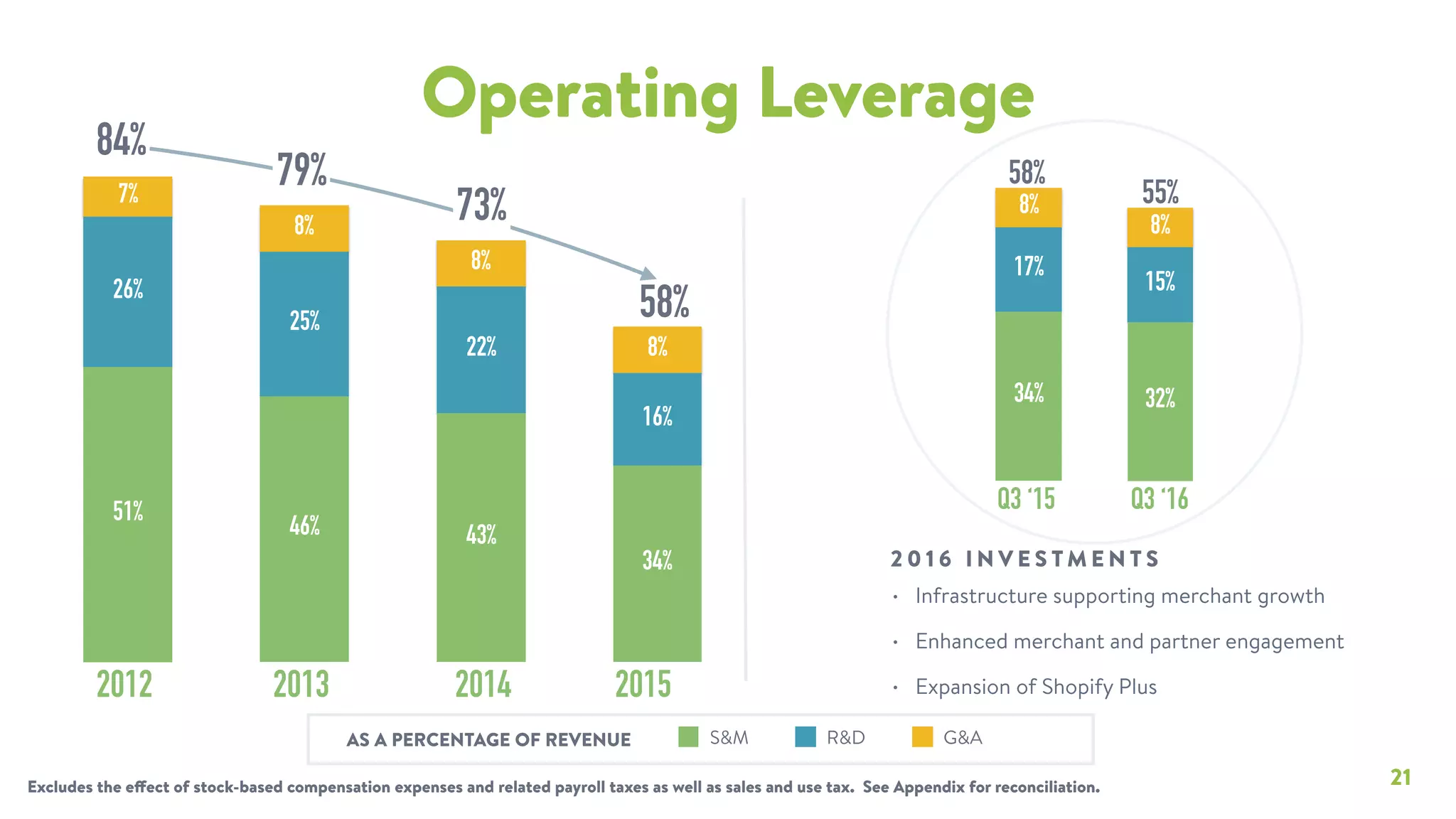
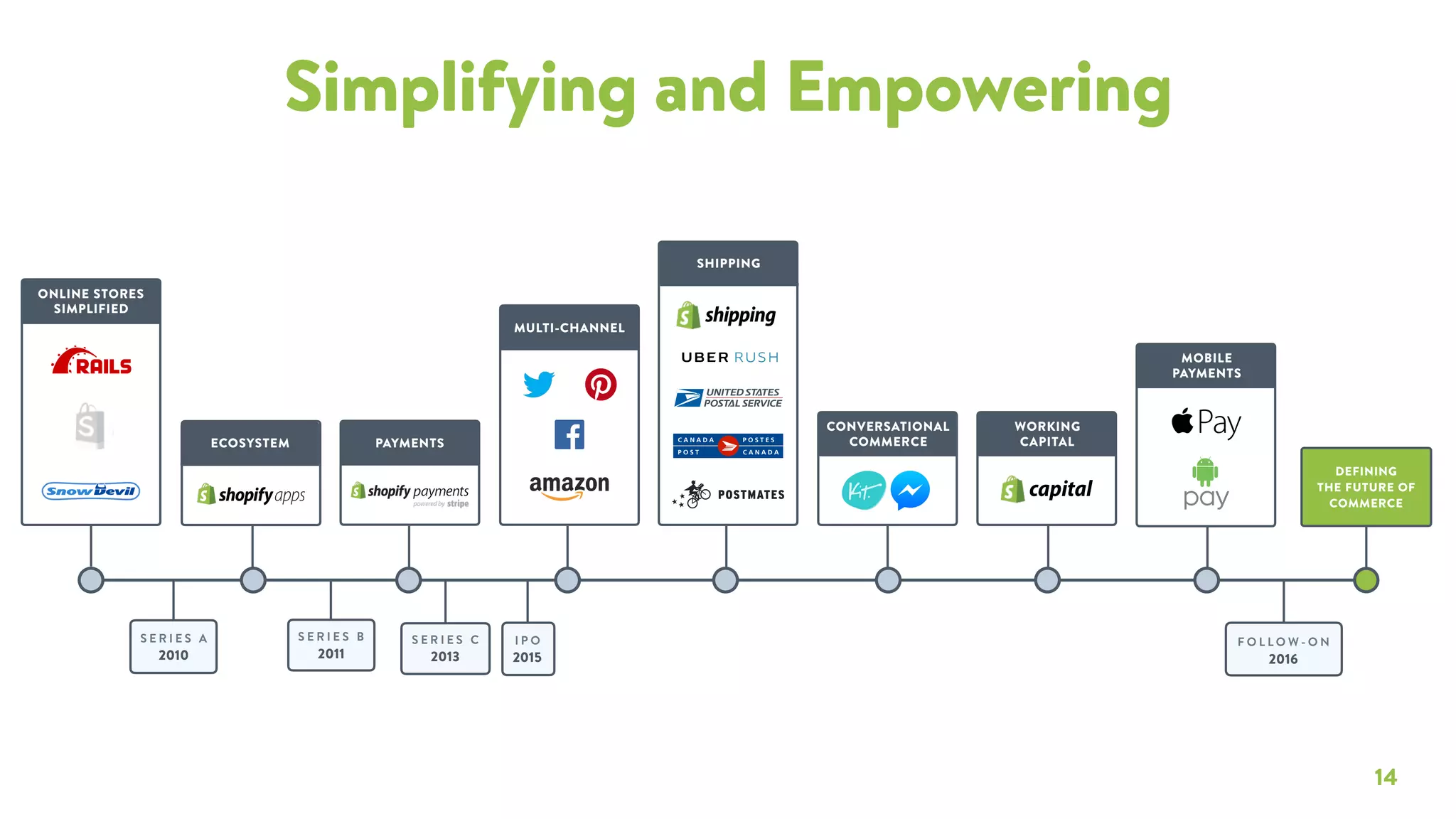
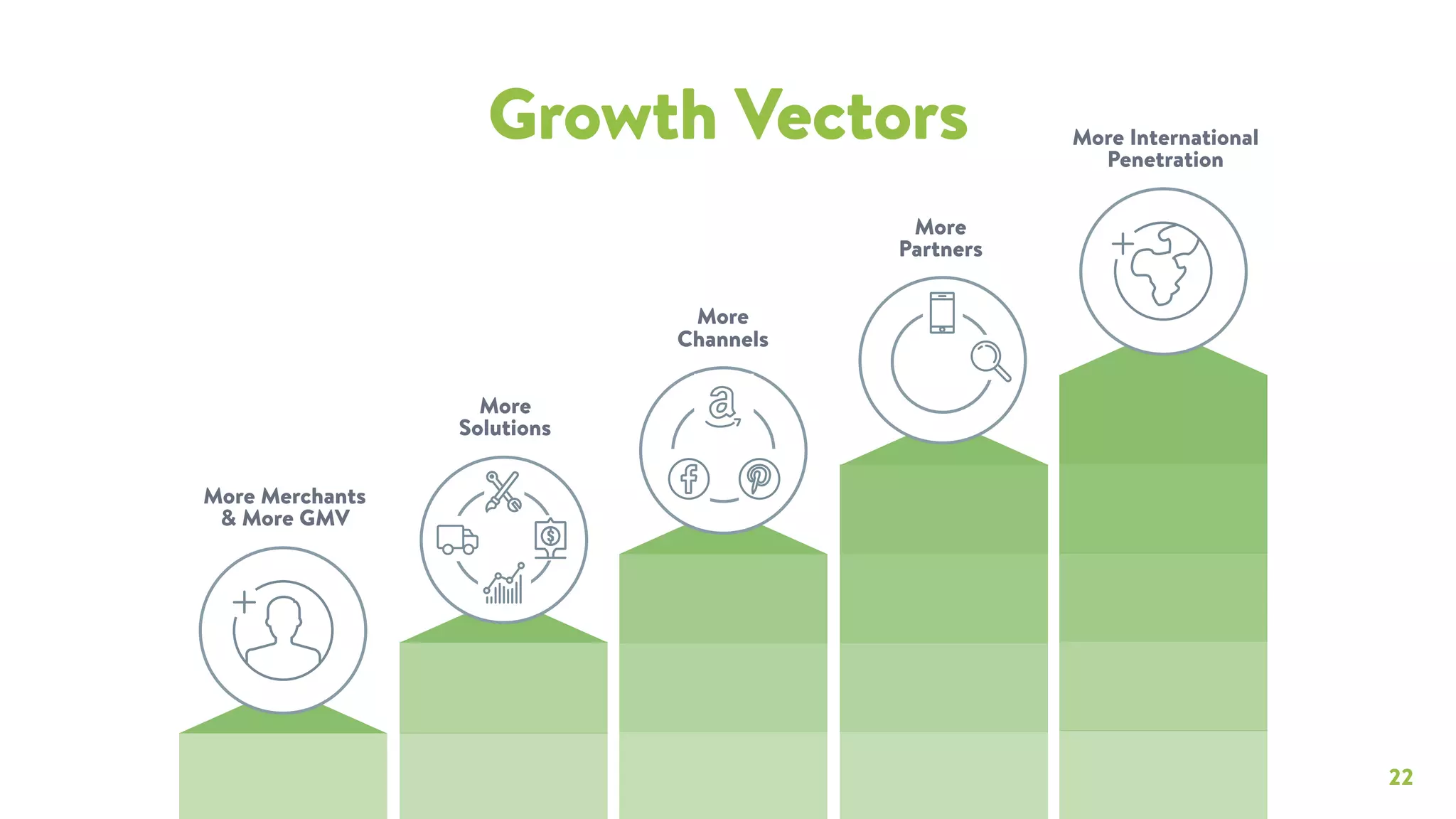
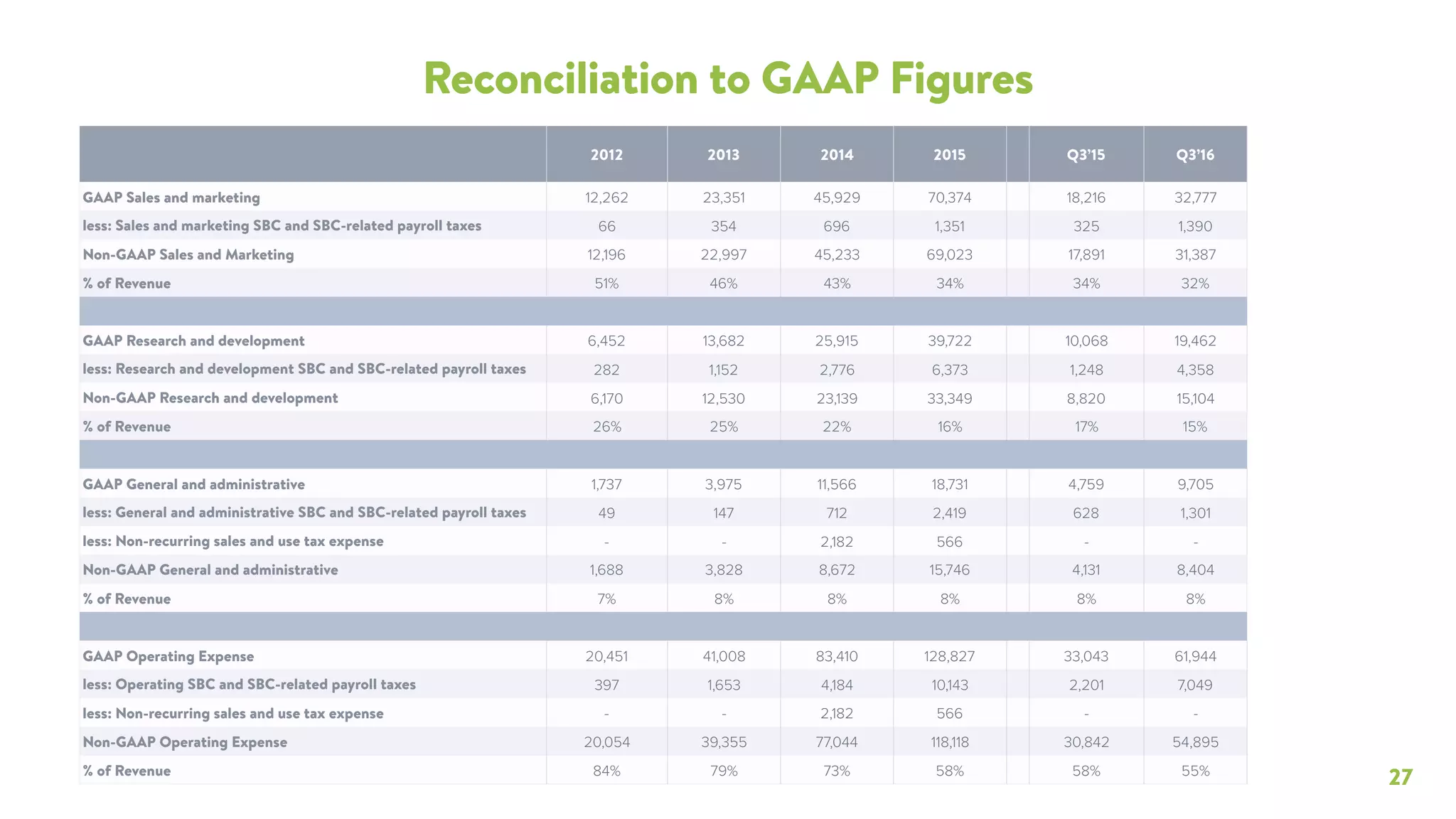
The operating leverage slide shows expense categories as a percentage of revenue over time (S&M, R&D, G&A) with a clear trend toward improved leverage. The timeline slide (Simplifying and Empowering) maps product launches, financing rounds, and strategic initiatives (payments, shipping, working capital, mobile payments) to illustrate how product investments enabled new monetization. Together these slides demonstrate disciplined reinvestment: heavy early investment to build features/partners, then improving leverage as revenue scales.

For founders, this is a reminder that investors look for both growth and capital efficiency. Presenting spend as % of revenue and showing a roadmap of product initiatives tied to future monetization helps justify current investment levels and shows a plan to drive operating improvements. Use timelines to show how past investments unlocked new revenue lines and how future investments will compound growth.

Key Takeaway: Show expense trends as a percentage of revenue and tie past/future investments to specific new revenue streams — this reassures investors that growth is being converted into durable operating leverage.
Investment Highlights & Vision

Investment Highlights & Vision

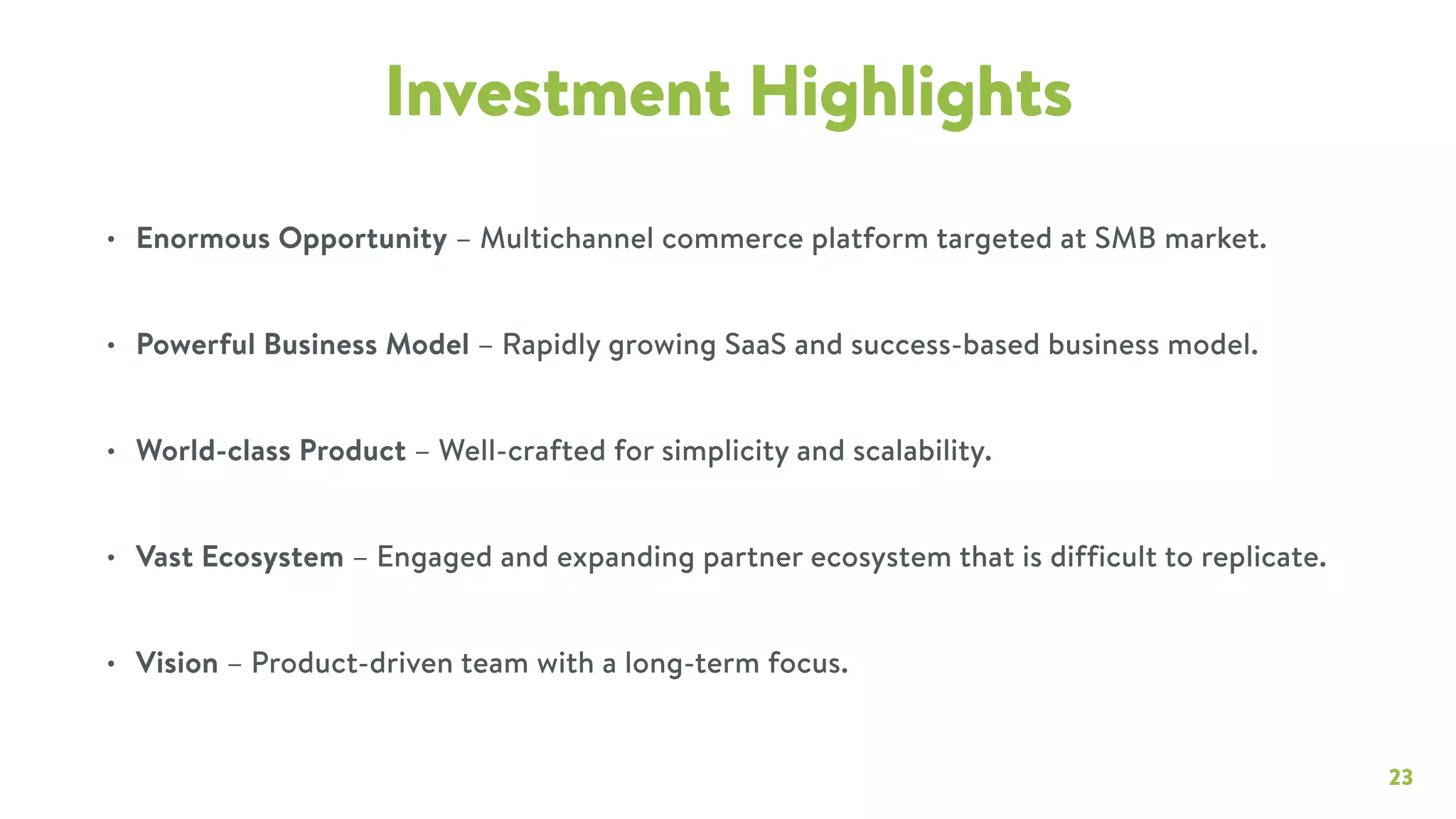
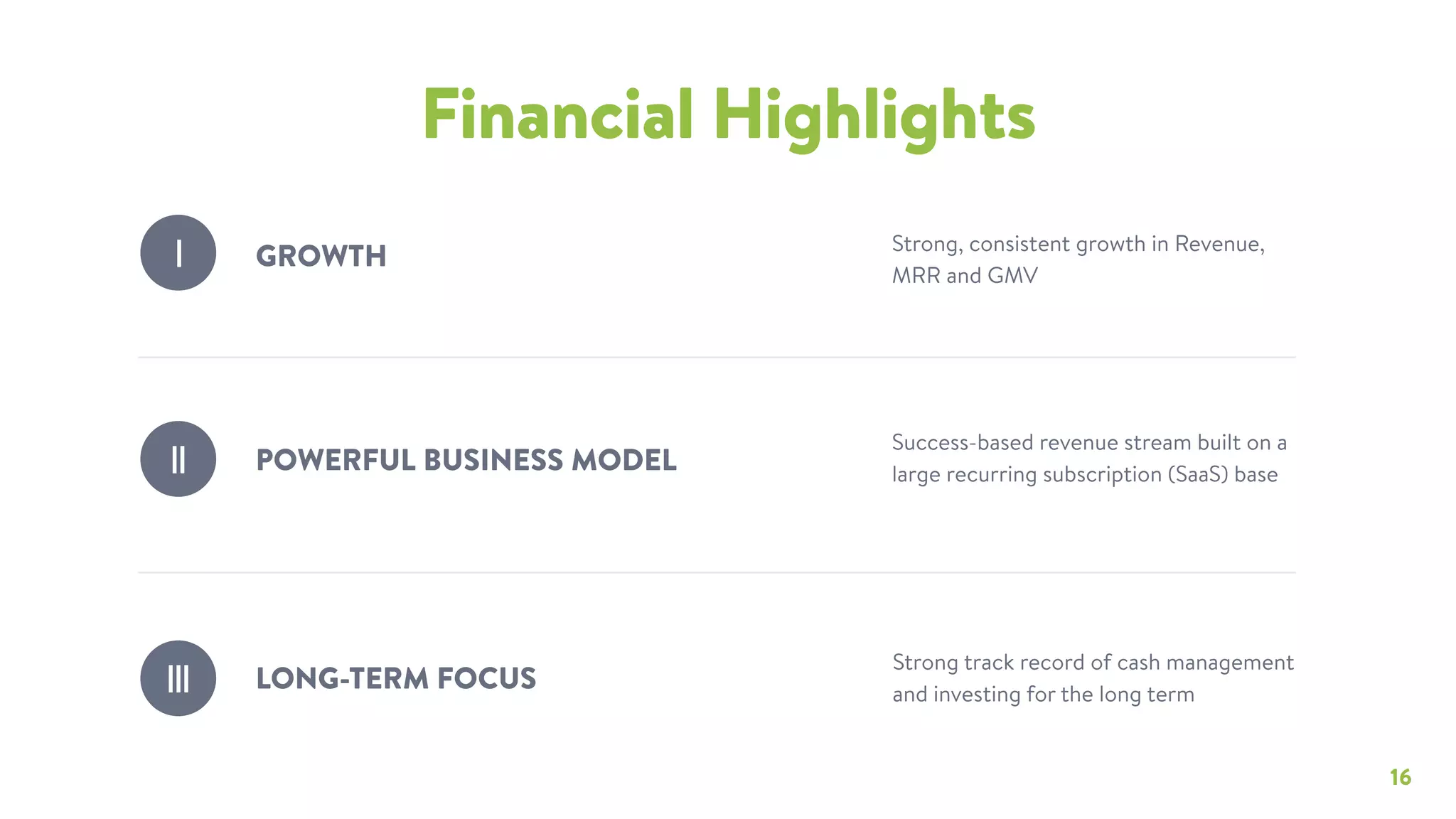
The deck closes by recapping the investment thesis: enormous opportunity, powerful SaaS + success-based model, world-class product, vast ecosystem, and long-term vision. This section crystallizes why Shopify is investible beyond the numbers — product quality, defensibility via ecosystem, and a founder/team narrative. It’s concise, investor-focused, and revisits the most important selling points to leave a strong final impression.

Founders should emulate this by ending decks with a tight bulleted summary that blends data and strategy: restate the market opportunity, defensible advantages, monetization model, and the team’s long-term orientation. A confident, succinct close reduces ambiguity and makes it easy for investors to remember the core thesis when evaluating your company.

Key Takeaway: Finish with a concise investment thesis that ties opportunity, moat, monetization, and team together — make it easy for investors to recall your core reasons to invest.

Conclusion: Key Lessons

Shopify’s investor deck is a masterclass in combining product storytelling, market sizing, partner/network effects, and clean financial evidence. Strengths include front-loading compelling traction metrics, using simple visuals and metaphors to explain a complex multi-channel product, explicitly mapping pricing to customer segments, and demonstrating both growth and improving operating leverage. The deck consistently ties strategy to measurable outcomes, which reduces investor friction.

Actionable advice for founders: open with the single most persuasive metric; humanize your product with a concrete customer example; use simple metaphors and diagrams to explain ecosystem value; present segmented revenue and growth metrics (MRR, GMV, ARPU) with clear drivers; and close with a tight investment thesis linking opportunity, moat, monetization, and team. Above all, make every slide answer the investor’s question: why now, why you, and how will this scale profitably?