Stack up against Dropbox

Compare Your Deck

Dropbox's 2007 Pitch Deck

SaaS
Stage: Seed
Raised: $1.2M
Year: 2007
Slides: 17
Outcome: IPO at $9.2B valuation

Pitch Deck

1 / 17
Slide 1
Click to expand

Deck Analysis

This is Dropbox's 2007 seed pitch deck: a compact, visual, product-first presentation that crisply frames a universal pain (file storage and sharing), demonstrates a working product, and highlights technical and team strengths. Notable for its simplicity and demo emphasis, the deck avoids heavy market spreadsheets and instead shows a real problem, a clear product experience, and why the founders were uniquely suited to execute — a combination that helped the company raise $1.2M and later reach a multibillion-dollar IPO.

The Opening: Clear brand and one-line positioning

The Opening: Clear brand and one-line positioning

The first slide is minimal: the Dropbox logo, the tagline “Moving the world’s files,” and a straightforward URL. It sets a confident, consumer-friendly tone and establishes what the product does in one short phrase. That brevity makes it instantly memorable and places emphasis on product rather than buzzwords or hyperbole.

Founders can learn from how this slide uses simplicity to convey clarity. Instead of overloading the audience with metrics or jargon, it leads with a brand promise that frames the rest of the deck. For early-stage pitches that rely on product intuition, a concise opening that communicates mission and focus is more effective than dense slides of background detail.

Key Takeaway: Open with a single memorable line that encapsulates your product’s core value — clarity beats complexity at seed stage.
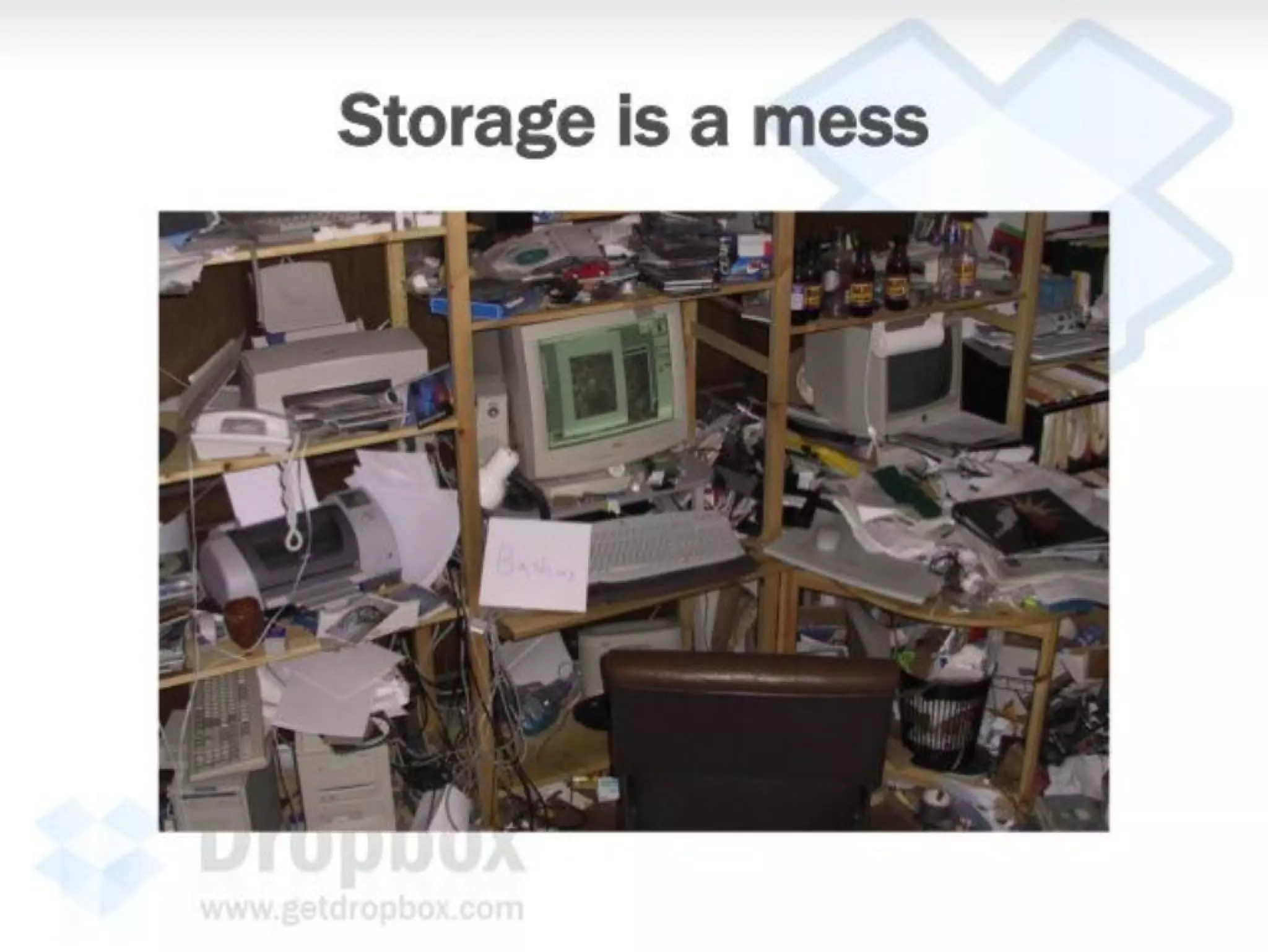
Problem: Visualizing the pain

Problem: Visualizing the pain

Slide 2 uses a single, relatable photo of a chaotic desk with the headline “Storage is a mess.” The visual metaphor instantly communicates the real-world frustration Dropbox aims to solve, making the problem visceral rather than abstract. This drives empathy and primes the audience to accept the product solution that follows.

This approach teaches founders the power of pairing a short, bold headline with a single evocative image. Rather than enumerating statistics, the slide makes the problem tangible. When pitching, concrete visuals that your audience can instantly relate to often beat long lists of market data, especially when your product solves a common, everyday pain.

Key Takeaway: Make the problem feel real with one powerful image and a short headline — it builds instant empathy and focus.
Detailing the pain and current workarounds

Detailing the pain and current workarounds

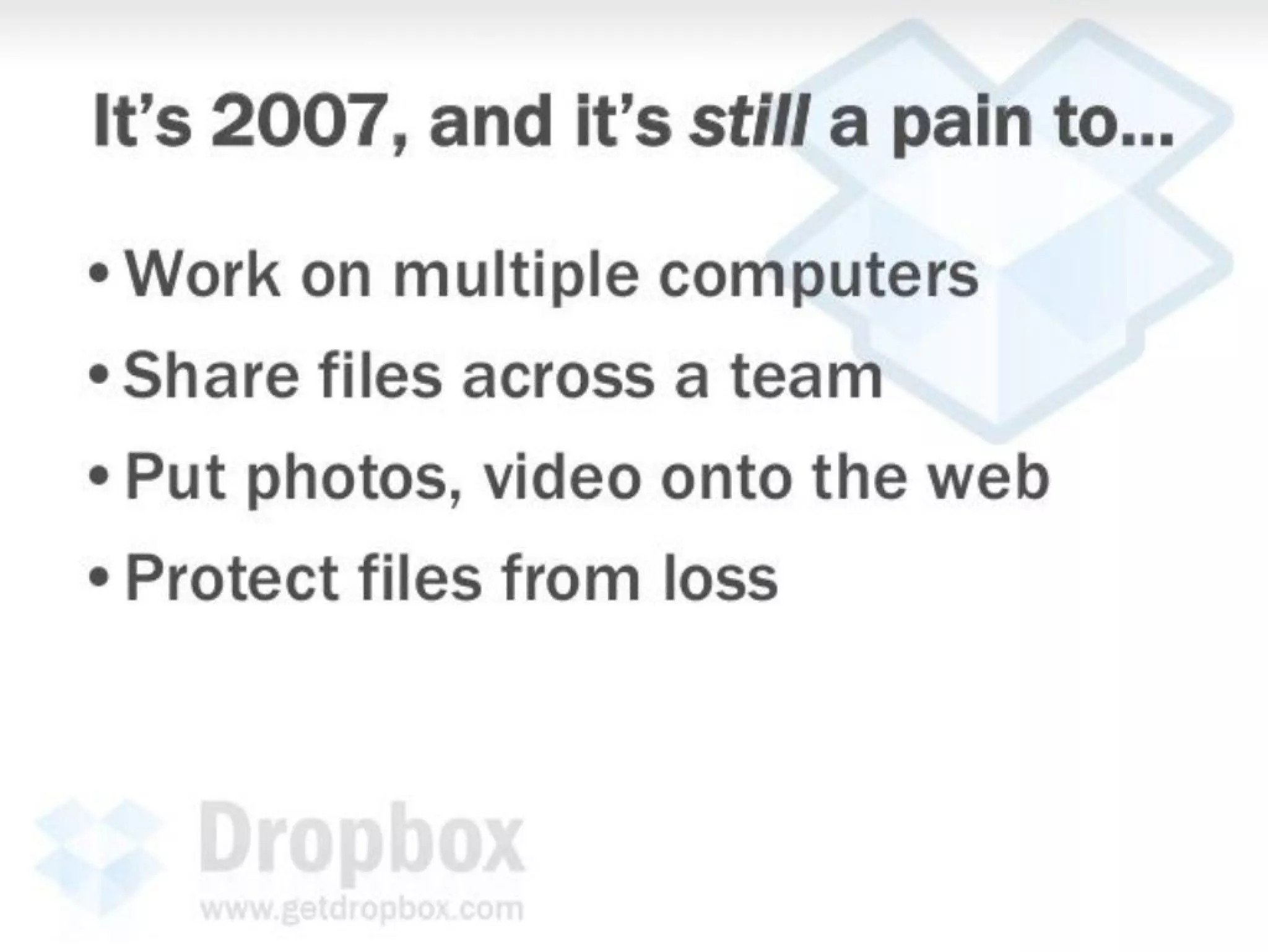
Slide 3 lists specific pain points: working on multiple computers, sharing files across a team, putting media online, and protecting files from loss. It translates the messy visual into actionable, product-oriented problems — the exact jobs users need done. That specificity makes it easier to map product features to customer needs in later slides.

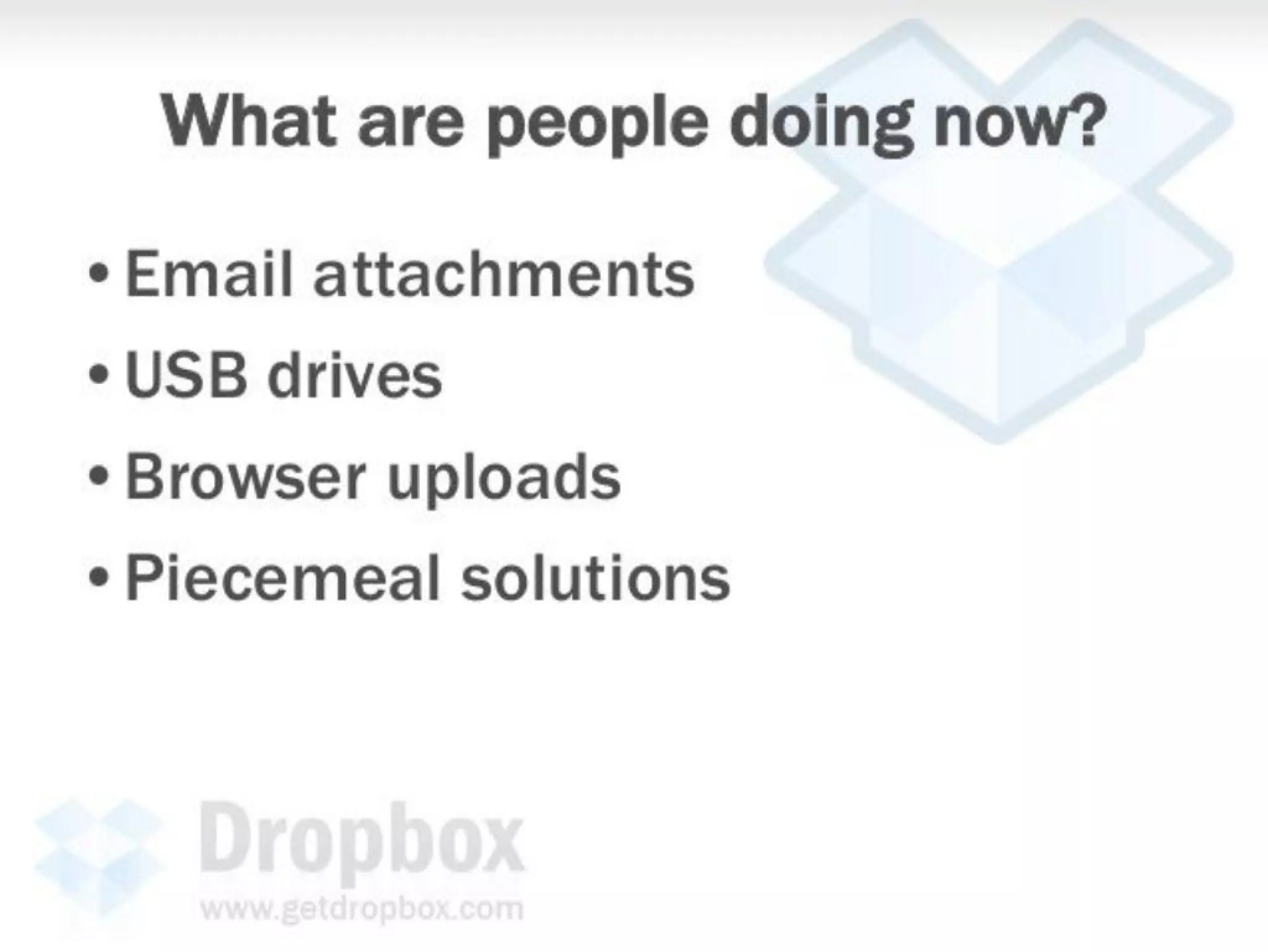
Following the pain list, slide 4 (covered conceptually here) details how people currently cope — email attachments, USB drives, browser uploads, piecemeal solutions. This contrast is effective because it shows incumbents are fragmented and awkward, creating a clear opening for an elegant single-app solution. Founders should emulate this structure: document user pains, then show the clumsy alternatives to underscore product-market fit.

Key Takeaway: List precise user jobs-to-be-done and contrast them with clumsy existing solutions to make the opportunity obvious.
Vision and product promise

Vision and product promise

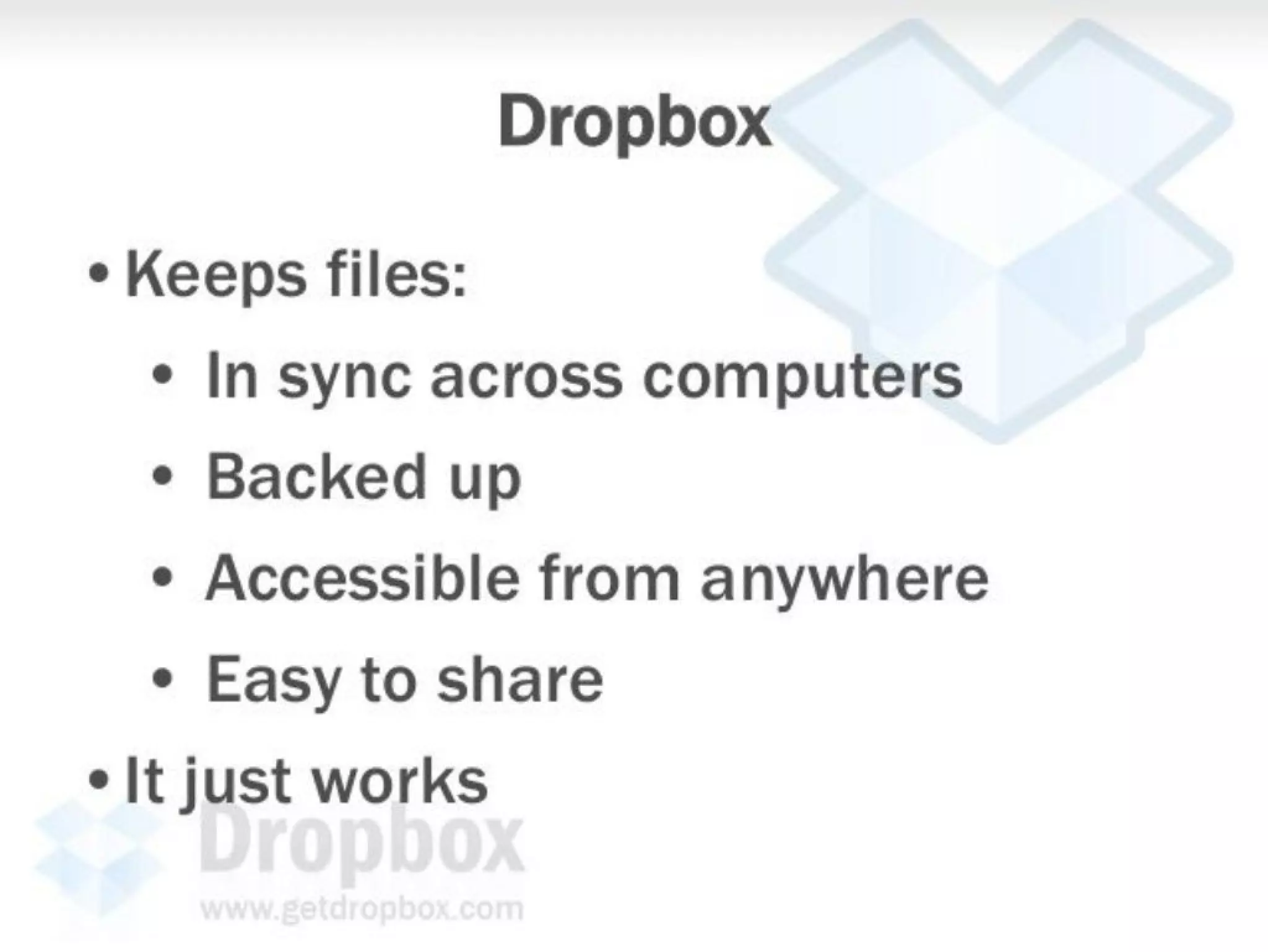
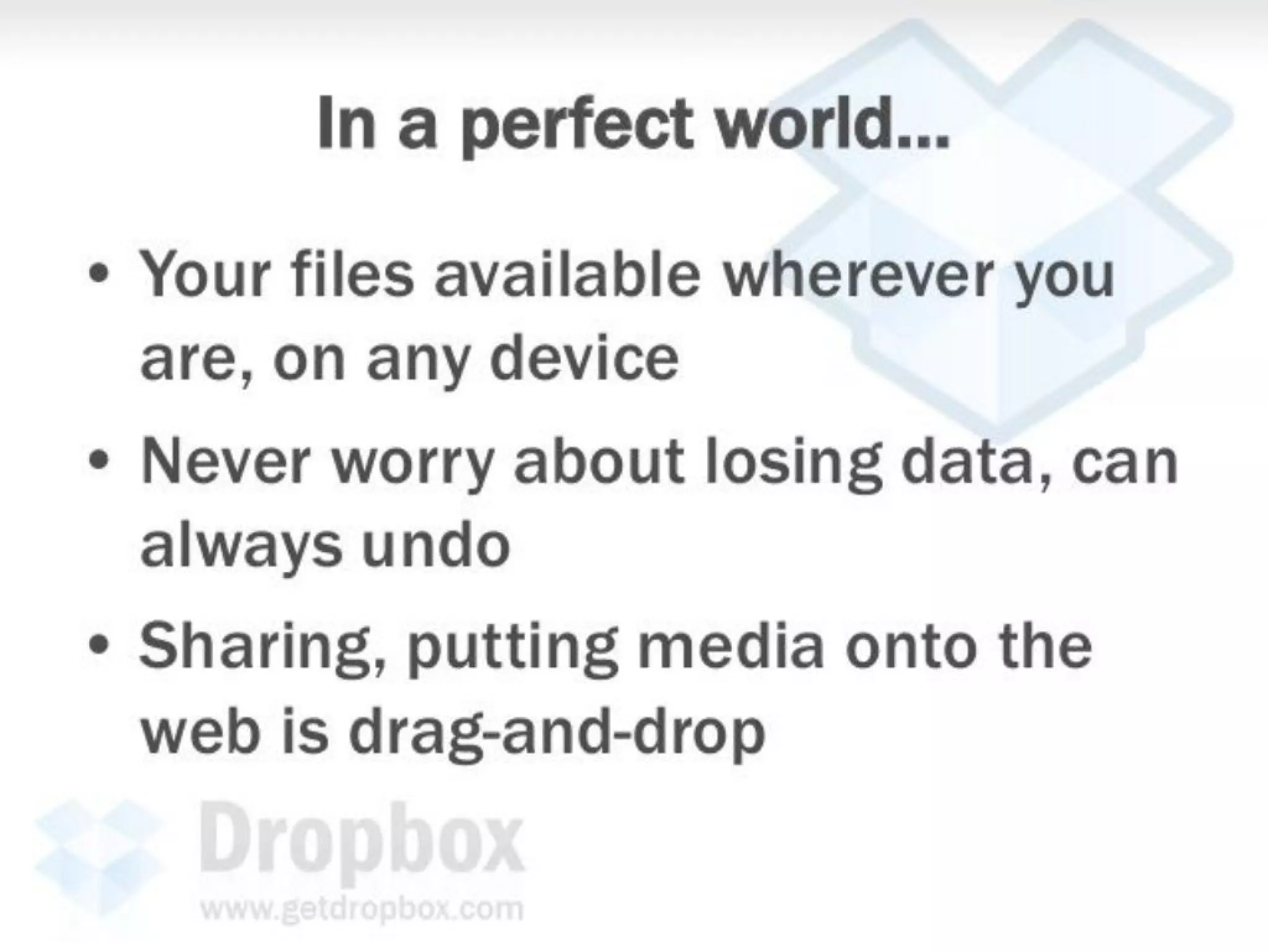
Slide 6 (and nearby slides) lays out a concise product promise: sync across computers, backed up, accessible anywhere, easy to share — and ends with “It just works.” These are simple, tangible outcomes rather than technical specs, which makes the value easy to grasp for non-technical investors and early users alike. The slide balances aspiration (available anywhere) with pragmatic benefits (backup, sharing).

For founders, this demonstrates that product positioning should translate features into human outcomes. The phrase “It just works” is powerful because it promises reliability, a key emotional trigger for users frustrated with brittle tools. When describing your product, lead with the benefits users will feel, not the internal mechanics.

Key Takeaway: Frame features as direct user outcomes (access, backup, sharing) and finish with a short emotional promise like “It just works.”
Demo-first execution and timing

Demo-first execution and timing

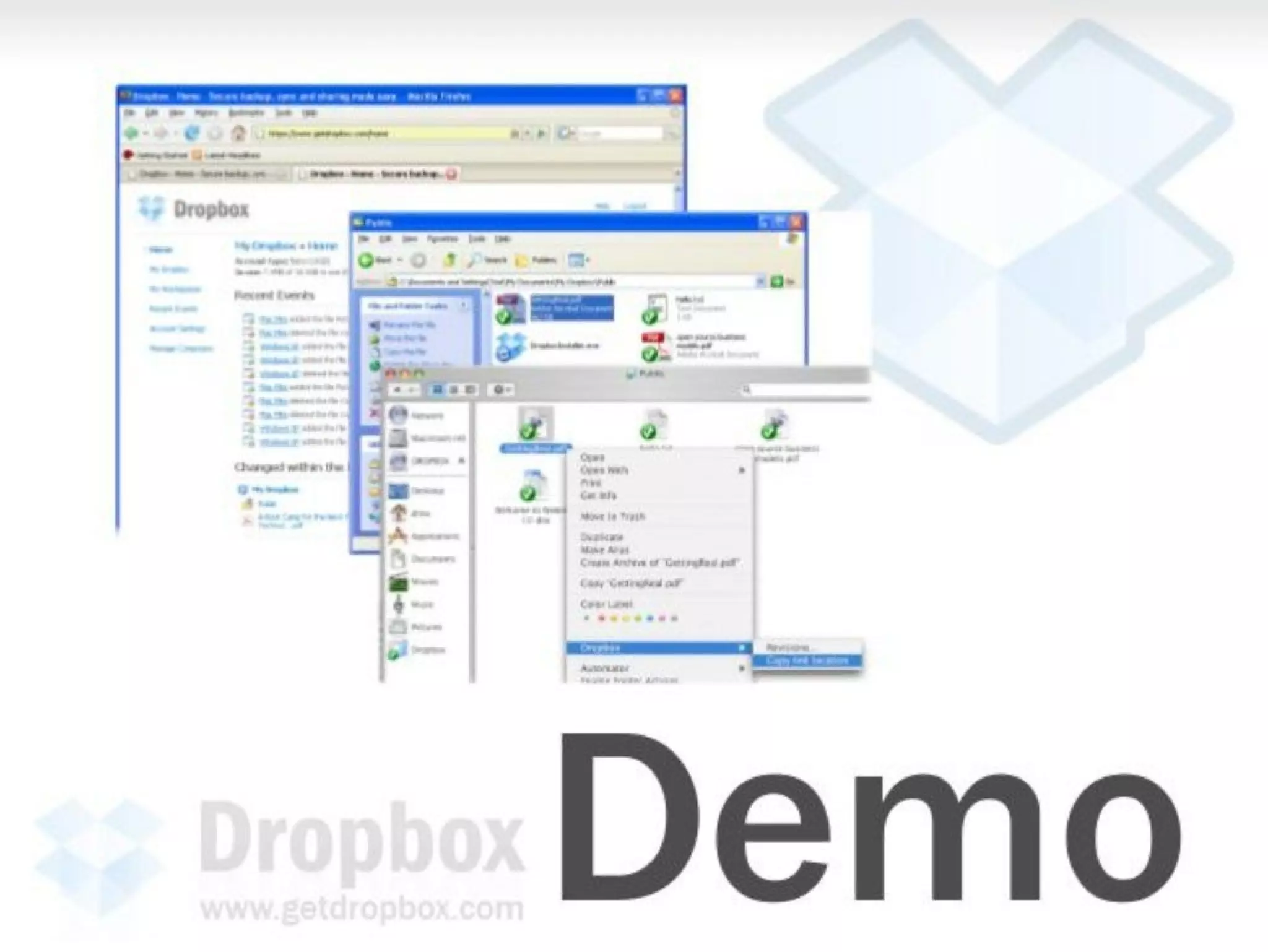
Slide 7 is a visual ‘Demo’ slide showing screens and a right-click flow — the team prioritized demonstrating actual product behavior over hypotheticals. Pairing a live (or screenshot) demo with the pitch signals confidence that the product already exists and works, which is crucial at seed stage. It reduces perceived risk by proving technical feasibility early.

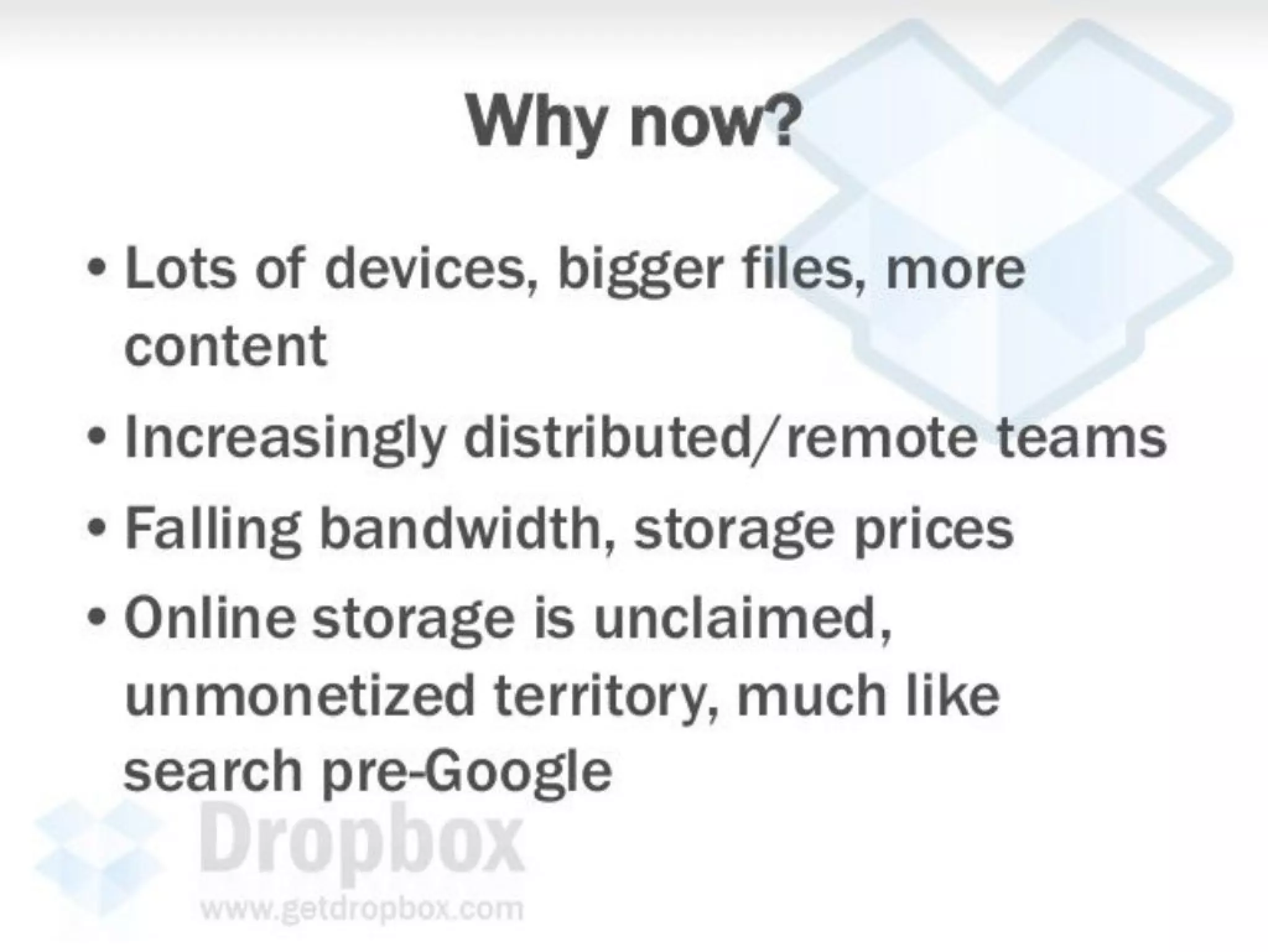
Complementing the demo, Slide 9 explains why 2007 was the right time — more devices, bigger files, distributed teams, falling bandwidth and storage costs. This combination (working demo + timing thesis) is a strong Go-to-Market argument: not only does the product work, but market conditions are aligning to accelerate adoption. Founders should bring a working demo and a crisp timing thesis to show both readiness and market tailwinds.

Key Takeaway: Show the product in action and pair it with a concise timing thesis to prove both feasibility and market opportunity.
Competitive positioning: simple, focused differentiation

Competitive positioning: simple, focused differentiation

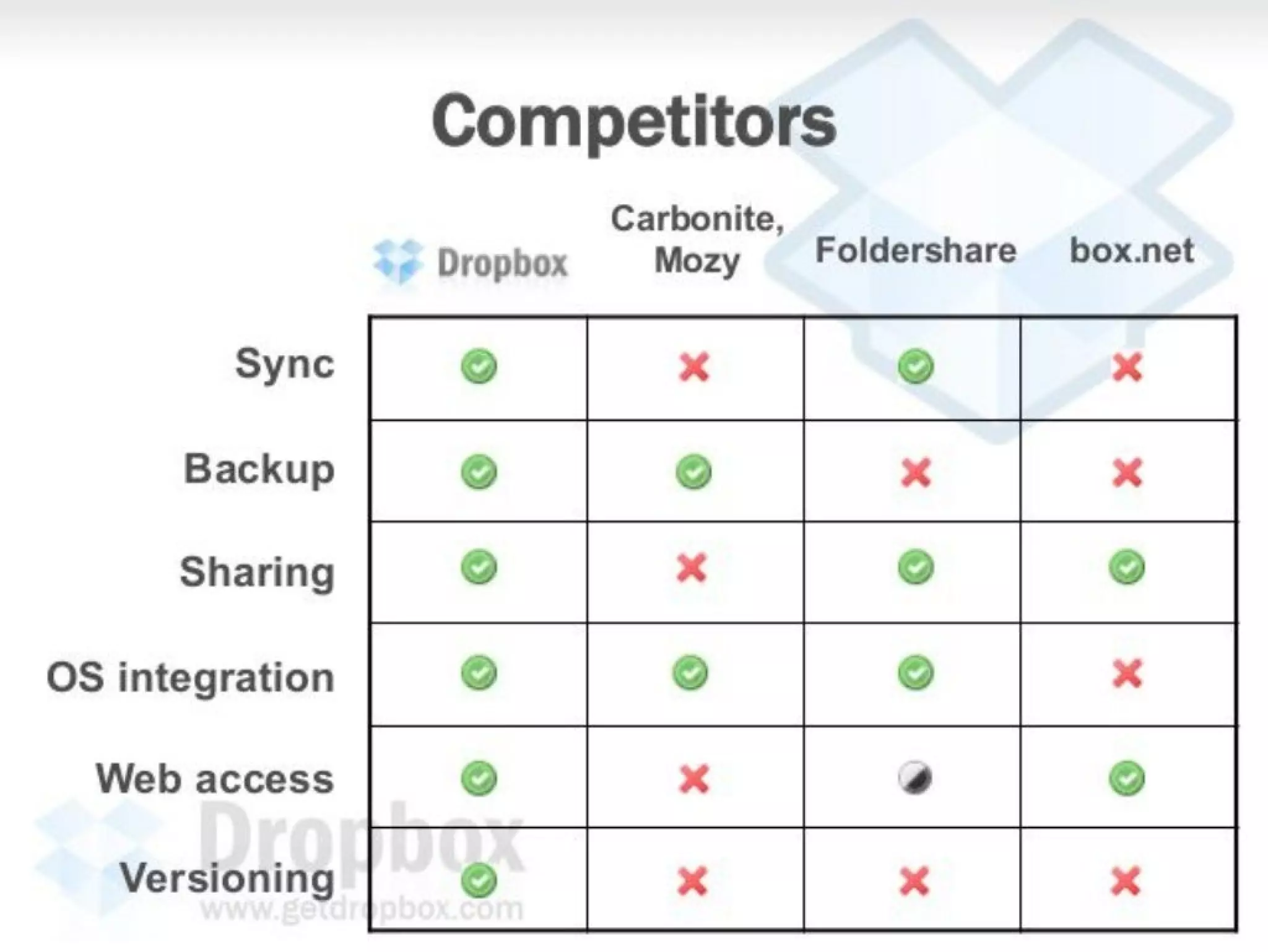
Slide 10 presents a clean competitive matrix comparing Dropbox to incumbents on sync, backup, sharing, OS integration, web access, and versioning. The table highlights Dropbox’s strengths across multiple axes and shows that competitors only solved parts of the problem. This clarifies a full-spectrum advantage rather than a narrow edge — essential when claiming market leadership.

The slide’s clarity offers a lesson: use comparisons to emphasize completeness and integration. Rather than attacking features in isolation, the matrix frames Dropbox as the integrated solution. Founders should build concise competitor matrices that spotlight where incumbents are fragmented and how their product unifies those gaps.

Key Takeaway: Use a simple matrix to show comprehensive differentiation — emphasize how you solve the whole problem, not just a piece.
Technical credibility and the founding team

Technical credibility and the founding team

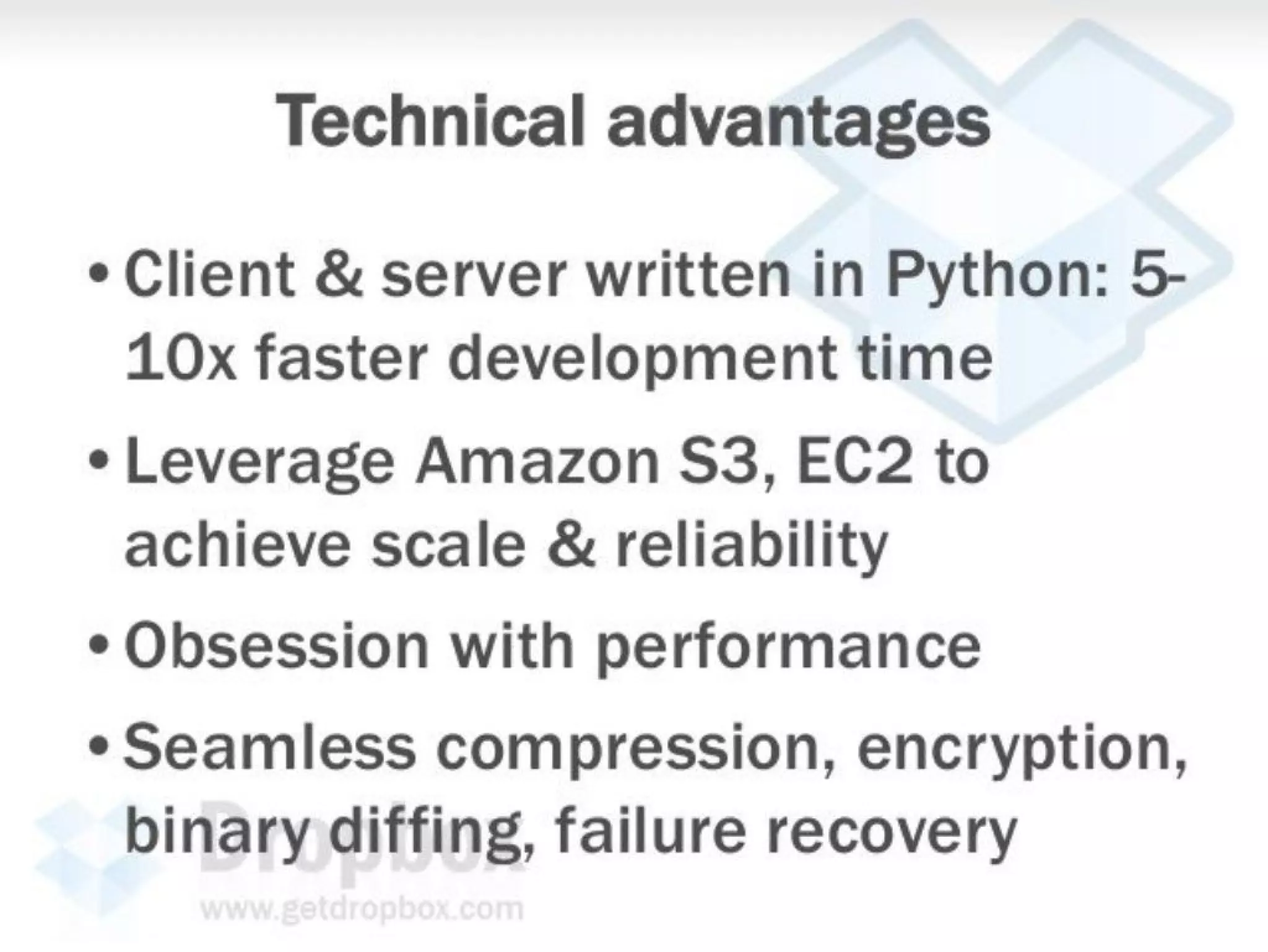
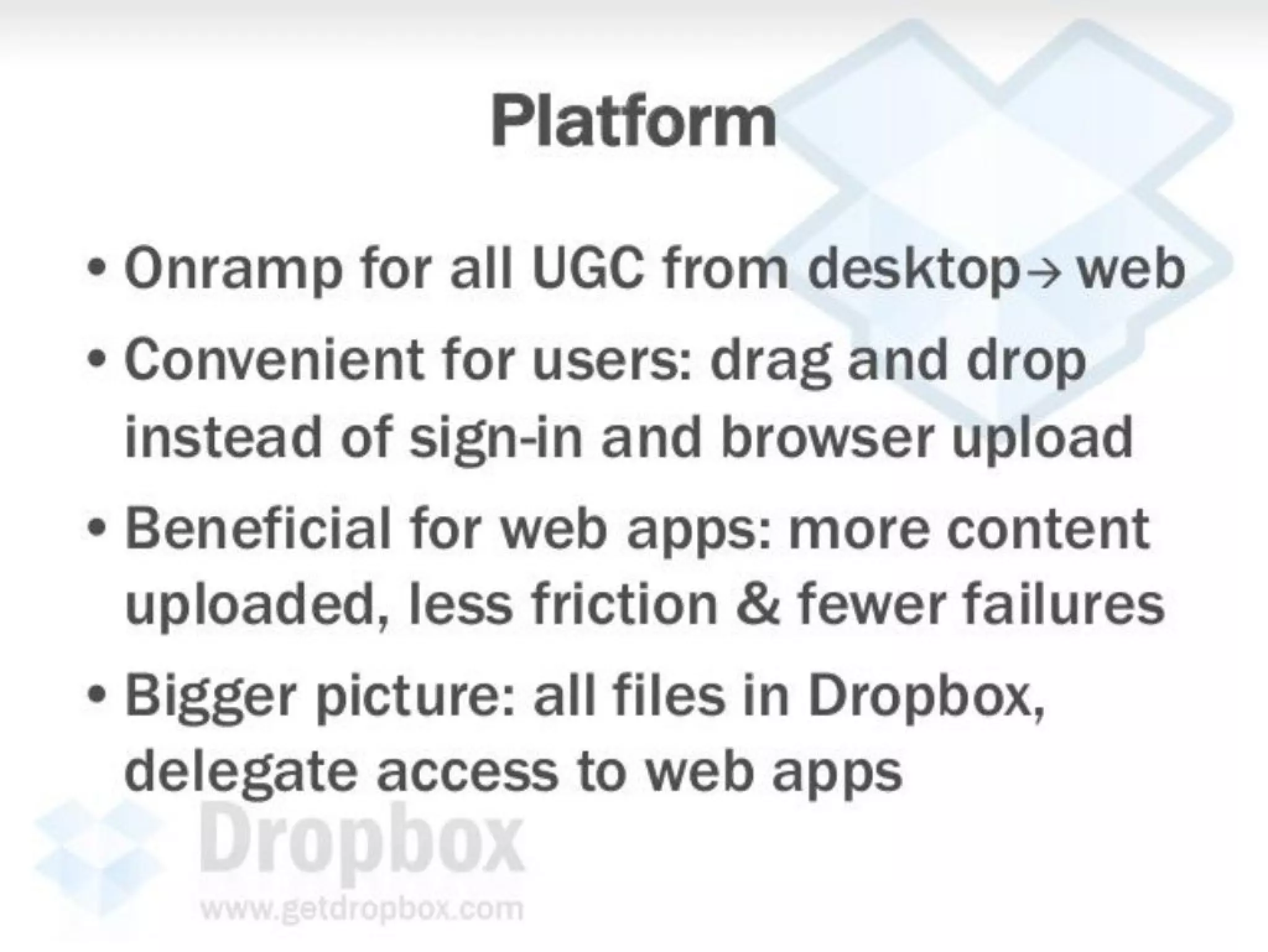
Slide 13 lists technical advantages — Python codebase for rapid development, leveraging Amazon S3/EC2 for scale, performance focus, and clever engineering (compression, diffing, recovery). It signals that the team isn’t just describing a problem but has a concrete, scalable technical approach. This technical transparency builds investor confidence that the product can be executed and scaled.

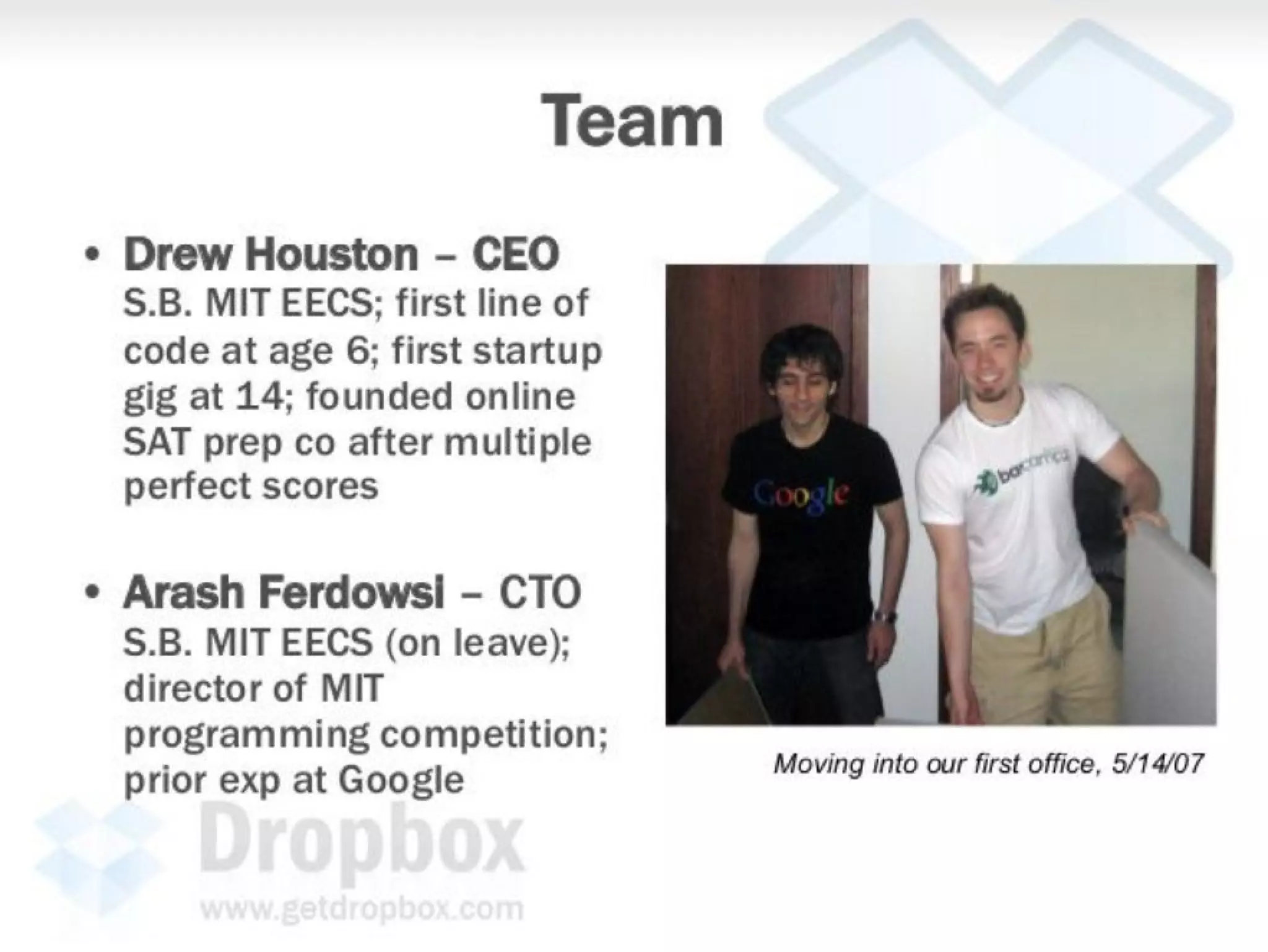
Slide 14 (team) reinforces that credibility with founder backgrounds (MIT, Google experience). Together these elements show why the founders could build the product and handle growth. For founders, the takeaway is to pair technical execution details with team credibility: show how your stack, architecture choices, and people uniquely position you to solve the problem and scale.

Key Takeaway: Combine clear technical choices with founder credentials to demonstrate both how you will build the product and who will execute it.

Conclusion: Key Lessons

Dropbox’s seed deck is a masterclass in product-first pitching: a simple opening, a visceral problem visual, concrete pain points, a working demo, a compact competitive matrix, and clear technical and team credibility. It focuses on outcomes for users rather than technical jargon or long market slides, which makes the deck accessible to non-technical investors and compelling to those who value product intuition.

Actionable advice for founders: lead with a memorable one-line value proposition; make the problem tangible with a single image; map specific user jobs-to-be-done to product outcomes; demonstrate a working product or screenshots; explain why now with concise market signals; and pair a defensible technical approach with founder credentials. Keep slides visual and economical — clarity and demonstration of execution often trump lengthy business modeling at seed stage.