Stack up against Palantir

Compare Your Deck

Palantir's 2010 Pitch Deck

SaaS
Stage: Various
Raised: Multiple
Year: 2010
Slides: 17
Outcome: IPO at $22B valuation

Pitch Deck

1 / 17
Slide 1
Click to expand

Deck Analysis

This deck presents Palantir as an enterprise SaaS company that solves large-scale data integration and analytics problems for government and commercial customers. It combines a clear problem statement, product differentiation (Gotham and Foundry), financial trajectory, business-model explanation and competitive positioning to justify a growth story that eventually led to an IPO. Notable elements are the focus on product-led expansion, a pilot-to-scale sales motion, and visual emphasis on revenue momentum and unit economics — all framed to convince investors that heavy upfront investment in pilots turns into high contribution margins over time.

The Opening: Brand and Focus

The Opening: Brand and Focus

Slide 1 establishes the company brand cleanly: a simple logo, the Palantir name and presenter attribution. The large, uncluttered visual and ample negative space make the slide feel professional and sets expectations for a structured presentation. Using a single, high-quality opening slide helps create a first impression of polish and confidence—important for signaling credibility to investors.

Founders can learn how a restrained opening slide primes an audience. Keep identity, speaker and role visible but don’t overload the first frame with metrics or details; let subsequent slides tell the story. The design choice to be visually appealing without verbose text signals discipline and prepares the listener for a focused pitch.

Key Takeaway: Start with a clean, branded cover that signals professionalism and prepares the audience for a concise, structured narrative.
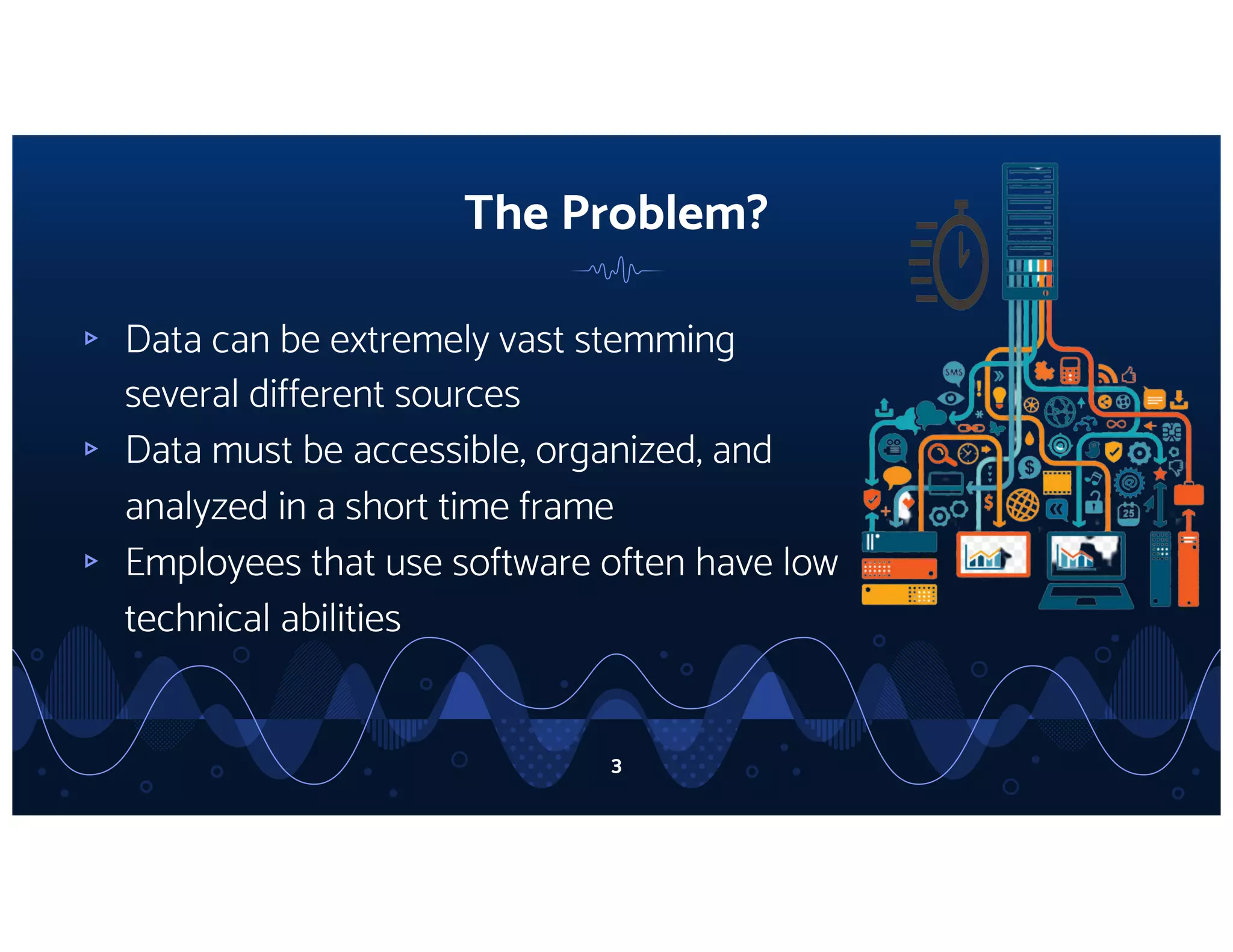
Framing the Problem: Data Complexity & User Limitations

Framing the Problem: Data Complexity & User Limitations

Slide 3 frames the market opportunity in plain language: data is vast, fragmented across sources, time-sensitive, and end-users often lack technical skills. The slide blends three succinct bullets with a supporting data pipeline illustration — these two elements together make the problem both relatable and concrete. This approach helps investors quickly understand the pain point and why a platform solution is necessary.

For founders, the lesson is to articulate both the scale of the problem and the human friction (non-technical users) that prevents simple fixes from working. Pairing a short, well-crafted set of bullets with a visual metaphor (pipes, servers, dashboards) communicates both technical depth and user-centric value, which appeals to both technical and non-technical stakeholders.

Key Takeaway: Define the problem crisply and pair it with a simple visual to show why existing tools don’t solve the real, human-facing friction.
Product Differentiation: Gotham vs. Foundry

Product Differentiation: Gotham vs. Foundry

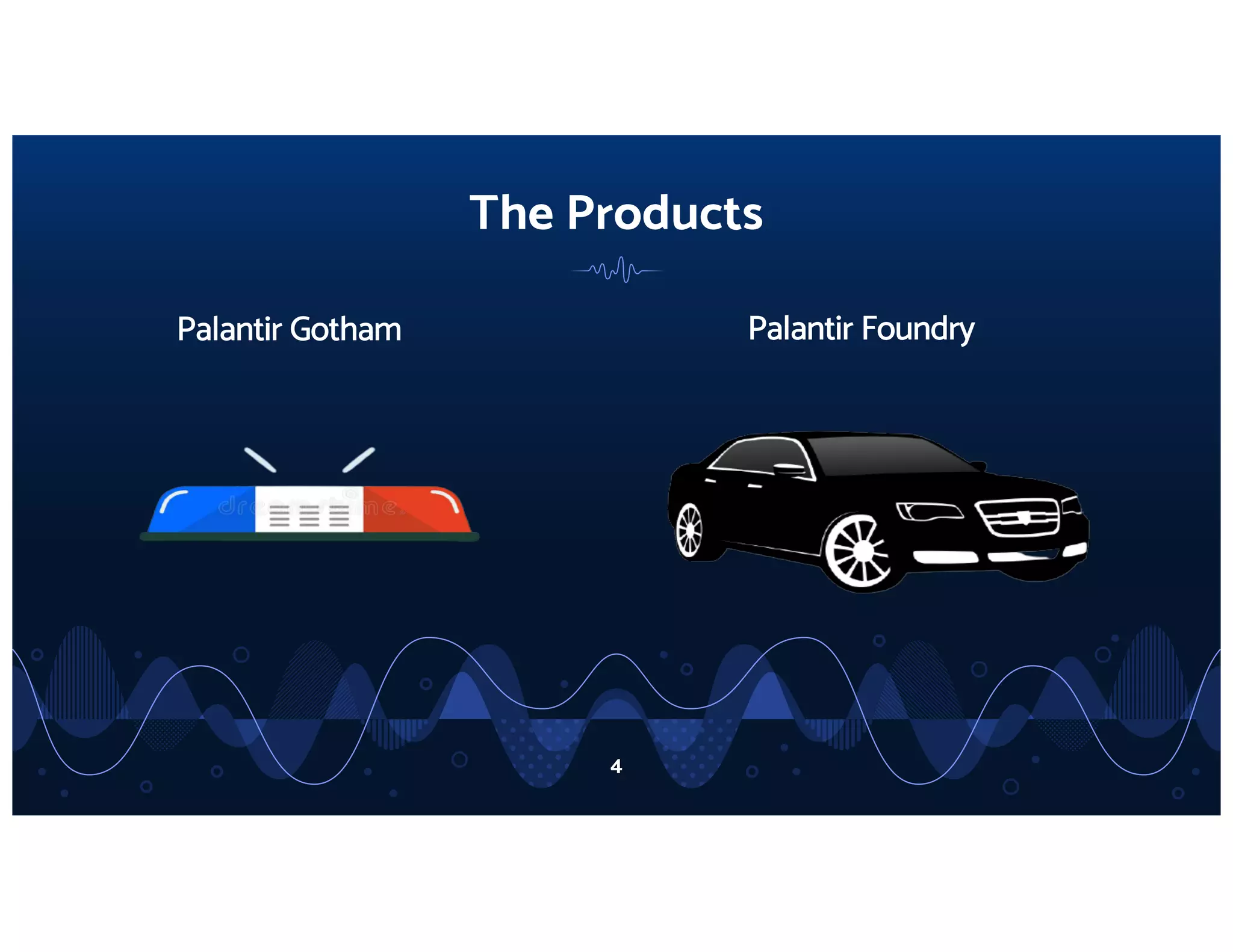
Slide 4 highlights the company’s product split—Gotham for government and Foundry for commercial—using straightforward labels and icons (police siren, car). This communicates that Palantir addresses distinct vertical needs while implying shared underlying technology. The visual shorthand is effective because it quickly tells investors there are multiple addressable markets and distinct go-to-market motions.

Founders should note the value of naming and positioning products clearly. If you serve different customer types with the same tech, present the split early and succinctly: it helps investors map revenue diversification and risk. Small, well-chosen icons can replace paragraphs of text and make product-market fit immediately legible.

Key Takeaway: If you have distinct product lines for different customer segments, label them clearly and use concise visuals to show market breadth without overexplaining.
Financial Snapshot: Revenue Growth vs. Profitability

Financial Snapshot: Revenue Growth vs. Profitability

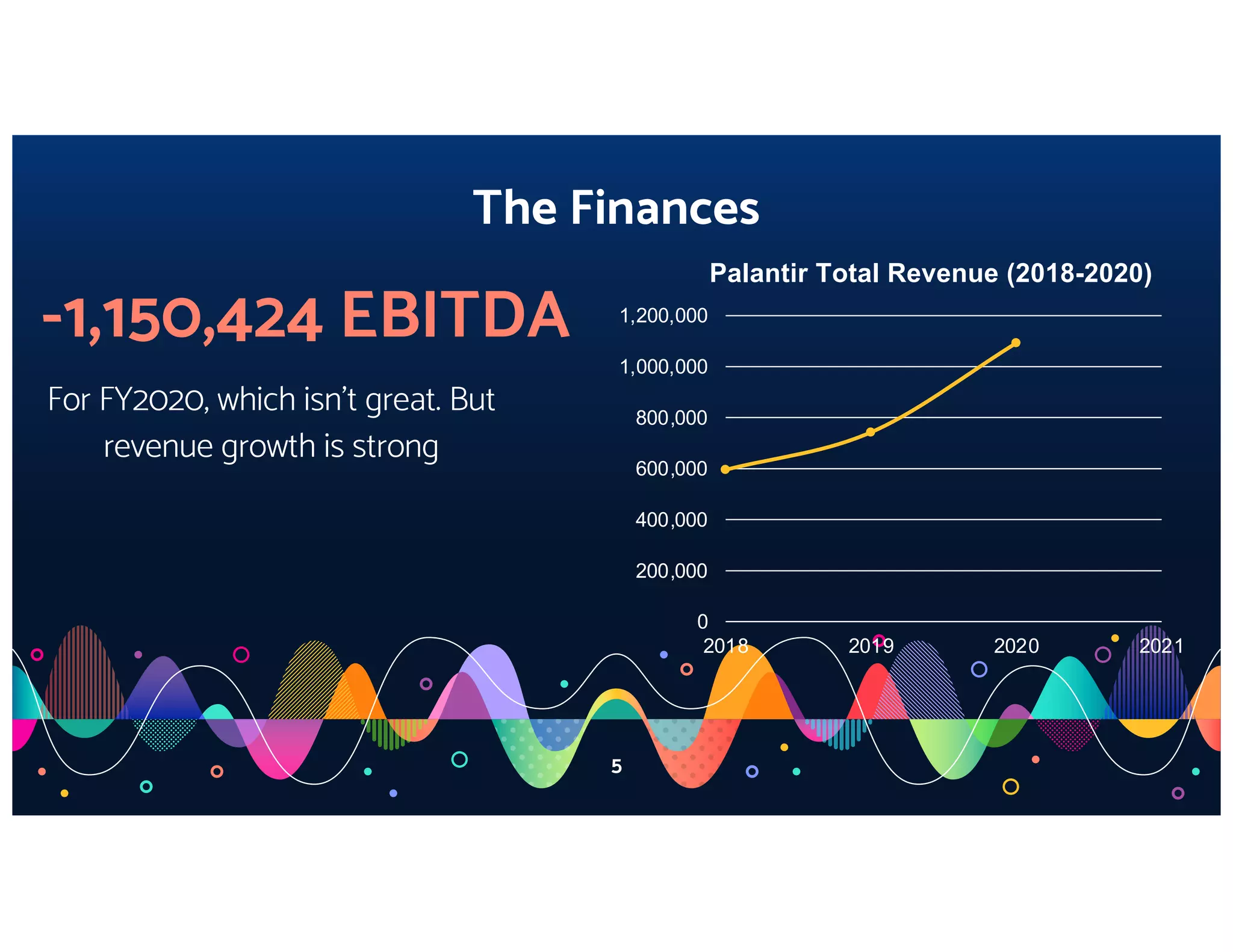
Slide 5 juxtaposes a large negative EBITDA number with a revenue growth chart. The honesty about FY2020 EBITDA being negative is counterbalanced by a clear revenue curve showing strong upward momentum — a narrative investors often accept for high-growth enterprise SaaS. The design emphasizes growth while not hiding losses, which builds trust and frames the business as scaling into profitability over time.

The lesson for founders: be transparent about current unit economics but contextualize them with growth metrics and a path to improved margins. Present both the problem (losses) and the upside (revenue acceleration) on one slide so investors can make a balanced judgment quickly.

Key Takeaway: Show losses honestly but pair them with convincing growth charts and narrative to signal a credible path to positive economics.
Market Reaction / Momentum: Stock Performance Visual

Market Reaction / Momentum: Stock Performance Visual

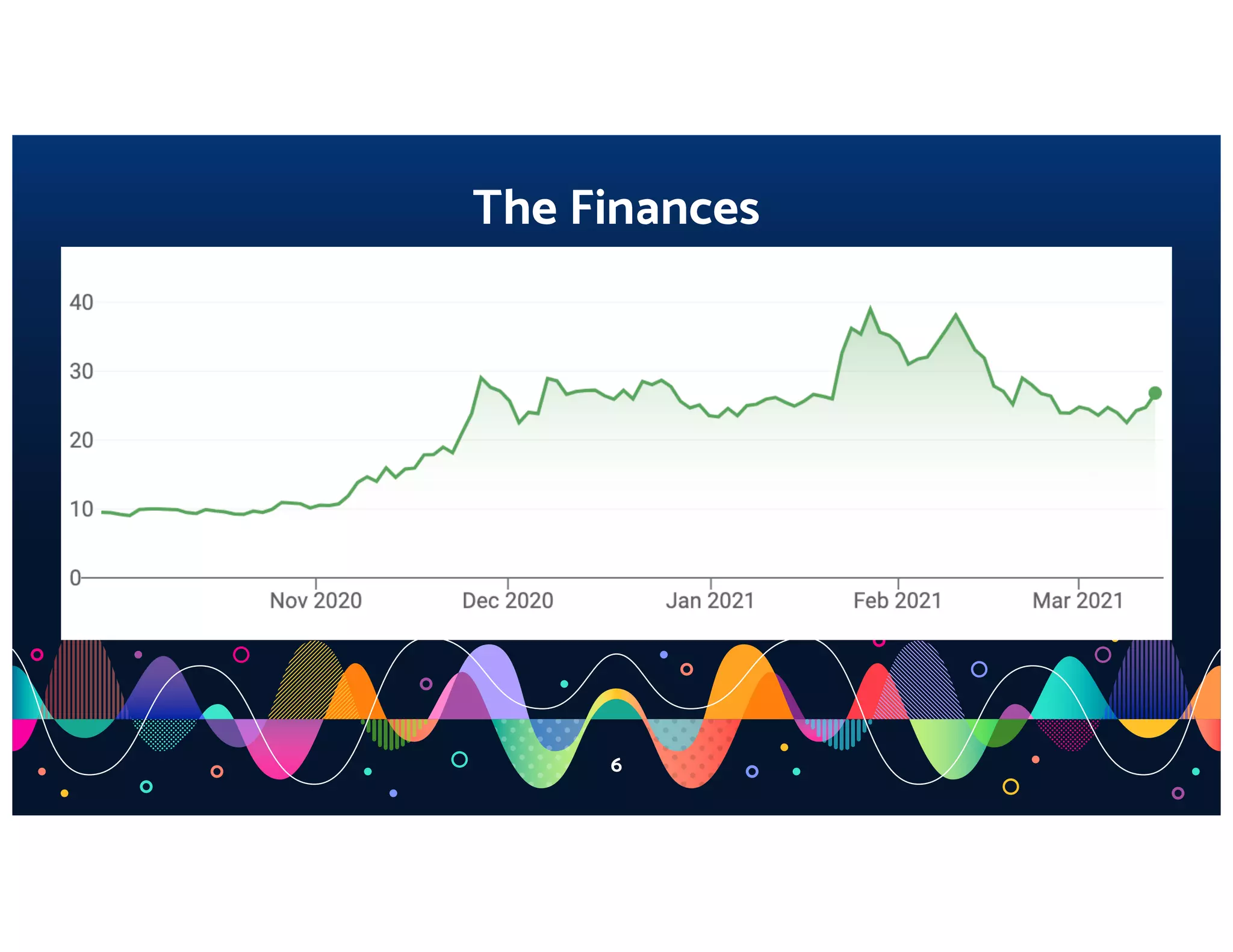
Slide 6 presents a stock-price/time chart that demonstrates market enthusiasm and momentum following public listing, using a simple line area chart. Including market performance is a validation signal — it tells potential investors and partners that the public markets have recognized value, reinforcing the narrative of strong demand. The choice to include a price chart is a strategic credibility play for later-stage audiences.

For other founders, this shows how third-party validation (customer logos, analyst coverage, or stock performance) can be leveraged to strengthen the story. Use such slides carefully: they work best when the numbers are supportive and you can explain the drivers behind the movement (e.g., product launches, contracts).

Key Takeaway: Use market or third-party validation charts to credibly signal demand and momentum, but be ready to explain the drivers behind the movement.
Business Model: From Pilot Costs to Scale Economics

Business Model: From Pilot Costs to Scale Economics

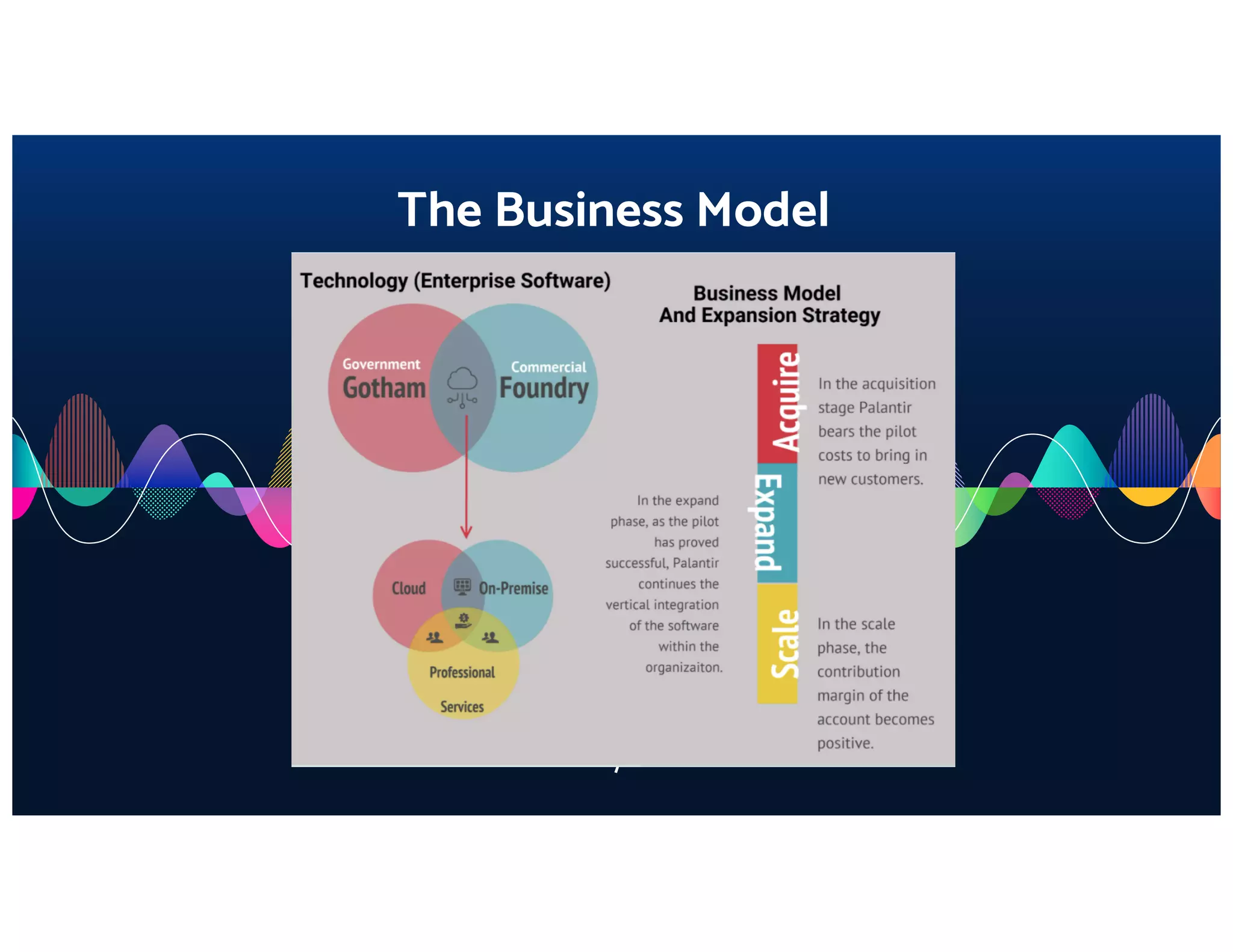
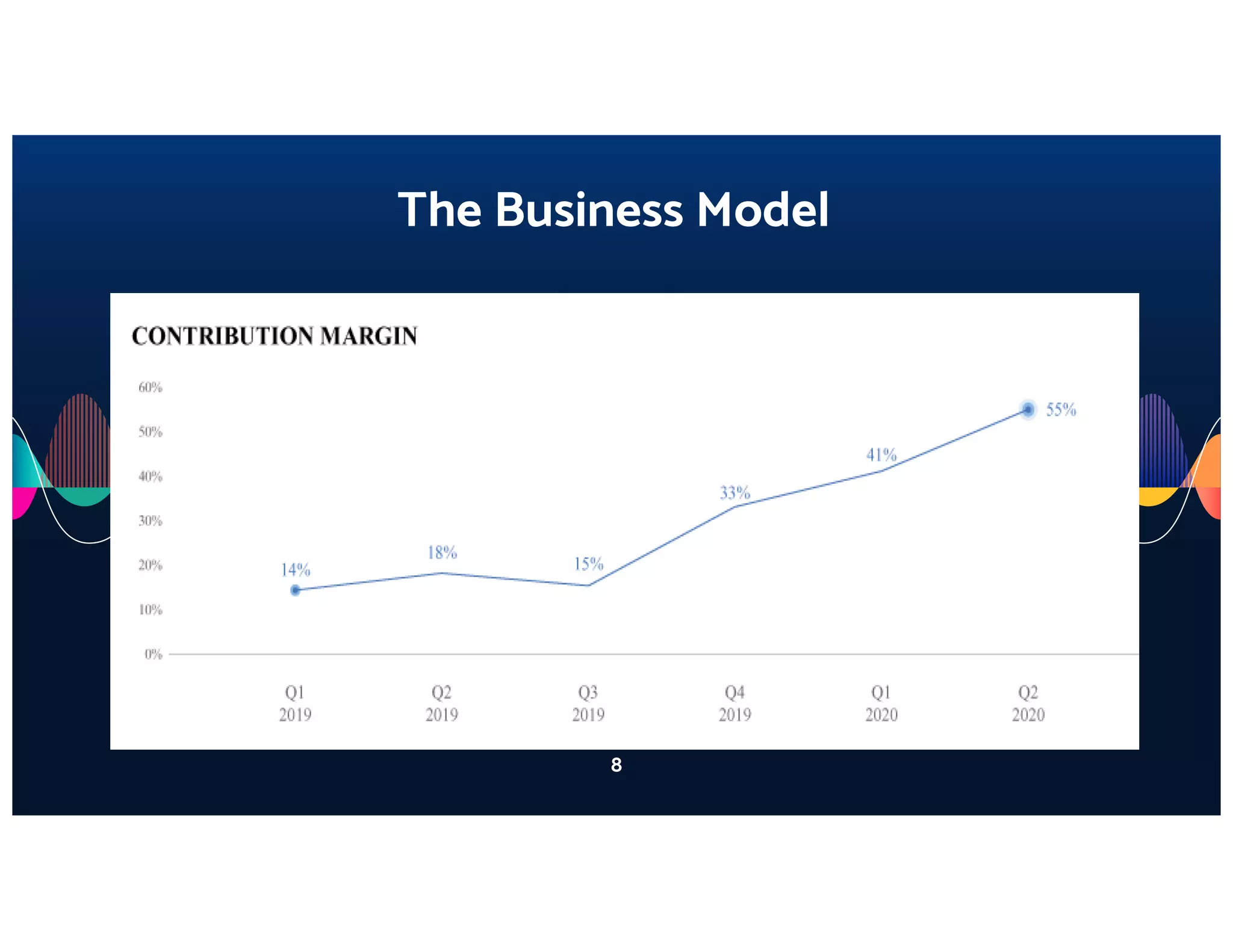
Slide 7 (and slide 8 content in the deck) explains Palantir’s acquisition-expand-scale model: Palantir bears initial pilot costs to demonstrate value, then expands and ultimately achieves positive contribution margins. The visual Venn and the acquisition/expand/scale vertical bar create a clear lifecycle picture of how customer economics change over time. This is a compelling way to justify large upfront CAC because it links pilot investment directly to durable account-level economics.

Founders should emulate this transparency: outline the customer journey, show why pilots are necessary, and quantify how unit economics improve as the product is adopted. A clear pilot-to-scale narrative reduces investor concern over high early spending and reframes it as an intentional investment to create defensible, high-margin accounts.

Key Takeaway: If your GTM requires heavy upfront pilot costs, map the customer lifecycle visually and show how economics improve as accounts scale to justify the initial investment.
Team & Differentiation: Leadership and Secret Sauce

Team & Differentiation: Leadership and Secret Sauce

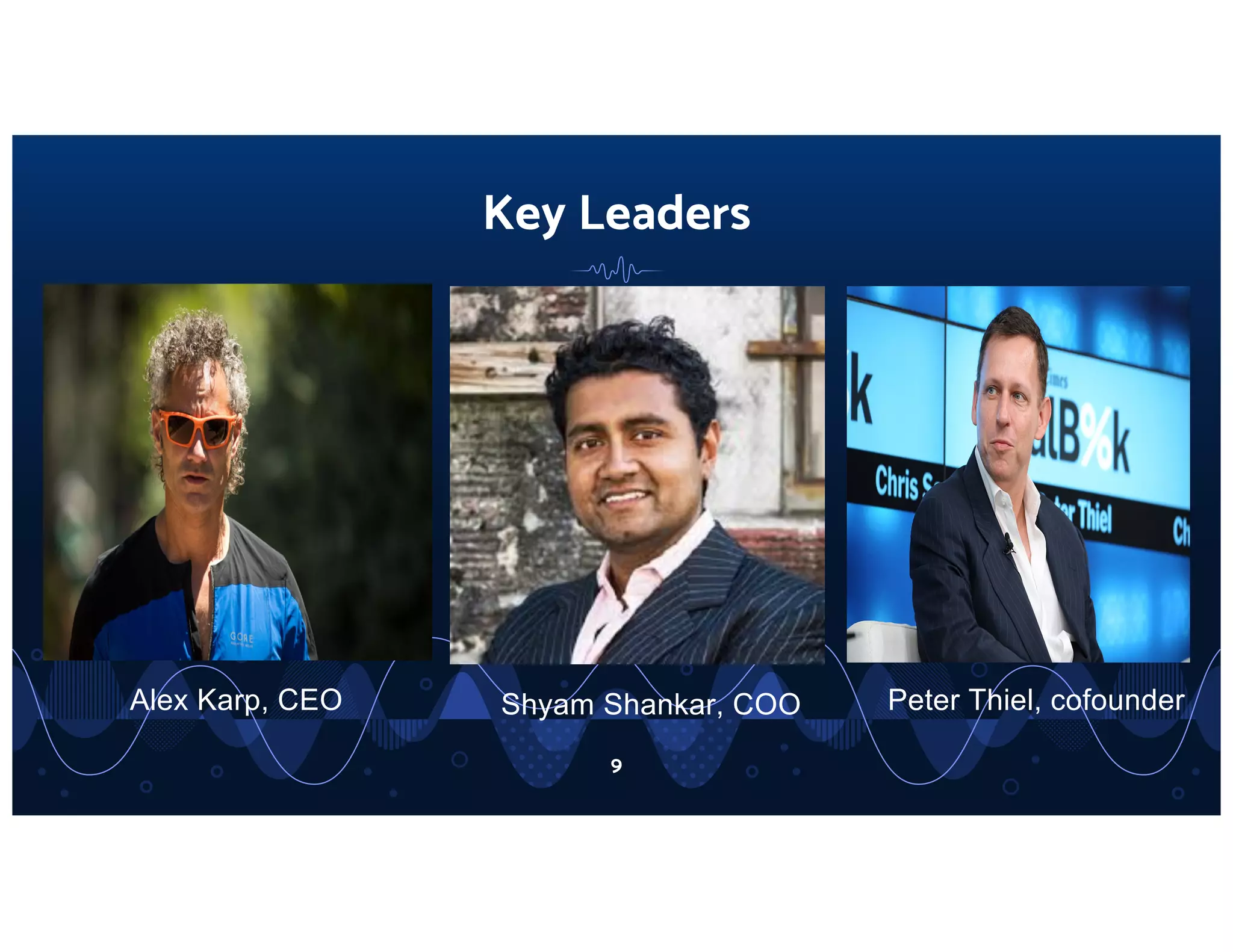
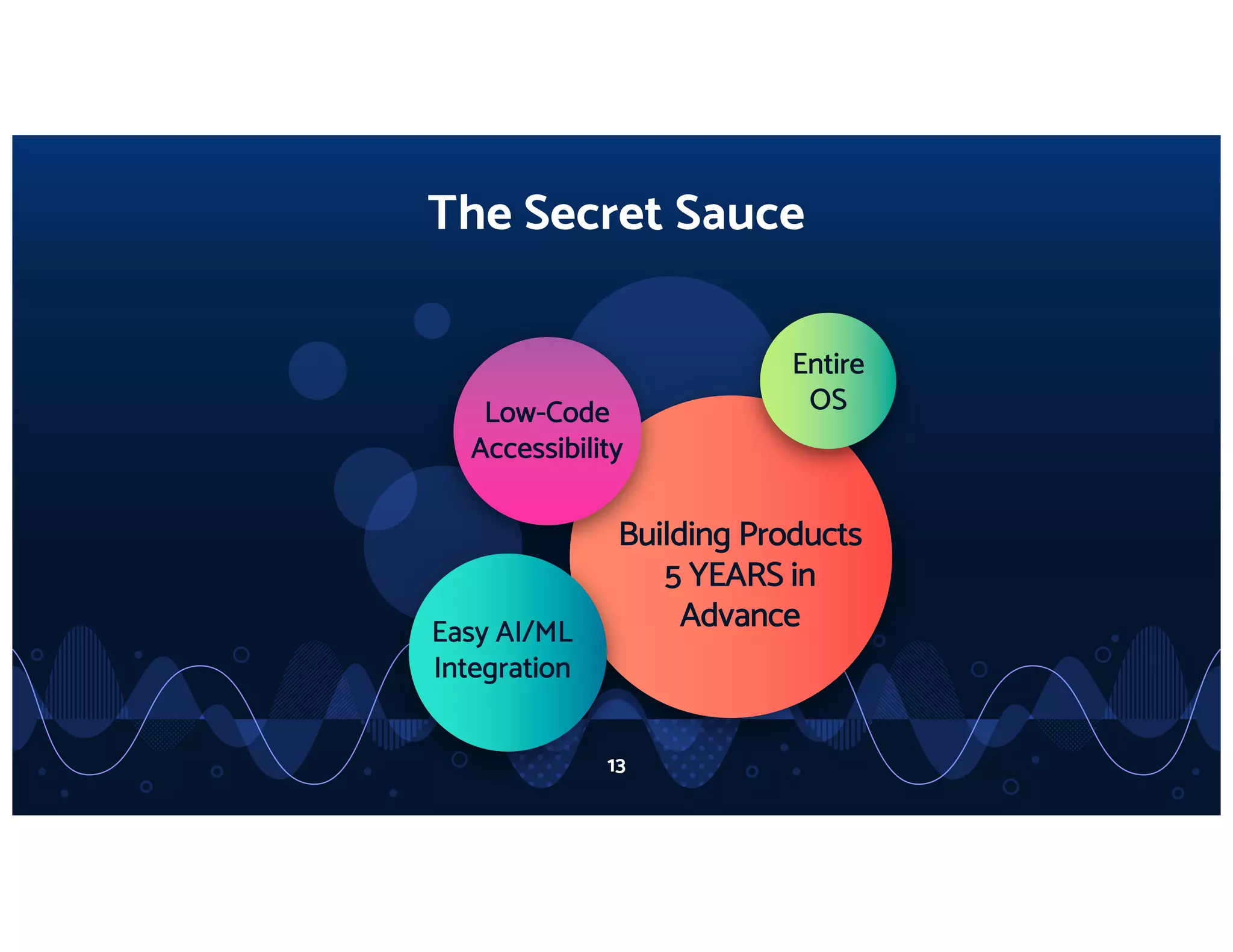
Slide 9 presents key leaders (CEO, COO, cofounder) giving the deck a human face and signaling leadership depth; slide 13 (The Secret Sauce) articulates product advantages like low-code accessibility, integrated AI/ML, and building products years ahead. Together they connect experienced leadership to defensible technical differentiation. Emphasizing both team credentials and concrete product advantages addresses two central investor concerns: execution risk and defensibility.

Founders should explicitly link people to product strategy: show who will execute the technical roadmap and why the team’s background reduces execution risk. Also, codify your unique advantages (technical stack, data moat, operational playbook) into a short “secret sauce” slide so investors can quickly understand what’s not easily copied.

Key Takeaway: Combine leadership signals with a succinct 'secret sauce' summary that ties team capabilities to defensible product advantages.

Conclusion: Key Lessons

This deck succeeds by balancing honesty and ambition: it admits near-term losses while showcasing rapid revenue growth, explains why heavy upfront investment is strategic (pilot → expand → scale), and pairs product differentiation with credible leadership. Visual clarity (simple opening, problem statement, product split, lifecycle visuals and financial charts) drives a coherent narrative that supports Palantir’s valuation and IPO trajectory. For founders building enterprise SaaS raises, actionable advice is: (1) define the customer problem crisply and show why simple tools won’t work; (2) map the customer economics over time to justify early spending; (3) present transparent financials paired with growth evidence; (4) articulate a concise, defensible 'secret sauce'; and (5) use simple, high-quality visuals to make a professional first impression. Following these principles helps turn complex technical stories into investable narratives.