Stack up against Mattermark

Compare Your Deck

Mattermark's 2015 Pitch Deck

SaaS
Stage: Series A
Raised: $6.5M
Year: 2015
Slides: 30
Outcome: Acquired by FullContact

Pitch Deck

1 / 30
Slide 1
Click to expand

Deck Analysis

This deck presents Mattermark — a SaaS data company that organized business data to answer questions about companies and markets. It frames the product as "Google for business people," defines a massive addressable market, shows early traction (rapid MRR growth and revenue segmentation), and highlights an experienced founding team. Notable aspects are the clarity of problem definition, simple but persuasive traction charts, and a crisp go-to-market narrative tying product to specific buyer roles (VCs, biz dev, sales). The deck helped Mattermark raise a Series A and ultimately was acquired, making it a useful model for founders who must balance product vision, market size, and proof of traction.

The Opening: Brand and Positioning

The Opening: Brand and Positioning

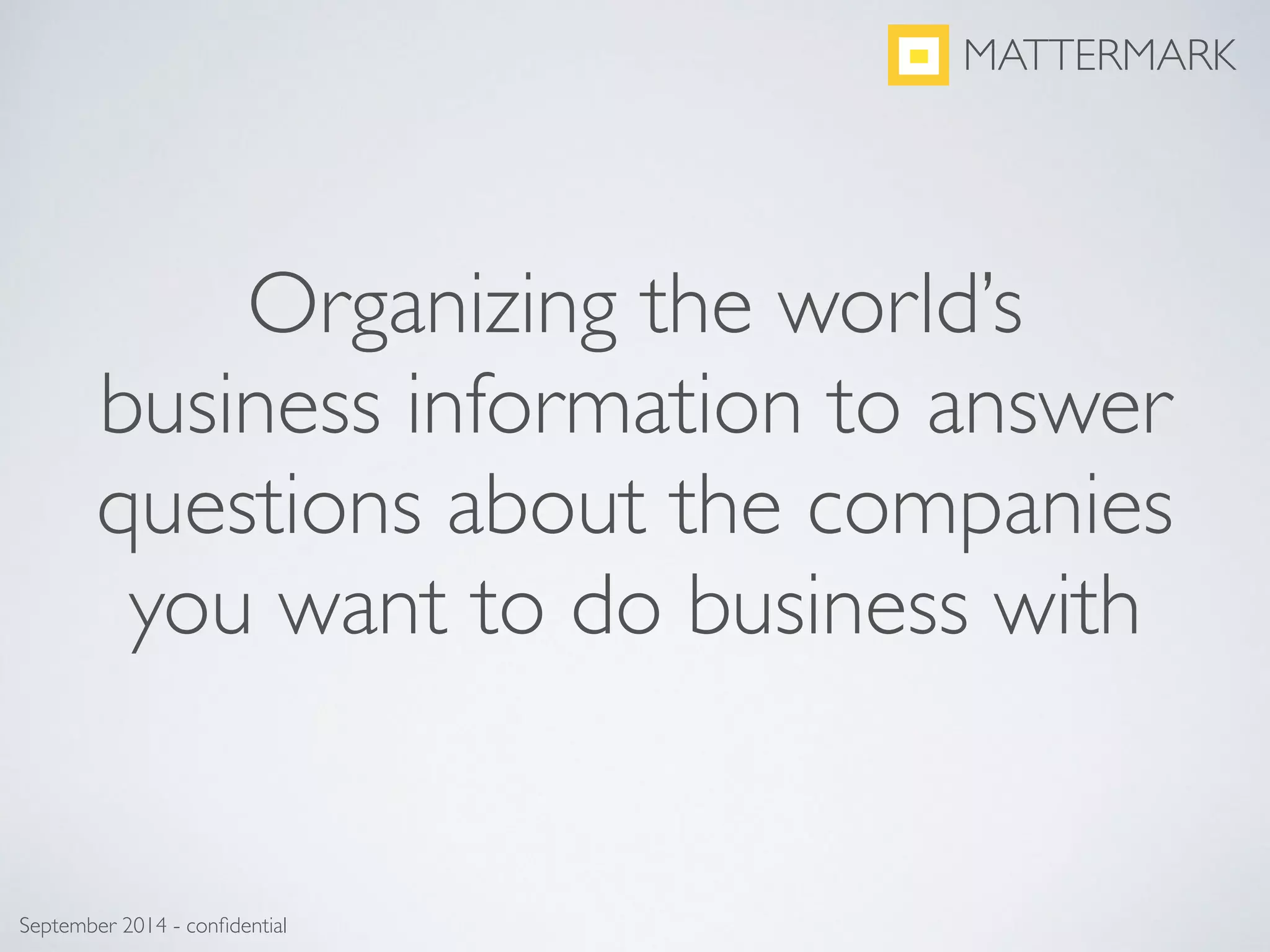
The cover (Slide 1) is deliberately minimalist: a bold logo, the company name and a short tagline — "organizing the world’s business information." That economy sets a professional tone and communicates the company’s mission immediately without distracting detail. The visual treatment (large white space, a single brand color) cues a data/product-first company and primes investors for a factual, numbers-driven presentation.

What founders can learn: an opening slide should establish brand/mission and visual seriousness. Mattermark uses the cover to signal focus and confidence rather than overloading with claims or busy graphics, which prepares the audience to digest the subsequent market and traction evidence.

Key Takeaway: Lead with a tight brand and single-sentence mission on the cover to frame the entire deck and set expectations for a focused, data-driven pitch.
Market Definition and Opportunity

Market Definition and Opportunity

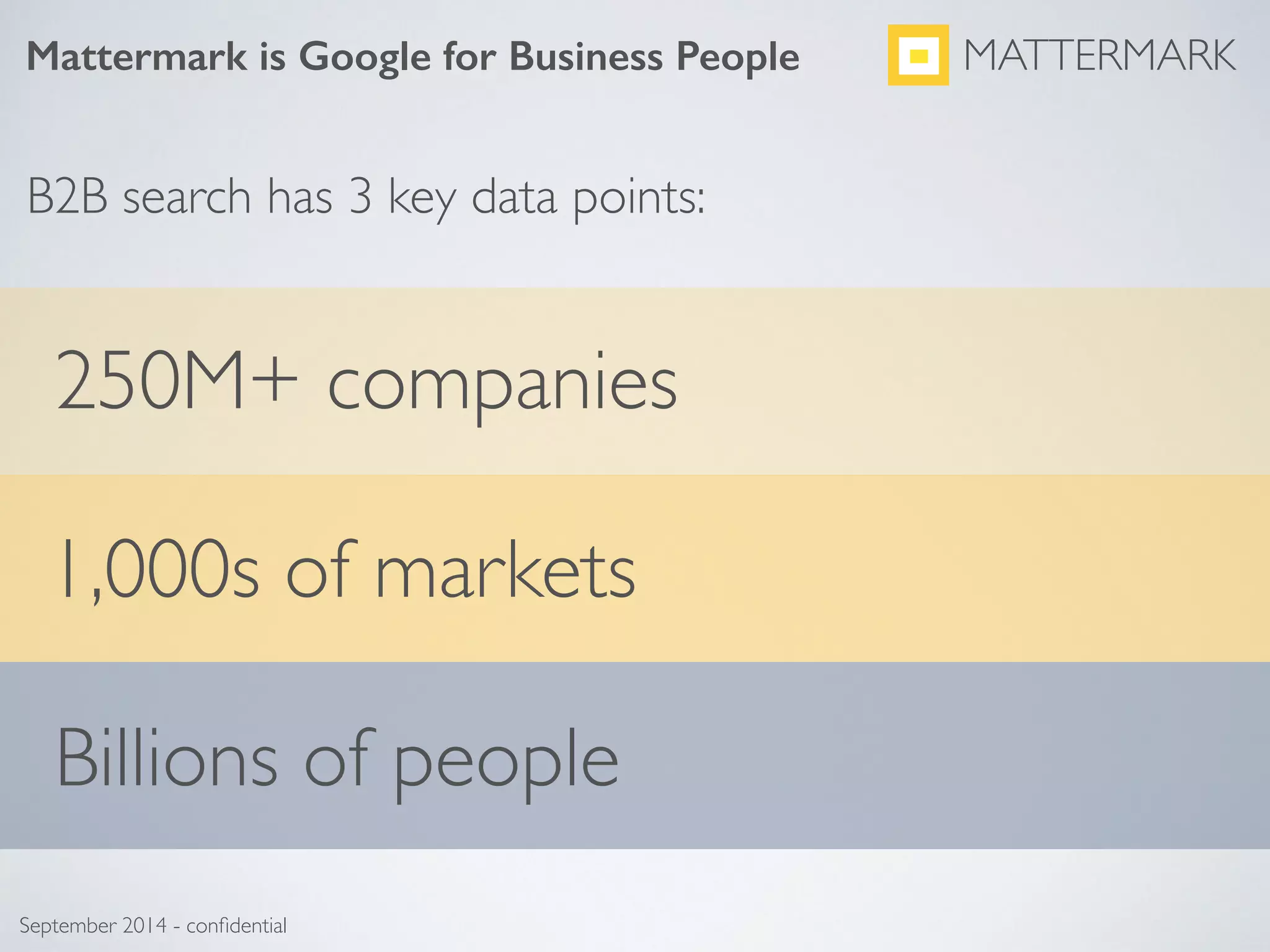
Slide 3 positions Mattermark with a memorable comparative — "Mattermark is Google for Business People" — followed by three concise data points: 250M+ companies, thousands of markets, billions of people. This combination of a simple analogy plus hard, large-scale numbers communicates both an intuitive product concept and a vast TAM (total addressable market). The phrasing ties product utility (search/answers) to scale, making the business case for building large datasets and search infrastructure.

For founders: pairing an easy-to-grasp metaphor with specific scale metrics is powerful. The metaphor helps non-experts understand the function, while the numeric indicators (company counts, market breadth, user population) give investors a handle on upside and why engineering investment makes sense.

Key Takeaway: Use a clear product metaphor plus a few authoritative scale numbers to convey both concept and market opportunity quickly.
Problem Statement: Clear Pain, Immediate Use Cases

Problem Statement: Clear Pain, Immediate Use Cases

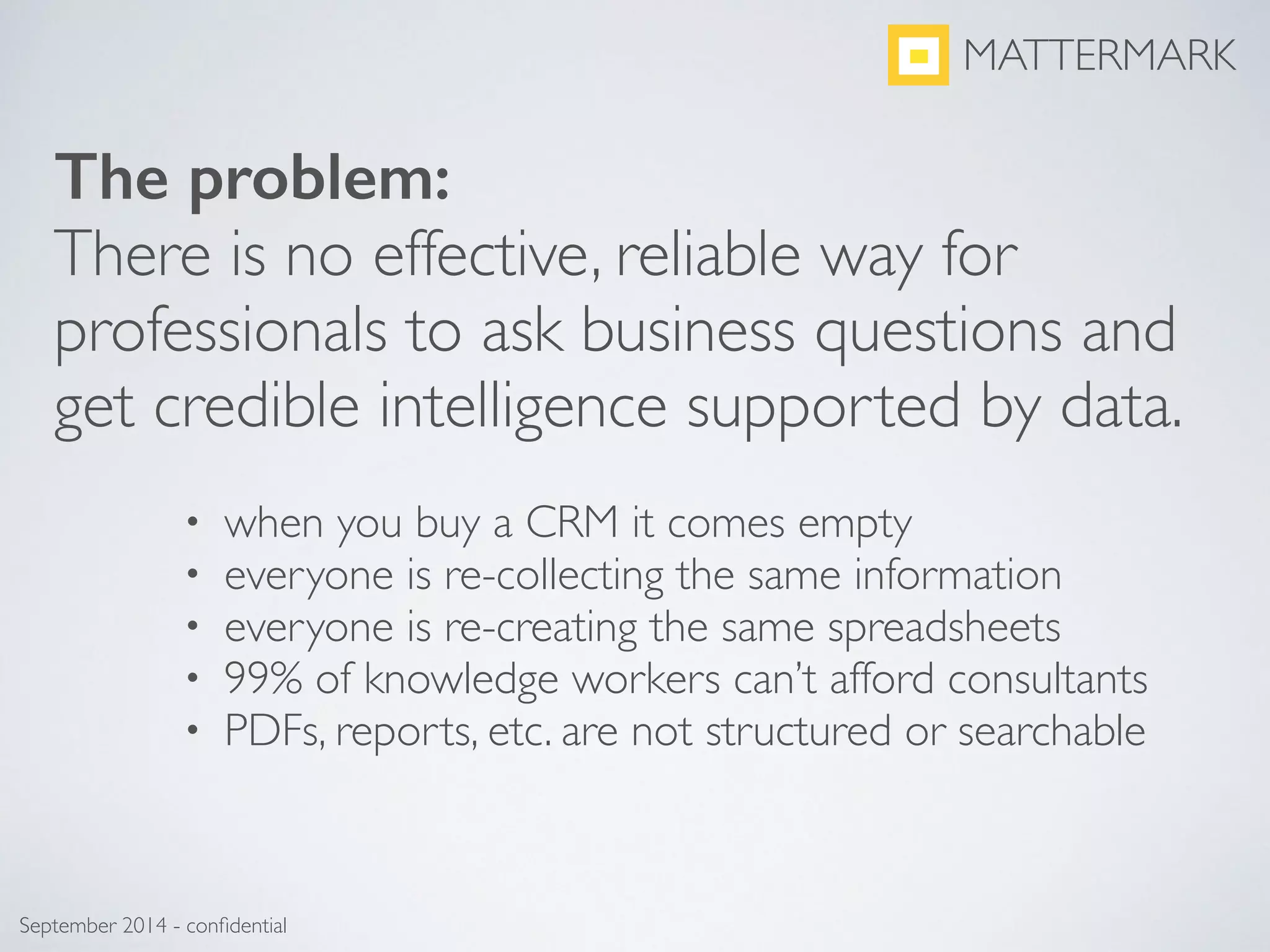
Slide 4 lays out the problem crisply: professionals lack an effective, reliable way to ask business questions and get data-backed answers. The slide lists specific pain points (empty CRM, duplicated spreadsheets, high consulting costs, unstructured documents) that ground the abstract problem in everyday workflow friction. That enumerated list makes the need tangible for several buyer personas (sales, VC, consultants).

This slide is effective because it moves beyond vague market chatter to concrete user pain that maps directly to value the product will deliver (automated, structured, searchable business intelligence). For founders, this demonstrates the importance of diagnosing the customer's current workaround and quantifying the inefficiency or cost to create urgency.

Key Takeaway: Describe the buyer’s current workaround and its frictions in concrete bullets — that contrast is what makes your solution feel necessary.
Product Vision: From Google+Spreadsheet to Data-driven Answers

Product Vision: From Google+Spreadsheet to Data-driven Answers

Slide 8 contrasts 'Market Research today = Google + spreadsheet' with a future state: 'data-driven answers, delivered in a format professionals can use to G.S.D.' That line neatly encapsulates the product’s promise: replace slow, manual research workflows with structured, actionable outputs. The slide frames the company’s roadmap in terms of replacing specific behaviors rather than simply providing another database.

Founders can learn from this clarity — showing how the product fits into and improves existing workflows helps buyers and investors visualize adoption and value capture. Also, pairing a concise problem narrative with an explicit future-state benefit (useable answers, not raw data) strengthens product-market fit messaging.

Key Takeaway: Show the current workaround and the concrete, workflow-level improvement your product delivers — not just the tech under the hood.
Traction: MRR, Growth Rates, and Visual Credibility

Traction: MRR, Growth Rates, and Visual Credibility

Slide 11 presents MRR growth as an easy-to-scan bar chart with a secondary line showing growth rate; headline metrics ($125K MRR, 377% CAGR) are called out prominently. This is classic traction storytelling: a clean time-series that demonstrates both momentum and durability. The combination of absolute dollars and growth percentage helps investors evaluate scale and velocity simultaneously.

The slide’s clarity and emphasis on month-by-month progress make it easy to validate claims and ask follow-up questions about churn, ARPU, and LTV. Founders should note how Mattermark uses a straightforward visual (bars + line) and big, bold metrics to anchor the company’s credibility — don’t hide behind vague claims when you can show an unambiguous trend.

Key Takeaway: Show month-by-month revenue growth with clear axes and a headline metric — investors want both the trend and the scale in one glance.
Revenue Mix and Customer Segmentation

Revenue Mix and Customer Segmentation

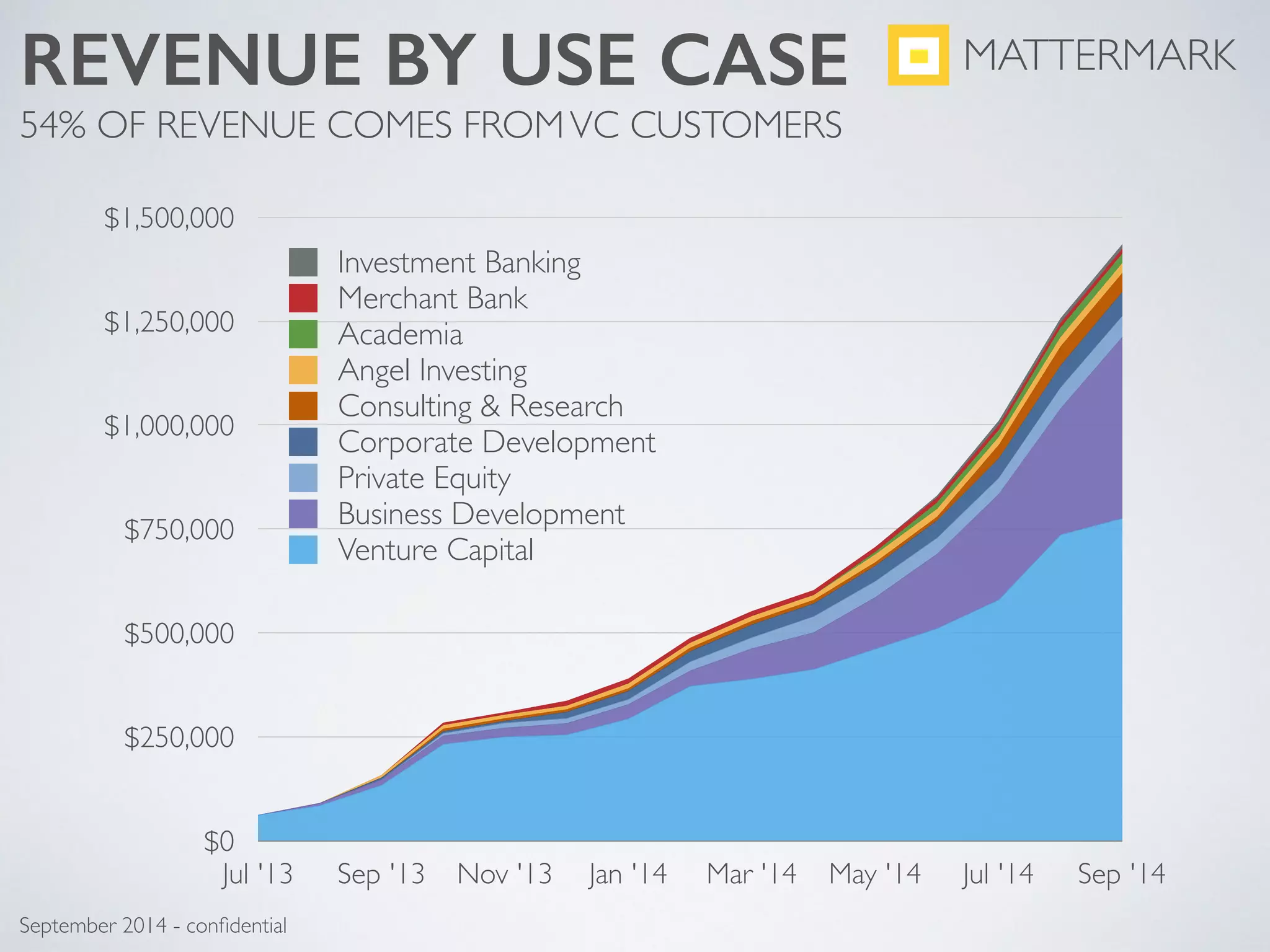
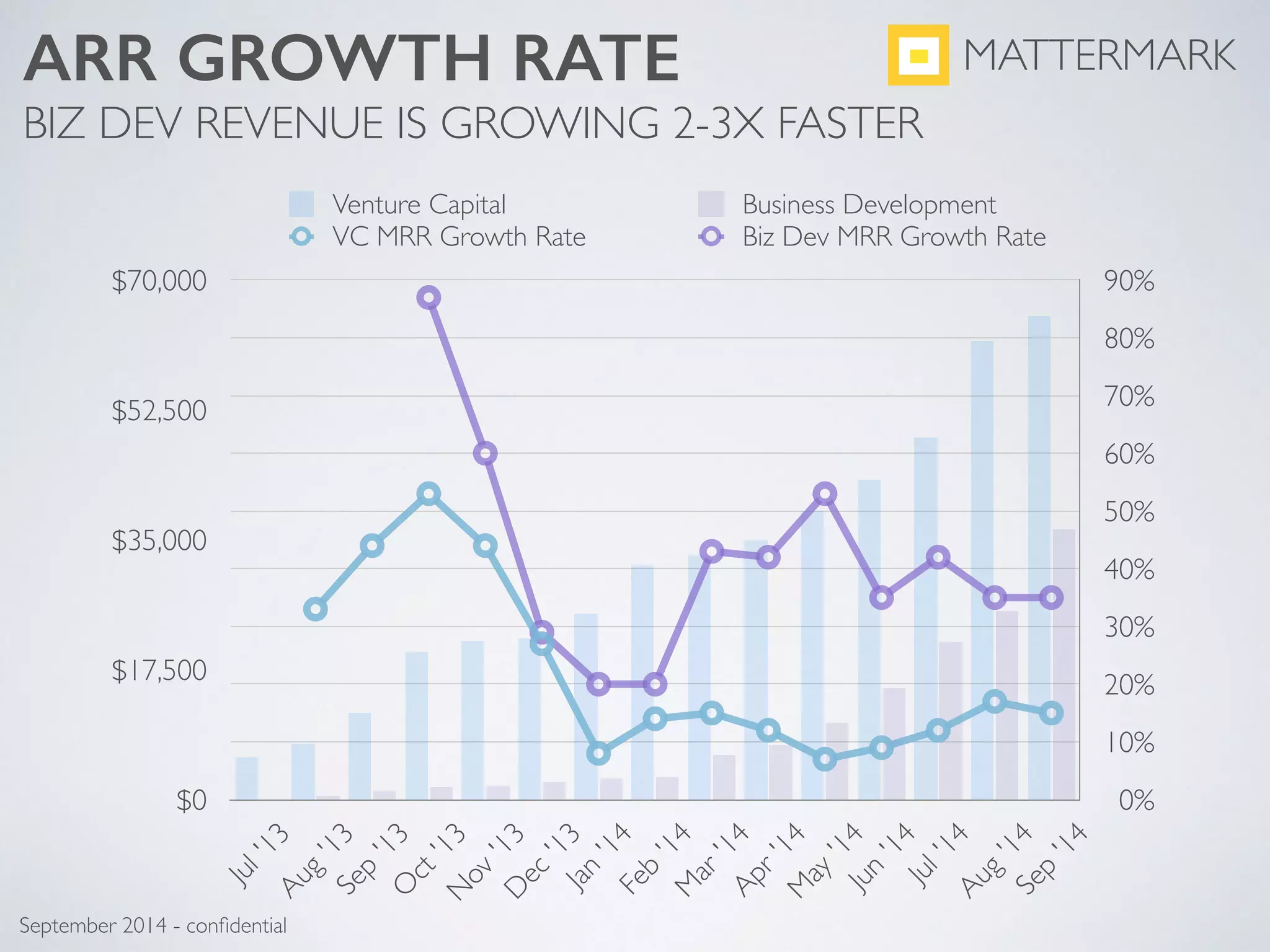
Slide 13 (Revenue by Use Case) breaks revenue down by vertical/use case over time and highlights that 54% of revenue comes from VC customers. This layered area chart conveys not just growth but the composition of that growth: which buyer segments are adopting and which are driving monetization. That’s important because it signals repeatable GTM channels and unit economics tied to specific customer profiles.

For founders, this is an excellent example of demonstrating early commercial validation (which segments pay) and scalability (expansion across categories). When possible, show revenue by use case or customer cohort — it helps investors understand where to double down and what predictable expansion looks like.

Key Takeaway: Break out revenue by customer segment or use case to show which buyers are paying and where your repeatable sales motion lives.
Team Credibility: Operators Who've Done It Before

Team Credibility: Operators Who've Done It Before

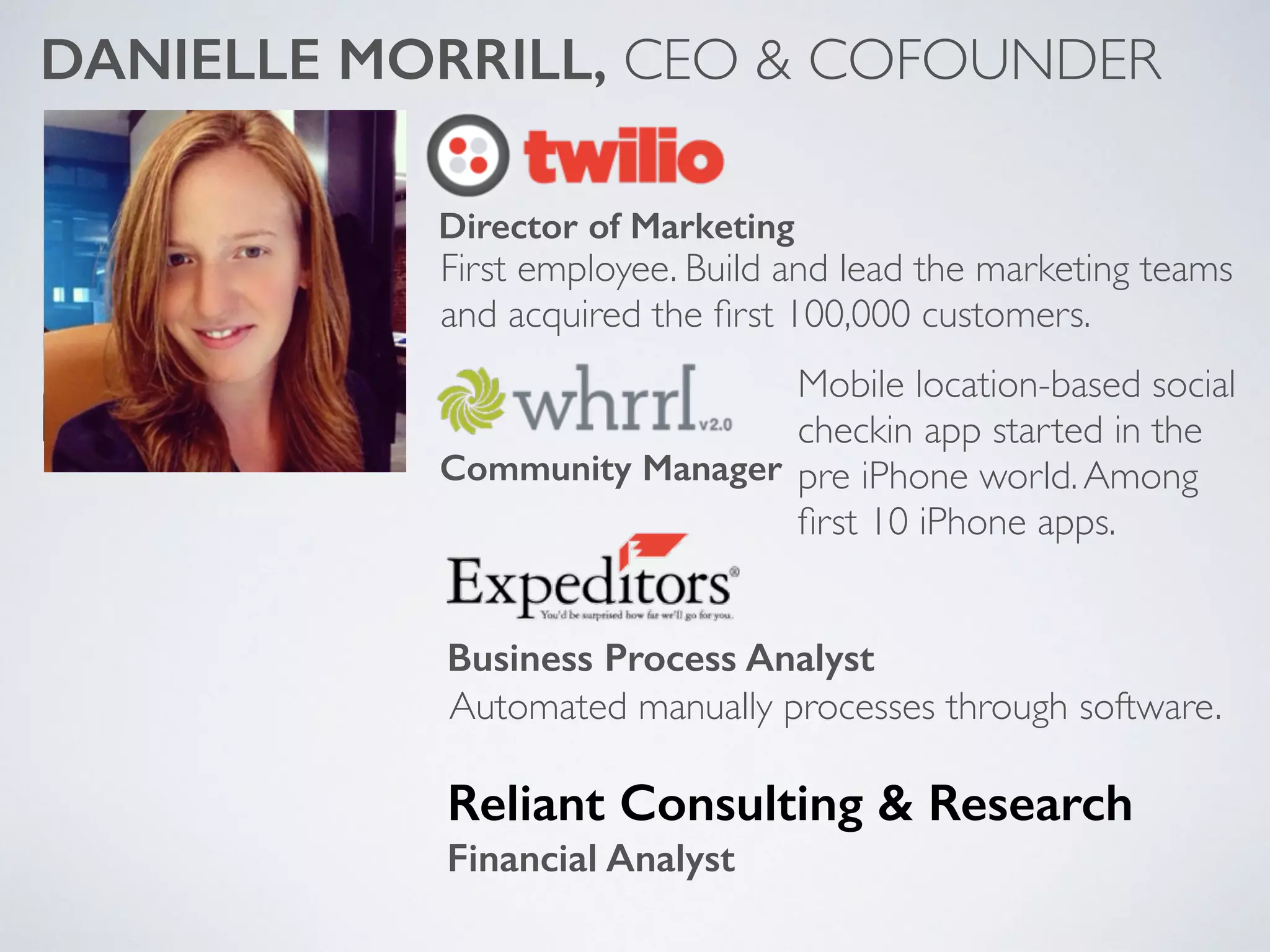
Slide 25 profiles Danielle Morrill with roles at Twilio and relevant experience in marketing, community building and finance/analytics. The slide uses specific prior outcomes (first employee, acquired users, analyst roles) to show demonstrated operator chops. Highlighting concrete past results (e.g., acquiring first 100,000 customers at Twilio) makes the team’s ability to execute believable.

This approach to team slides — focusing on outcomes, relevant domain experience, and complementary skill sets — is persuasive for investors. Founders should present succinct bios that emphasize prior operational accomplishments tied to their current company’s core challenges (e.g., growth, data, enterprise sales). It’s less about titles and more about repeatable success signals.

Key Takeaway: Highlight founders' relevant past outcomes (not just titles) that map to the current company's biggest execution risks.

Conclusion: Key Lessons

Mattermark’s deck is strong because it pairs an intuitive product metaphor with concrete scale metrics, spells out a clear customer pain and workflow improvement, and backs claims with month-by-month traction and revenue segmentation. Visuals are simple and purposeful: large numbers and clean charts make the evidence easy to absorb, while team bios link prior outcomes to execution risk mitigation. The narrative flows from mission to problem to solution to traction to team — the classic investor checklist — executed with restraint and clarity.

Actionable advice for founders building pitch decks: open with a crisp mission and a memorable product metaphor; quantify market size with a few credible numbers; articulate the customer’s current workaround and the specific workflow improvement you provide; show unambiguous traction (time-series revenue + headline MRR/Growth); break revenue out by customer segment to prove a repeatable sales motion; and present team bios centered on relevant, prior outcomes. Keep slides visually clean, emphasize the single most important number on each page, and make it effortless for investors to see product-market fit and execution capability.