Stack up against Groupon

Compare Your Deck

Groupon's 2011 Pitch Deck

Marketplace
Stage: IPO Roadshow
Raised: $950M IPO
Year: 2011
Slides: 40
Outcome: IPO at $12.7B, later declined

Pitch Deck

1 / 40
Slide 1
Click to expand

Deck Analysis

This is Groupon's 2011 IPO roadshow deck, presented as the company prepared to list publicly after rapid global expansion. The deck is notable for combining simple, brand-forward design with a heavy focus on unit economics, marketing ROI, and scale advantages — communicating both the opportunity and the operating playbook. It showcases a marketplace playbook: how customer acquisition, merchant economics, local density and product/technology features combine to drive revenue and margin expansion.

The Opening: Clear brand and framing

The Opening: Clear brand and framing

Slide 1 is a clean title slide that immediately establishes brand identity and the purpose of the presentation (Initial Public Offering). It uses large, legible typography and a single month/year date to set the time-context — an effective way to orient investors without noise. The design choice (simple, green, strong logo) signals confidence and continuity between consumer product and corporate story.

Founders should note how the slide sets a professional tone quickly. For investor-facing decks, your first slide should do less than you think: brand + purpose + date is often enough. Avoid clutter; the goal is to create a consistent visual identity that carries through the entire presentation so that subsequent slides feel like parts of one integrated story.
Key Takeaway: Start with a simple, brand-forward title slide that communicates purpose and sets a consistent visual tone for the whole deck.
The Offering: Clear IPO terms and structure

The Offering: Clear IPO terms and structure

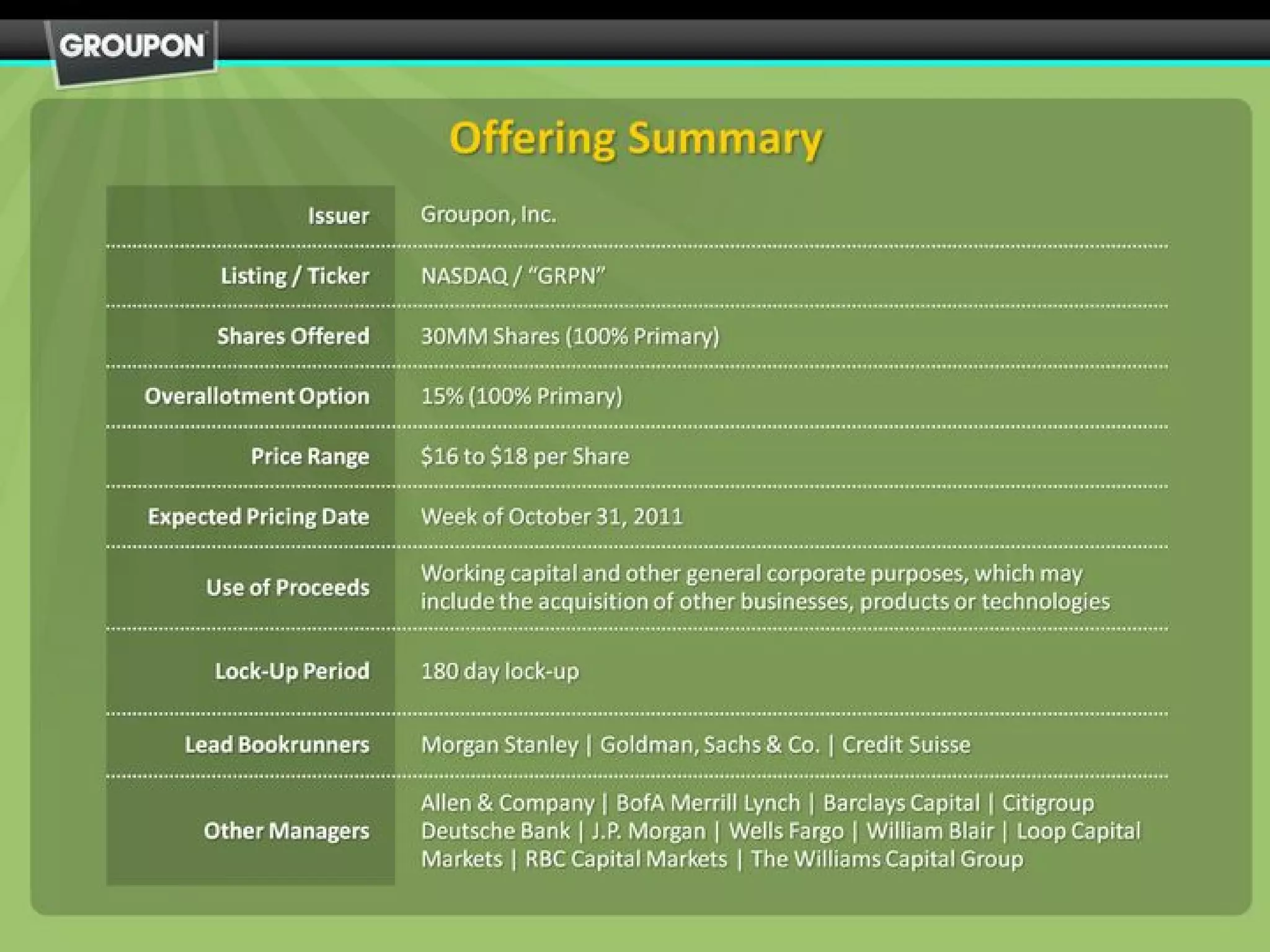
Slide 3 (Offering Summary) lays out the IPO terms and deal structure succinctly: issuer, ticker, shares offered, price range, lock-up, and lead bookrunners. Presenting these facts up-front is important for a roadshow because it answers the immediate transaction-level questions that institutional investors care about.

This slide demonstrates discipline: investors appreciate transparency on size, pricing expectations and use of proceeds. For founders raising capital (public or private), mirroring this clarity — i.e., concise bullet points for the ask, structure, and use of funds — removes friction during diligence and signals professionalism.

Key Takeaway: Be explicit and concise about the financial terms and uses of proceeds — investors want clarity on the ask and structure as early as possible.
Investment Highlights: Framing the value proposition

Investment Highlights: Framing the value proposition

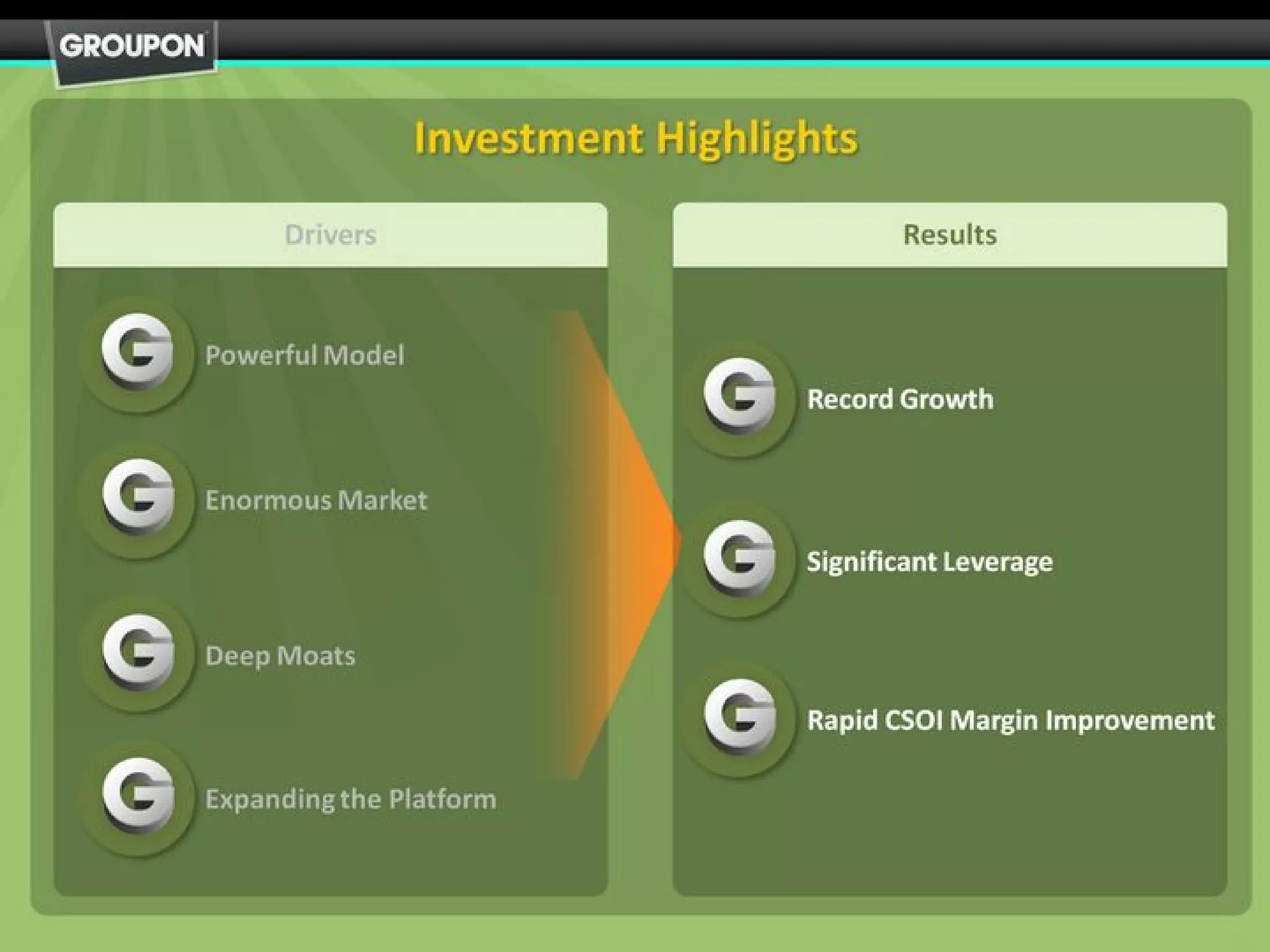
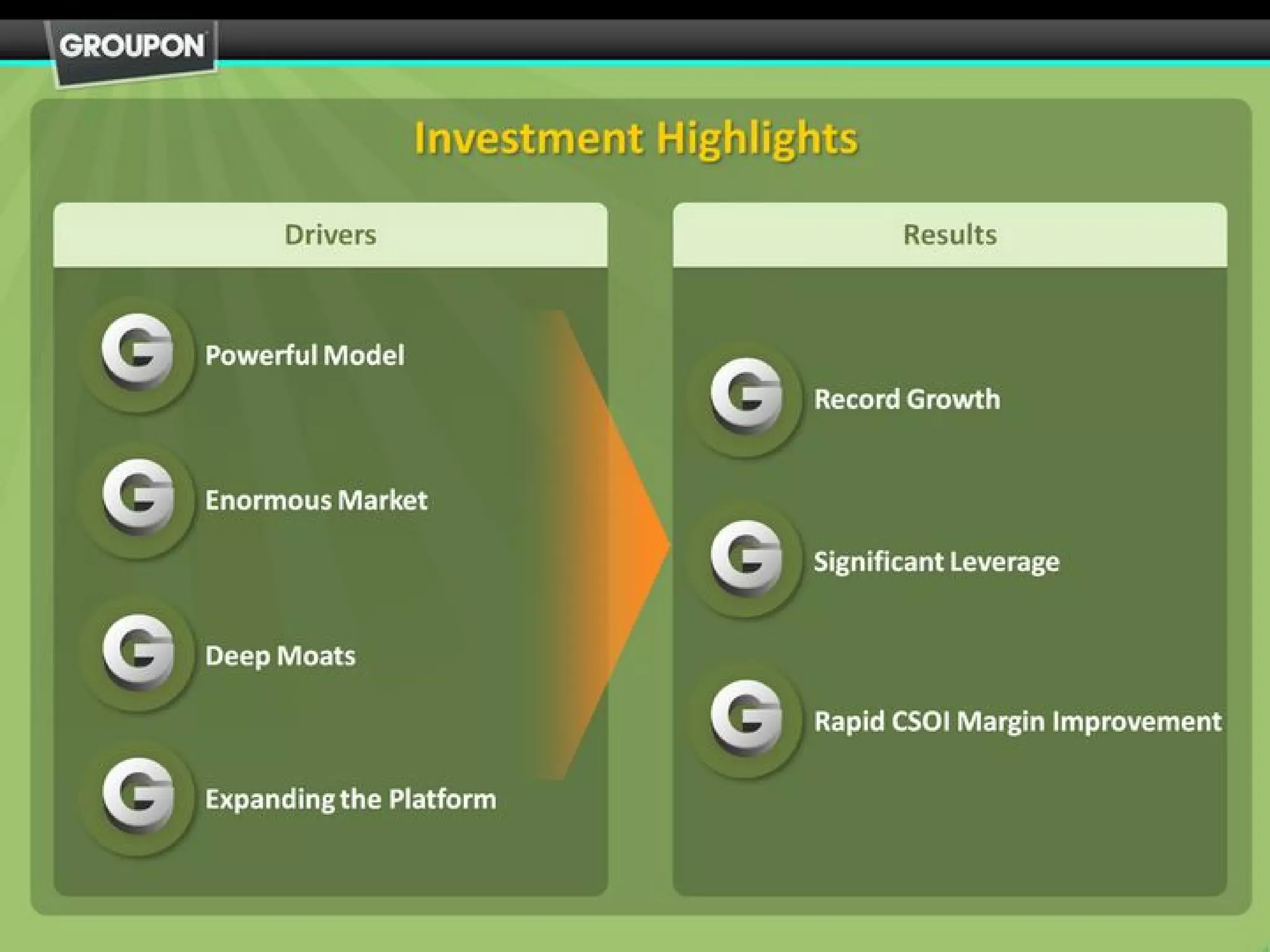
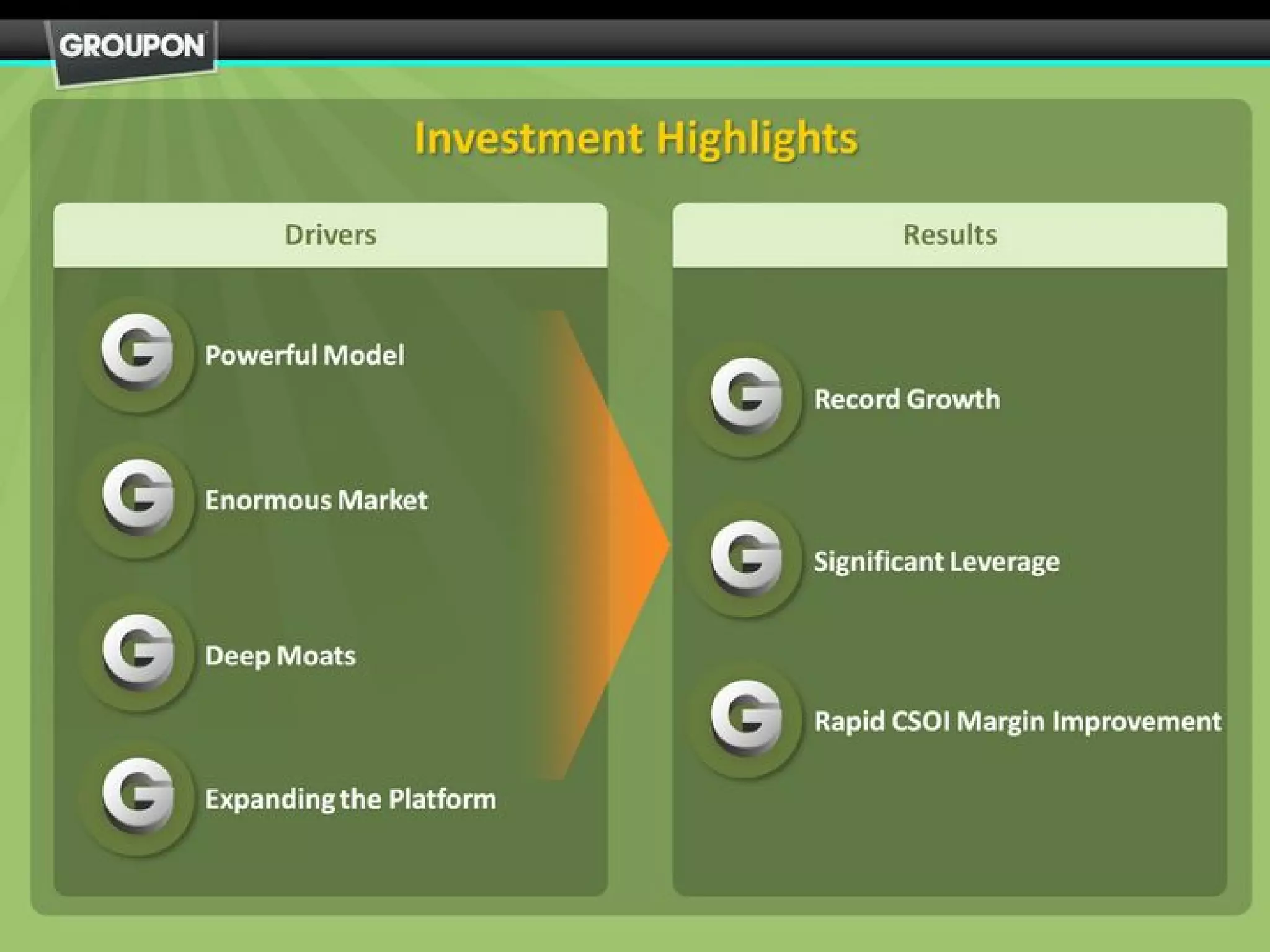
Slide 5 (Investment Highlights) juxtaposes 'Drivers' on the left with 'Results' on the right, turning qualitative strengths (powerful model, enormous market, moats, platform expansion) into measurable outcomes (record growth, leverage, margin improvement). The visual flow (left to right with icons) helps investors map causes to effects quickly.
This is a model slide for any company: start with a few crisp strategic pillars, then show the concrete results they yield. The deck avoids overclaiming; instead, it ties each driver to a specific operational or financial result. Founders should build similar slides to show not just ambition but the mechanism by which ambition translates to measurable outcomes.
Key Takeaway: Link strategic drivers to concrete outcomes — show the causal path from what you do to the measurable results investors care about.
Two-sided marketplace: Simple visualization of supply and demand

Two-sided marketplace: Simple visualization of supply and demand

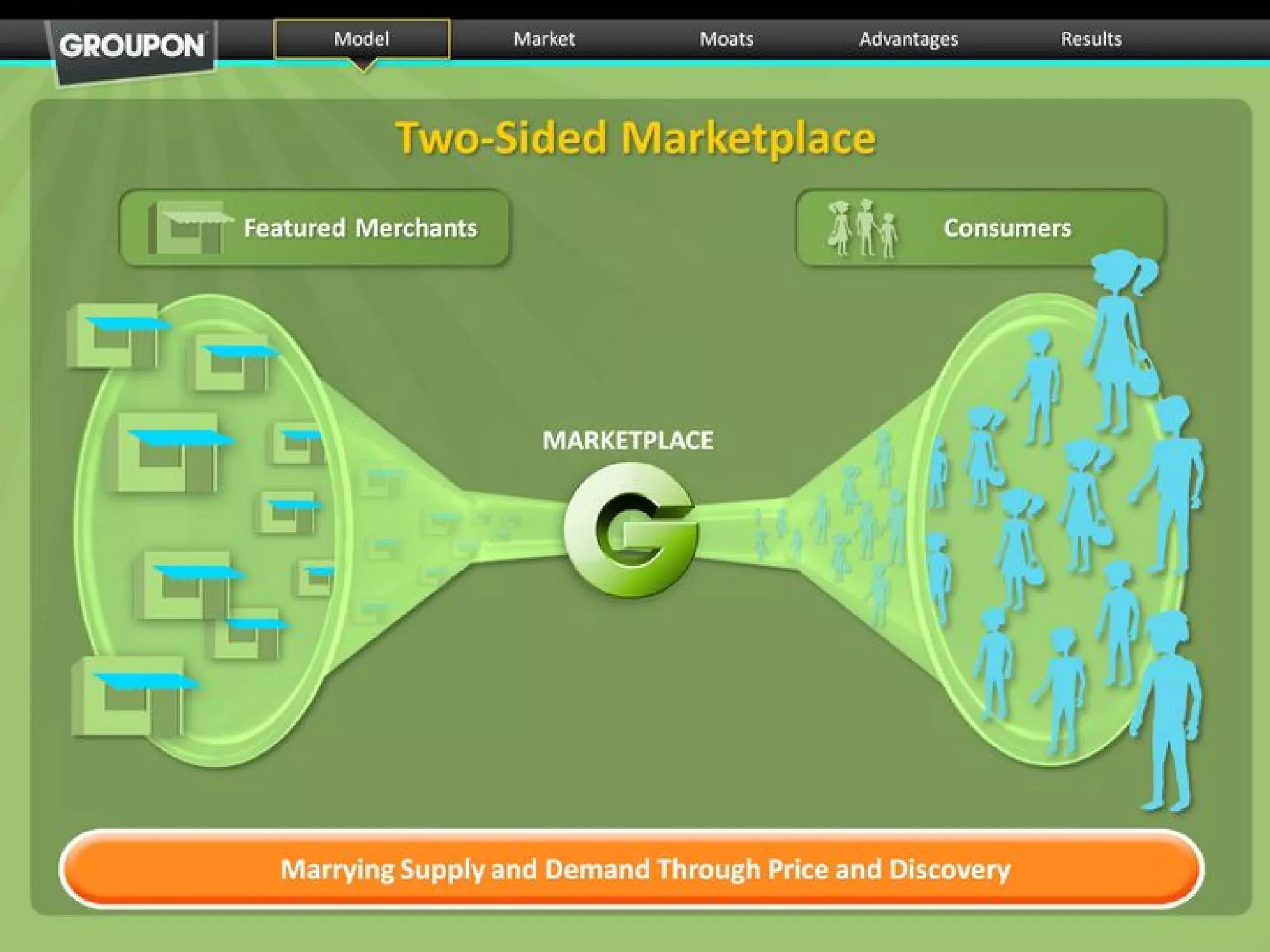
Slide 12 presents Groupon as a two-sided marketplace with merchants on one side and consumers on the other, funneled through a central marketplace. The illustration is intuitive: it communicates matchmaking at scale (mirroring network effects) without heavy copy. The orange callout at the bottom (‘Marrying Supply and Demand Through Price and Discovery’) succinctly encapsulates the mechanism.

For marketplace founders, this slide is a reminder to clearly show the flow between supply and demand and the levers you control (pricing, discovery, distribution). Visual, symmetric diagrams make it easy for investors to see how liquidity, matching efficiency, and pricing power interrelate — and where you plan to capture value.

Key Takeaway: Use a simple two-sided visualization to show how supply and demand meet and where your product captures value.
Market Opportunity: Big total addressable market (TAM) framing

Market Opportunity: Big total addressable market (TAM) framing

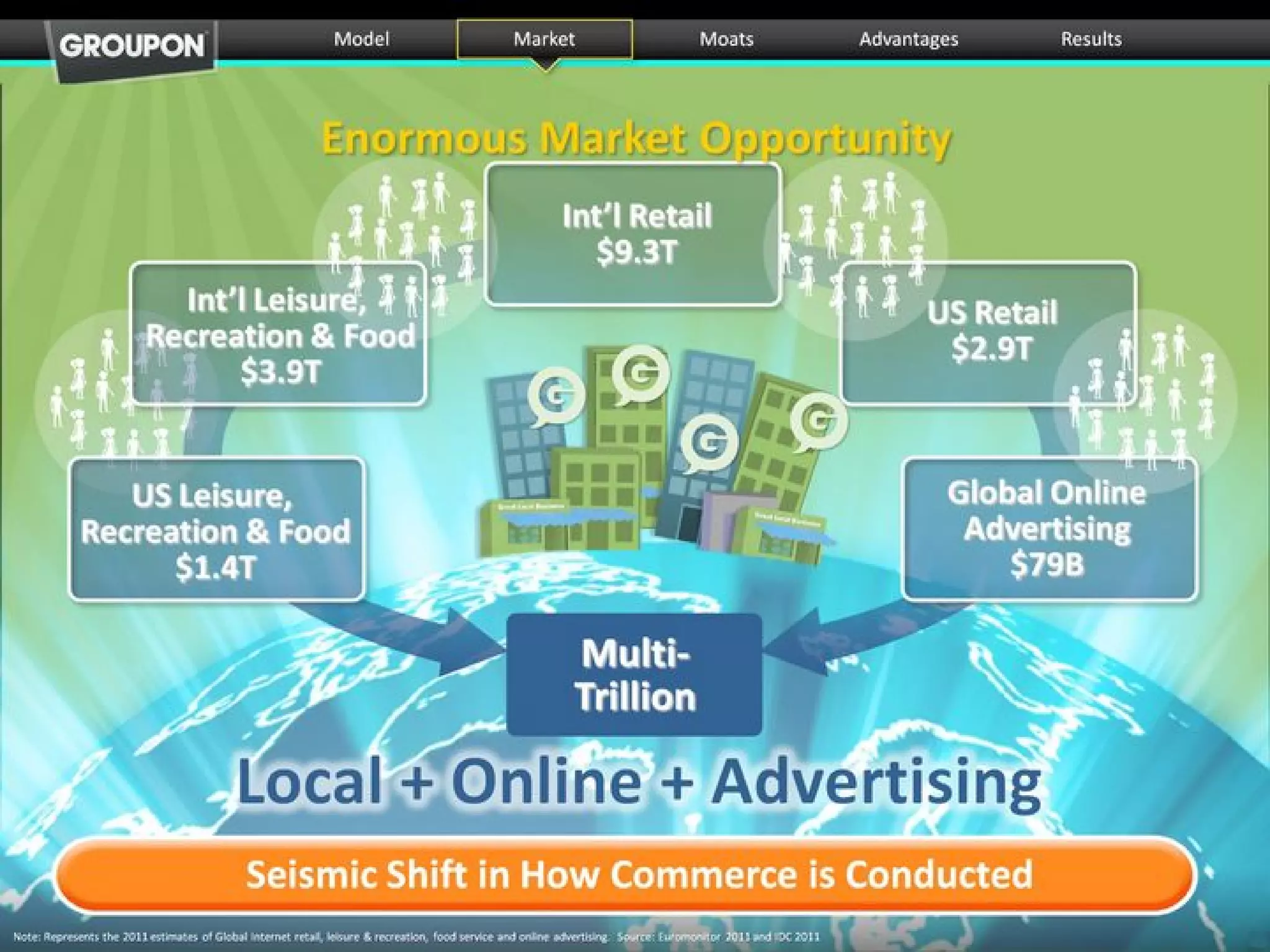
Slide 13 (Enormous Market Opportunity) uses high-level, large-scale market figures (US retail, international retail, leisure, global online advertising) to argue that the opportunity is multi-trillion dollars. The graphics and callouts emphasize breadth (local + online + advertising) to justify the company's fast expansion and product extensions.

This is effective because it addresses a core investor question: 'Is this big enough to justify the investment?' Founders should similarly combine realistic market subsections to show both immediate and longer-term addressable markets. Be explicit about data sources and the segments you expect to capture — investors want credible TAM math and a path to penetration.

Key Takeaway: Quantify and segment your market opportunity clearly, showing both near-term monetizable segments and longer-term expansion possibilities.
Growth and traction: Visualizing rapid scale

Growth and traction: Visualizing rapid scale

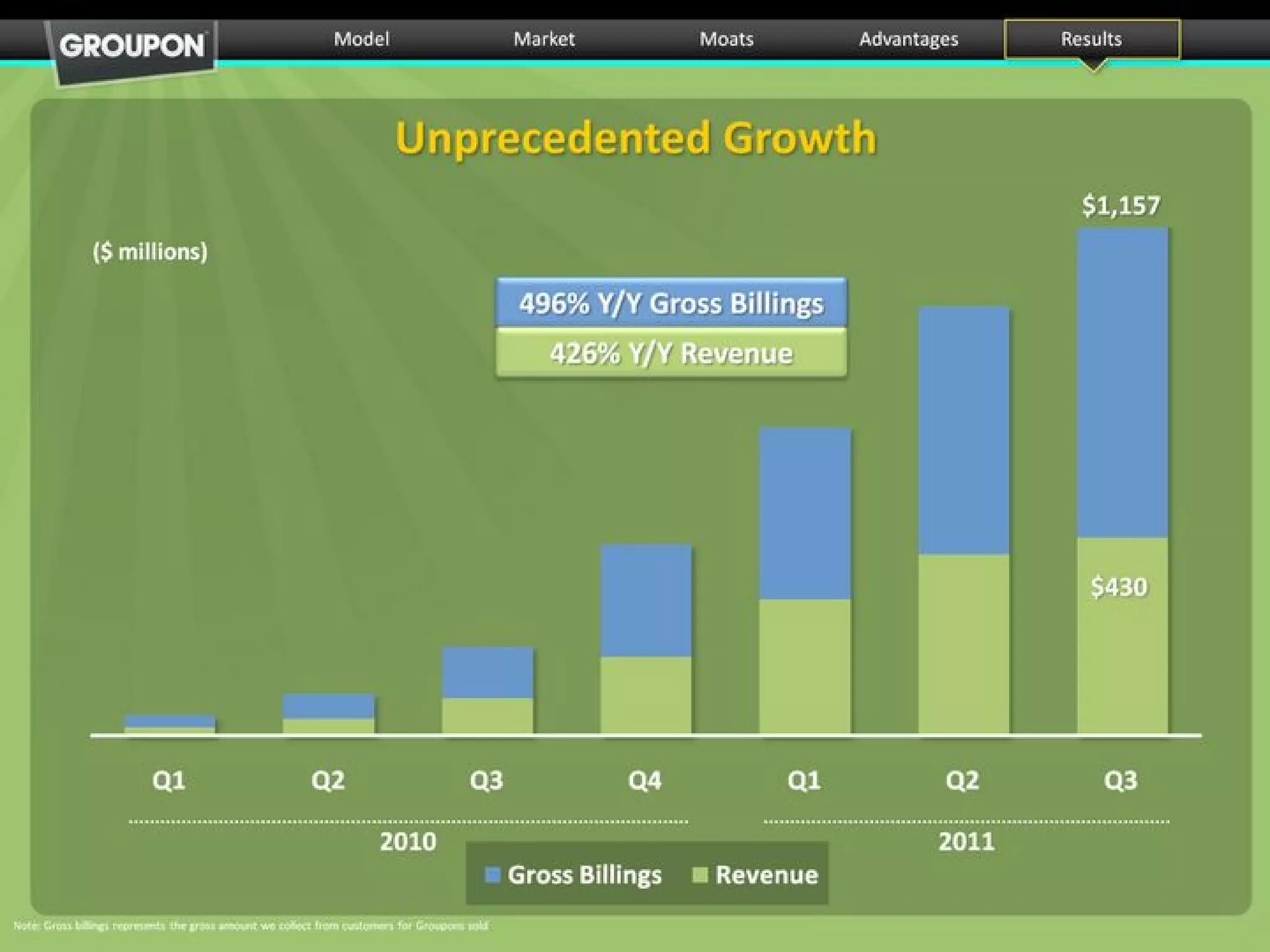
Slide 33 (Unprecedented Growth) shows a clean stacked bar chart of gross billings and revenue growth across quarters, with percentages (496% Y/Y gross billings, 426% Y/Y revenue). The visual emphasizes momentum and scale, a core narrative for a growth-stage company heading to IPO. Using both gross billings and revenue demonstrates understanding of the different top-line metrics relevant to marketplaces.

Investors focus on growth quality as much as rate. Founders should present growth with context: show the drivers (customer acquisition, expansion to new markets) and include important complementary metrics (unit economics, churn, marketing efficiency) nearby so growth doesn't appear disconnected from profitability.

Key Takeaway: Show rapid growth with clear, comparable metrics and contextualize the drivers so investors see both scale and quality.
Unit economics and ROI: Demonstrating payback and contribution

Unit economics and ROI: Demonstrating payback and contribution

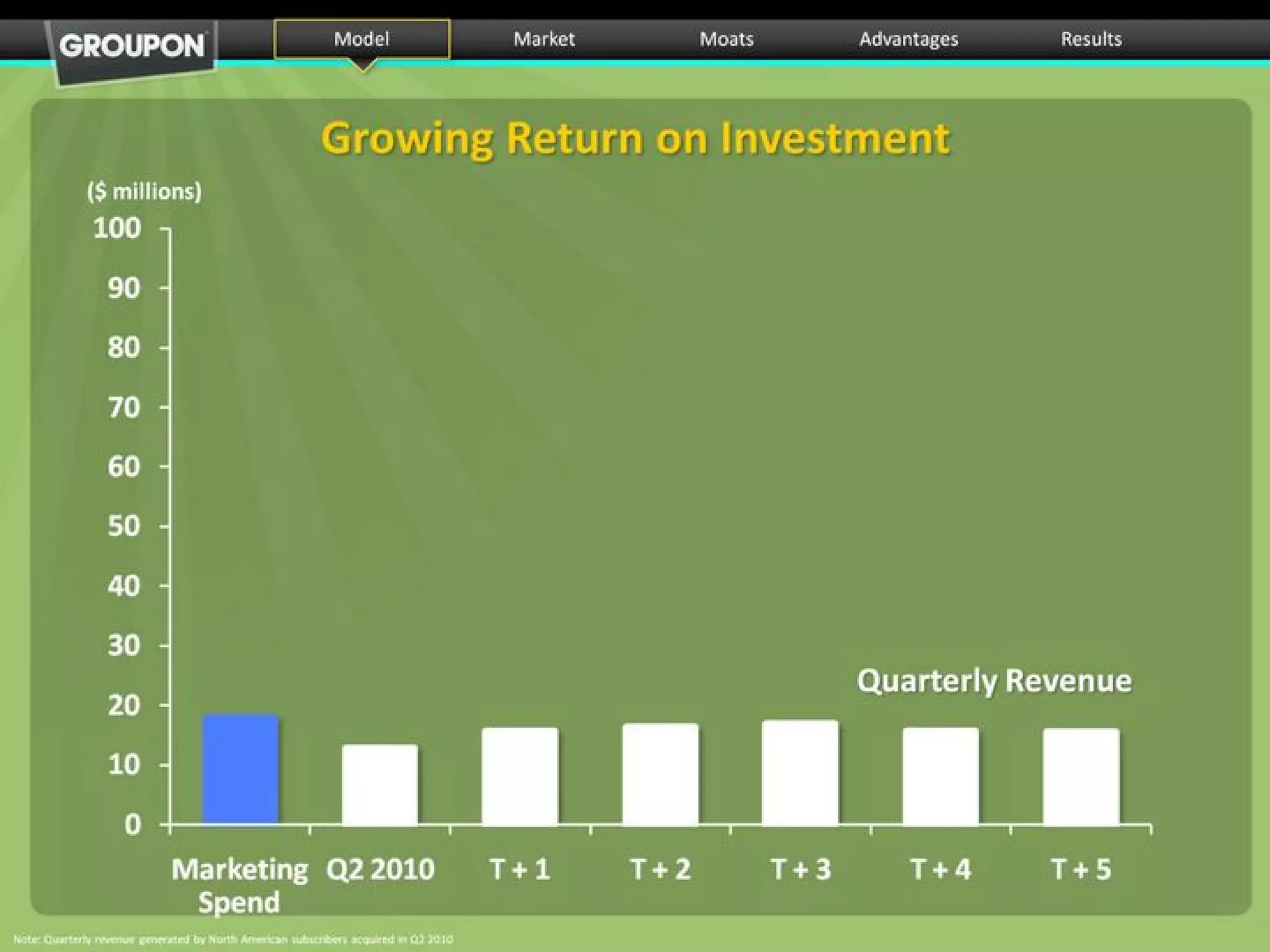
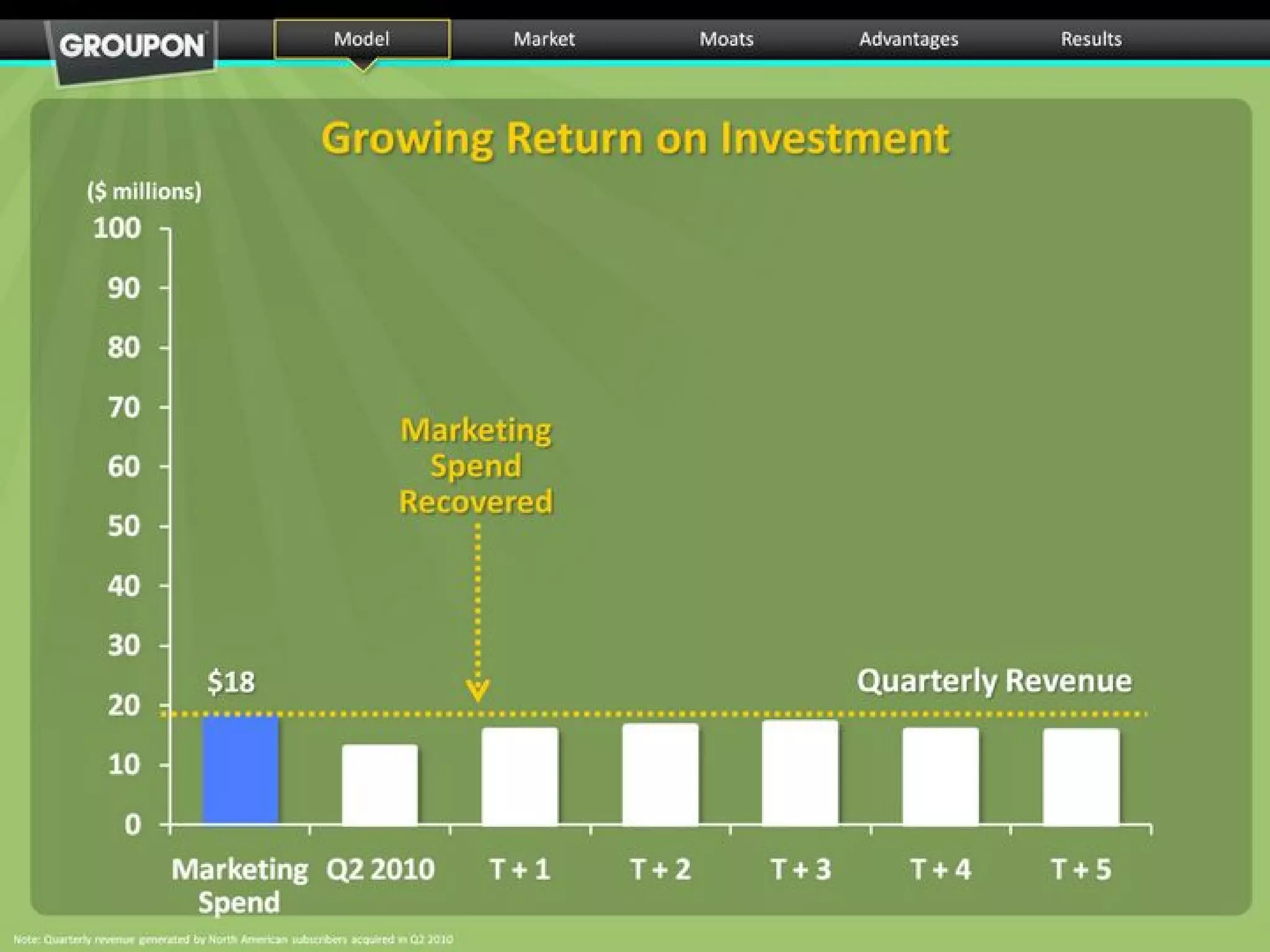
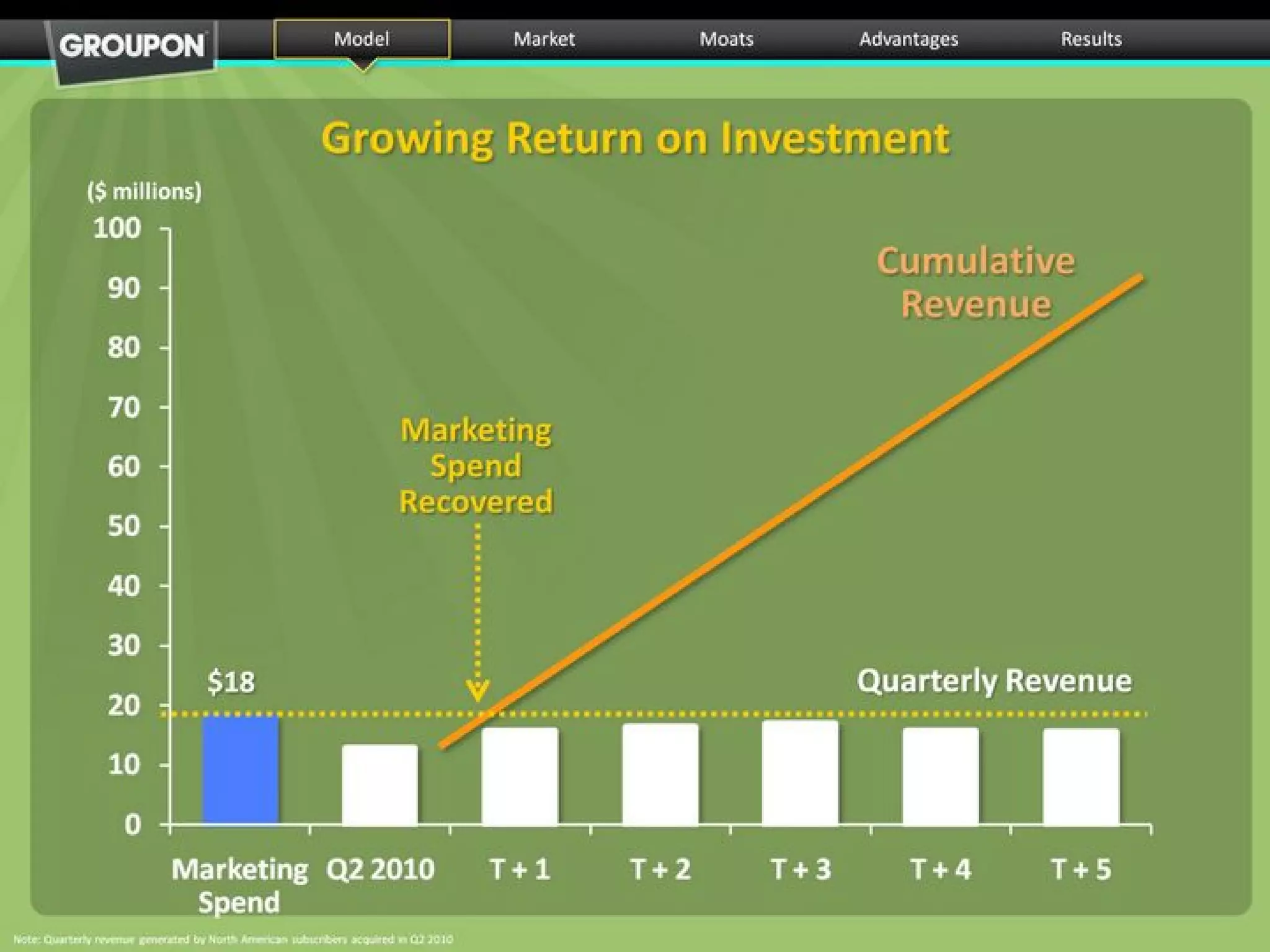
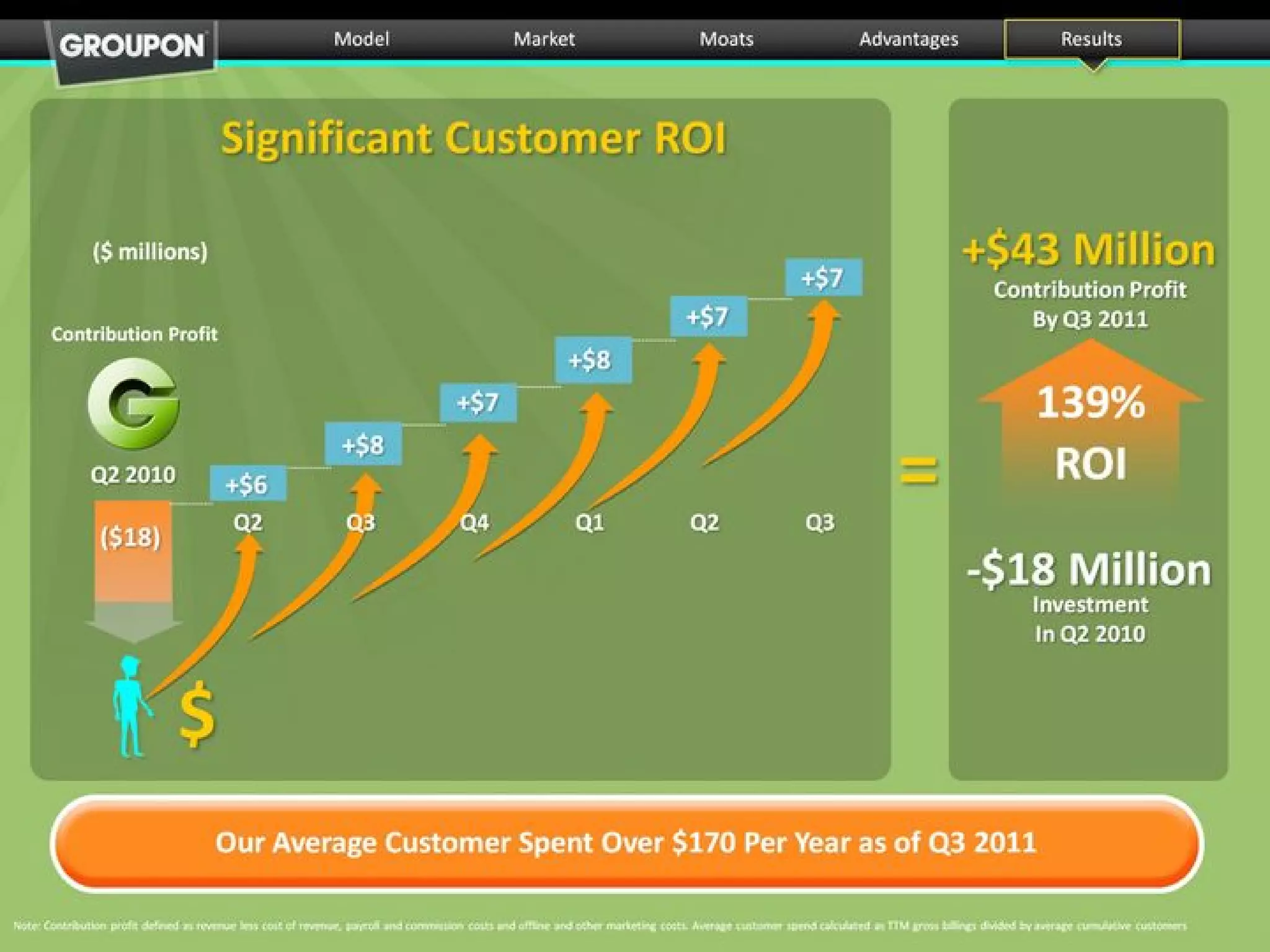
Slide 36 (Significant Customer ROI) lays out an accessible customer ROI narrative: initial marketing investment, subsequent quarterly contribution per cohort, and cumulative return leading to a net positive contribution by Q3 2011. It converts abstract growth into dollar-per-customer economics, quantifying how an $18M marketing investment produced sustained incremental contribution and an average customer spend of over $170 per year.

This is a standout part of the deck because investors need to believe growth is durable and profitable at scale. For founders, the lesson is to present unit economics (CAC, payback period, contribution margin) plainly and visually: show the investment, the ensuing per-customer cashflow, and the timeline to payback. This reduces risk perception and makes scaling assumptions credible.

Key Takeaway: Present unit economics clearly — show CAC, payback timeline, and per-customer contribution so investors can assess scalability and sustainability.

Conclusion: Key Lessons

Groupon’s IPO deck excels at combining simple, consistent branding with rigorous operational detail. Strengths include: a concise offering summary, a clear mapping of strategic drivers to measurable results, clean marketplace visuals, explicit TAM segmentation, transparent growth charts, and persuasive unit-economics analysis. Those elements together create a narrative that growth is not only fast but underpinned by repeatable economics and scale advantages.

Actionable advice for founders: (1) start with a focused opening and maintain consistent visual language, (2) state the ask and deal mechanics up-front for investor convenience, (3) link strategy to measurable outcomes, (4) use simple diagrams to explain marketplace mechanics and where value accrues, (5) quantify TAM credibly, and (6) make unit economics and payback visuals central — growth without credible economics is risky. Following this structure helps transform an aspirational product story into a investable, evidence-backed company case.