Stack up against Airbnb

Compare Your Deck

Airbnb's 2009 Pitch Deck

Marketplace
Stage: Seed
Raised: $600K
Year: 2009
Slides: 14
Outcome: IPO at $47B valuation

Pitch Deck

1 / 14
Slide 1
Click to expand

Deck Analysis

This seed-stage pitch deck from Airbnb (2009) concisely introduced a marketplace that connects travelers with local hosts. It pairs simple market validation and size estimates with clear problem/solution framing, product screenshots and a crisp business model. Notable for its combination of emotional imagery, data-backed opportunity and a founder-forward team slide, the deck demonstrates how to present a novel two-sided marketplace to early investors with clarity and conviction.

The Opening: Simple, human cover that sets the brand tone

The Opening: Simple, human cover that sets the brand tone

The opening slide (cover) pairs a warm, lived-in interior photo with a bold brand lockup and the one-line value proposition “Book rooms with locals rather than hotels.” The visual immediately signals that this is a hospitality product rooted in local experiences rather than commodity lodging. The aesthetic choice (homey photography, generous white space and a friendly red accent) establishes an emotional connection and orients the audience to the problem space before any numbers are shown.

For founders, this demonstrates the power of a single, memorable positioning line backed by evocative imagery. You don’t need to cram the cover with metrics or a long description — use it to convey tone, audience, and the core promise in a way that primes the rest of the presentation.
Key Takeaway: Open with a concise value proposition and imagery that communicates your product’s emotional benefit — not a laundry list of features.
Problem framing: Highlight pain points that create urgency

Problem framing: Highlight pain points that create urgency

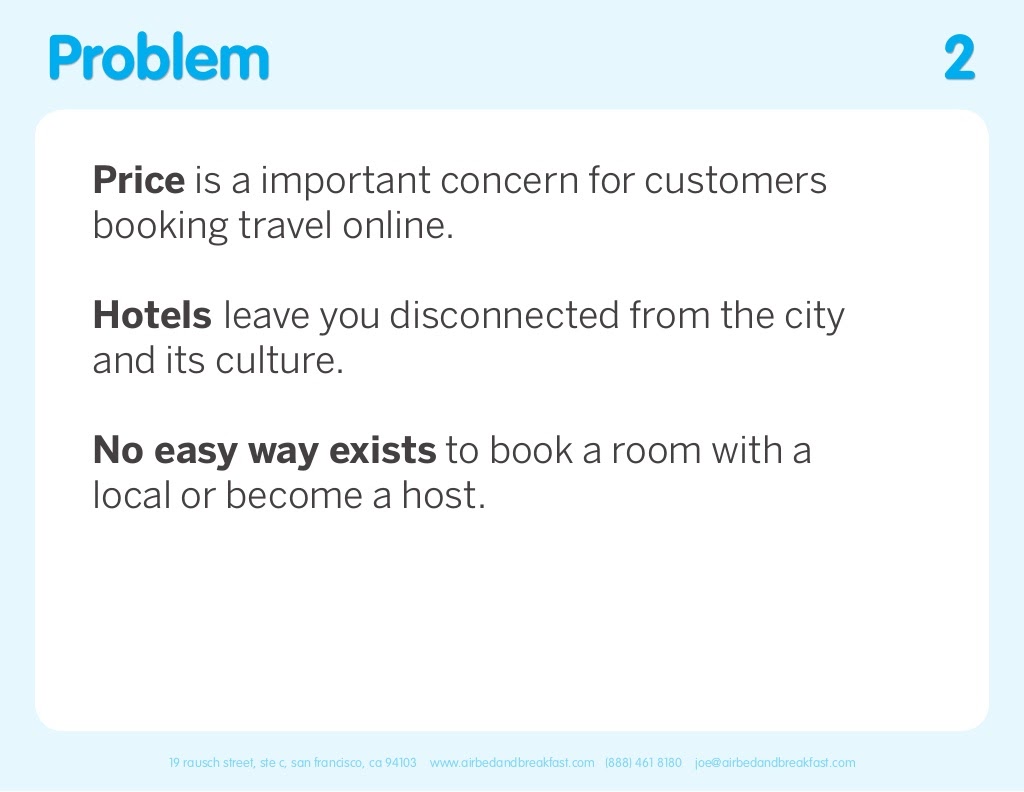
Slide 9 (Problem) lists three crisp user pains: price sensitivity, hotels’ disconnect from local culture, and the lack of an easy way to book rooms with locals or become a host. The language is short, bold and prioritized — each line is a clear pain that maps directly to the later solution. The background photograph of a real living room subtly reinforces the contrast versus sterile hotel rooms.

This approach is effective because it ties the product to specific, investor-relevant customer problems that are large and relatable. Founders can learn to keep problem statements direct and prioritized, and to pick imagery that reinforces the user experience rather than distracting from the message.

Key Takeaway: State 2–4 specific, high-impact customer pain points in plain language so investors immediately understand the need you’re solving.
Solution & Product: Show how the product addresses the pains

Solution & Product: Show how the product addresses the pains

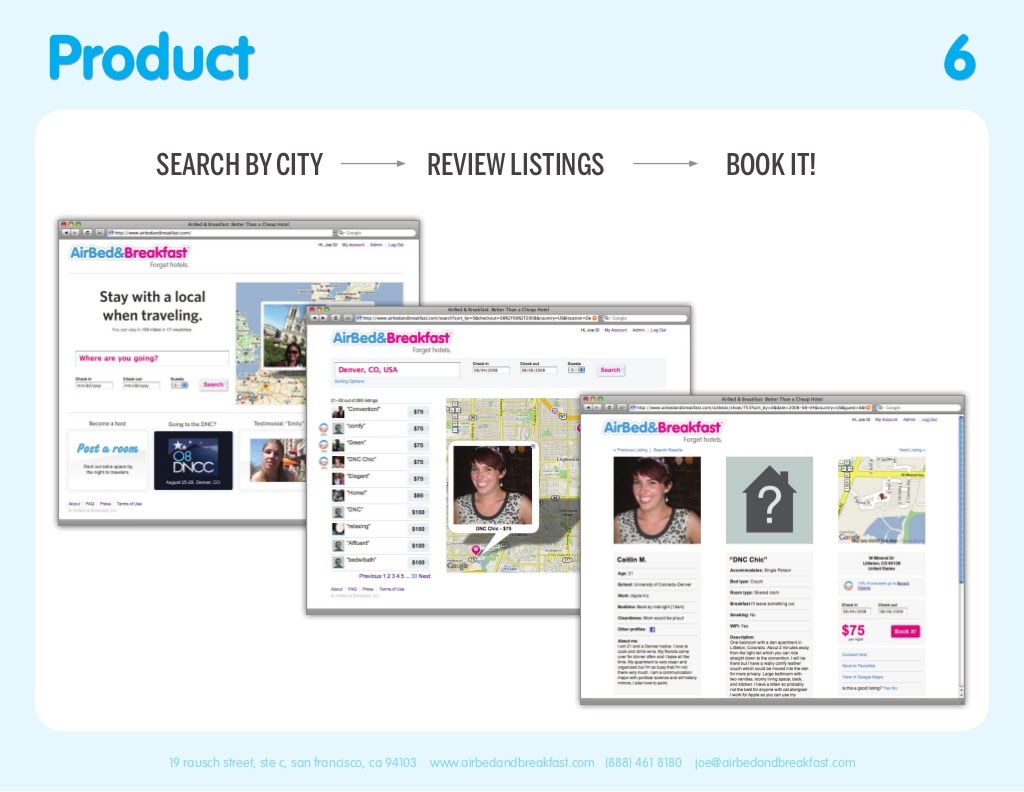
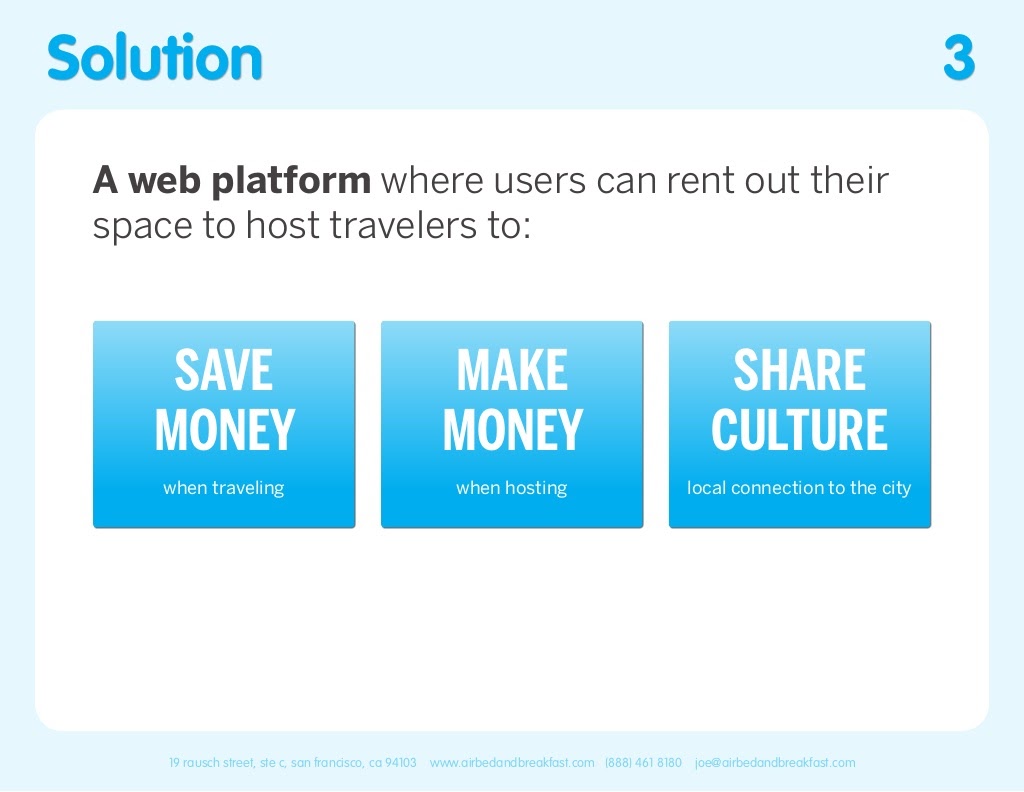
The deck uses two complementary slides to present the solution: a stylized solution slide (SLIDE 23) with icons and a bold headline, and a product/UX slide (SLIDE 24) showing the booking experience. The solution slide distills value into three clear benefits — save money, make money, share culture — tying directly back to the problem bullets. The product slide then demonstrates the actual flow (search, review, book) using a real interface screenshot, grounding the promise in a tangible product.

This combination is powerful because investors need both the conceptual value proposition and proof that the team can build a usable interface. Founders should mirror this pattern: first articulate benefits in plain terms, then show actual product screens or flows to prove feasibility and user experience.

Key Takeaway: Pair a short benefit-driven solution statement with product screenshots that demonstrate the user flow — concept + proof sells confidence.
Market validation & size: Use credible comparators and simple metrics

Market validation & size: Use credible comparators and simple metrics

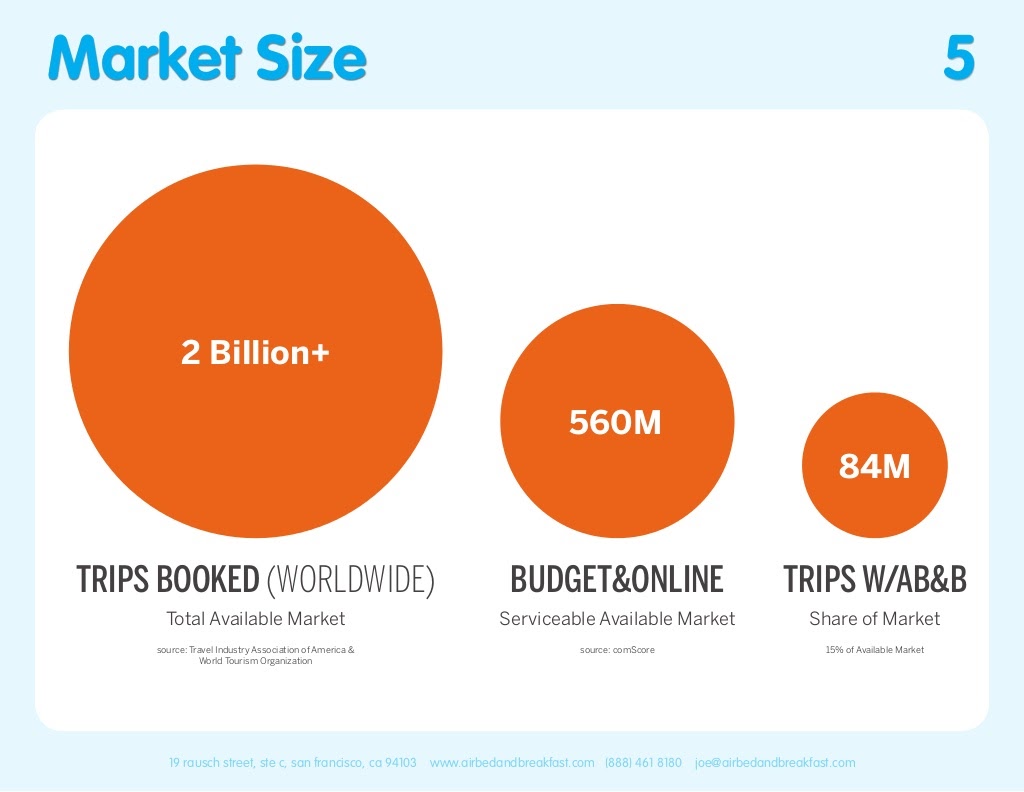
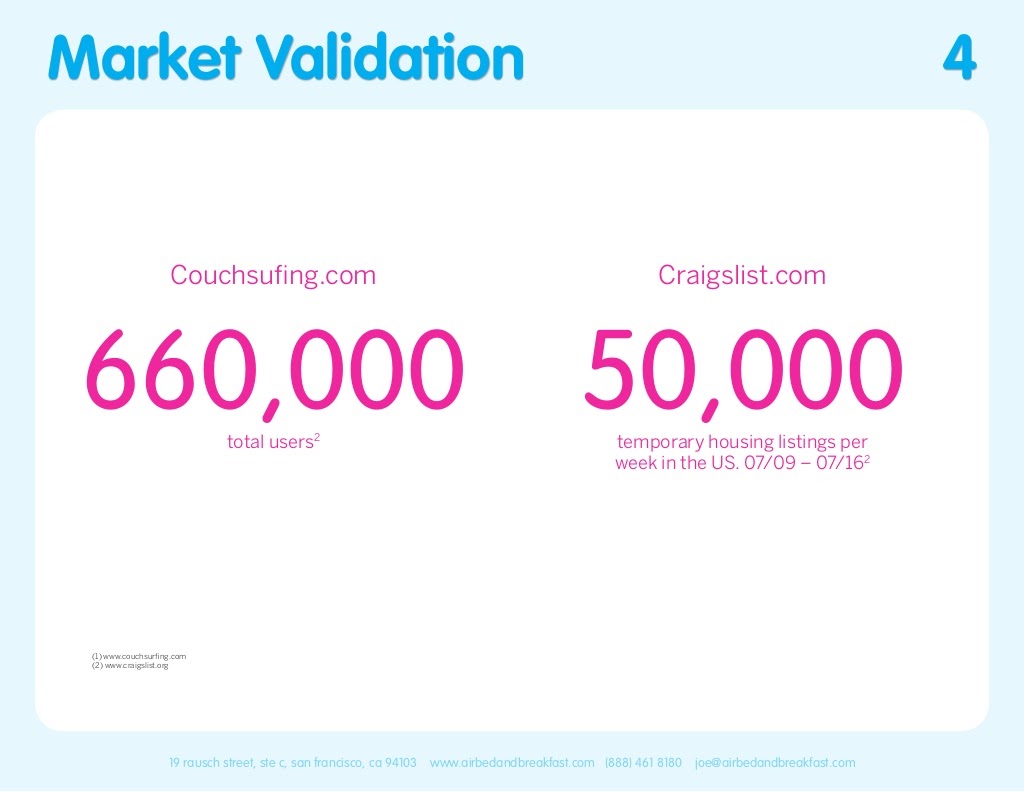
Slide 30 (Market Validation) and Slide 27 (Market Size) work together to show both validation and scale. The validation slide cites Craigslist and Couchsurfing metrics to prove existing demand and analogous user behavior, while the market size slide uses bold bubble graphics to quantify the total addressable and serviceable available market. These choices show there is both immediate behavioral evidence and a large long-term opportunity.

The lesson for founders is to present both types of market evidence: early signals (users, listings, analogous services) that justify traction, and clear TAM/SAM/SOM framing that demonstrates upside. Use simple, sourced numbers and visual metaphors (bubbles, bars) to make the scale intuitive at a glance.

Key Takeaway: Combine quick validation from similar platforms with a simple, sourced market sizing graphic to show both demand and scale.
Business model & financial ask: Clear unit economics and the raise

Business model & financial ask: Clear unit economics and the raise

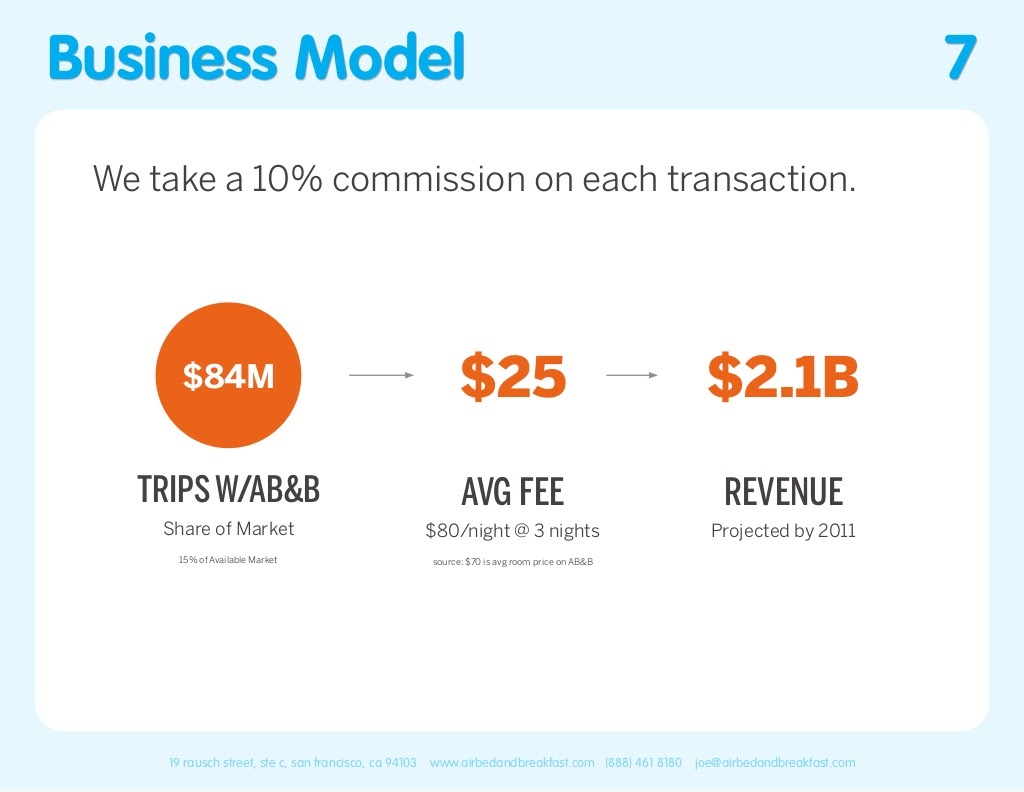
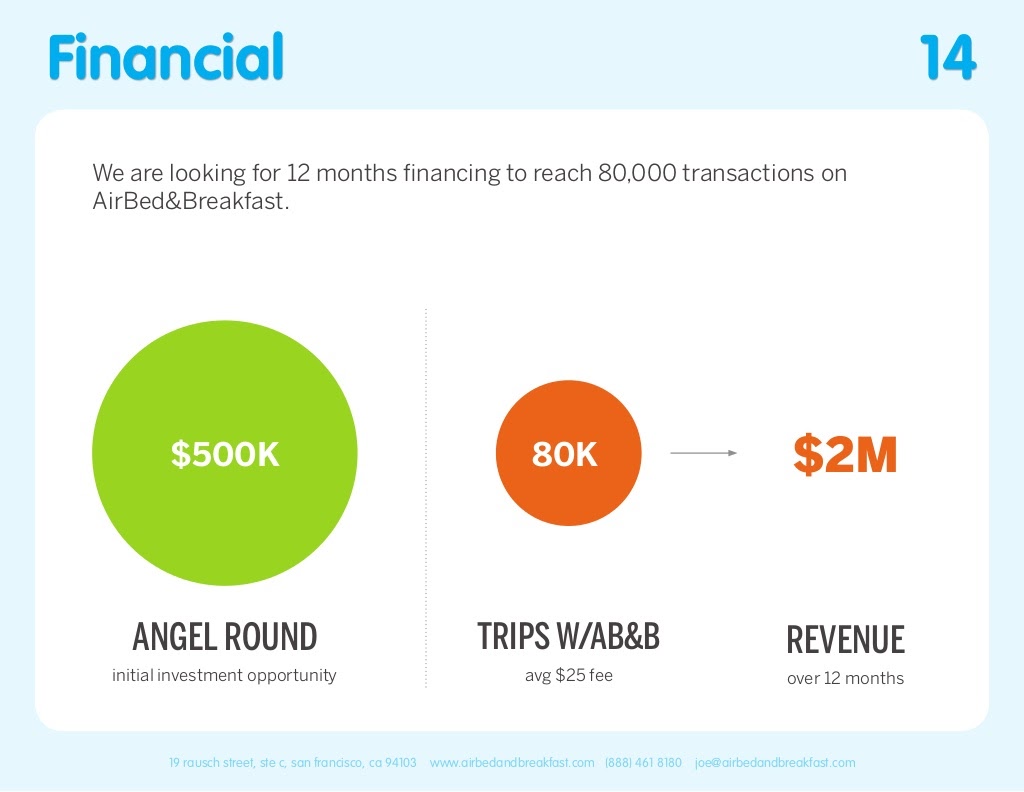
The deck lays out a straightforward revenue model — a percentage commission per transaction — and couples it with conservative projections and a specific ask. Slide 22 shows the ‘we take a 10% commission’ business model with simple big-number projections ($84M, $25 average fee, $200M projected revenue). Slide 10/11 present the specific seed ask ($500K) and how it maps to expected transactions and revenue. The clarity and arithmetic make it easy for investors to evaluate the economics and the capital efficiency of the proposed plan.

Founders should adopt this directness: state the monetization mechanism plainly, show the math for how users convert to revenue, and tie the fundraising ask to measurable milestones (users, transactions, revenue). Avoid vague statements — investors want to see how their capital will move metrics over a defined time window.

Key Takeaway: Explain your monetization with simple unit economics and link the fundraising ask to concrete milestone-driven outcomes.
Team slide: Highlight relevant backgrounds and credibility

Team slide: Highlight relevant backgrounds and credibility

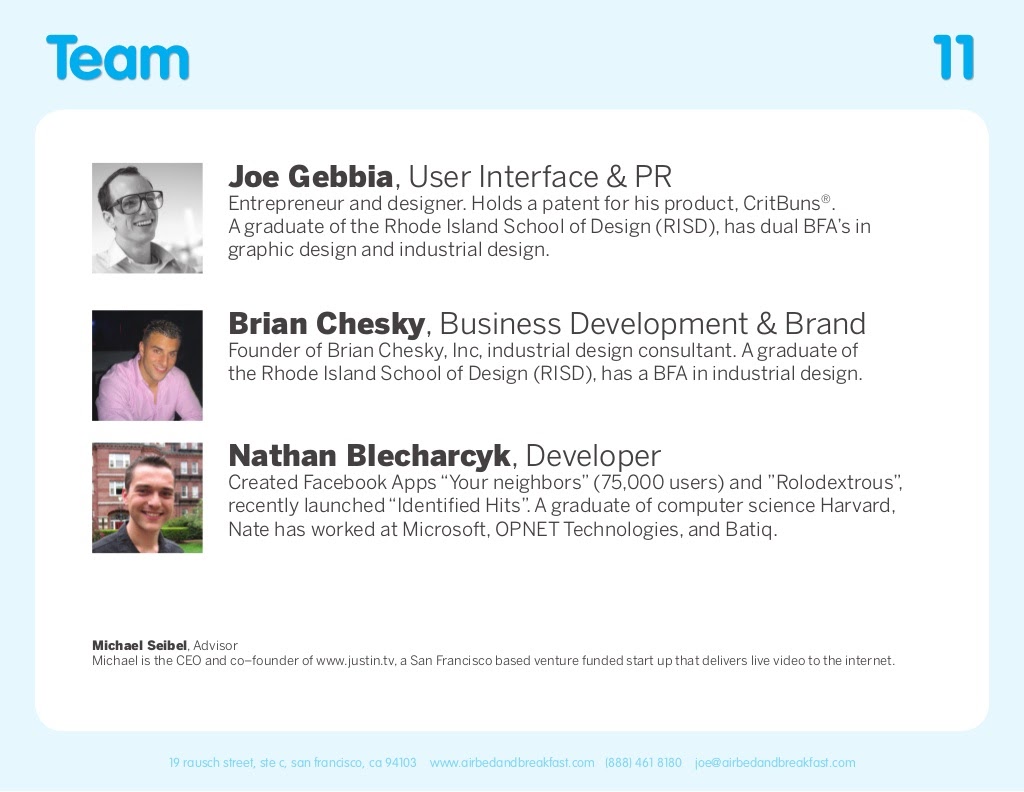
Slide 16 (Team) presents the founders with short blurbs tying their skills to the product needs — design/UI, brand/business, and technical capabilities. It also mentions a known advisor (Michael Seibel) which signals early access to network and mentorship. The layout is clean, focused on roles and relevant experience rather than CV-length bios, which keeps the investor’s attention on why this team can execute.

For founders, the takeaway is to emphasize complementary skills, prior relevant accomplishments and advisors that bring credibility. Keep bios punchy and role-focused — investors want to quickly see fit between team capabilities and product requirements.

Key Takeaway: Show complementary founder roles and a few concrete achievements or advisors that demonstrate the team can deliver.
Traction & social proof: Use testimonials and press to build trust

Traction & social proof: Use testimonials and press to build trust

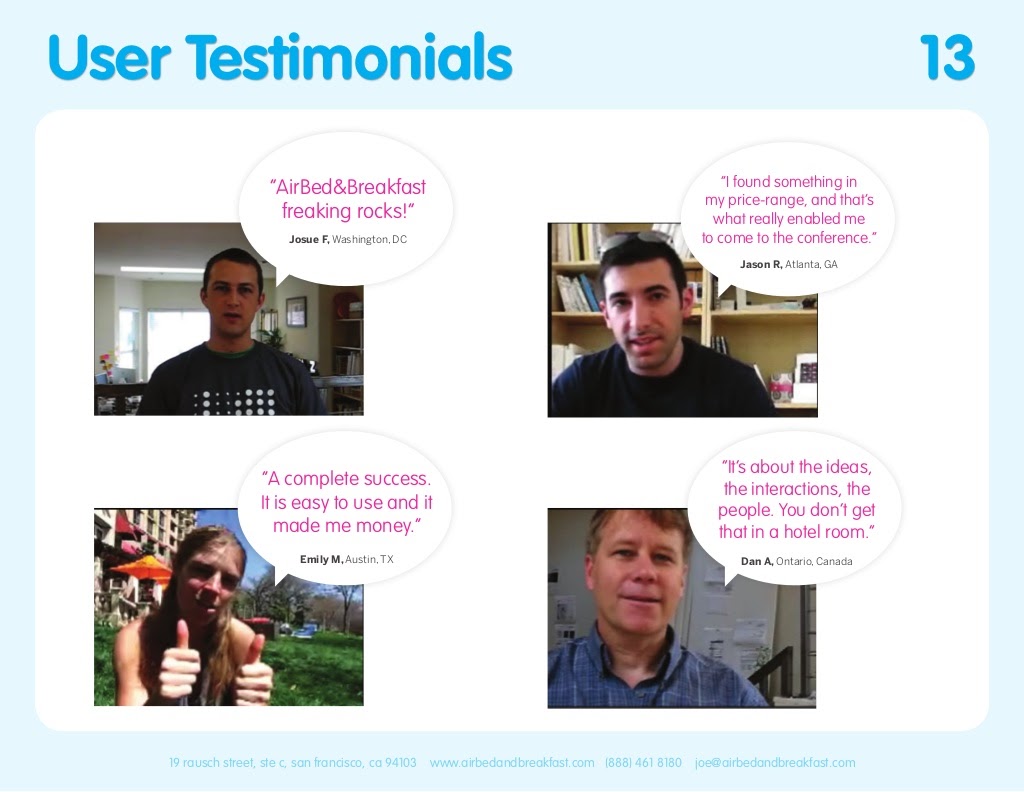
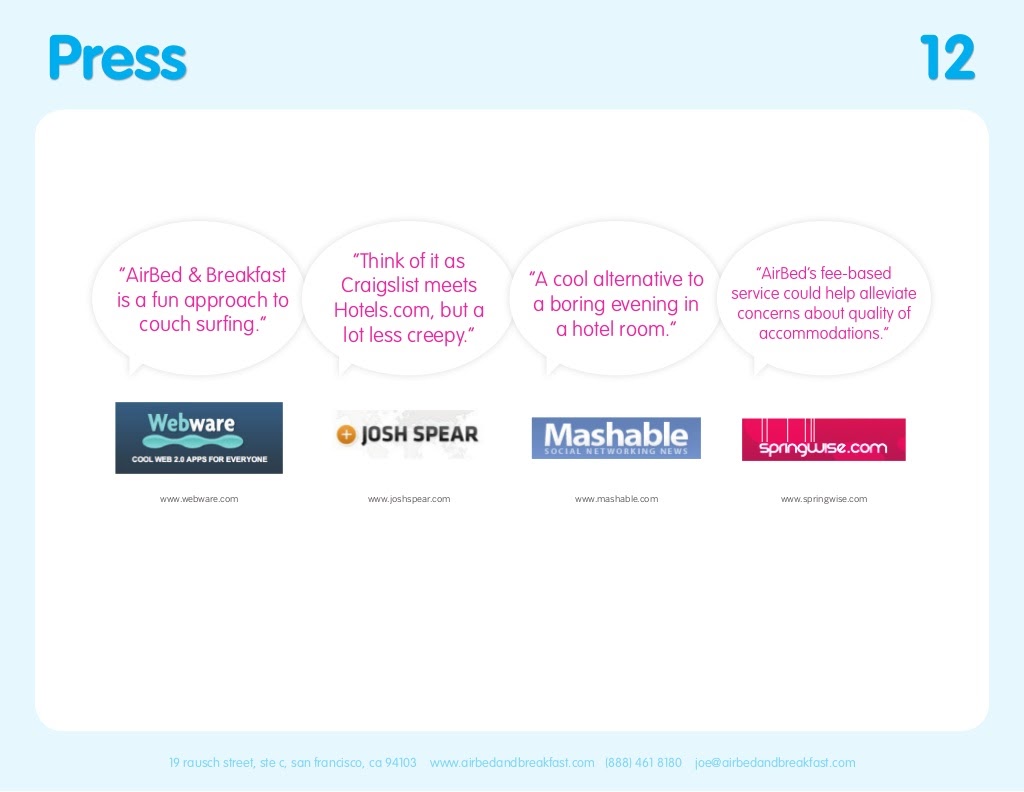
The deck uses user testimonials (Slide 11/12 equivalents) and press quotes (Slide 14) to provide social proof that the service resonates with users and the media. The testimonials are short, credible and paired with faces, while press snippets position the product in relation to known services (Craigslist, CouchSurfing) — framing Airbnb as a safer, more commercial alternative. This multi-channel social proof helps reduce perceived risk for users and investors alike.

Founders should gather and present early qualitative proof (user quotes, screenshots of bookings, press mentions) to humanize traction. Concrete anecdotes backed by numbers (when available) can be more persuasive than polished projections alone.

Key Takeaway: Augment early metrics with user quotes and press highlights to lower perceived risk and show genuine demand.

Conclusion: Key Lessons

Airbnb’s seed deck is effective because it blends emotional storytelling, succinct problem/solution framing, clear product proof, credible market validation, simple unit economics and a confident team pitch. The deck is visually coherent, prioritizes a few high-impact points per slide, and ties the fundraising ask to explicit milestones. Actionable advice for founders: lead with a single, memorable value proposition and evocative imagery; state concrete customer pains; pair benefits with real product screenshots; present credible market evidence and straightforward unit economics; and spotlight a complementary team with relevant credibility. Keep it simple, visual and milestone-driven — clarity and focus are the most persuasive tools at the seed stage.