Stack up against Amplitude

Compare Your Deck

Amplitude's 2017 Pitch Deck

SaaS
Stage: Series C
Raised: $30M
Year: 2017
Slides: 8
Outcome: IPO at $5B valuation

Pitch Deck

1 / 8
Slide 1
Click to expand

Deck Analysis

This Series C pitch deck from Amplitude (2017) positions the company as the product analytics platform that helps enterprise product teams "build better products." The deck pairs clear market framing — the digital transformation of all industries — with concrete proof points: marquee customers, a steep ARR growth chart, and product capabilities that address complex, behavioral questions. What makes it notable is the combination of storytelling (why the market needs a new class of analytics) and tactical product positioning (real-time behavioral queries, scalability, and collaboration) that foreshadowed Amplitude's later success and eventual IPO.

The Opening: Strong branding and a clear mission

The Opening: Strong branding and a clear mission

Slide 1 is a classic example of how to open a deck: single, clean visual with the logo, a short, memorable tagline (“Build Better Products”), and a date. The slide sets tone and audience expectations without distracting details — investors immediately know this is a product-focused company and that the deck will be about enabling product teams. The background cityscape and consistent color palette also establish brand identity and professionalism.

Founders can learn from this restraint: a title slide should establish the mission and brand cadence, not cram in metrics or team bios. That one-line mission gives the rest of the presentation a through-line, so every subsequent slide can be judged against whether it helps teams “build better products.”
Key Takeaway: Open with a concise mission and clean brand presentation that sets the narrative for the rest of the deck.
Traction & credibility: customers, team, and growth

Traction & credibility: customers, team, and growth

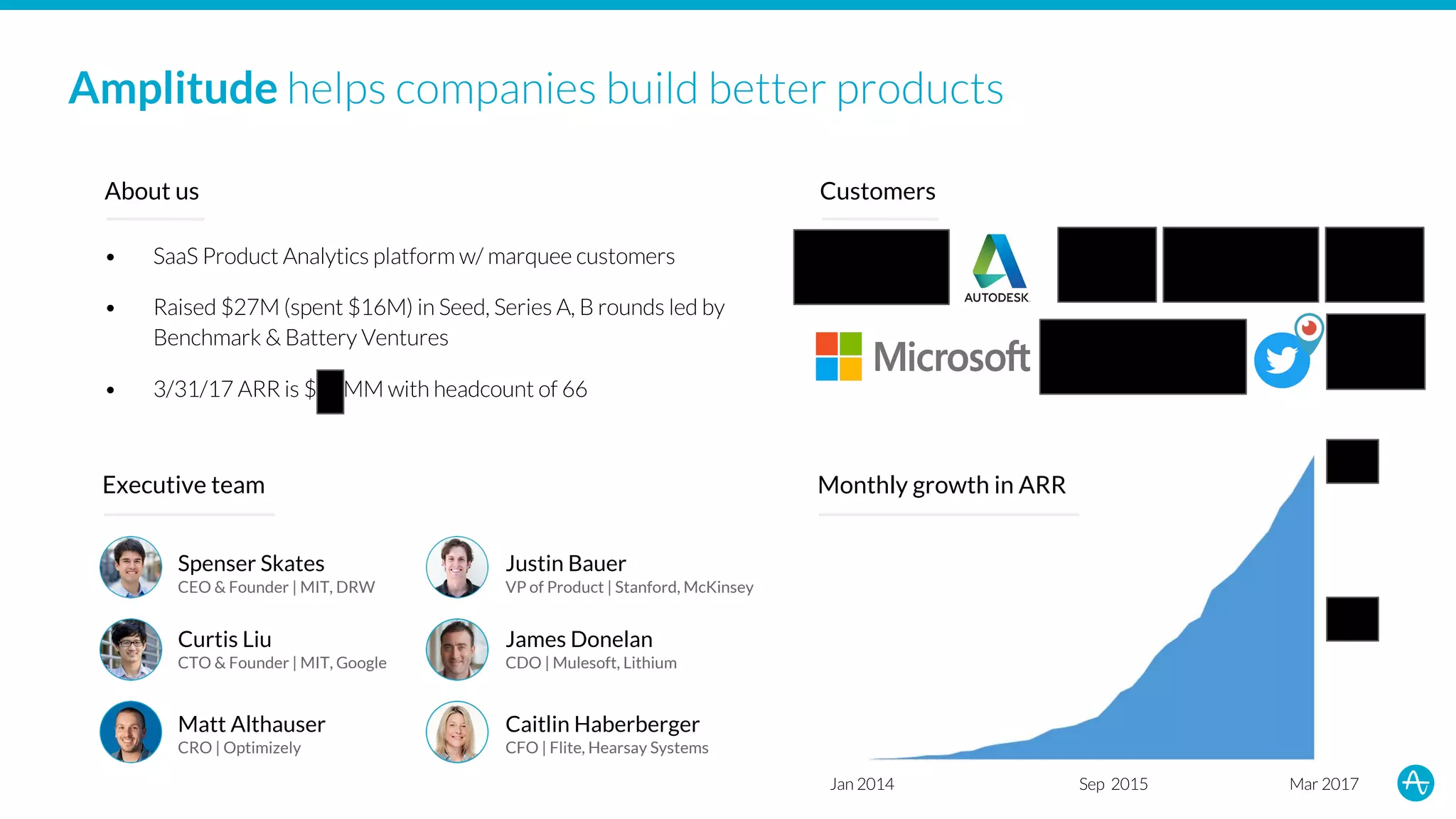
Slide 2 packs several investor-critical elements: a short ‘About us’ summary, financing history, ARR and headcount (ARR partially redacted here), marquee customers (logos), executive team photos/bios, and a clear chart of ARR growth. This slide balances social proof (Microsoft, Autodesk, Twitter icons) with operational evidence (rapid ARR curve and a headcount metric). Showing the executive team with affiliations (MIT, Stanford, McKinsey, Optimizely) reinforces that the company has relevant domain and execution experience.

The design is effective because it consolidates trust signals that VCs look for at a Series C: repeatable revenue trajectory, endorsements from recognizable customers, and a strong leadership bench. Founders should note the order — customers and growth are prominent — and that high-quality visuals (portraits, logos, and a simple growth area chart) communicate maturity faster than text-heavy slides.

Key Takeaway: Combine a concise summary of traction with recognizable customers and a clean growth chart to quickly demonstrate momentum and credibility.
Market narrative: everyone is becoming a digital product business

Market narrative: everyone is becoming a digital product business

Slide 3 delivers the core market insight in a single, emphatic sentence: “All companies are turning into digital product businesses.” It’s a crisp macro thesis that creates urgency and frames the addressable market. By making this the anchor, Amplitude primes investors to interpret subsequent slides through the lens of widespread digital transformation rather than a niche analytics play.

This approach teaches founders to lead with a broad, intuitive market shift that justifies a large opportunity. The simpler and more universal the statement, the easier it is for investors to map industry trends (mobile, SaaS, IoT) onto the product’s value proposition. A one-line market thesis is especially powerful when followed immediately by concrete examples and customer evidence.

Key Takeaway: Lead with a single, memorable market thesis that explains why demand for your product will scale across industries.
Contextualizing change: historical shifts that make product the channel

Contextualizing change: historical shifts that make product the channel

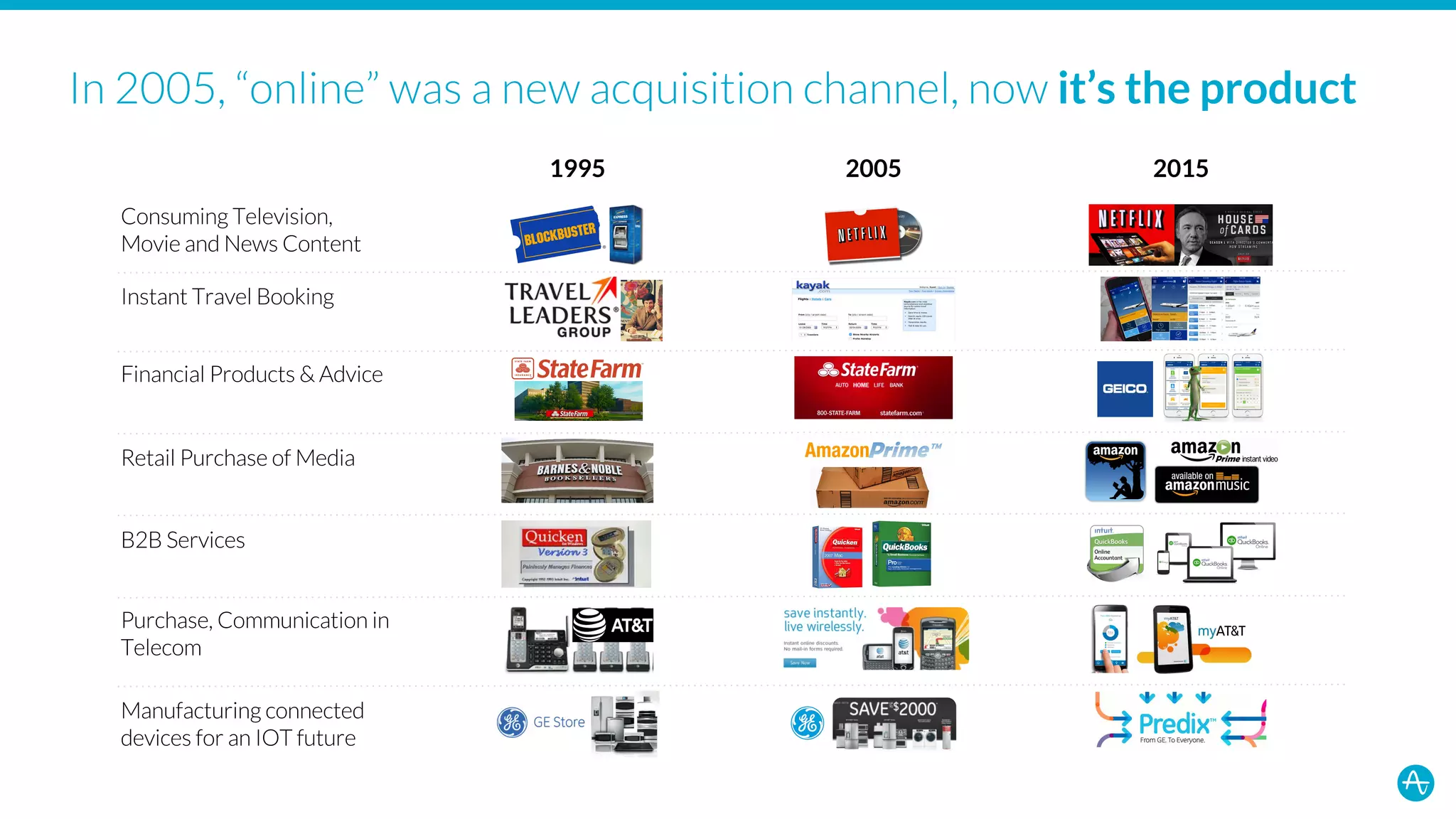
Slide 4 uses a three-column timeline (1995, 2005, 2015) across multiple verticals to show how digital channels evolved into product experiences (e.g., Netflix, Amazon, GE Predix). This visual mapping is persuasive: it converts an abstract trend into tangible, familiar examples and demonstrates that what were once marketing or distribution innovations are now core product experiences. It’s effective because it educates the investor and strengthens the claim that product analytics is now mission-critical.

Founders can replicate this by grounding big market claims with simple historical comparisons and industry logos that highlight progress over time. The slide also implicitly argues that incumbent approaches (legacy analytics) are obsolete — a gentle setup for introducing a differentiated solution.

Key Takeaway: Use historical, cross-industry examples to make the market transition tangible and justify the need for a new category of product tools.
Problem definition: product teams need to measure complex behavior

Problem definition: product teams need to measure complex behavior

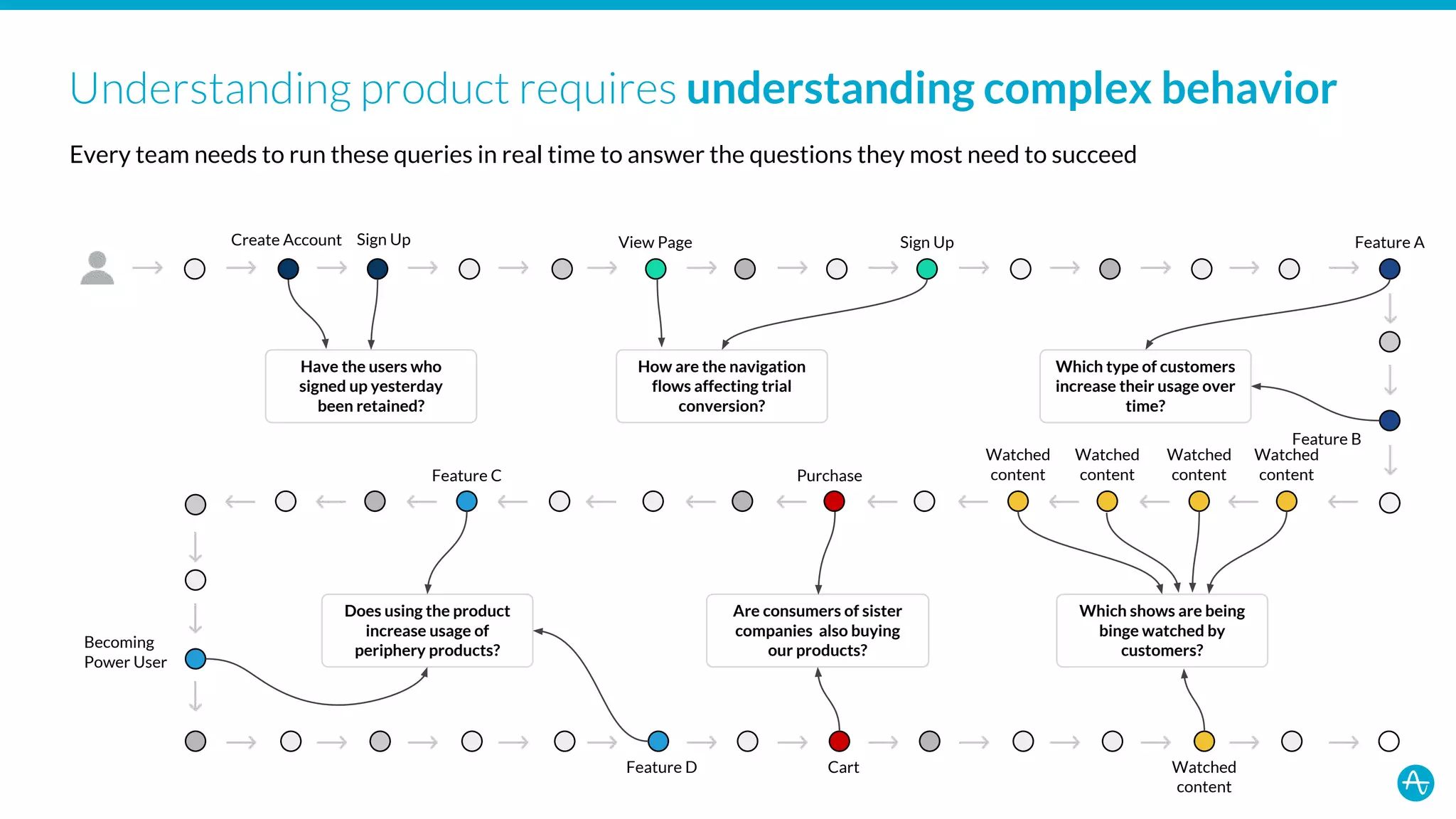
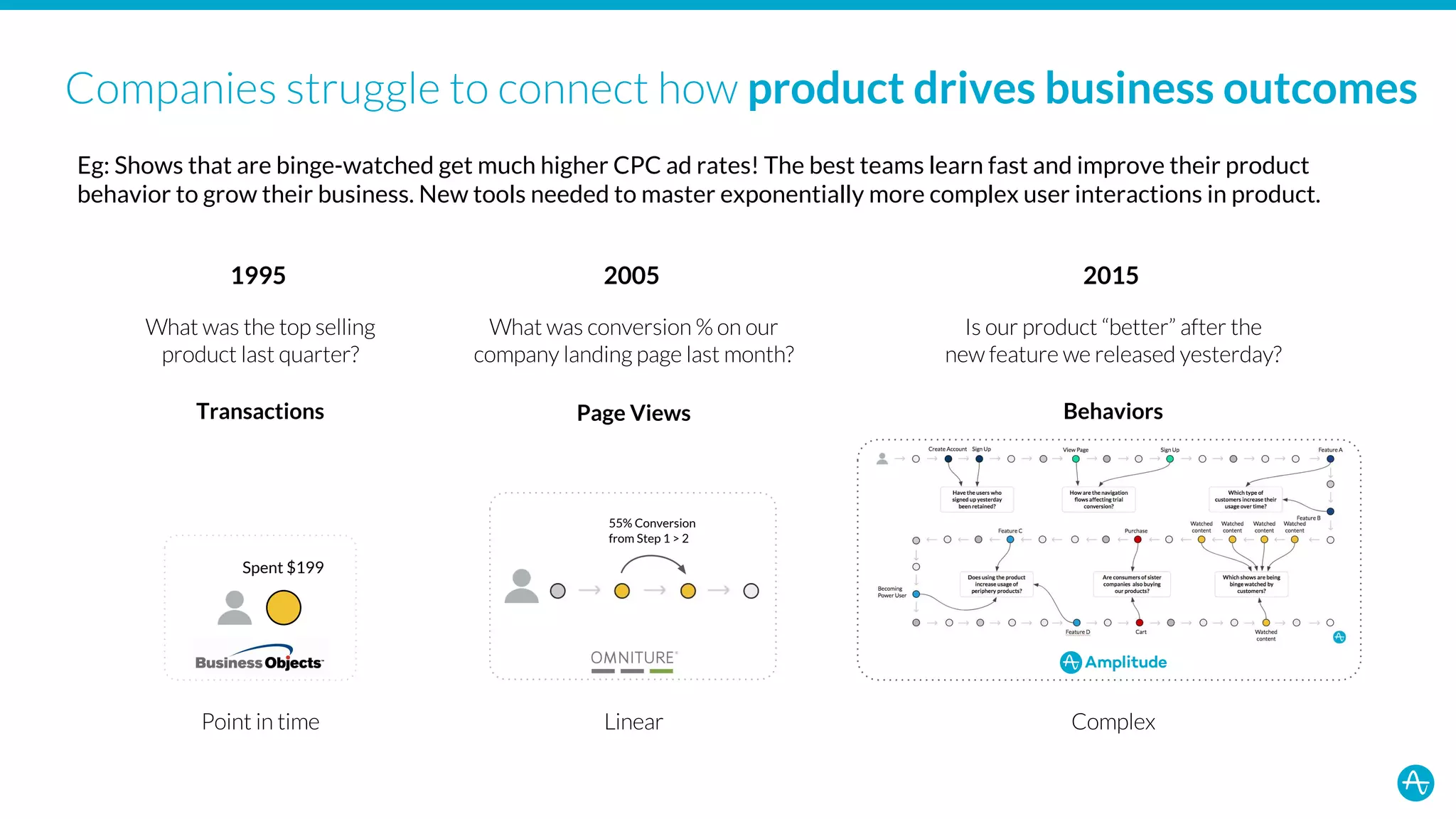
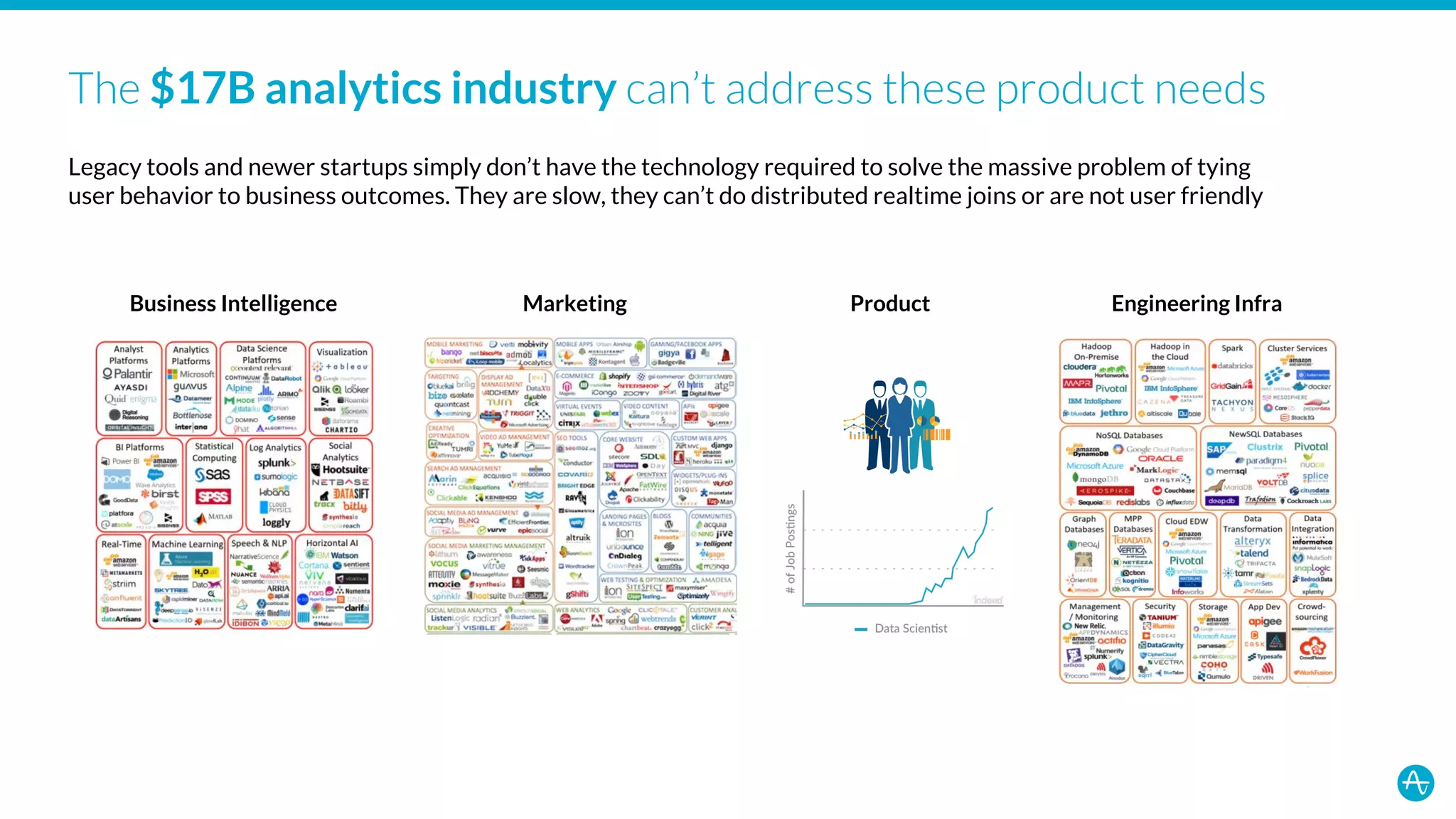
Slide 6 frames the technical and operational challenge: understanding product requires understanding complex, multi-step user behaviors and being able to run those queries in real time. The slide contrasts prior eras (point-in-time transactions, linear page views) with modern behavioral complexity, making it clear why legacy BI and marketing analytics fall short. It articulates the pain point in user and team language — not just technical jargon — which helps non-technical investors grasp product-market fit.

This is an instructive example of problem-first storytelling. By demonstrating the kinds of questions product teams actually ask (retention of yesterday’s signups, conversion flows, which customers increase usage), the deck signals that Amplitude’s feature set was purpose-built. For founders, the lesson is to present the precise, job-to-be-done for customers and show why incumbents can’t solve it — then align product capabilities directly to those jobs.

Key Takeaway: Spell out the concrete, modern customer problems that incumbents can’t solve and map them to real user questions product teams ask.
Product & GTM: capabilities that match the problem

Product & GTM: capabilities that match the problem

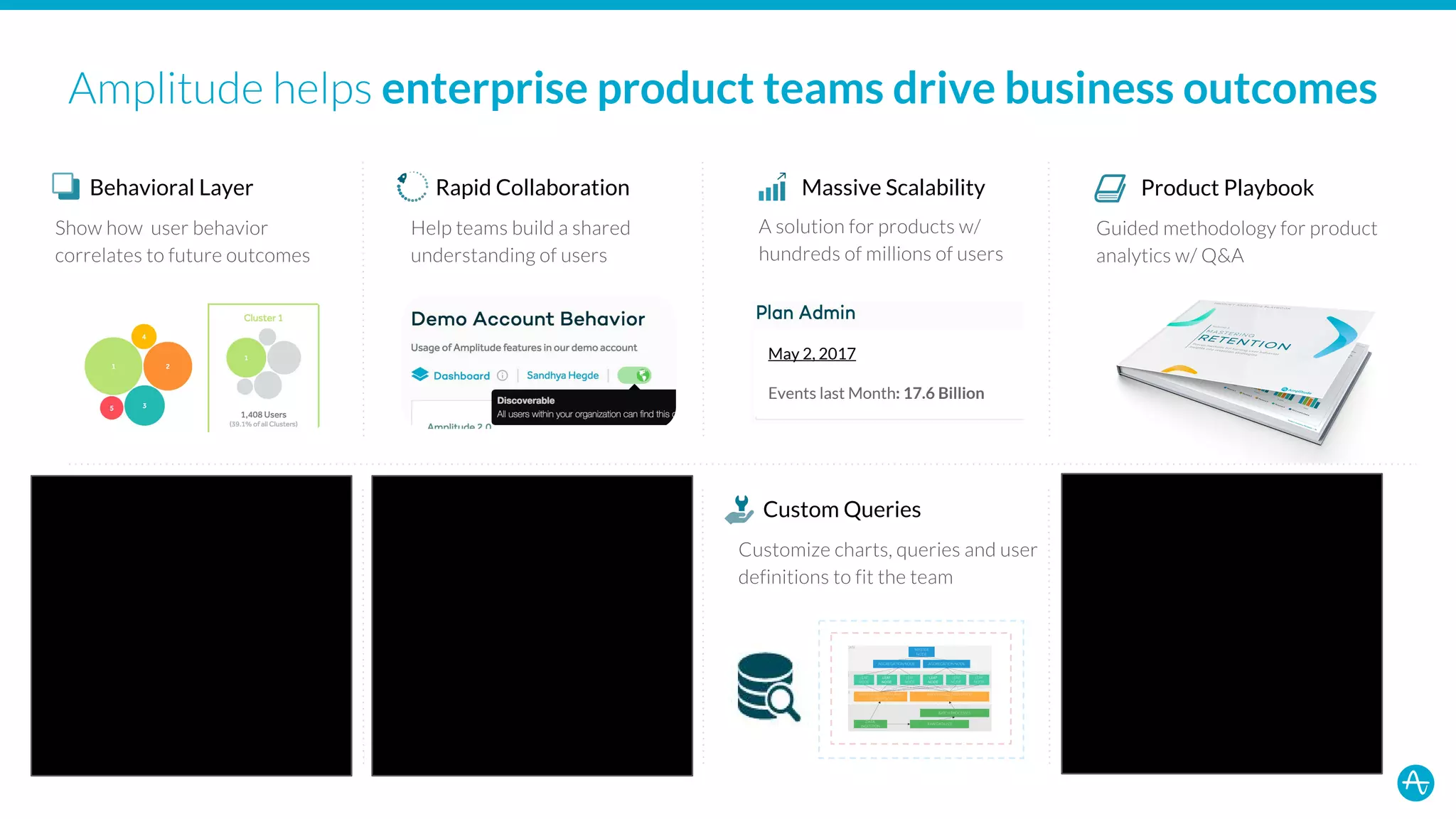
Slide 8 transitions to solution and value props: Behavioral Layer, Rapid Collaboration, Massive Scalability, Product Playbook, and Custom Queries. Each capability maps neatly back to the problems earlier slides described — showing causality between need and feature. The inclusion of an example metric (events last month: 17.6B) and the emphasis on collaboration and playbooks indicate Amplitude’s focus on enterprise customers, not just data teams.

This slide is effective because it moves beyond generic claims to tactical differentiators: real-time scale, team workflows, and methodology. Founders should emulate this structure when describing products: list a small set of differentiated capabilities, tie each to customer outcomes, and include at least one operational metric to prove scale.

Key Takeaway: Present a concise set of differentiated capabilities tied directly to customer outcomes and back them with a scale metric.

Conclusion: Key Lessons

Amplitude’s Series C deck is a strong example of narrative-driven pitch design: start with a crisp mission, define a broad market thesis, show credible traction, explain the specific hard problem customers face, and then present targeted capabilities that solve those problems at scale. Strengths of the deck include visual clarity, strong social proof, and a tight mapping from market insight to product features. For founders building their own decks, actionable advice is to lead with one bold market insight, use recognizable examples and logos to quantify that insight, prioritize problem-driven storytelling (real user questions), and present a short set of differentiated capabilities tied to measurable signals of scale and adoption. Finally, keep slides visually clean and use each one to advance the narrative rather than dump data — clarity and causality win minds and checks.