Stack up against Theranos

Compare Your Deck
Cautionary Tale

Theranos's 2006 Pitch Deck

Cautionary Tales
Stage: Series C
Raised: $28.5M+
Year: 2006
Slides: 24
Outcome: FAILED - Fraud, dissolved

Pitch Deck

1 / 24
Slide 1
Click to expand

Deck Analysis

This deck is Theranos's Series C investor presentation from 2006. It presents a bold vision: a low-volume blood-testing cartridge and reader plus an informatics backend to enable real-time drug monitoring and post-prescription patient management. The slides mix product imagery, performance claims, clinical use-cases and large market estimates to make a fast, venture-friendly story — notable both for how convincingly it packaged a complex technology for investors and, retrospectively, for how many high‑impact claims went insufficiently substantiated before massive capital was raised and the company ultimately failed amid fraud allegations.

The Opening: Clear branding and investor framing

The Opening: Clear branding and investor framing

Slide 1 is the simple cover page with the Theranos logo, the phrase 'A Presentation For Investors' and a date (June 1, 2006). It’s minimal and professional, immediately signaling the audience and purpose. For investors, this sets expectations: a focused pitch, not a product brochure. The design is clean and unobtrusive, which helps direct attention to the name and the ask that follows.

Key Takeaway: Start with a clean, audience-specific cover that signals purpose and date — small details build credibility.
Company overview and go-to-market focus

Company overview and go-to-market focus

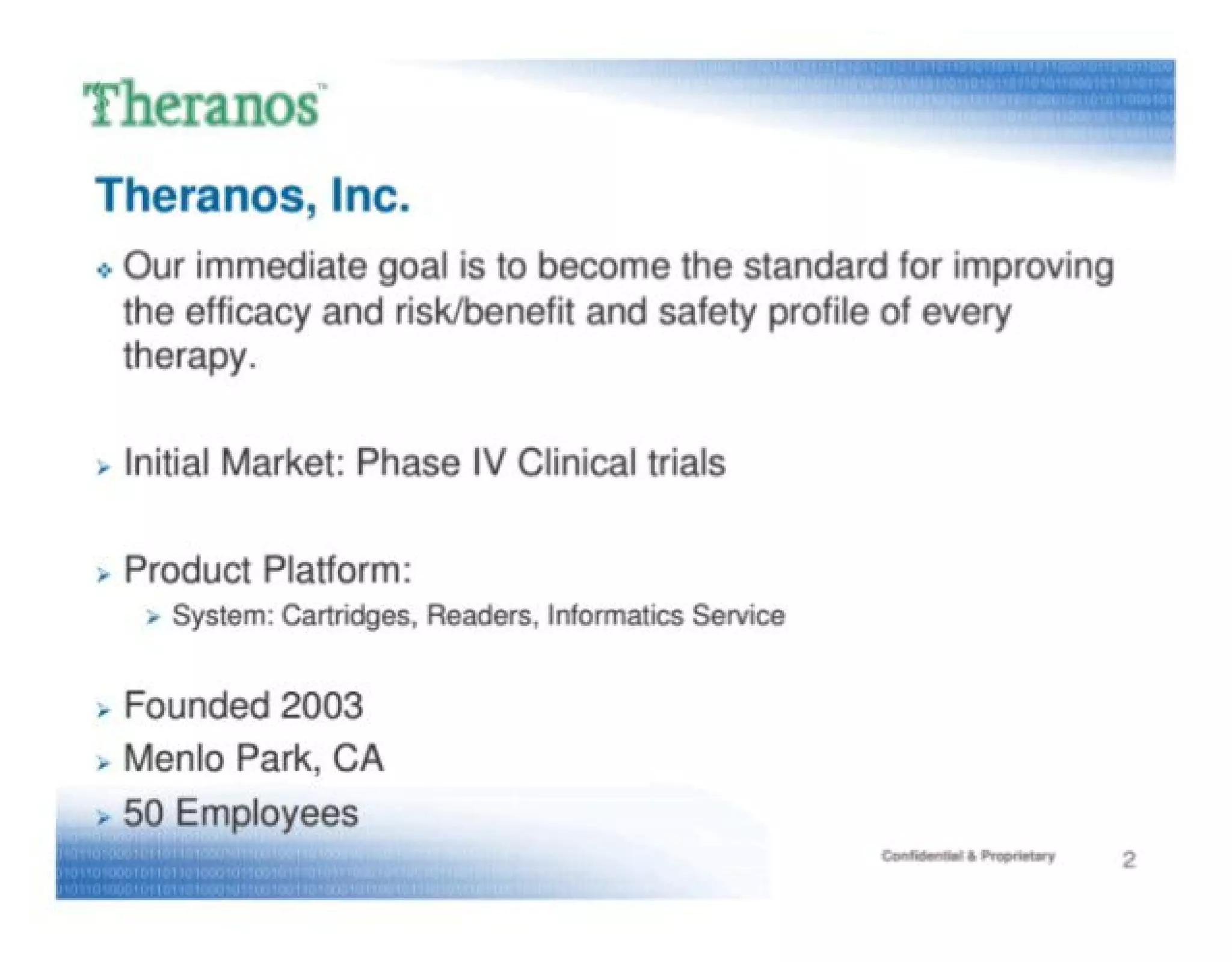
Slide 2 lays out the company's immediate goal, initial market (Phase IV clinical trials), product platform (cartridges, readers, informatics) and basic company facts (founded 2003, Menlo Park, 50 employees). This is effective because it quickly answers the who/what/where/why that investors want and ties the technology to a specific commercial entry point (post-marketing clinical trials) rather than an abstract 'healthcare' promise. Framing the initial market narrowly helps investors assess near-term traction potential and the revenue model.

Key Takeaway: Define a realistic initial beachhead market and explain the product components that map directly to that market.
Team slide: show depth but avoid vague credentials

Team slide: show depth but avoid vague credentials

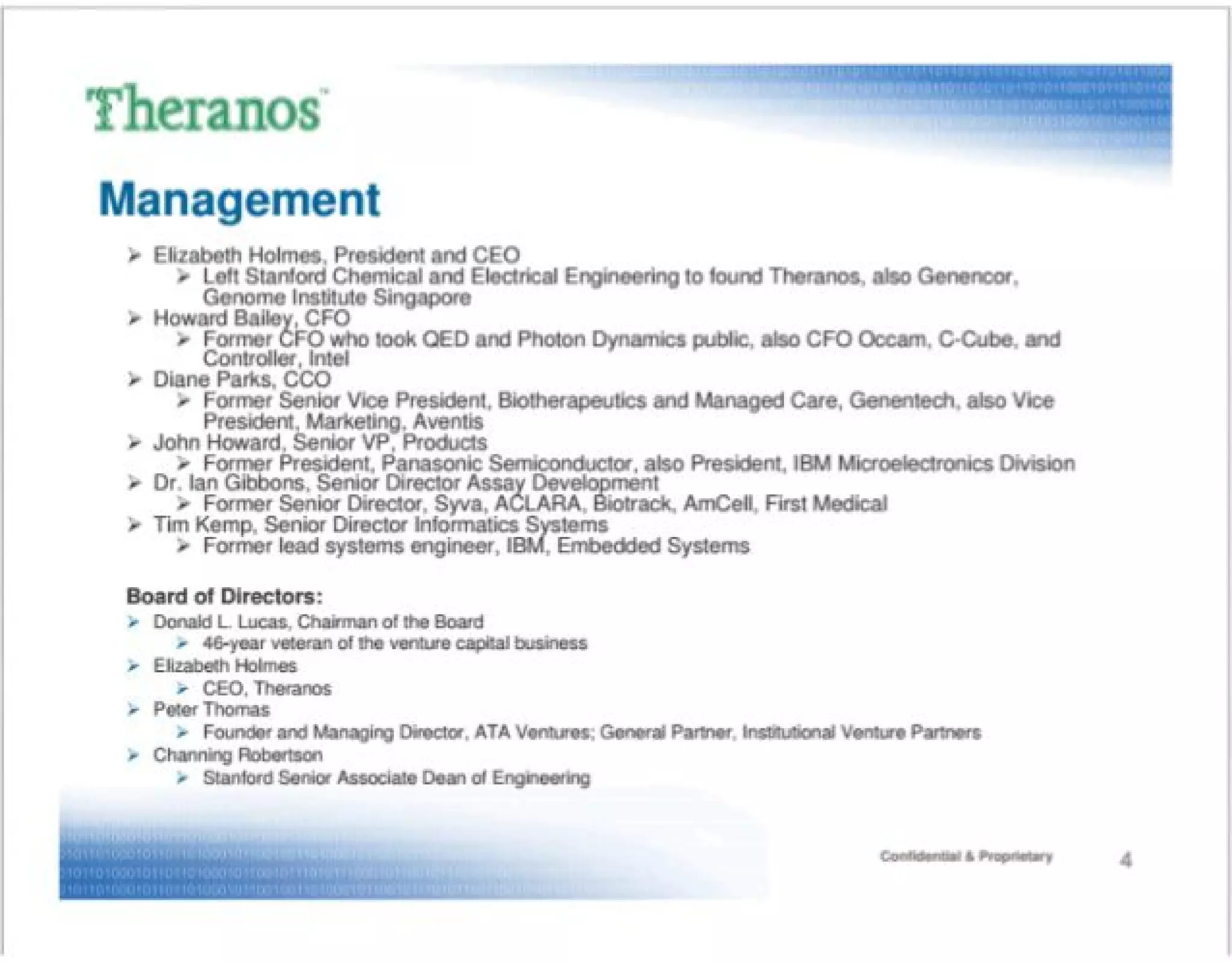
Slide 4 (Management) lists leadership and board members with short bios and past affiliations. It attempts to reassure investors by mixing industry veterans and technical leads. A strong team slide pairs relevant experience with clear roles; investors look for operational and scientific credibility. Theranos’s slide shows that principle: it highlights executives with prior exits and big-company experience to suggest the capacity to scale.

Key Takeaway: List leaders and board members with concise, relevant credentials and quantifiable achievements to give investors confidence — but also ensure governance and transparent validation.
Product visuals and the ‘what is our system’ story

Product visuals and the ‘what is our system’ story

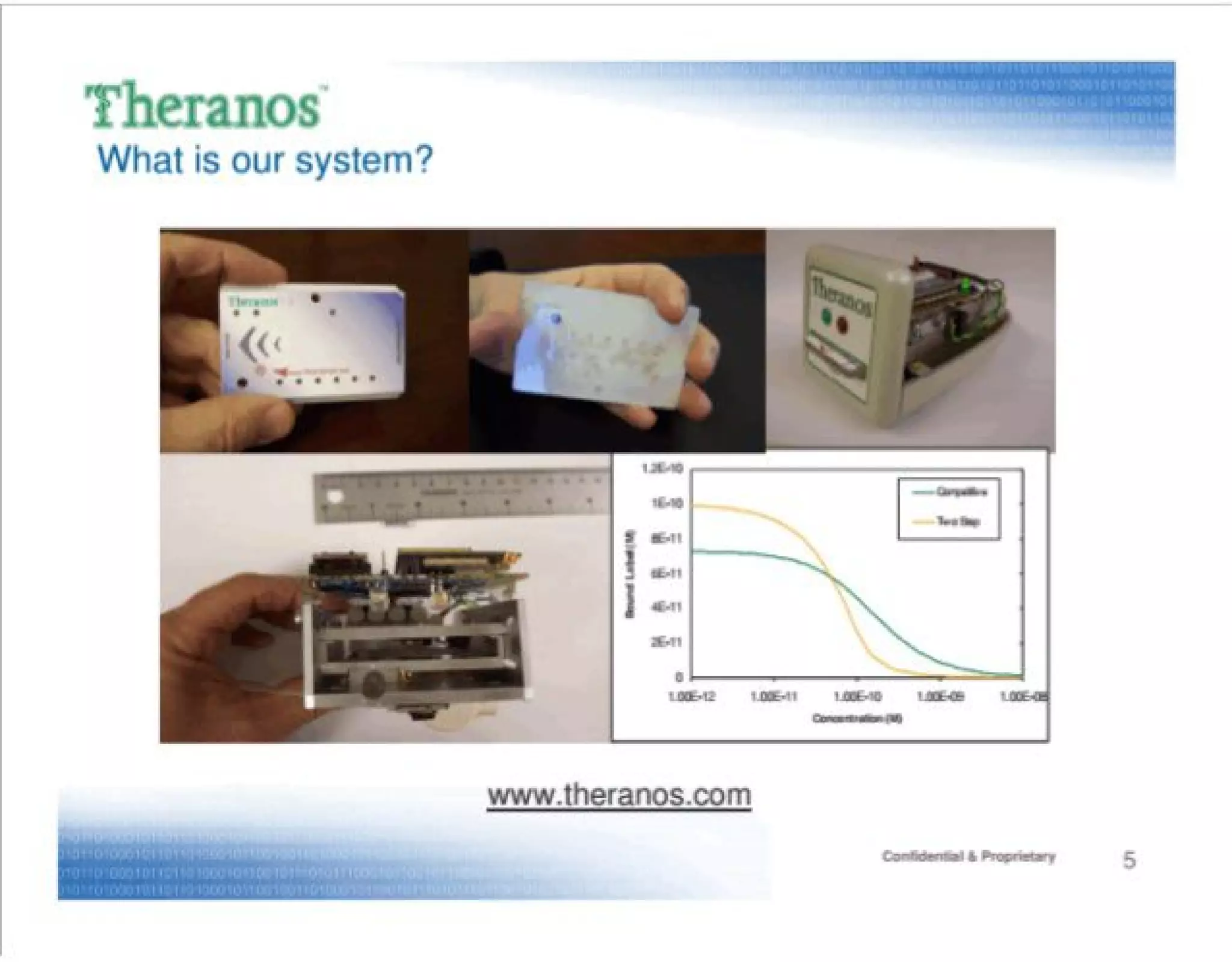
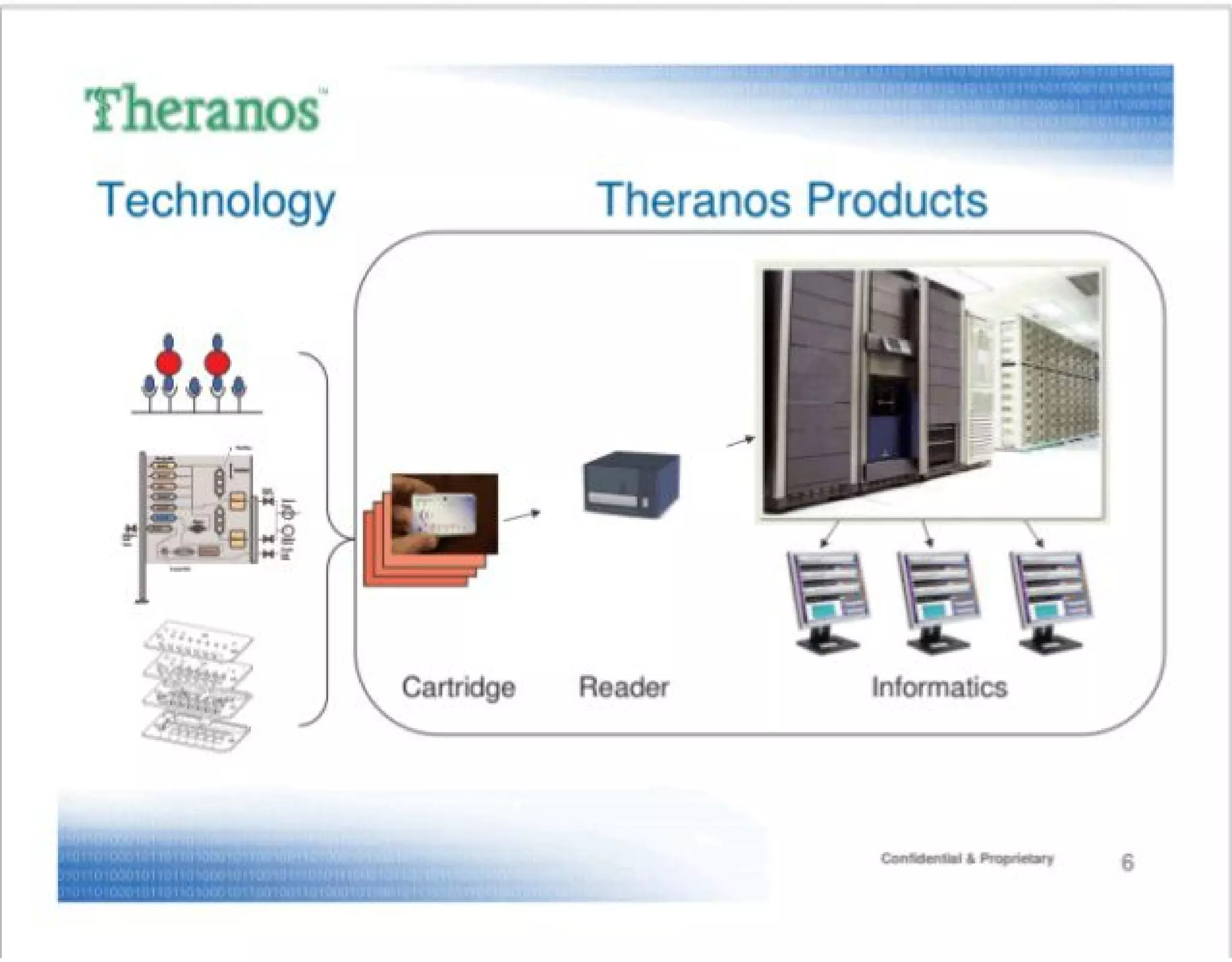
Slide 5 shows photos of cartridges, readers and a compact instrument, plus a simple graph. Visuals make the product tangible: investors can see scale, form factor and that some prototype exists — important for hardware and diagnostics companies. The deck uses imagery to bridge the technical world and the investor's need to believe something physical is being built. Showing multiple views (cartridge, internal components, and a result curve) is a good way to communicate complexity without overwhelming.

Key Takeaway: Use clear, honest product photos and representative outputs to make the technology tangible — but pair them with objective validation data.
Product features and technical claims

Product features and technical claims

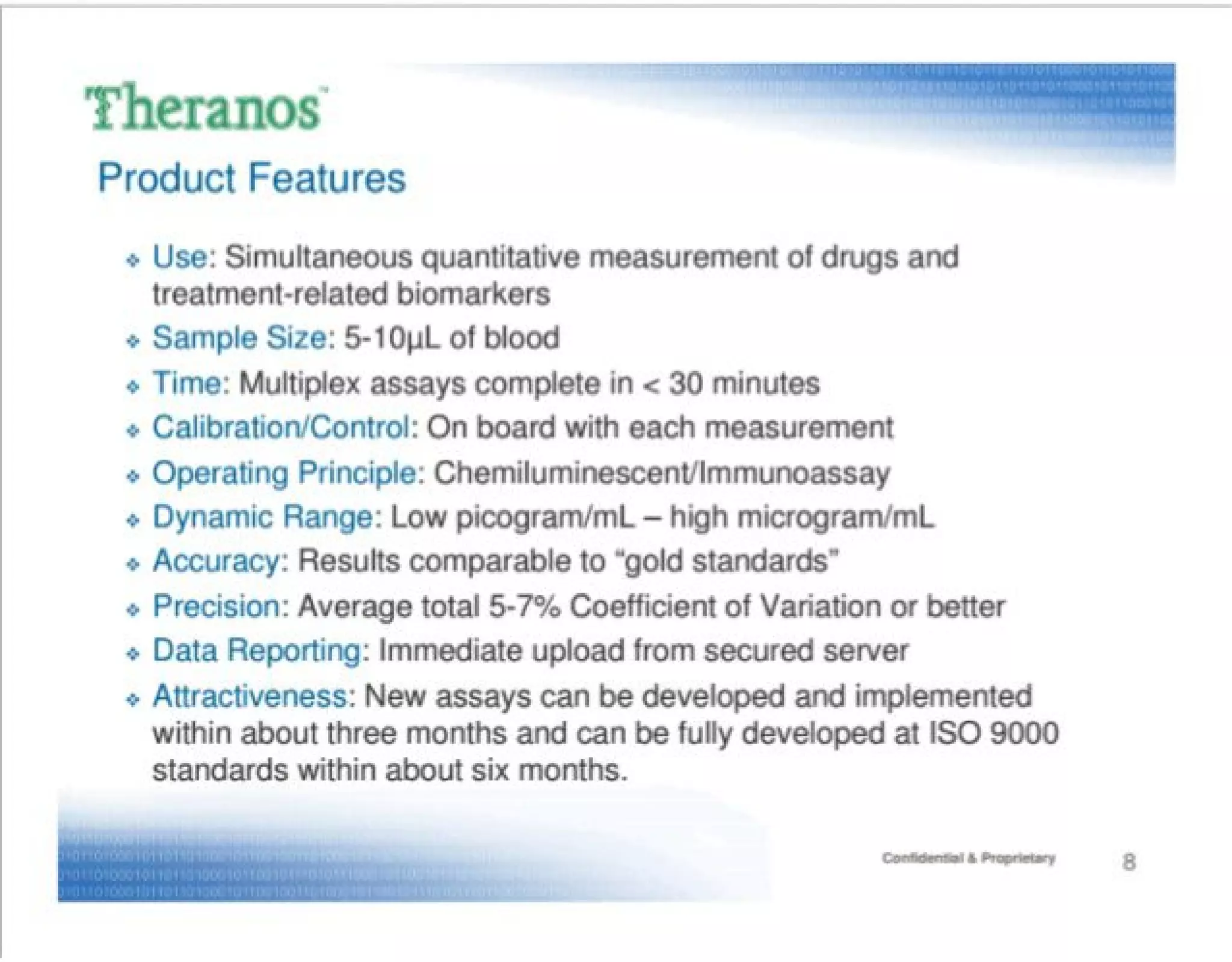
Slide 9 (Product Features) lists key technical specs: sample size (5–10 µL), time to result (<30 minutes), operating principle (chemiluminescent/immunoassay), precision (5–7% CV), immediate upload to secured server, and an attractive development timeline for new assays. This succinct, bullet‑point approach is effective because it addresses common diligence questions—sample volume, throughput, accuracy and data handling—without bogging down the deck.

Key Takeaway: State core technical specifications clearly and concisely, and be prepared to substantiate each claim with protocol-level data and third-party comparisons.
Market sizing and revenue assumptions

Market sizing and revenue assumptions

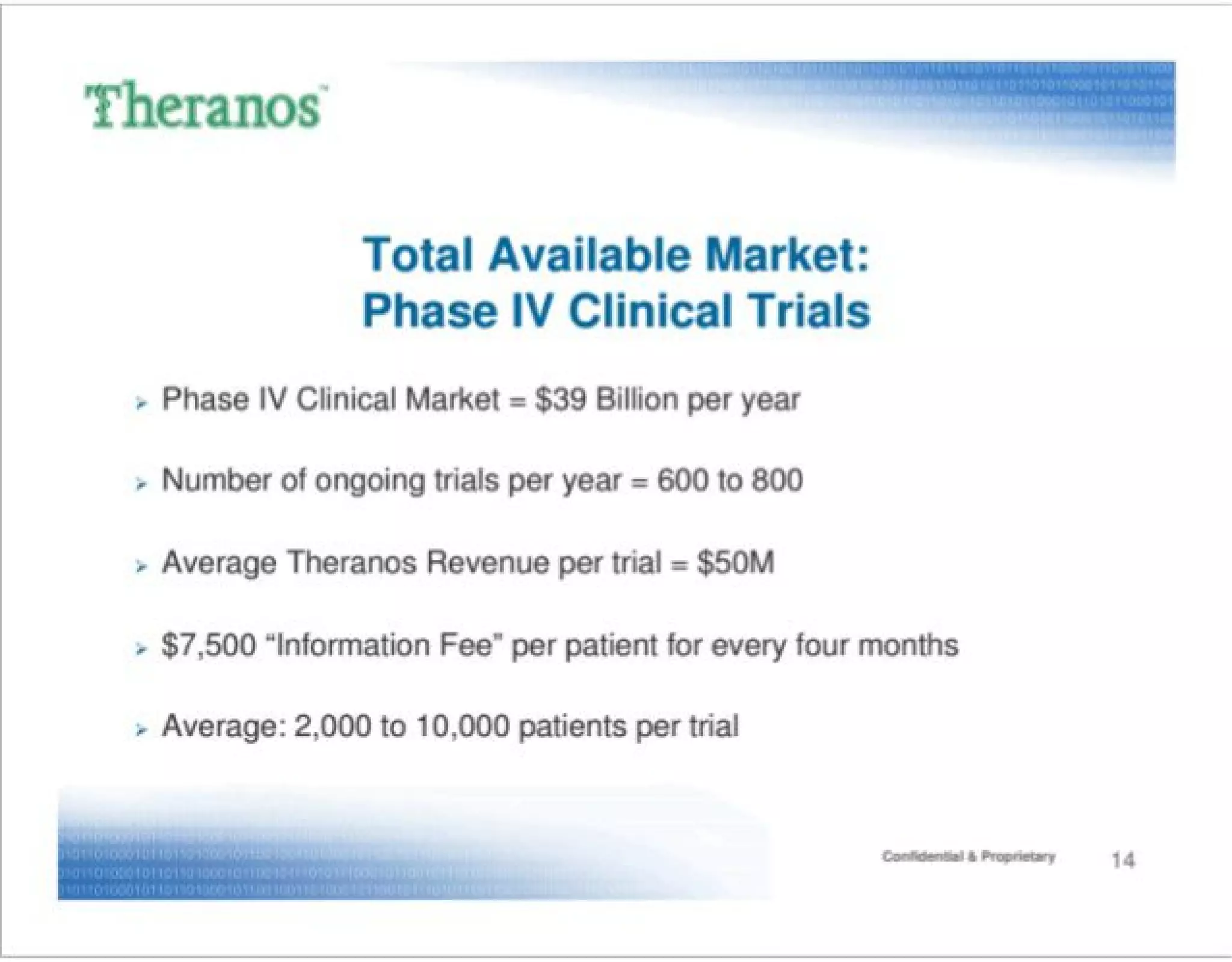
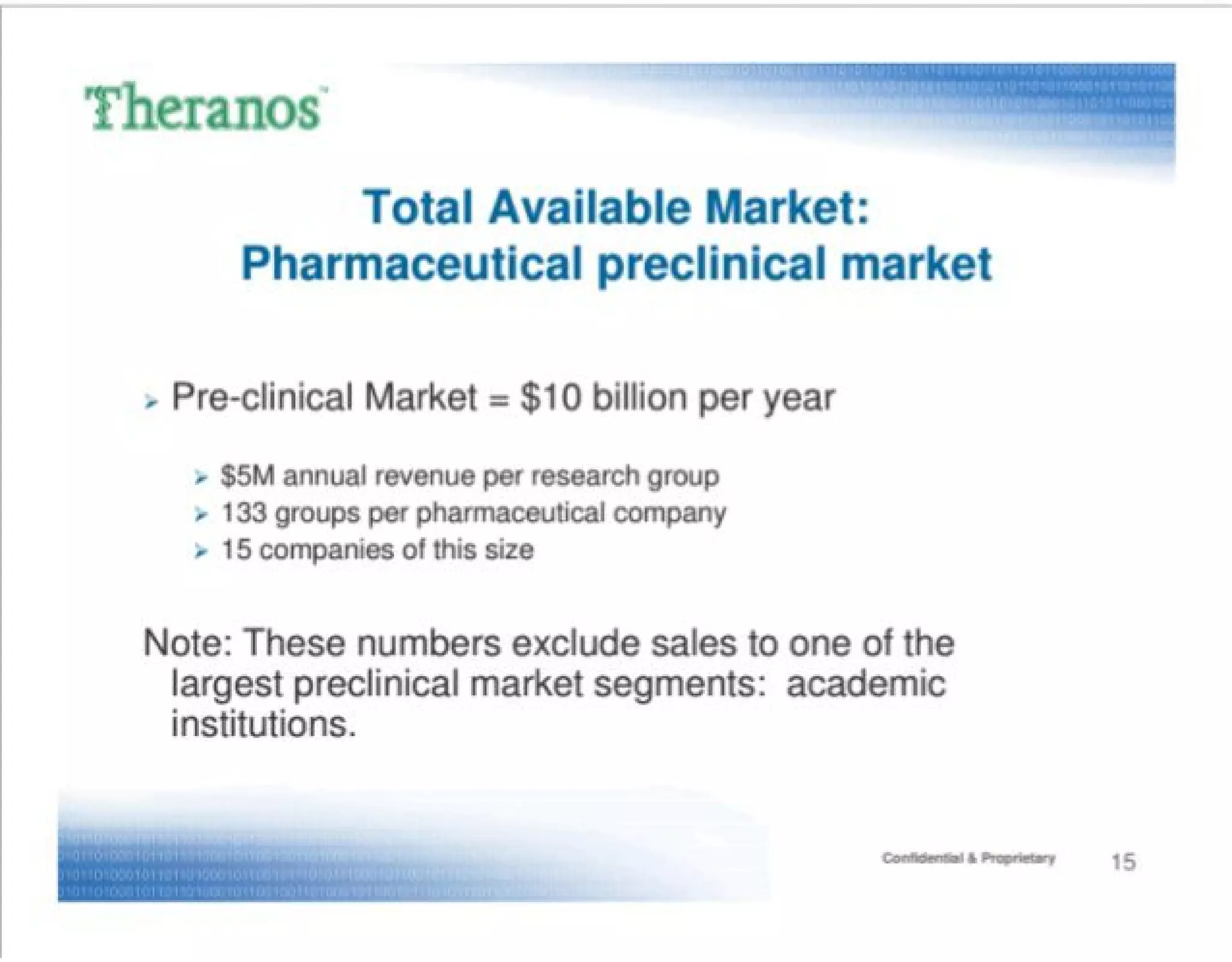
Slide 14 provides TAM details for Phase IV clinical trials: a $39B/year market, 600–800 ongoing trials, average Theranos revenue per trial of $50M, and an information fee model per patient. This is classic VC-facing math: combine a credible market segment with a clear monetization model to arrive at large revenue potential. Presenting trial counts and average revenue per trial helps investors do back-of-envelope checks quickly.

Key Takeaway: Show TAM with clear unit economics and conservative adoption assumptions; make it easy for investors to sanity-check your revenue math.
The offering and investor list: clarity and credibility

The offering and investor list: clarity and credibility

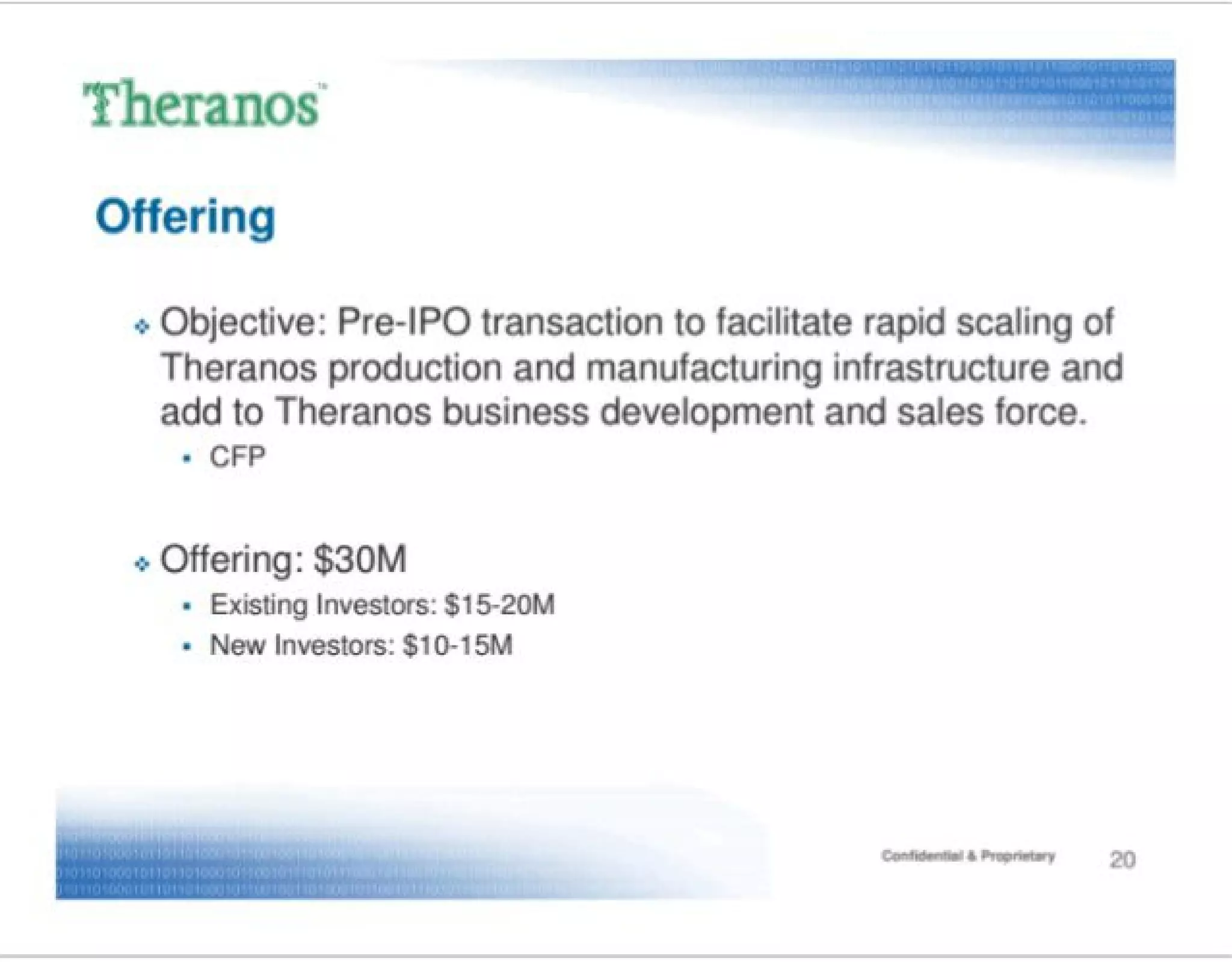
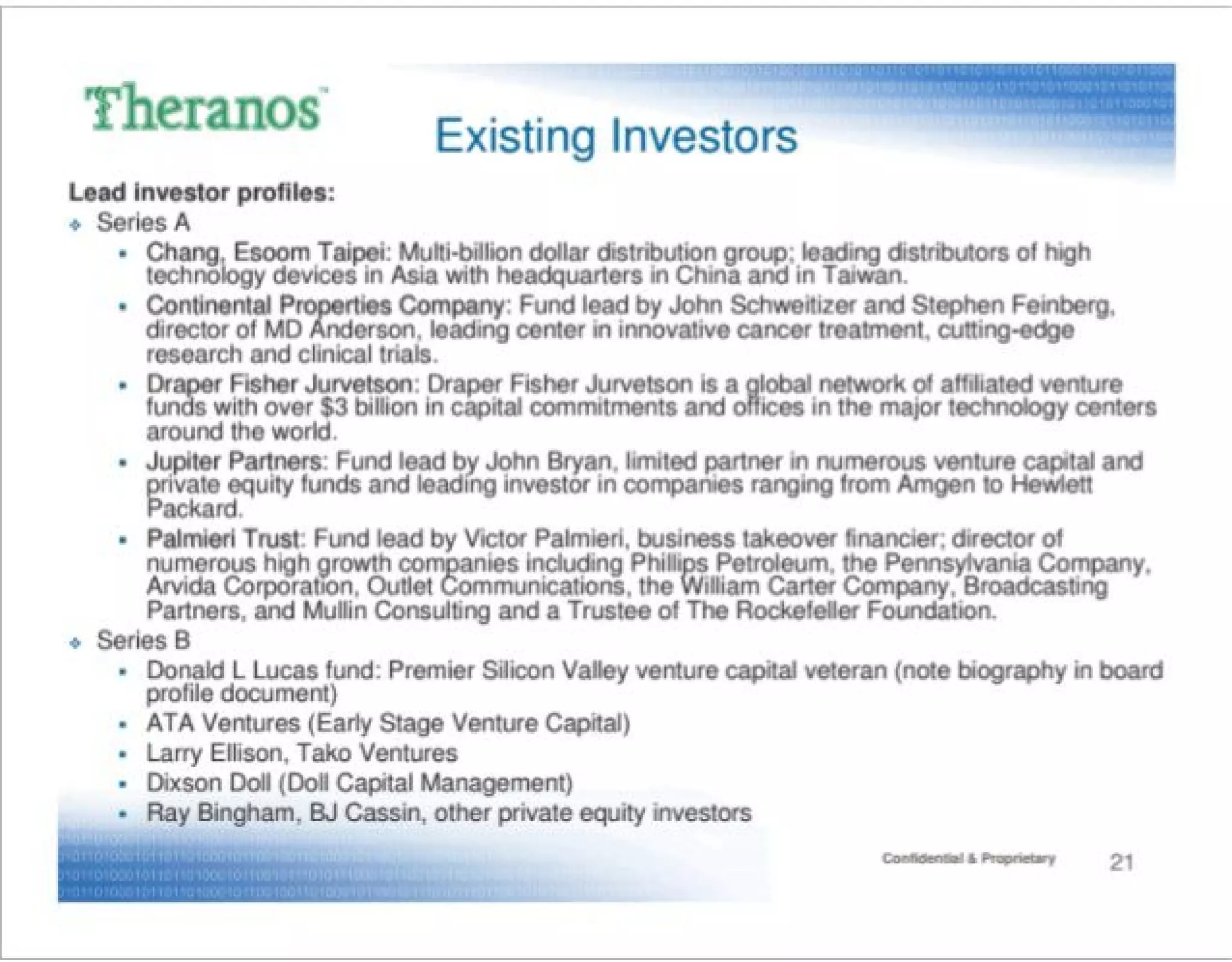
Slide 20 (Offering) states the fundraising objective ($30M), and splits expected allocation between existing and new investors. Slide 21 (Existing Investors) lists lead investor profiles across Series A and B, naming recognizable funds and individuals. This combination does two important things: it gives a clear ask and shows momentum/backing, which reduces perceived risk for new investors.

Key Takeaway: Be explicit about the round size, allocation and use of funds, and highlight reputable existing investors — but make sure commitments are accurate and supported.

Conclusion: Key Lessons

Theranos’s Series C deck is a strong example of investor-focused storytelling: clear branding, a defined beachhead market, tangible product visuals, succinct technical claims and ambitious market math. These are the right elements for a hardware/diagnostics raise and helped Theranos raise large sums quickly. However, the deck also illustrates critical pitfalls: grand claims without transparent, reproducible validation, optimistic TAM/conversion assumptions without conservative scenarios, and over-reliance on reputation rather than demonstrable, auditable performance.

For founders: craft a crisp narrative that ties product, market and monetization together; use visuals and a team slide to build trust; but pair every performance and market claim with verifiable evidence (protocols, blinded comparisons, regulatory milestones, and third-party data). Be conservative in your financial assumptions, transparent about use of funds, and ensure governance and data integrity are front and center — those are the factors that protect investors and founders alike as a company scales.