Stack up against Snapchat

Compare Your Deck

Snapchat's 2014 Pitch Deck

Social
Stage: Business Deck
Raised: N/A
Year: 2014
Slides: 14
Outcome: IPO at $24B valuation

Pitch Deck

1 / 14
Slide 1
Click to expand

Deck Analysis

This 2014 Snapchat business pitch deck positions the company as an ephemeral, mobile-first communications platform with a clear product philosophy, early user metrics, and practical playbooks for brands. Notable for its strong visual identity (the ghost + vivid yellow), simple user-centric explanations, and concrete examples of how publishers and brands used the product, the deck doubles as a tactical manual and a narrative about why ephemeral storytelling matters. Founders can learn how a differentiated product philosophy, crisp UX explanations, and real-world use cases help turn early traction into convincing business conversations.

Cover & Brand: Instant recognition and tone-setting

Cover & Brand: Instant recognition and tone-setting

The cover (slide 1) uses Snapchat’s iconic yellow and ghost logo with a bold “FOR BUSINESS” headline. It’s not trying to overwhelm with numbers or features — it immediately communicates brand identity and signals that the deck is targeted at commercial partners rather than consumers. The minimalism is powerful: the color and symbol do the heavy lifting, creating instant recognition and emotional association before any words are read.

For founders, this is a reminder that the first impression should set tone and audience expectations. If your product has strong visual equity, lead with it; it communicates confidence and focuses the reader on what matters next in the deck.

Key Takeaway: Start with a memorable, audience-specific cover that leverages brand assets to set tone and focus before diving into features or metrics.
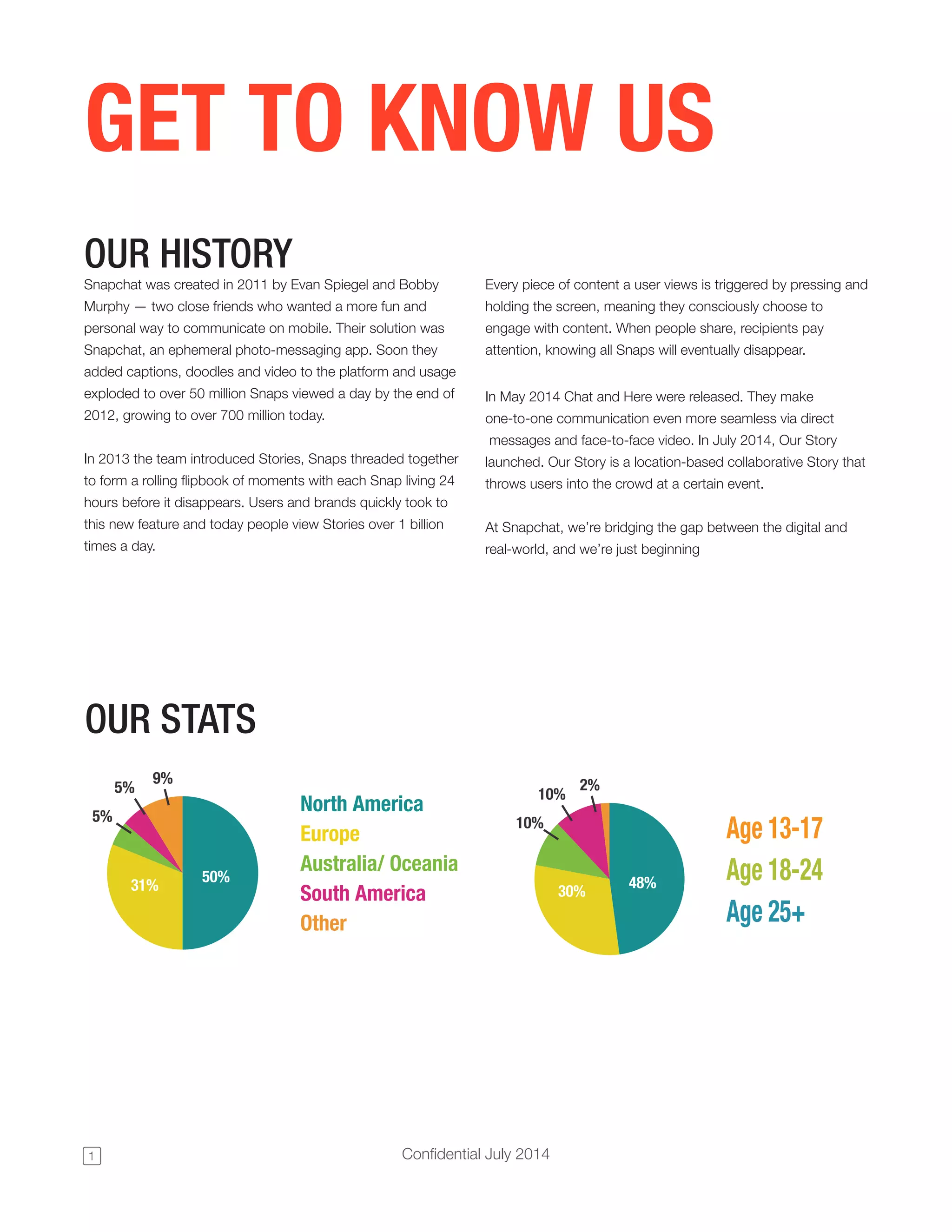
Company Overview & Early Traction: Narrative + stats

Company Overview & Early Traction: Narrative + stats

Slide 2 combines a concise origin story with simple regional and age pie charts that show rapid adoption and a youthful skew. The history paragraph narrates the founders’ intent and product evolution, while the pie charts visually validate scale and demographic fit without overwhelming the viewer. Pairing qualitative backstory with quantitative proof is effective: it humanizes the product and then anchors claims with data.

The lesson for founders is to balance storytelling and validation early in the deck. Explain why the product exists and then provide a few clear metrics or demographic facts that explain market opportunity and product-market fit. Keep charts simple and labeled clearly so they reinforce — not distract from — the narrative.

Key Takeaway: Lead with a crisp origin story plus two or three easily digestible metrics that validate adoption and audience fit.
Philosophy: a single differentiating product principle

Philosophy: a single differentiating product principle

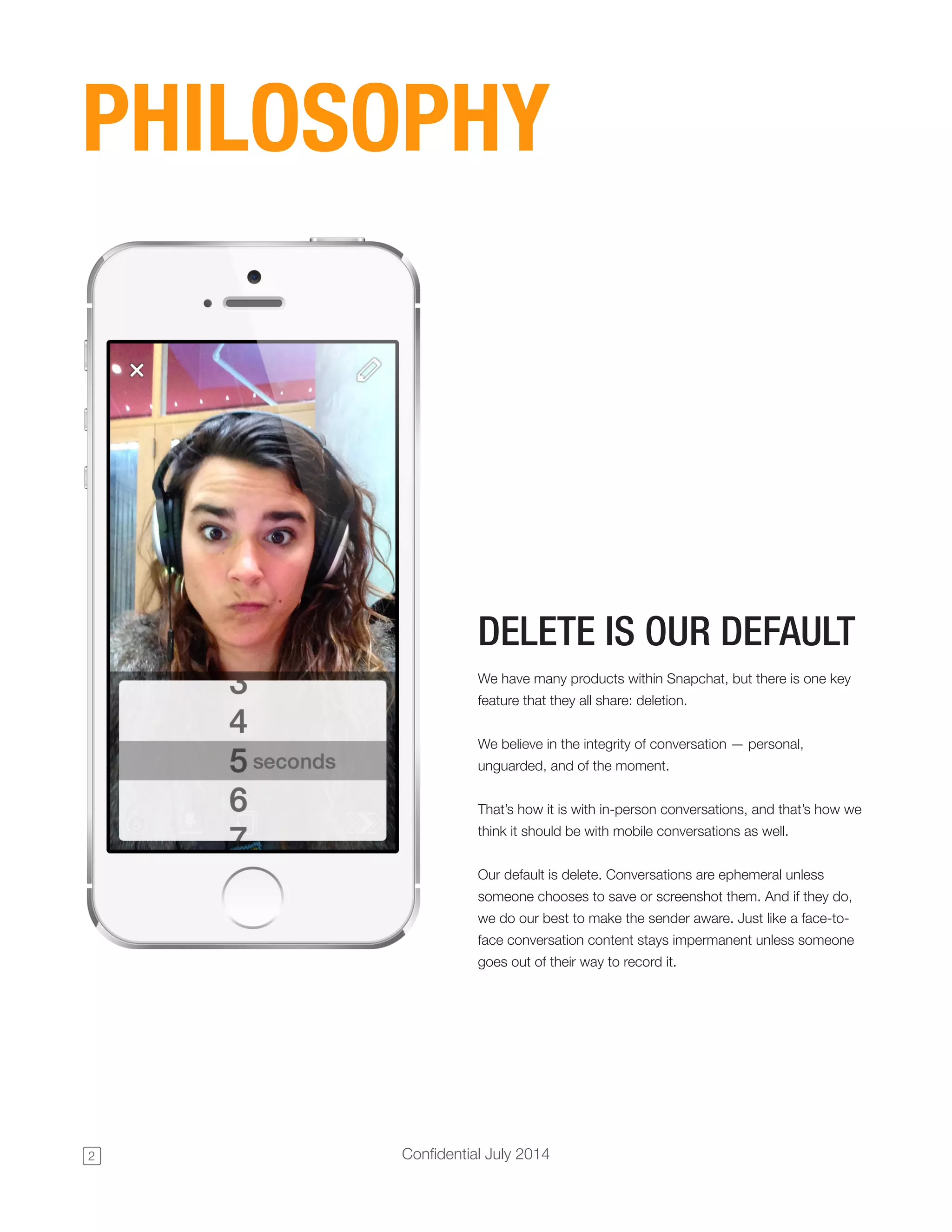
Slide 3 centers Snapchat’s core philosophy — “Delete is our default” — and uses a strong visual (phone with a snap UI) to make the concept tangible. This slide is effective because it articulates a single, defensible product principle that explains user behavior, privacy expectations, and the emotional value proposition: candid, in-the-moment sharing. By foregrounding a principle rather than a feature list, Snapchat frames product decisions and future features under a coherent rationale.

Founders should emulate this clarity: define one or two core product principles that explain why your product exists and how it changes user behavior. These principles become north stars for product design and compelling hooks for partners who want to understand the platform’s unique affordances.

Key Takeaway: Distill your product into one clear philosophical statement that explains user value and guides product choices.
Product Overview & UX: show, don't just tell

Product Overview & UX: show, don't just tell

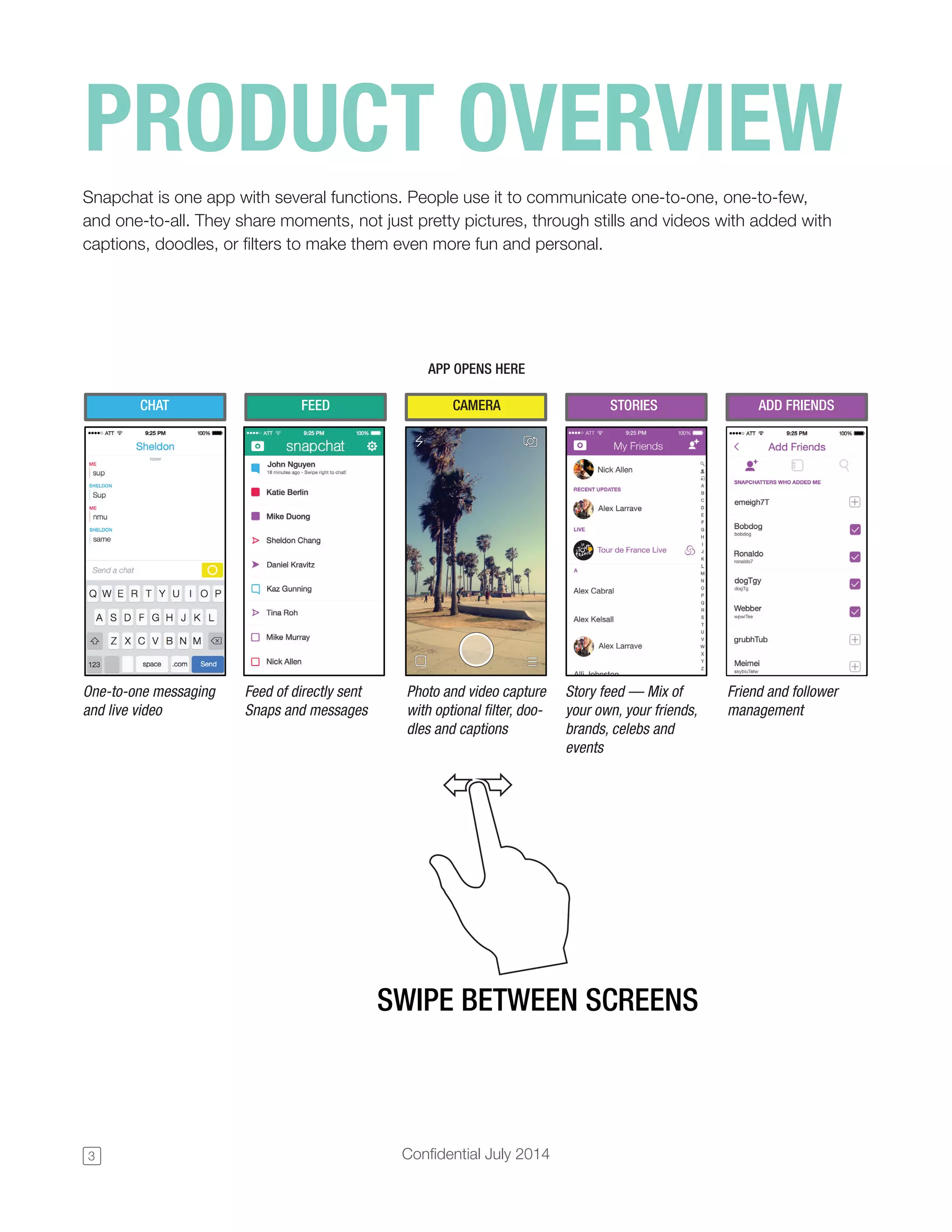
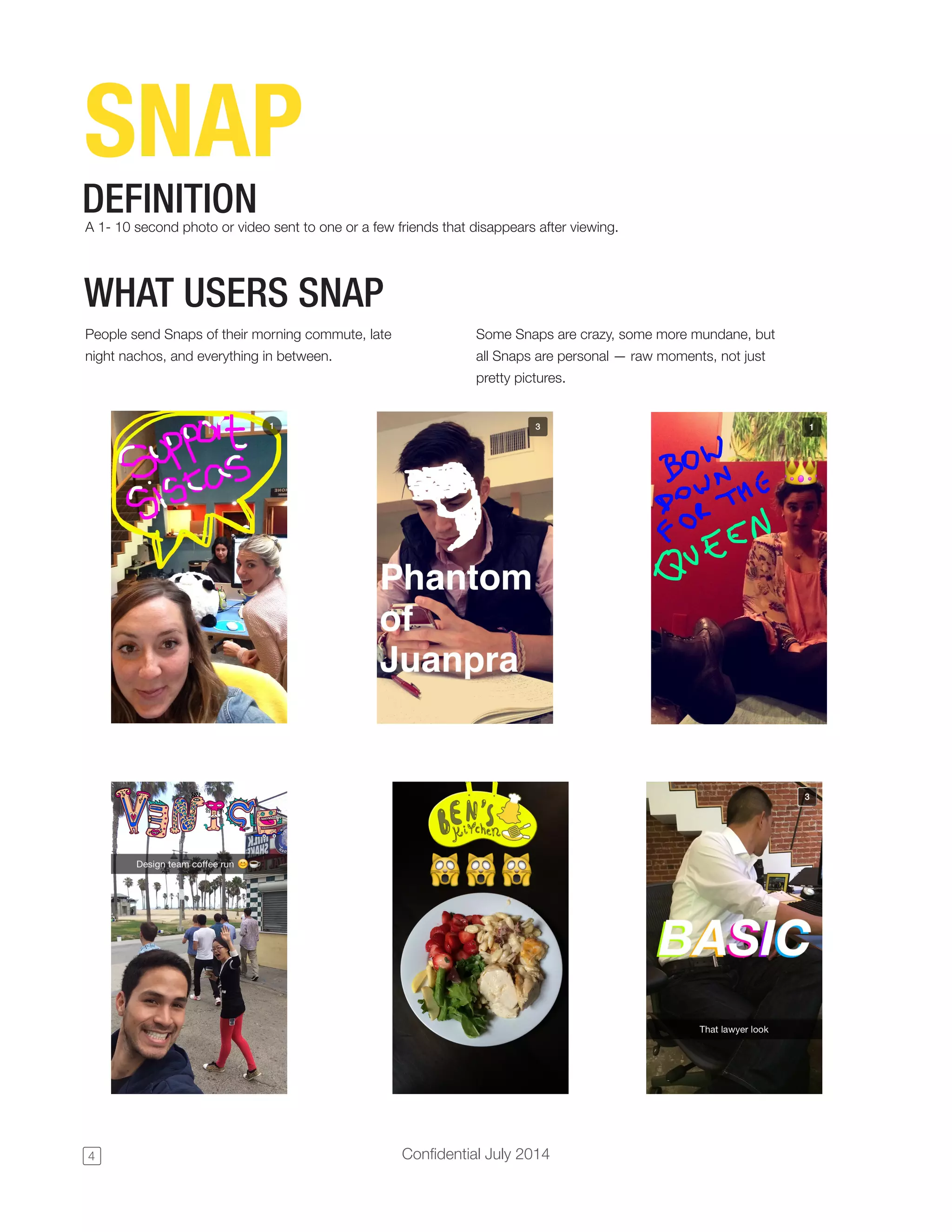
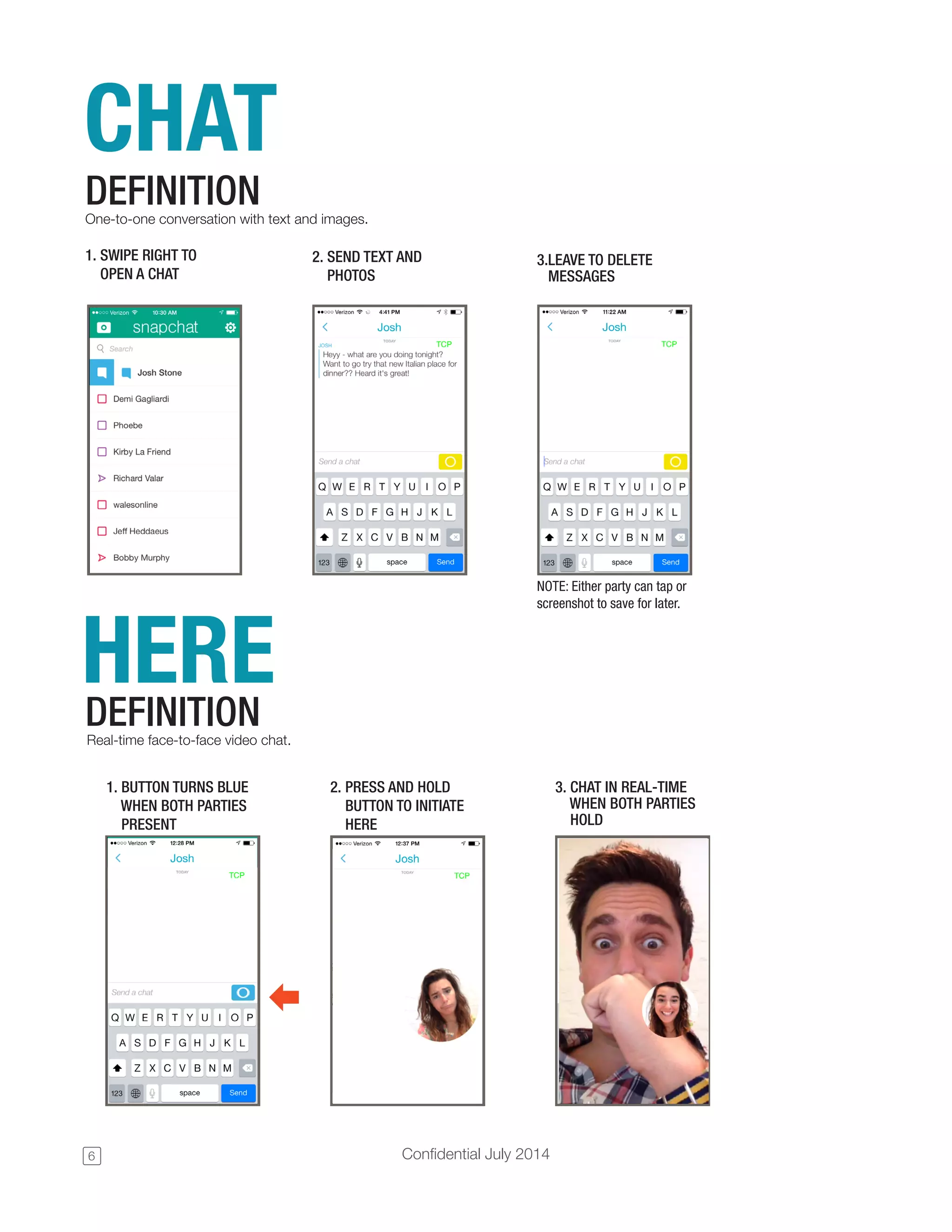
Slide 4 lays out the app’s primary screens (Chat, Feed, Camera, Stories, Add Friends) with short captions and a literal swipe illustration. This is an exemplary product slide: it maps the user journey and interface in a single glance and explains how users move between modes (swipe). The combination of real UI screenshots and a simple interaction diagram demystifies the experience for business partners who may not be familiar with mobile-first UX conventions.

For founders, prioritize visual walkthroughs of core flows — not exhaustive feature lists. Show where users land, how they move, and what the key interactions feel like. A concise UI map reduces cognitive friction and helps investors or partners quickly understand product mechanics and potential integrations.

Key Takeaway: Use annotated UI screenshots and simple flow diagrams to make your product immediately understandable to non-technical stakeholders.
Stories Product: demonstrating new formats with examples

Stories Product: demonstrating new formats with examples

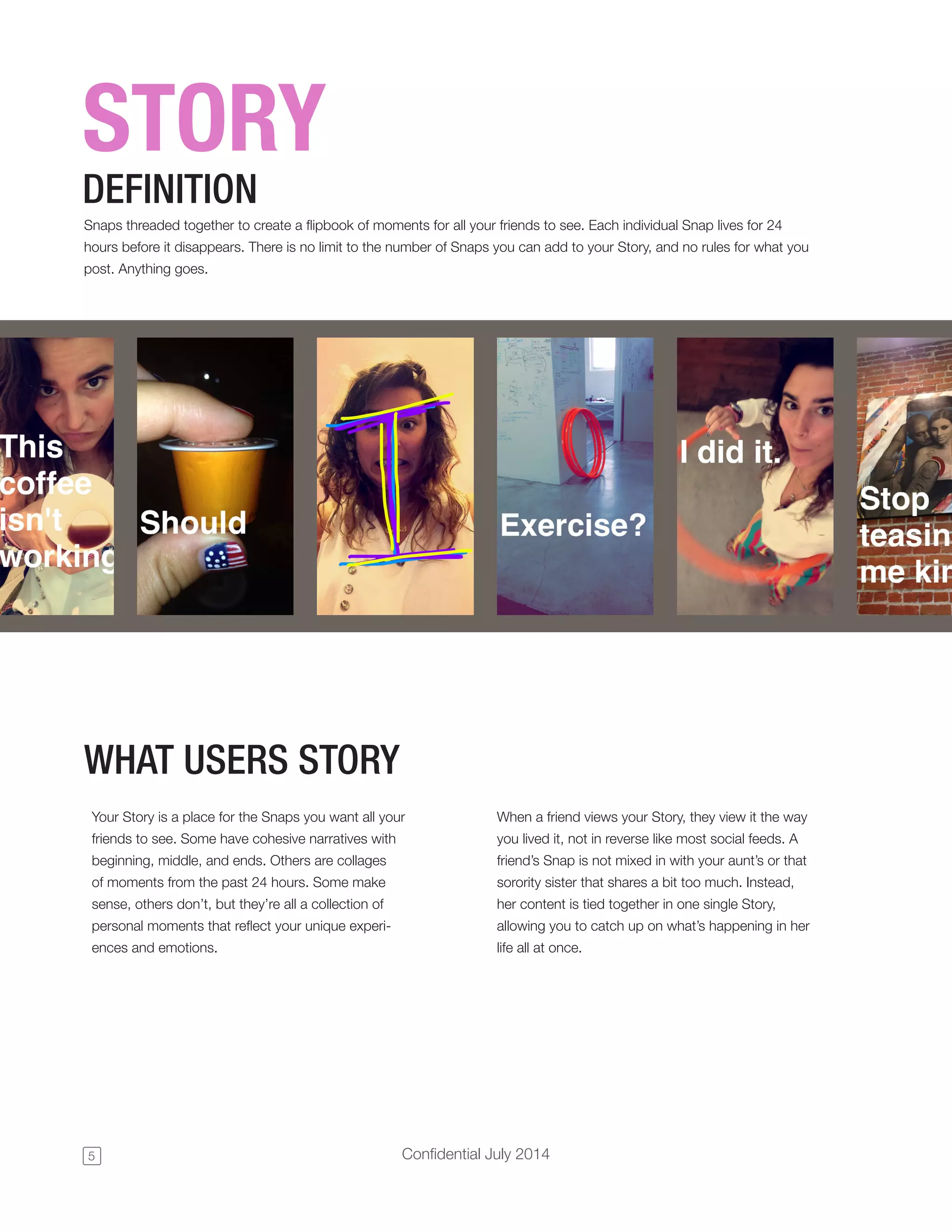
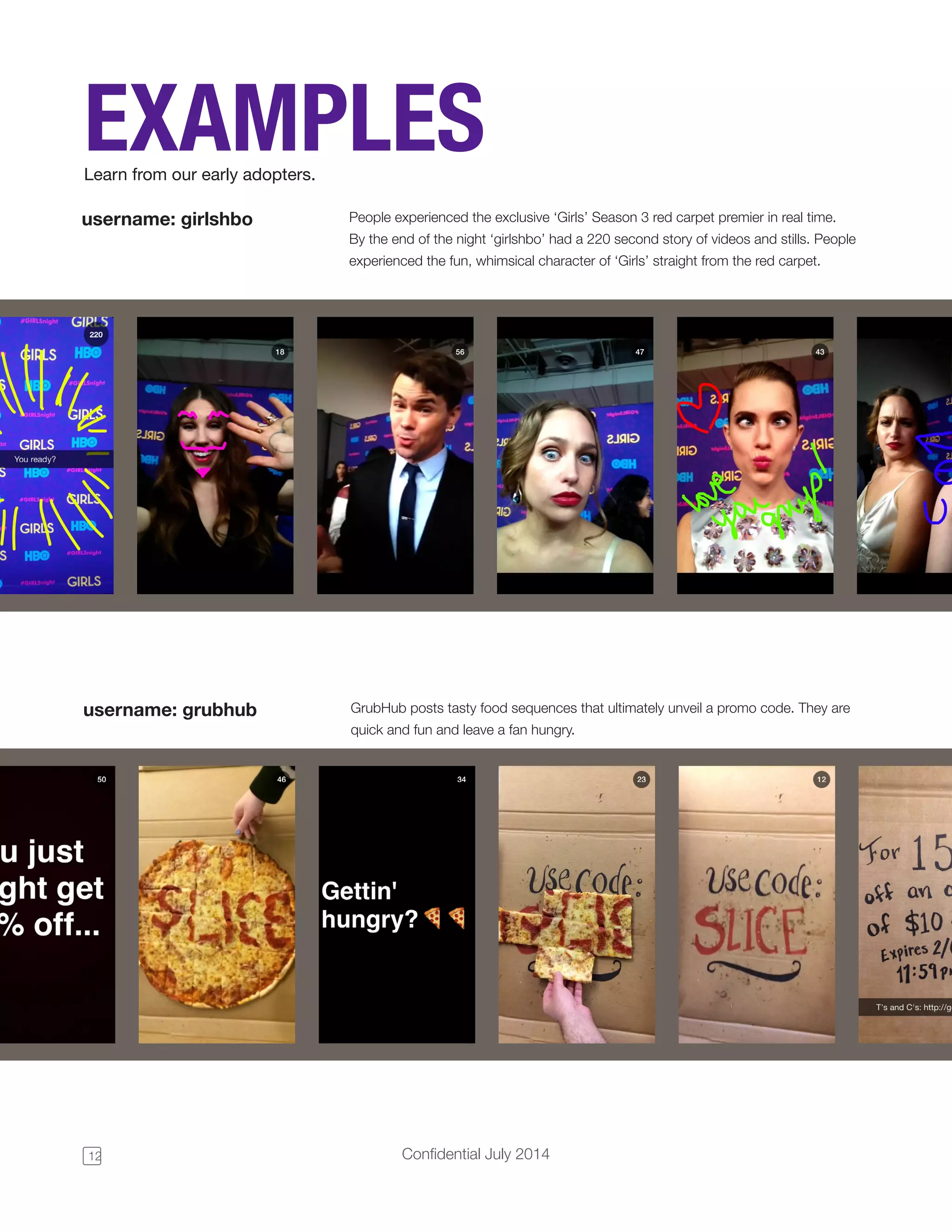
Slide 6 explains Stories (24-hour flipbook of moments) with a visual strip of content and a description of the format’s creative freedom. The slide demonstrates both form and function: users can create narrative arcs or collage-like streams, and the examples show how that content looks in practice. By including examples rather than abstract claims, Snapchat shows how the product manifests culturally and visually.

Founders launching new content formats should mirror this approach: accompany the feature definition with authentic examples showing how users or creators actually use it. This helps potential partners and advertisers imagine use cases and creative opportunities, accelerating buy-in.

Key Takeaway: When introducing a novel content format, pair the definition with real examples so partners can visualize use cases and creative possibilities.
How It Works: step-by-step mechanics for mass participation

How It Works: step-by-step mechanics for mass participation

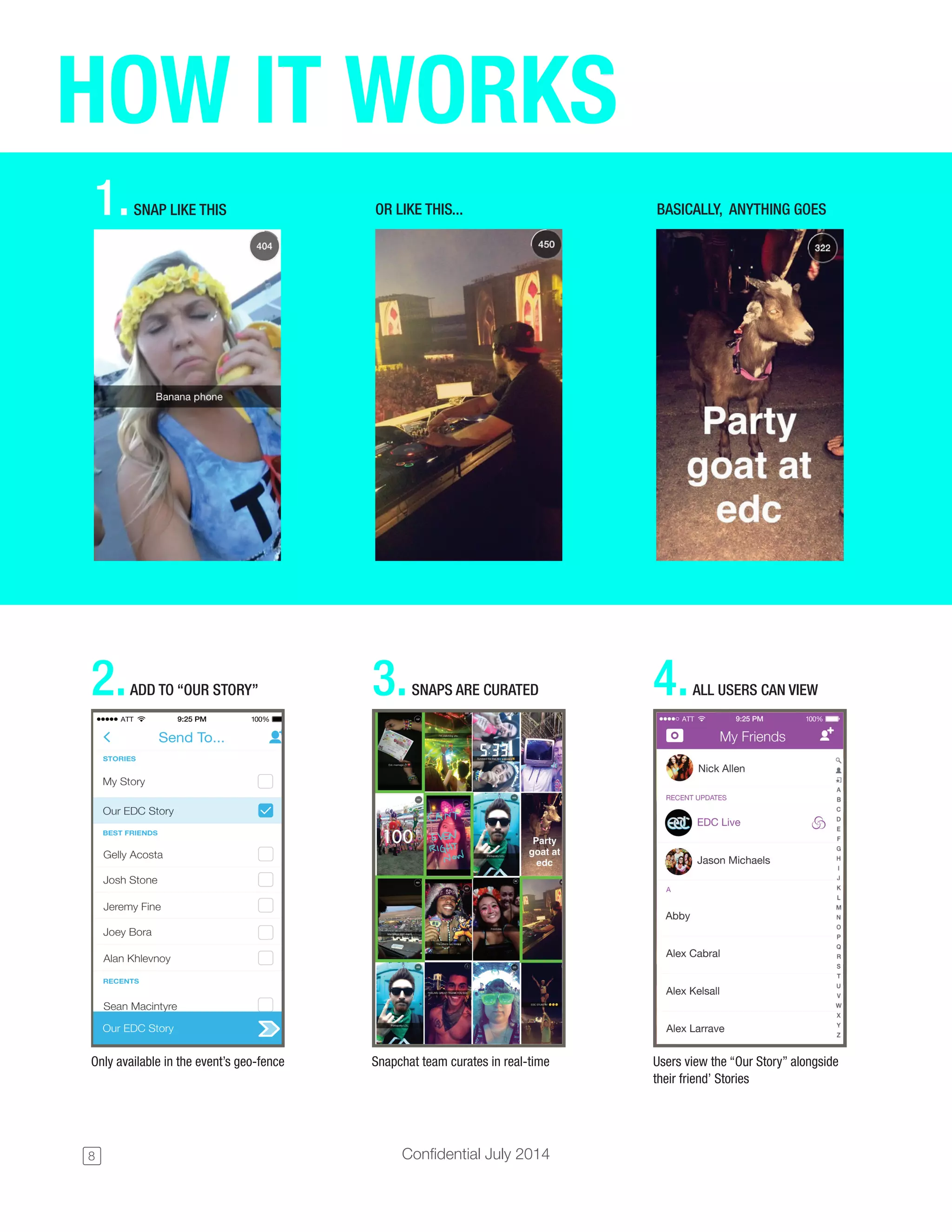
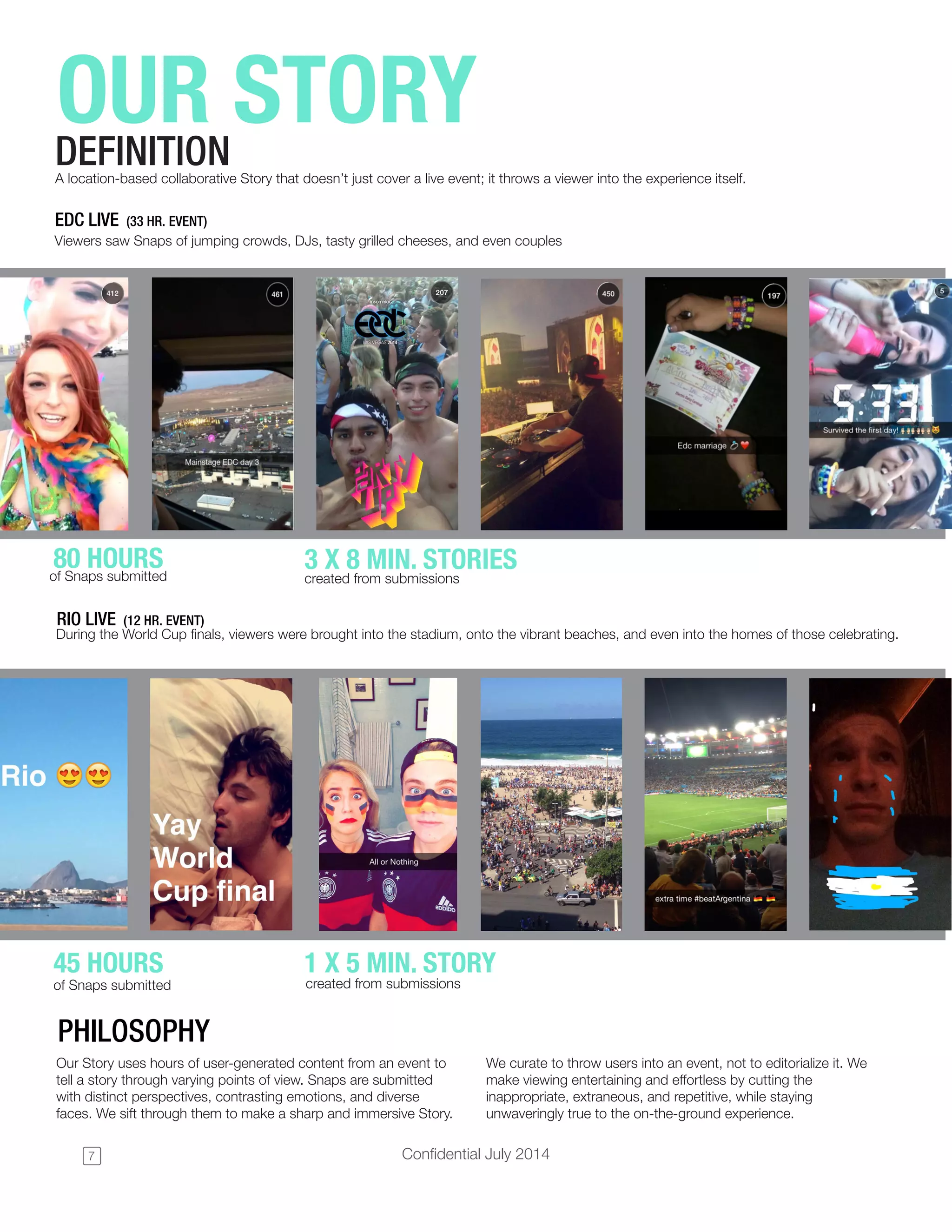
Slide 9 breaks down the mechanics of geo-fenced live Stories in four clear steps with strong imagery: snap, add to Our Story, curation, and distribution. The numbered flow and screenshots explain how user-generated content becomes a curated broadcast, making the operational model clear for brands and event partners. This operational transparency is crucial for commercial adoption because it answers practical questions about how content is gathered, moderated, and surfaced.

Founders should include a simple operations slide like this when pitching platform features that rely on user participation. Show the end-to-end process and indicate what’s manual vs. automated — partners need to know how content quality and brand safety will be handled.

Key Takeaway: Provide a clear end-to-end process diagram for features that rely on user participation, highlighting curation and distribution mechanics.
Monetization & Brand Playbook: tactical advice for partners

Monetization & Brand Playbook: tactical advice for partners

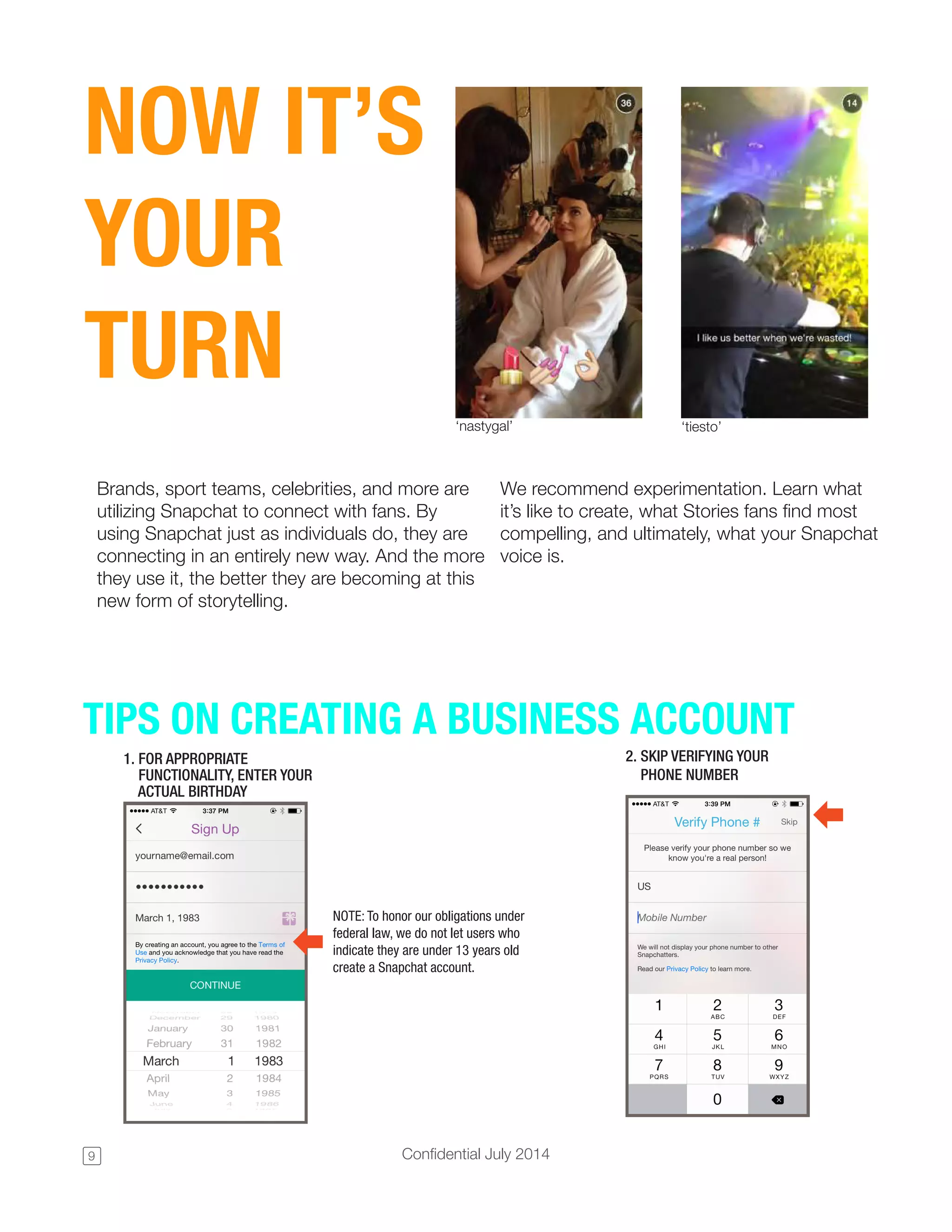
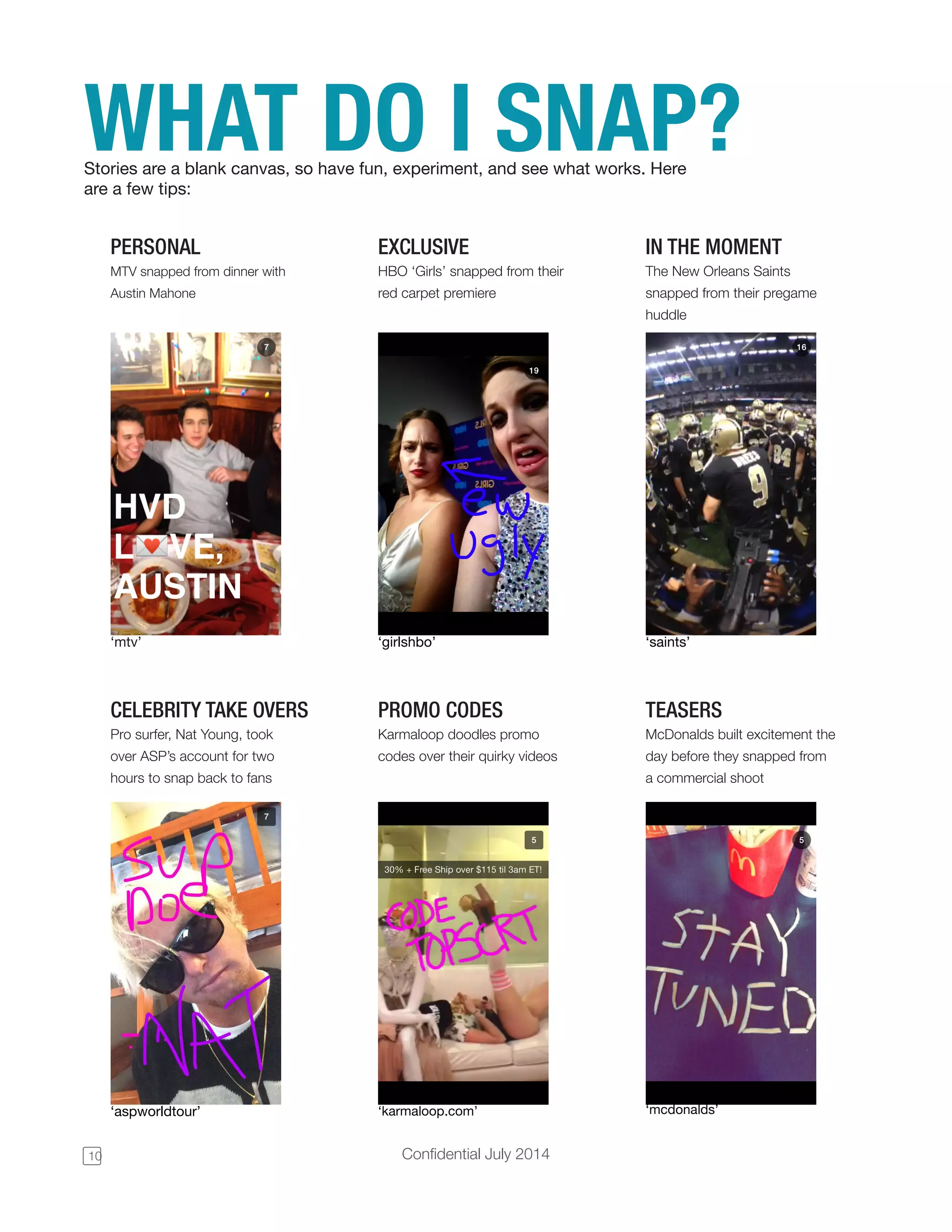
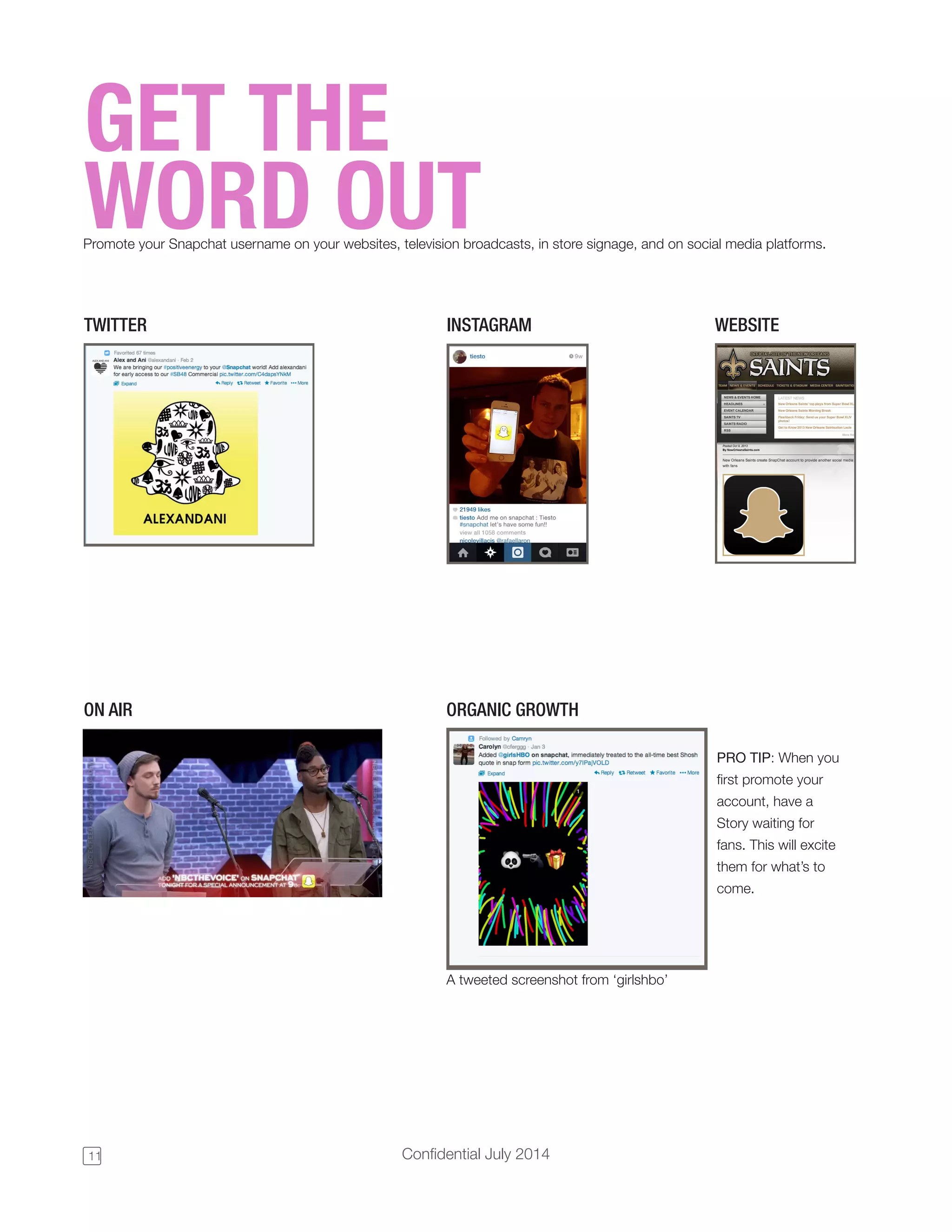
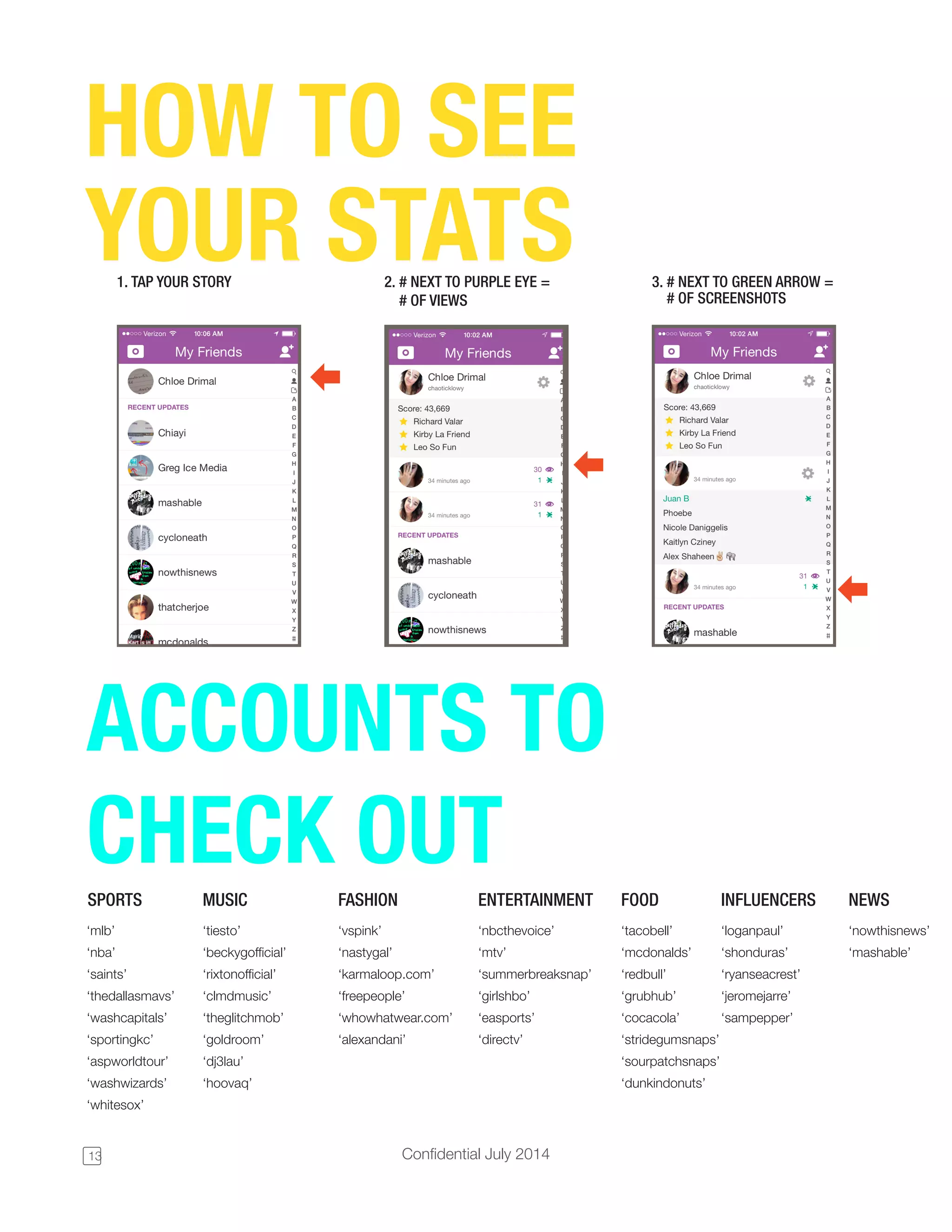
Slide 10 (Now It’s Your Turn) and slide 11 (Tips on Creating a Business Account) pivot from product to playbook: how brands, celebrities, and teams can use Snapchat, with practical tips (e.g., verifying phone number, entering birthday). These slides are playbooks rather than revenue models, showing Snapchat’s strategy to lower the activation barrier for brands and coax creative experimentation. The inclusion of concrete, actionable steps is smart — it reduces friction for first-time brand users and signals that the company expects and supports commercial usage.

For founders, including a tactical partner guide in the deck can accelerate adoption. Show not only why partners should use your product but also how to get started, common content ideas, and quick technical tips that remove early obstacles to use.

Key Takeaway: Include a short operational playbook for partners that covers setup, best practices, and creative ideas to lower activation friction.

Conclusion: Key Lessons

Snapchat’s 2014 business deck is effective because it combines a strong, recognizable brand identity with a concise product philosophy, simple UX walkthroughs, real user examples, and tactical partner playbooks. The deck balances narrative and evidence: it explains why ephemeral sharing matters, shows how the product works, proves early traction with clean metrics, and removes barriers for commercial partners through step-by-step guidance.

Actionable advice for founders: open with a bold brand statement, articulate one clear product philosophy, use annotated UI images to explain core flows, include real examples of user-generated content, and finish with a brief operational playbook for partners. These elements together make a deck not just persuasive but practically useful — accelerating both investor understanding and commercial adoption.