Stack up against Facebook

Compare Your Deck

Facebook's 2004 Pitch Deck

Social
Stage: Ads Pitch
Raised: N/A
Year: 2004
Slides: 10
Outcome: IPO, now Meta valued at $1T+

Pitch Deck

1 / 10
Slide 1
Click to expand

Deck Analysis

This is an analysis of Facebook's original 2004 pitch materials (the early media/pitch deck labeled thefacebook.com). The deck is notable for communicating a simple product idea — a college social directory — with strong visual branding, early social proof, and a clear explanation of product features that create network effects. What makes it remarkable is how the founders prioritized product clarity, audience targeting (campus-by-campus rollout), and evidence of traction rather than overblown financial projections — a template many successful consumer startups have since followed.

The Opening: Strong, focused branding and frame

The Opening: Strong, focused branding and frame

The title slide (SLIDE 1) uses a single, bold brand treatment and a compact subtitle (“Media Kit”), immediately signaling professionalism and clarity. The simple blue background with the recognizable mark centers attention and sets a consistent visual tone for the rest of the deck. By treating the pitch as a 'media kit' rather than an investor-only document, the founders position the product as public-facing and press-ready, which amplifies credibility.

Founders can learn from this economy of design — open with a recognizable identity and a one-line descriptor that frames how the audience should read the rest of the slides. The visual consistency also helps; a tight color palette and a single type hierarchy reduce cognitive load and let the content speak for itself. This approach builds immediate trust and reduces friction when the deck transitions into product details and metrics.


Key Takeaway: Open with a bold, simple brand frame and a concise descriptor that defines the narrative lens for the entire deck.
Using press to create social proof and urgency

Using press to create social proof and urgency

The press quote slide (SLIDE 3) leads with an external endorsement — a dramatic headline from The Stanford Daily about students skipping class and being ‘utterly fascinated.’ This is an early example of using third‑party validation to demonstrate demand and cultural relevance. The large, pull-quote style combined with a background image of students using a phone ties product usage to social behavior, making the claim both emotional and concrete.

For founders, leveraging real press or user testimonials is an effective way to show traction without relying solely on raw numbers. A well-placed quote can communicate virality and urgency, especially when it comes from a respected source in the product’s target community. The visual treatment matters: make the quote readable, attribute it clearly, and pair it with imagery that reinforces the message.

Key Takeaway: Include an early, prominent third‑party quote or testimonial to convert product interest into credible social proof.
Clear product definition: what the product actually is

Clear product definition: what the product actually is

The 'What is thefacebook.com?' slide (SLIDE 4) provides a concise definition that explains who the product serves, what it does, and how it connects users. It describes the site as an 'expanding online directory' with social networking features and a messaging system — all in plain language without technical jargon. This kind of upfront product definition is crucial to bring any audience to the same baseline understanding before introducing features or metrics.

Founders should emulate this clarity: define the core value proposition in one or two sentences and explain the primary user flows. Doing so prevents confusion and allows the rest of the deck to focus on traction, monetization, or competitive advantage. The slide also hints at multi-dimensional connections (friendship, courses, social networks), which foreshadows the network effects that the product exploits.

Key Takeaway: Start with a plain-language one-paragraph product definition that explains who it’s for and the core value it delivers.
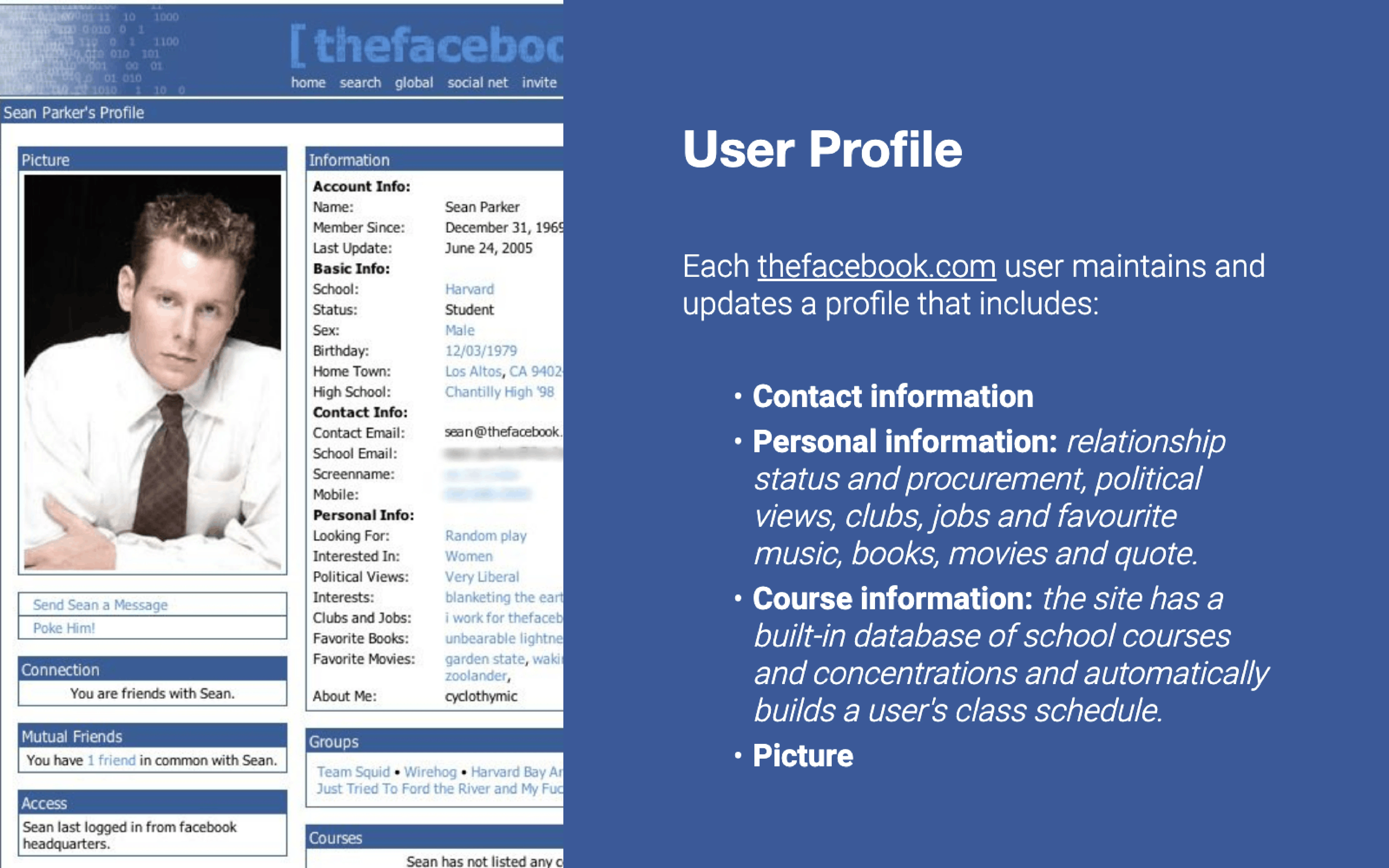
Product detail: user profile as the atomic unit

Product detail: user profile as the atomic unit

The user profile slide (SLIDE 5) breaks down the individual profile into clear components — contact info, personal details, course information, and a picture — and pairs a screenshot of an actual profile. Presenting an example profile makes the product tangible and demonstrates how data points enable discovery and connection. The slide emphasizes that profiles are both self-updated and structured, showing how the founders designed for both personal expression and searchable attributes.

For founders building consumer products, this is a useful pattern: show the atomic unit of the product (a profile, a listing, a playlist) and explain how it drives engagement and discoverability. Use real screenshots or mockups and annotate them to show the functional intent. This builds confidence that product features are thought through and usable from day one.

Key Takeaway: Expose the atomic unit of your product with a real or believable mockup and explain how its fields drive user value and searchability.
Feature-driven network effects: intra-school discovery

Feature-driven network effects: intra-school discovery

The Social Networking slide (SLIDE 7) outlines concrete mechanisms for discovery (Social Net, Course Roasters, Advanced Search). Each item is specific and tied to how users find one another, which articulates the sources of network effects. Importantly, the slide mixes short feature names with brief explanations, making it easy for readers to see how each feature contributes to the product’s viral loop and engagement.

Founders should be explicit about the levers they’ll use to generate network effects. Rather than vague claims, list precise features and how they translate into user interactions and growth. This helps investors evaluate defensibility and the uphill cost of copying the product. The slide’s minimalist format — headline plus concise description — is an effective way to present product mechanics without overwhelming the audience.

Key Takeaway: List specific discovery features and explain how each contributes to network effects and user acquisition.
The rollout playbook: targeted expansion and traction data

The rollout playbook: targeted expansion and traction data

The Ivy‑League table (SLIDE 9) presents a simple, verifiable rollout timeline — dates paired with each college launch. This level of granularity communicates traction and a deliberate expansion strategy (college-by-college) rather than a scattershot national launch. The table format makes it easy to scan progress and reinforces that growth was planned, measured, and replicable across similar communities.

Founders can borrow this approach by showing concrete milestones and the playbook for geographic or segment expansion. Investors want to see not only that you have growth but how you’ll replicate it. A short timeline or table that ties openings to lift in users or activation rates is a clear, credible way to show repeatability.

Key Takeaway: Show a clear, repeatable rollout plan with verifiable milestones to demonstrate traction and repeatability.

Conclusion: Key Lessons

Facebook’s original deck excels at clarity, social proof, and a product-first narrative. It starts with strong branding, uses press and screenshots to prove demand, defines the product in plain terms, describes the atomic unit (the profile) and the features that create network effects, and closes with a practical expansion timeline. The deck focused on demonstrating real user engagement and replicable distribution rather than speculative financials — a strategy that matched the company’s early priorities.

Actionable advice for founders: lead with a simple product definition and strong branding, use third-party validation and real screenshots to make claims credible, explain the specific features that generate network effects, and present a clear, repeatable rollout plan with verifiable milestones. Keep slides visual, concise, and framed so each element reinforces why the product will scale.