Stack up against Quora

Compare Your Deck

Quora's 2010 Pitch Deck

Social
Stage: Various
Raised: $225M+ total
Year: 2010
Slides: 16
Outcome: Valued at $2B

Pitch Deck

1 / 16
Slide 1
Click to expand

Deck Analysis

This deck is an early-stage investor pitch for Quora (2010) that crisply positions the product as the intersection of knowledge Q&A and social search. It uses strong visual branding, a clear problem→solution narrative, founder credibility, early traction metrics, and a straightforward financing ask. Notable for its focus on product-led differentiation (real-time, verified social profiles, topic streams) and for communicating adoption signals that matter to investors (user growth, search traffic mix, and content quality).

The Opening: Clear, memorable positioning

The Opening: Clear, memorable positioning

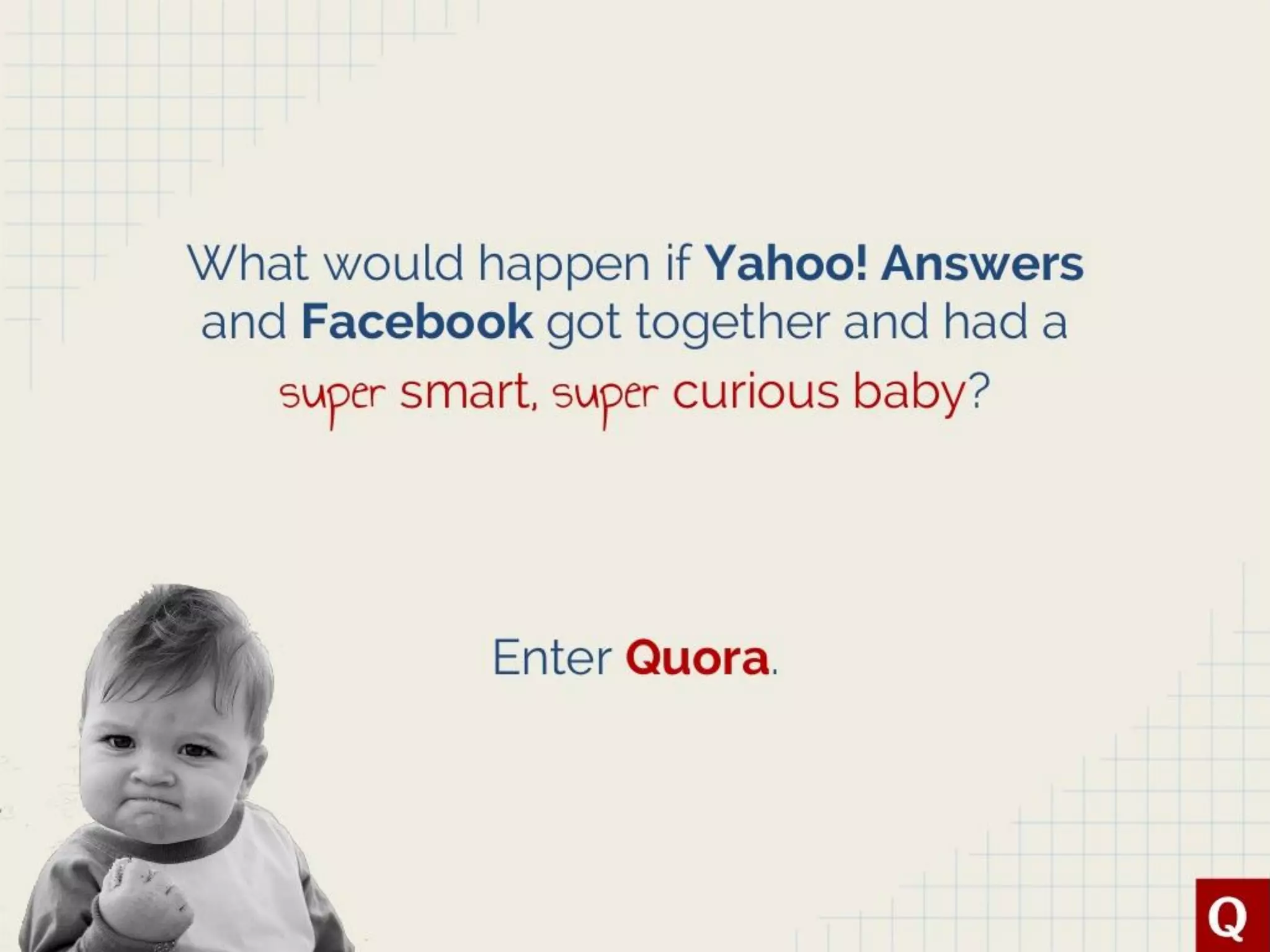
Slide 1 opens with a simple, memorable hook: “What would happen if Yahoo! Answers and Facebook got together and had a super smart, super curious baby? Enter Quora.” The line quickly conveys what Quora is by referencing two well-known comparisons rather than relying on abstract product language. Paired with a striking, viral-friendly baby image, it creates an easy-to-repeat narrative investors and press can use to describe the company.

This is effective because it reduces cognitive load for the audience and provides an emotional hook. Founders can learn to use analogies that map to familiar products to position new ideas quickly, and to pair that positioning with a simple visual that reinforces the message.

Key Takeaway: Lead with a concise, memorable analogy plus a supporting visual to make your product instantly understandable.

Brand and value proposition: concise and differentiated

Brand and value proposition: concise and differentiated

Slide 2 presents the Quora mark and the one-line value proposition: “Where Knowledge Queries meets Social Search.” The slide is visually clean and uses typographic emphasis to highlight the two axes of differentiation: knowledge (quality content) and social (people-centric discovery). It reframes Q&A as a new category rather than a direct clone of existing players.

This clarity helps investors quickly grasp the unique positioning and perceived defensibility. Founders should emulate this economy of language: combine an attractive visual identity with a tightly worded value prop that highlights how you differ from incumbents.

Key Takeaway: Use a single, tightly worded value proposition paired with a recognizable visual identity to stake out your category.
Team credibility: show relevant experience

Team credibility: show relevant experience

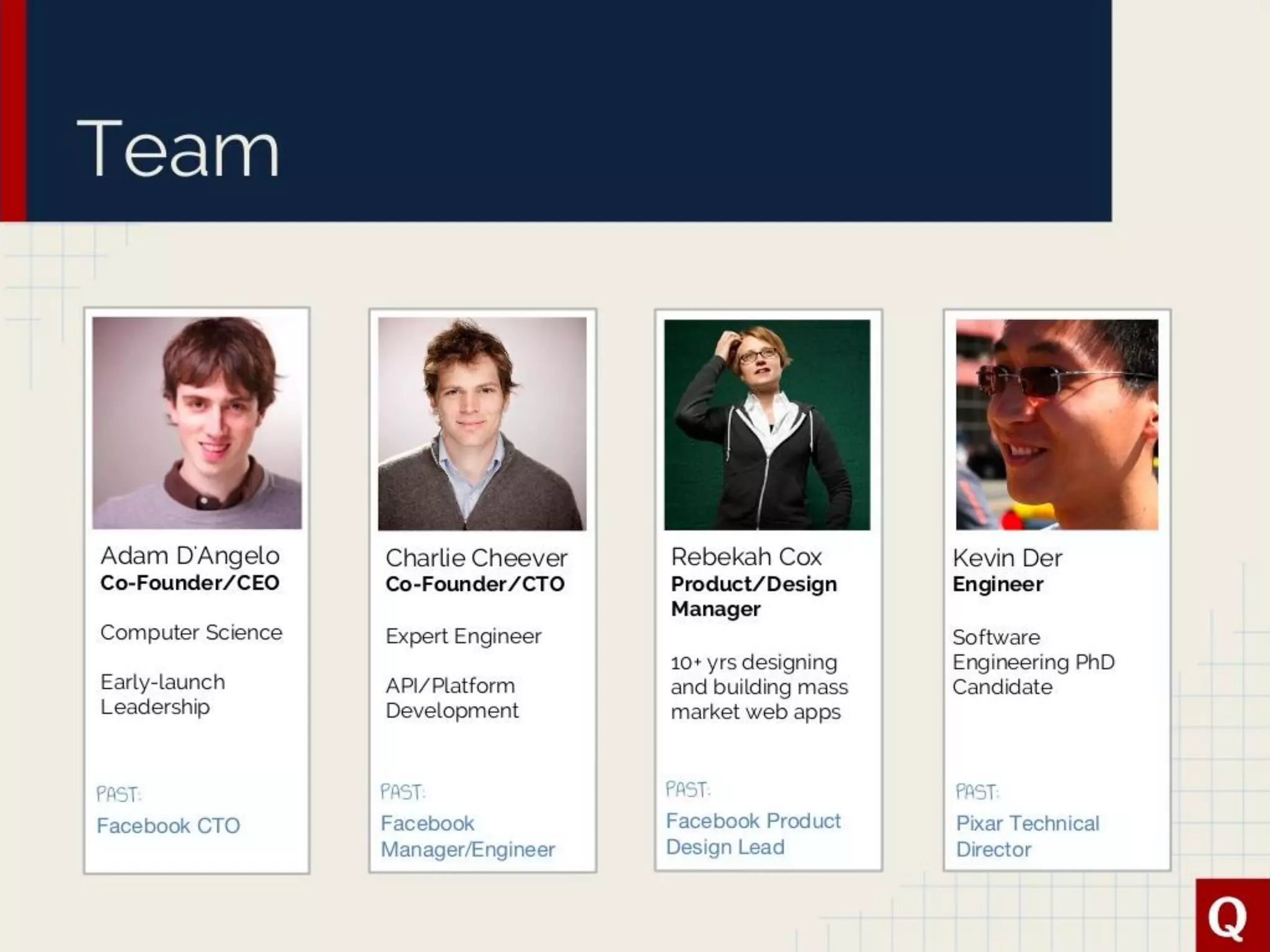
Slide 3 profiles the founding team (Adam D’Angelo, Charlie Cheever, Rebekah Cox, Kevin Der) and emphasizes relevant backgrounds (Facebook CTO, engineering leads, product/design). Photos plus short blurbs convey capability and role fit—technical founders with product and design strength. The slide includes past affiliations which serve as social proof that the team can build and scale social products.

Investors often bet on teams as much as ideas. This slide is effective because it balances brevity and relevance—highlighting the core hires and why they matter for execution. Founders should present a focused team slide that ties each founder’s background to the company’s critical early priorities (e.g., product, platform, growth).

Key Takeaway: Showcase a compact team slide connecting each founder’s prior experience directly to the startup’s execution risks.
Problem articulation: precise pain points and competitive context

Problem articulation: precise pain points and competitive context

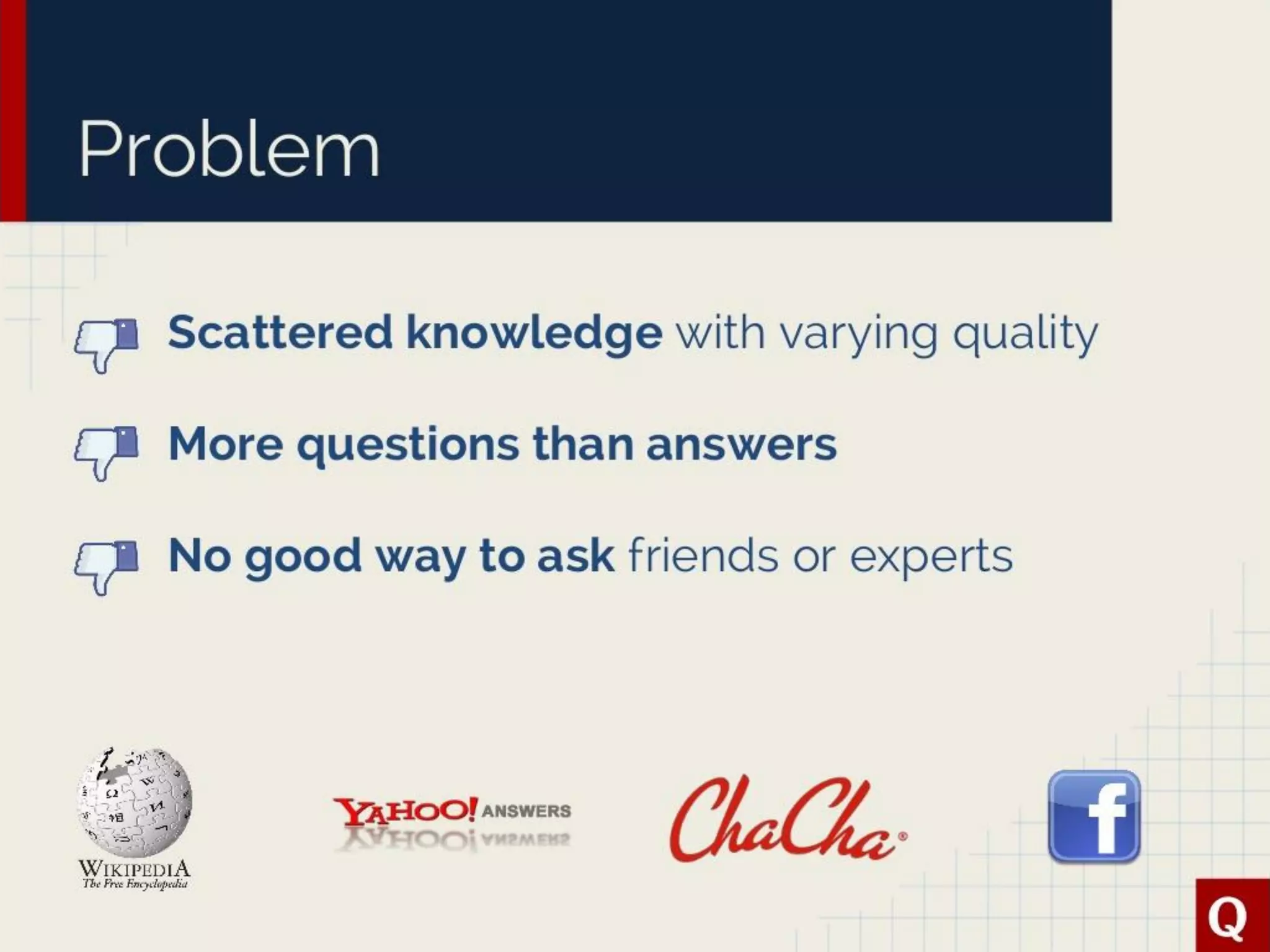
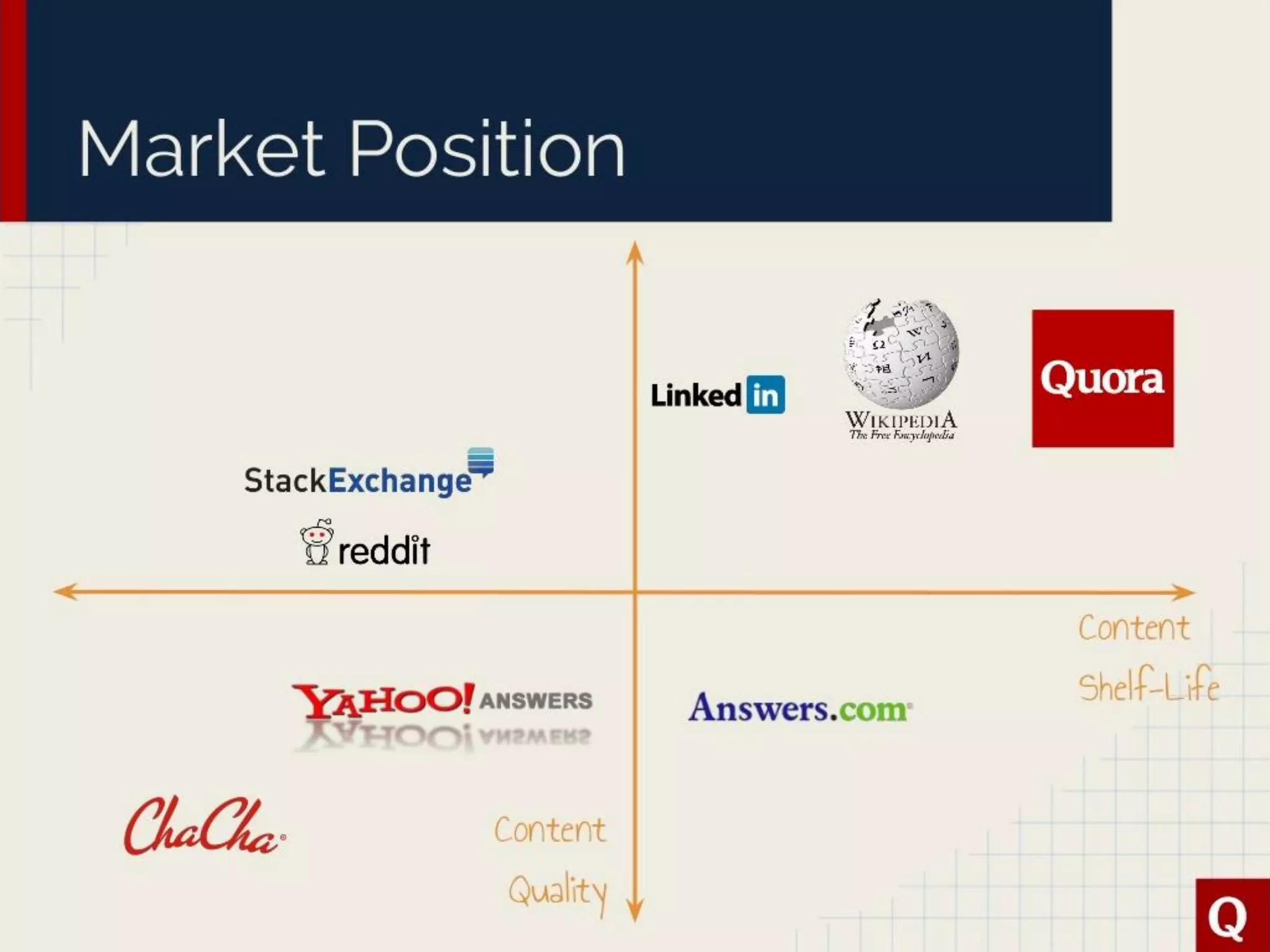
Slide 4 states three concise problems: scattered knowledge with varying quality, more questions than answers, and no good way to ask friends or experts. The slide pairs these bullets with icons and competitive logos (Wikipedia, Yahoo Answers, ChaCha, Facebook) to quickly contextualize the market. By naming both user pain and weak incumbents, it sets up the need for a new solution.

This approach is effective because it focuses on user-centric problems rather than feature lists, and it foreshadows how Quora’s social + quality approach addresses those gaps. Founders should use a similar structure—small set of clear, user-focused problems supported by competitive mapping—to justify their product direction.

Key Takeaway: Frame a short list of real user pain points and show where incumbents fail to create urgency for your solution.
Why now: market timing and attention economics

Why now: market timing and attention economics

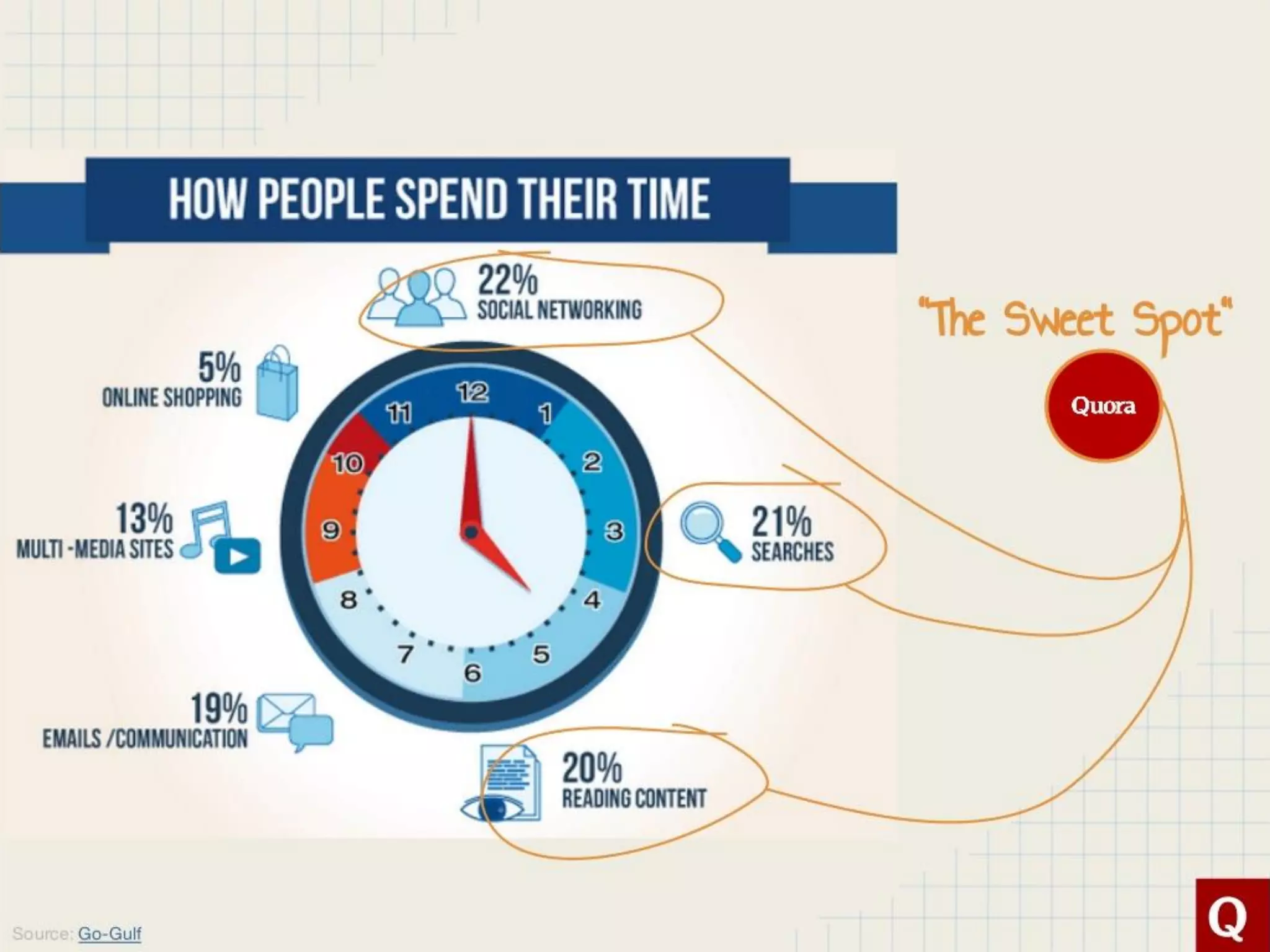
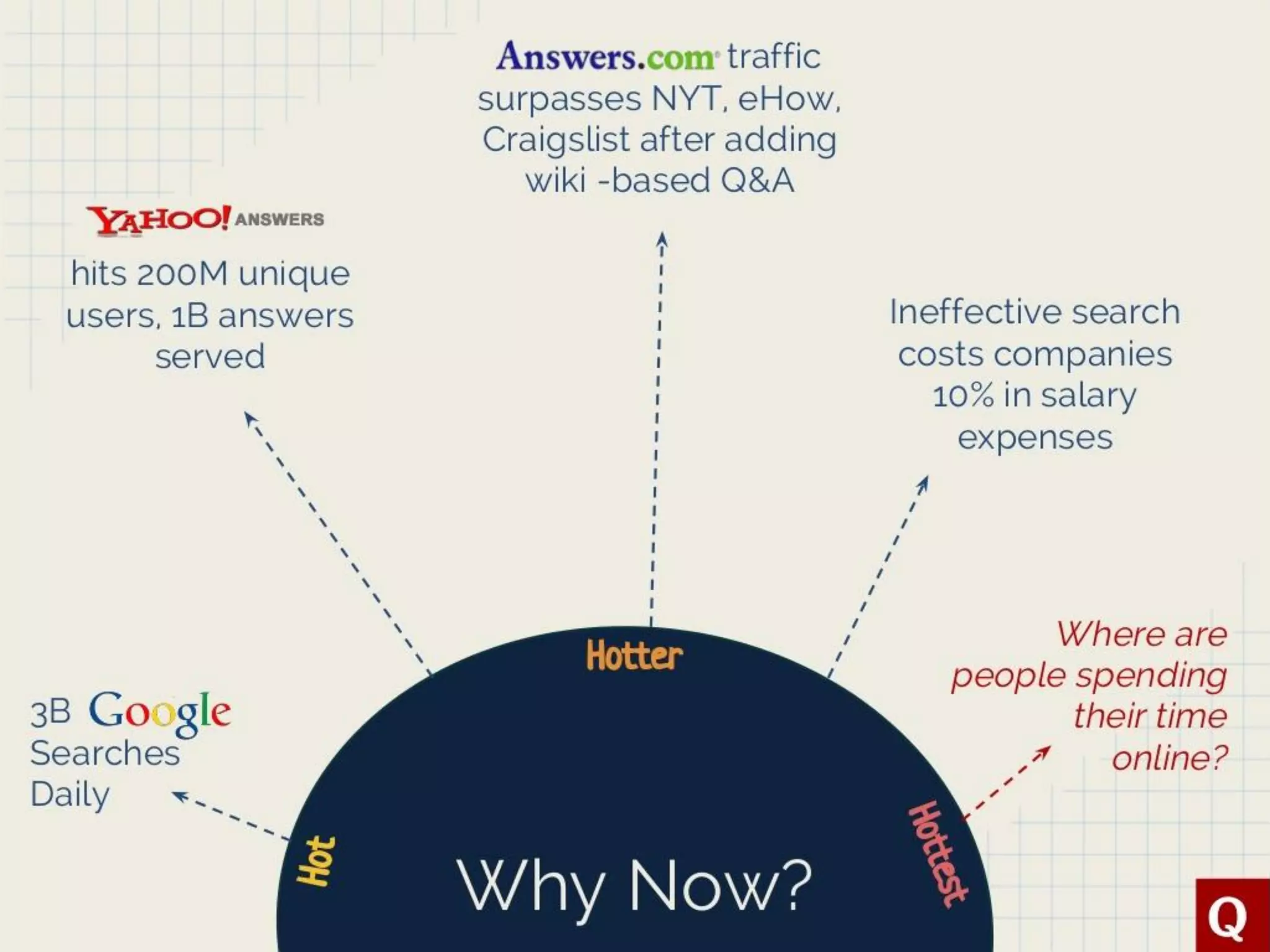
Slide 6 (Why Now?) mixes macro signals—3B daily Google searches, Yahoo Answers scale, search-driven revenue pain inside companies—with a key insight about where people spend time online. The deck uses this to argue that user attention and search behavior are aligning to make a social, high-quality Q&A product feasible and valuable. The slide conveys both demand-side (search volume, wasted corporate time) and supply-side (existing Q&A momentum) evidence.

This combination is persuasive because it shows the founders are thinking beyond product to timing and distribution. Founders should back their product thesis with quantifiable trends and show how timing improves the odds of building a durable business.

Key Takeaway: Support your product narrative with measurable market trends that amplify demand and distribution opportunities.
Solution & product design: social features that create quality

Solution & product design: social features that create quality

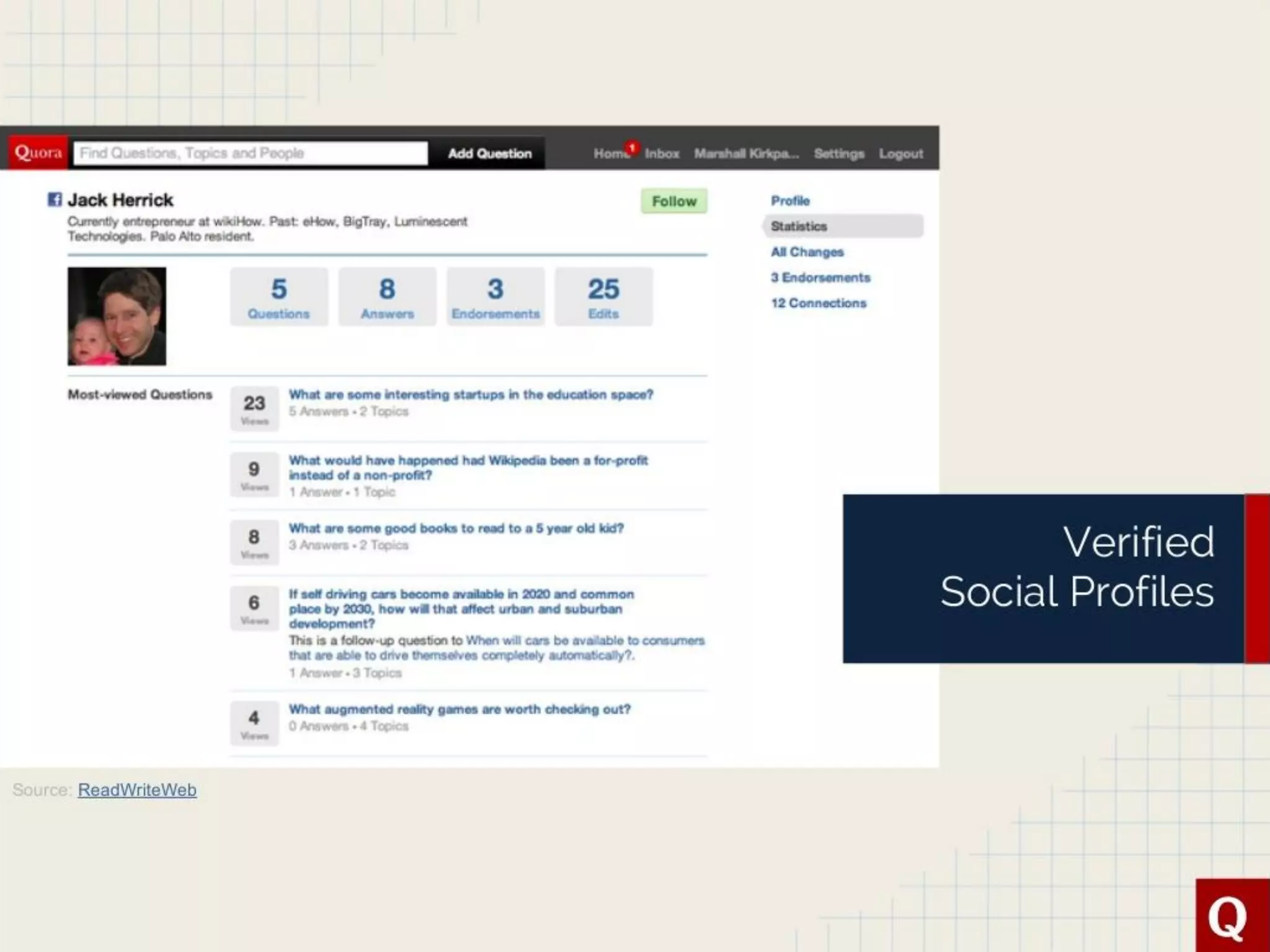
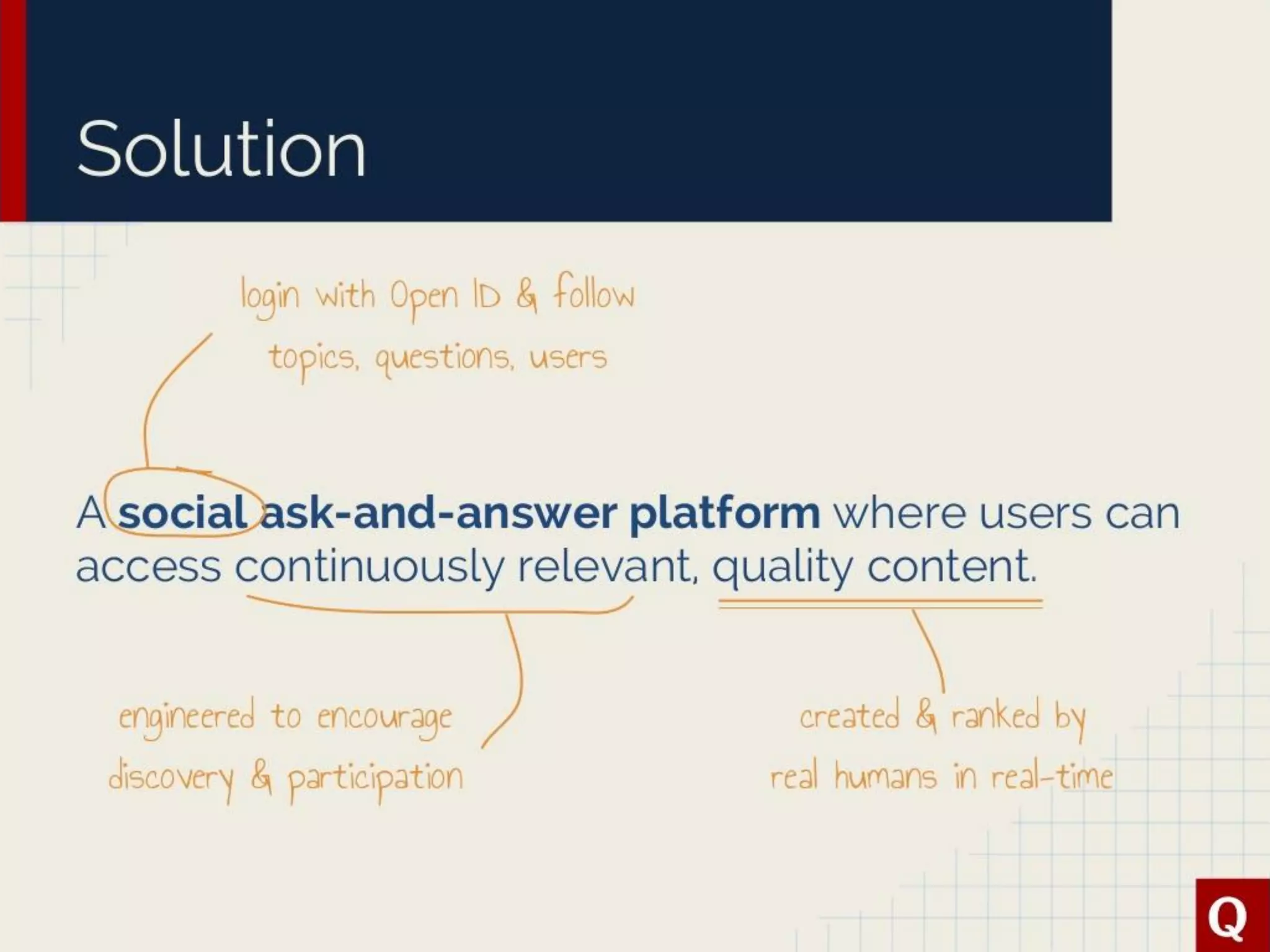
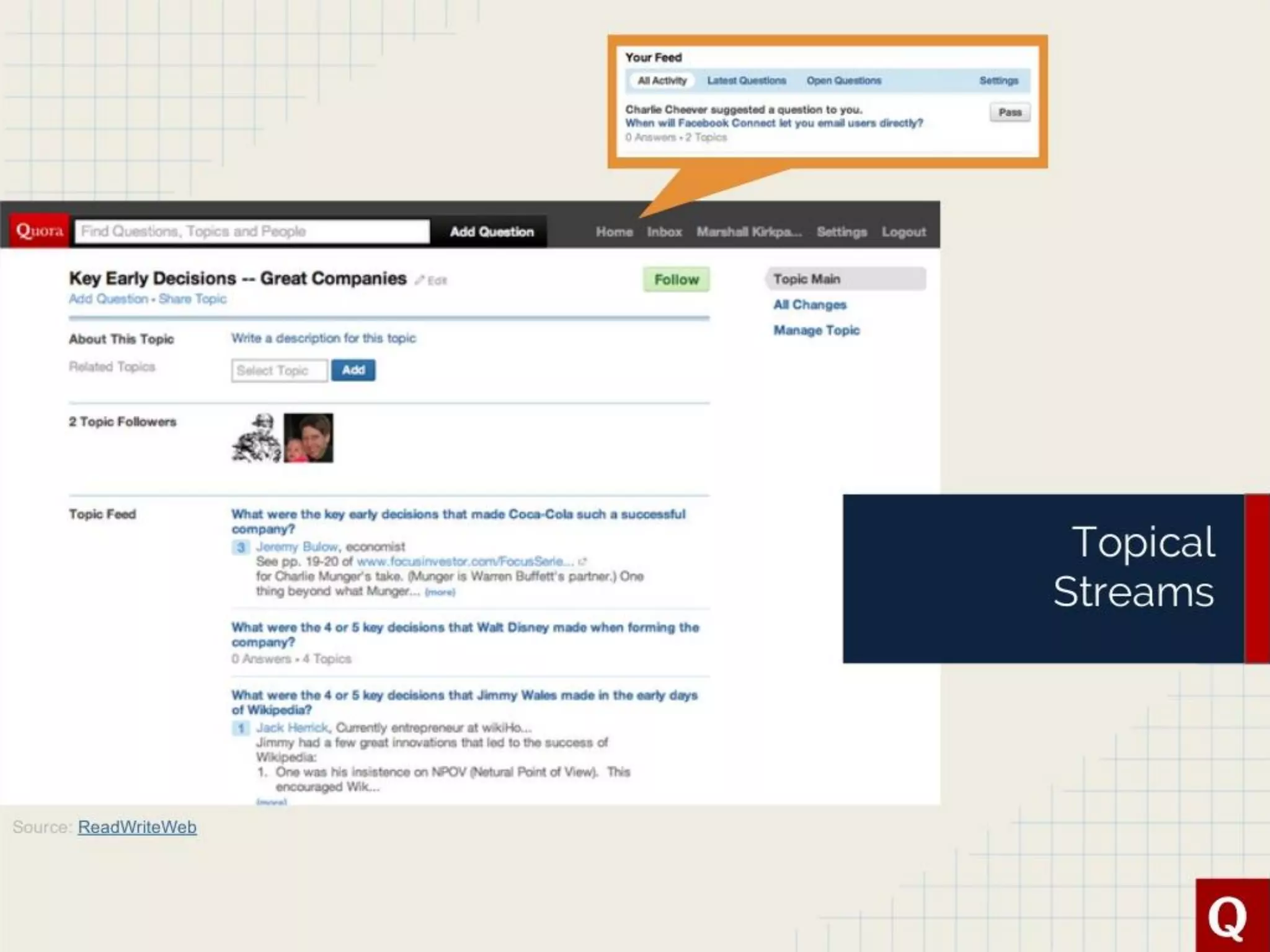
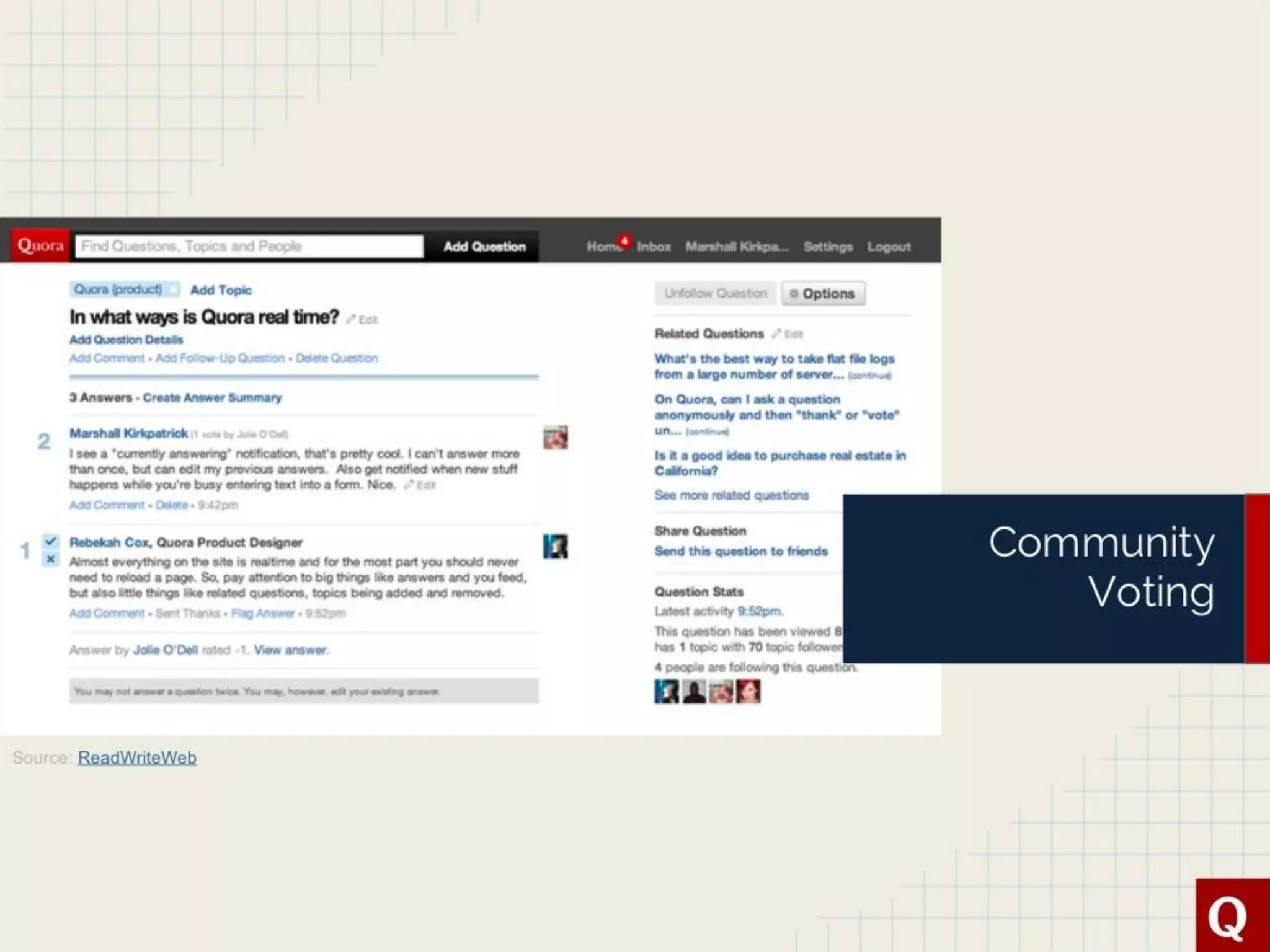
Slide 8 lays out the core solution: a social ask-and-answer platform with OpenID login, followable topics/questions/users, engineered discovery and participation, and human-created rankings. Adjacent slides (9 and 10 in the deck sequence) show concrete product elements—verified social profiles, topical streams, community voting—that translate the abstract value prop into user flows and moderation mechanics.

This is effective because it ties product mechanics to the earlier problems (quality, discoverability, social reach). Founders can learn to map specific features to each pain point and to show how product design creates the desired content quality and engagement loops.

Key Takeaway: Map product features directly to stated problems and show how design choices produce quality, discovery, and engagement.
Traction & Vitals: early metrics to prove momentum

Traction & Vitals: early metrics to prove momentum

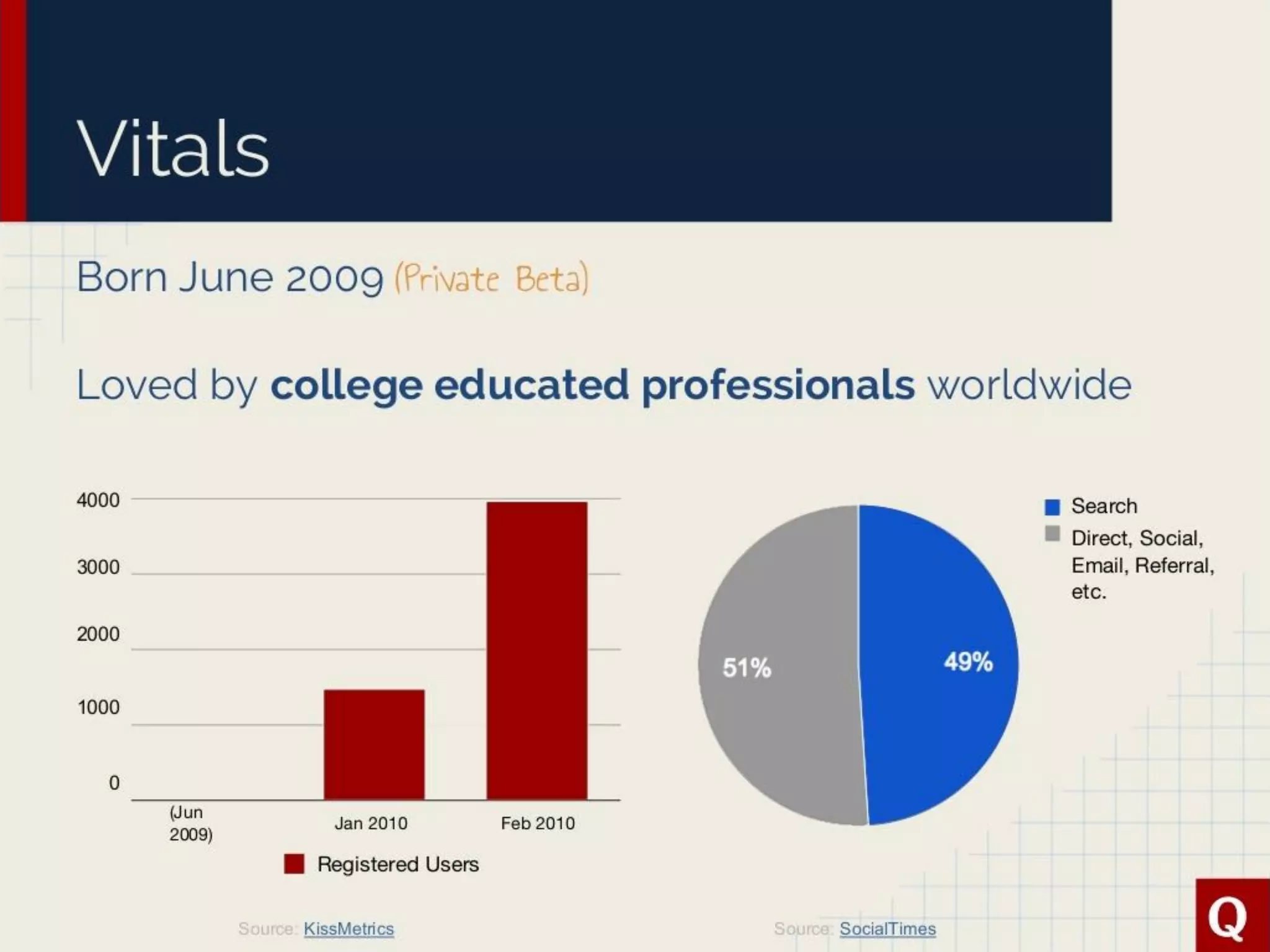
Slide 11 presents key early metrics: born June 2009 (private beta), adoption by college-educated professionals, registered user growth from Jan to Feb 2010, and traffic source split (search ~49%). The deck highlights the kind of traction investors care about—cohort signals, organic growth channels, and search discoverability that implies long-term growth potential via SEO and referral.

This slide works because it provides concrete numbers without overwhelming detail, focusing on the signals that validate product-market fit and growth engine. Founders should include a compact metrics slide that emphasizes adoption velocity, quality of users, and scalable traffic channels.

Key Takeaway: Present a short set of high-signal metrics (growth, user quality, acquisition channels) to prove early traction and drive investor confidence.

Conclusion: Key Lessons

Quora’s 2010 deck combines clarity of positioning, founder credibility, product mechanics tied to user pain, market timing, and compact traction evidence into a persuasive investor narrative. Strengths include a memorable opening analogy, disciplined value proposition, a team slide that reduces execution risk, problem→solution pairing that maps features to pains, and a small set of meaningful metrics that signal momentum. The visuals are clean and support quick comprehension rather than distracting with data overload.

Actionable advice for founders: lead with a one-line category-defining proposition, show why now with measurable trends, connect each product feature to a specific user problem, present a tight team slide that demonstrates execution capability, and include 3–5 high-signal traction metrics. Keep slides visually simple—use brand, single-sentence positioning, and clear numeric evidence to tell a coherent story investors can repeat.