Stack up against LinkedIn

Compare Your Deck

LinkedIn's 2004 Pitch Deck

Social
Stage: Series B
Raised: $10M
Year: 2004
Slides: 28
Outcome: Acquired by Microsoft for $26.2B

Pitch Deck

1 / 28
Slide 1
Click to expand

Deck Analysis

This Series B pitch deck from LinkedIn (August 2004) frames the company as 'Professional People Search 2.0' — a network-driven marketplace that leverages verified relationships to create trust and derive revenue. Notable for its clean narrative arc, the deck uses analogies to eBay, PayPal and Google to explain how network effects enable better product outcomes and monetization, then follows with traction, competitive positioning, and a pragmatic three-pronged revenue plan. It's an early example of a product-led, network-effect-first fundraising story that later scaled into one of the largest tech exits in history.

Value proposition: Professional People Search 2.0

Value proposition: Professional People Search 2.0

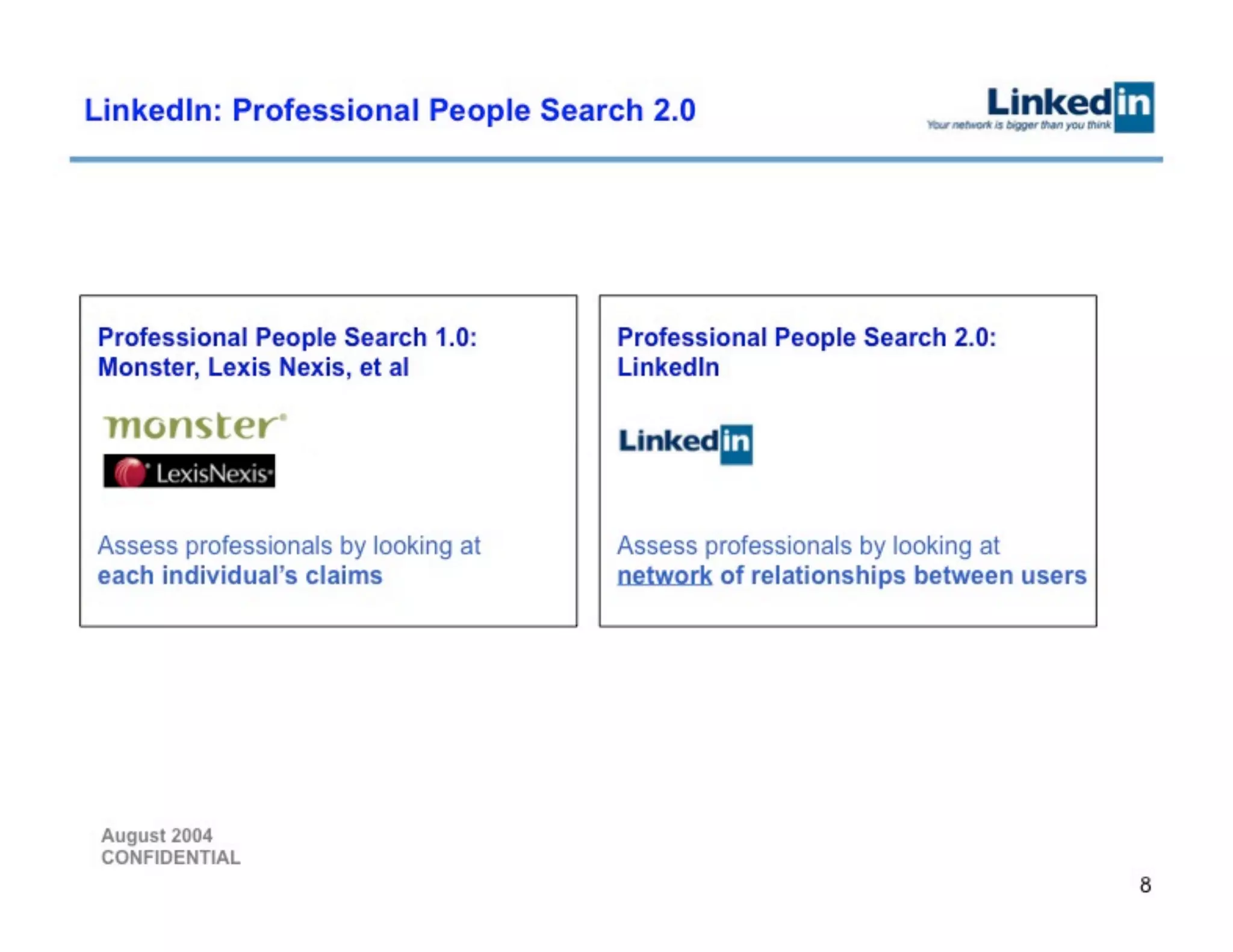
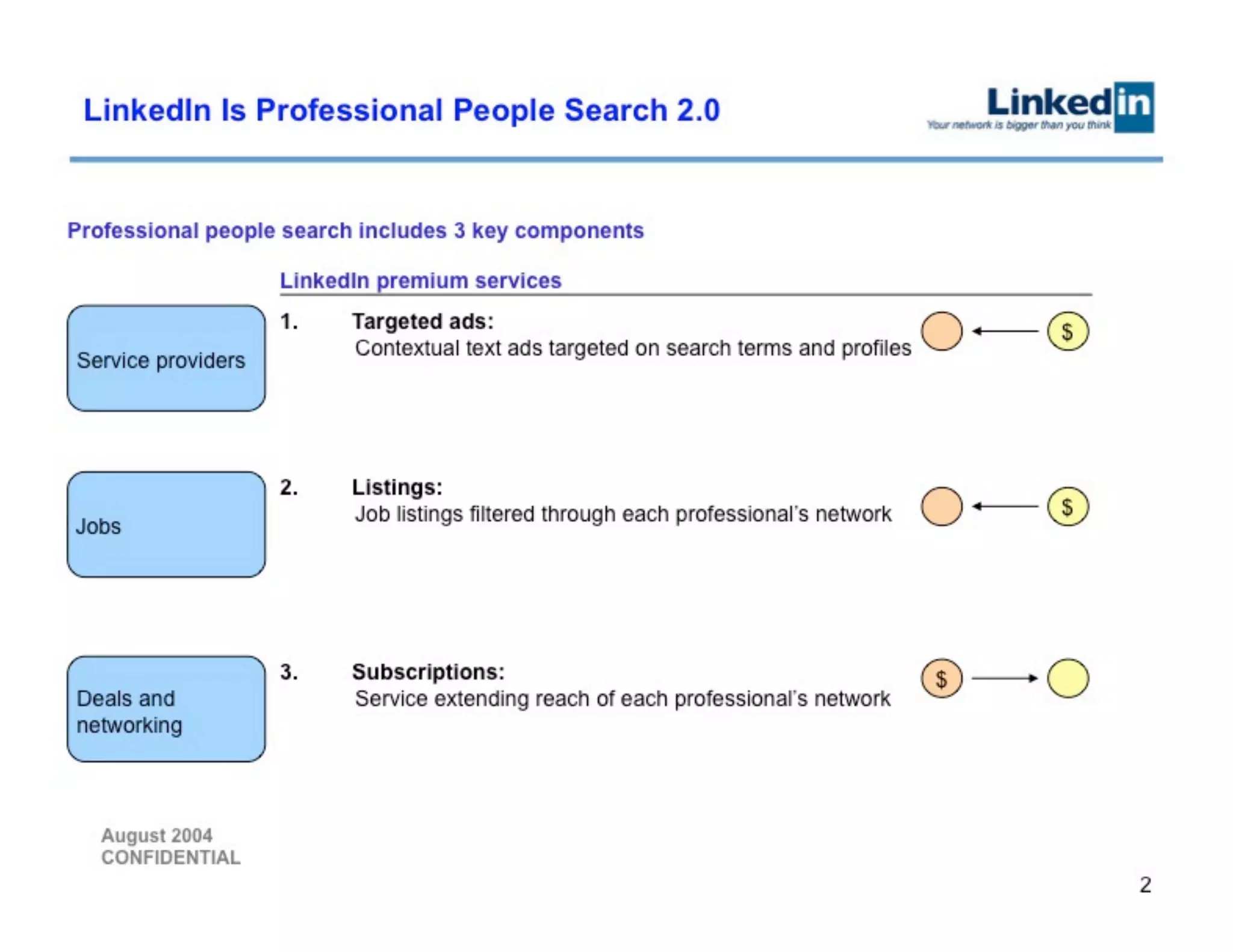
Slide 2 succinctly defines LinkedIn's product thesis: transform people search by using professional networks rather than flat directories. The slide is effective because it states the three revenue levers (targeted ads, job listings, subscriptions) while anchoring them to user value categories (service providers, jobs, deals and networking) — tying monetization directly to product utility.

Founders can learn from the clarity here: begin with the customer problem, show how your product uniquely solves it, and then map each major monetization channel to the user experience it extends. That reduces investor suspense and shows you understand both product and business model alignment.

Key Takeaway: Lead with a clear product thesis that ties each revenue stream to explicit user value.
Why networks beat flat directories

Why networks beat flat directories

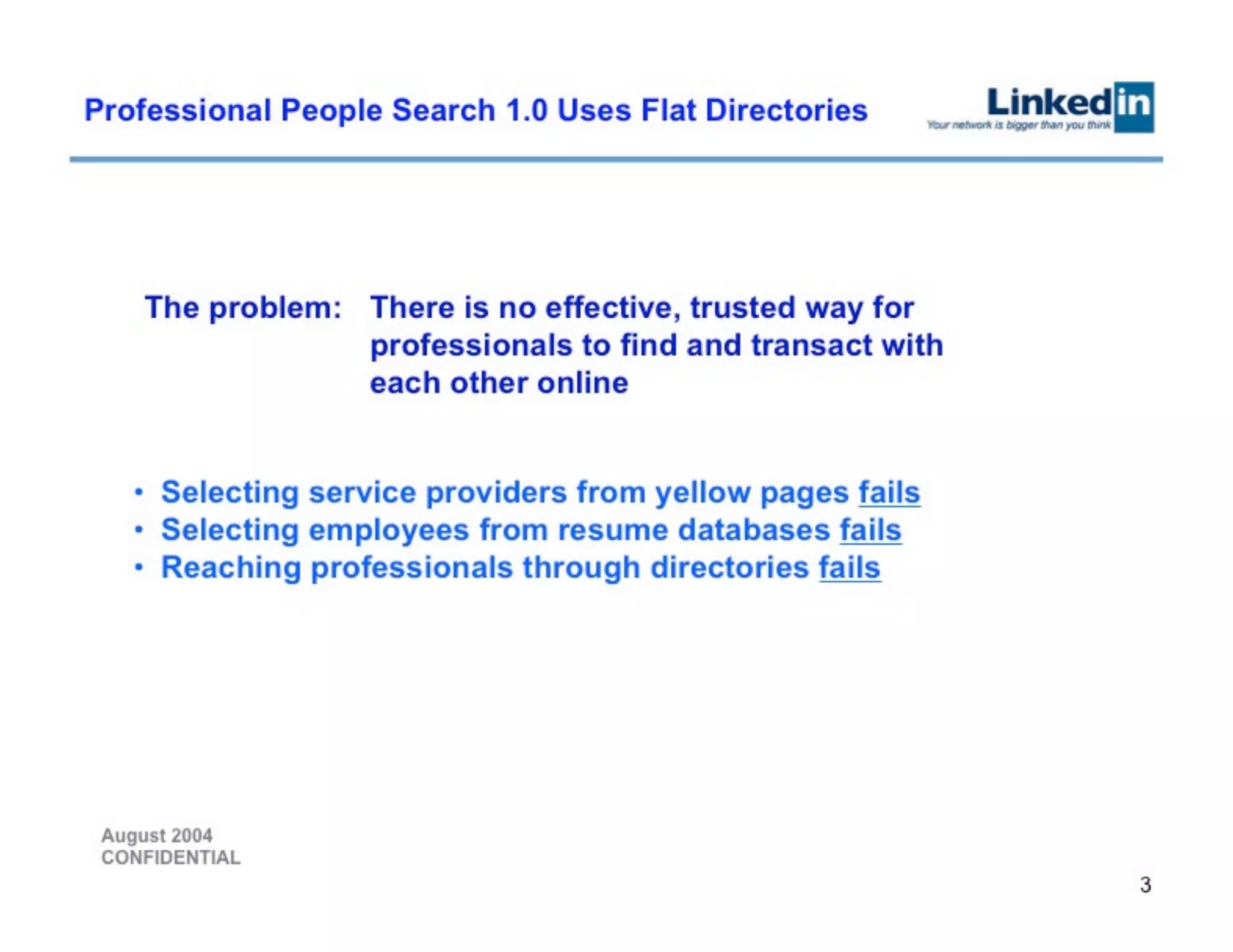
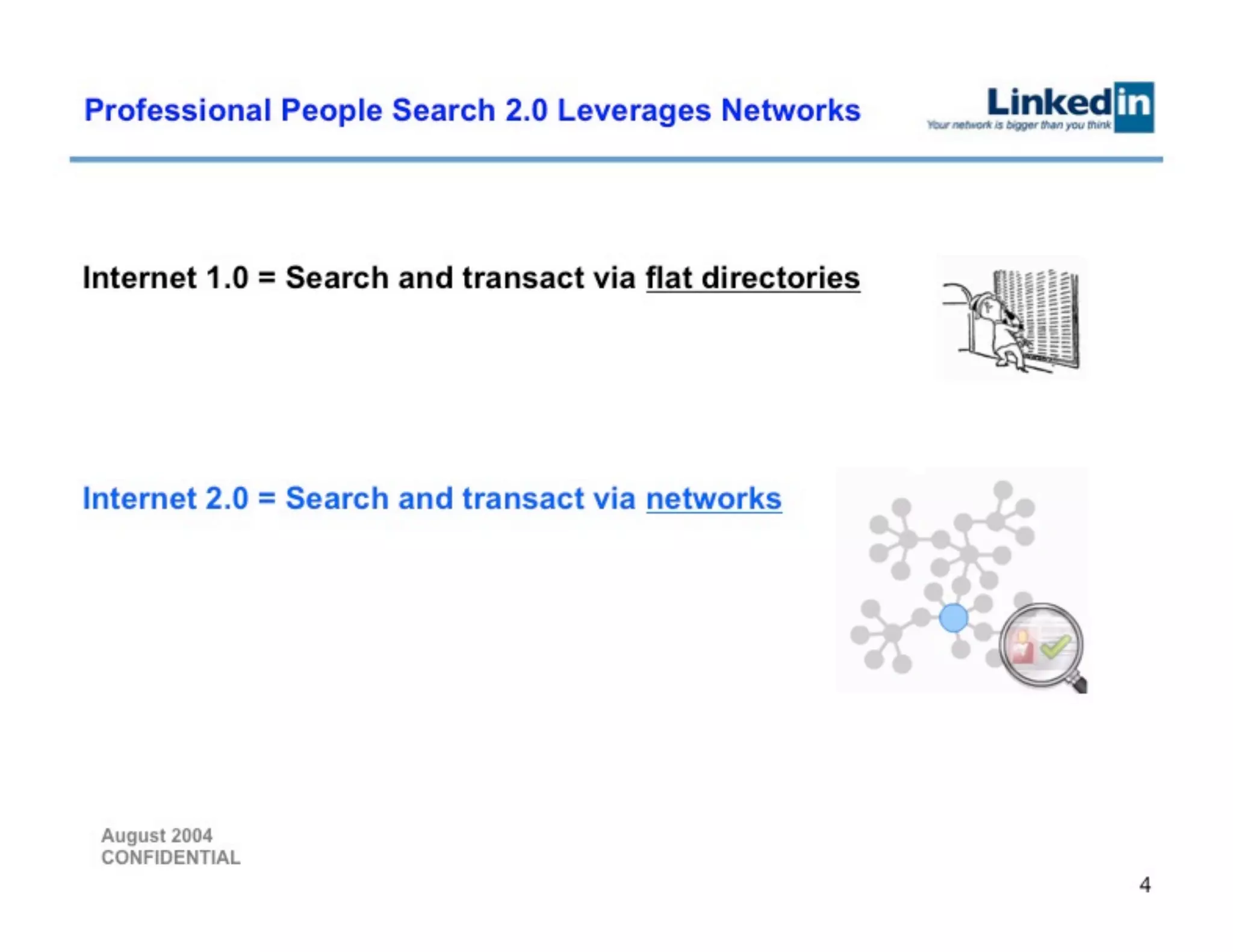
Slide 4 contrasts Internet 1.0 (flat directories) with Internet 2.0 (networks) and uses simple imagery to make the conceptual leap intuitive. The idea — that relationships provide verification, context, and reach that isolated records cannot — is both the product insight and the defensibility argument. Framing the business as a platform improvement rather than just another directory reframes market dynamics in LinkedIn's favor.

For founders, this slide demonstrates the power of a one-slide conceptual pivot: show the old paradigm, show the new paradigm, and make clear why the new one scales and locks in value. It’s especially helpful when your advantage is network-driven or algorithmically amplified, because it concisely communicates why incumbents struggle to replicate your moat.

Key Takeaway: Use a single clear comparison to show how your product creates a structural advantage over legacy alternatives.
Analogies to proven '2.0' businesses (trust & network effects)

Analogies to proven '2.0' businesses (trust & network effects)

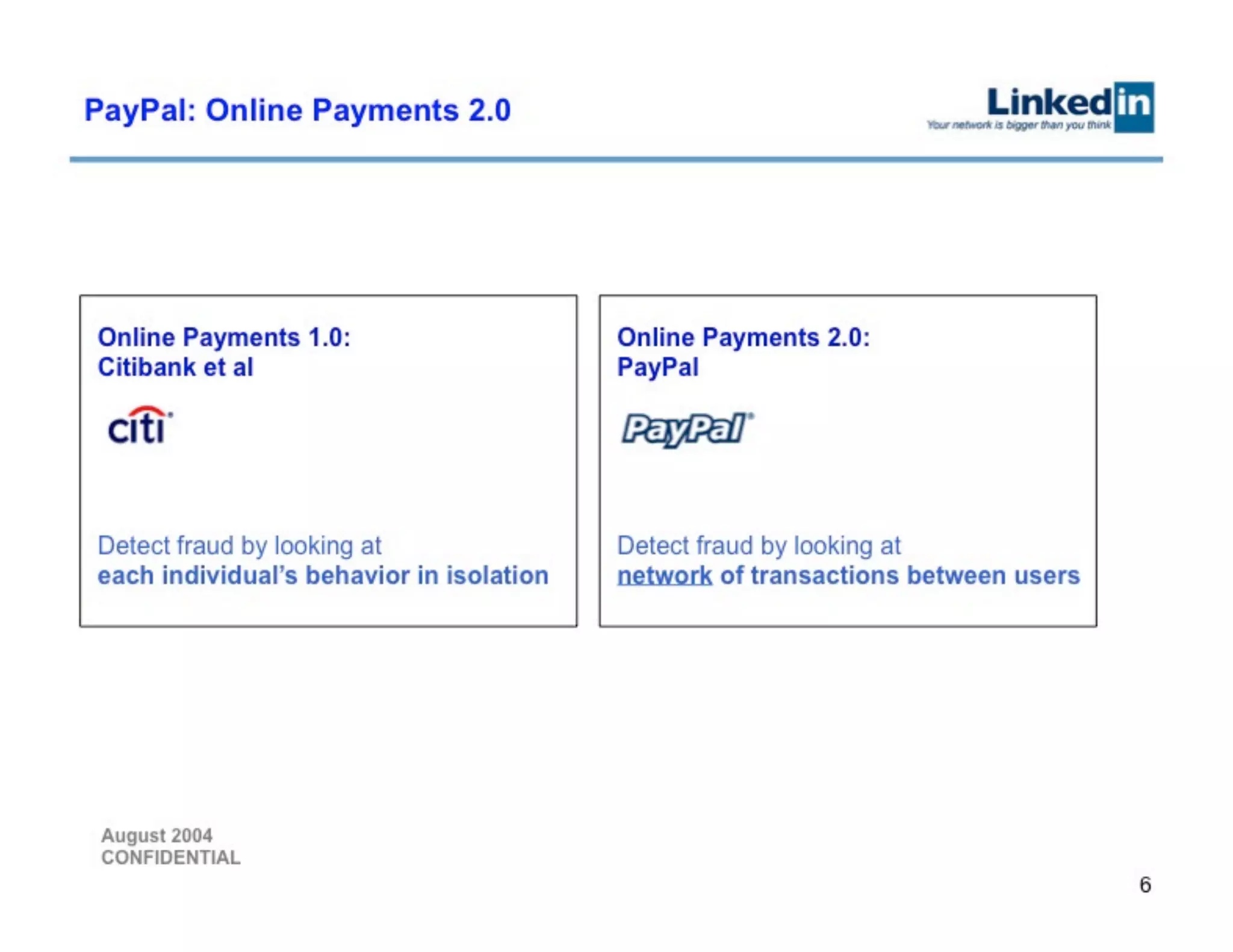
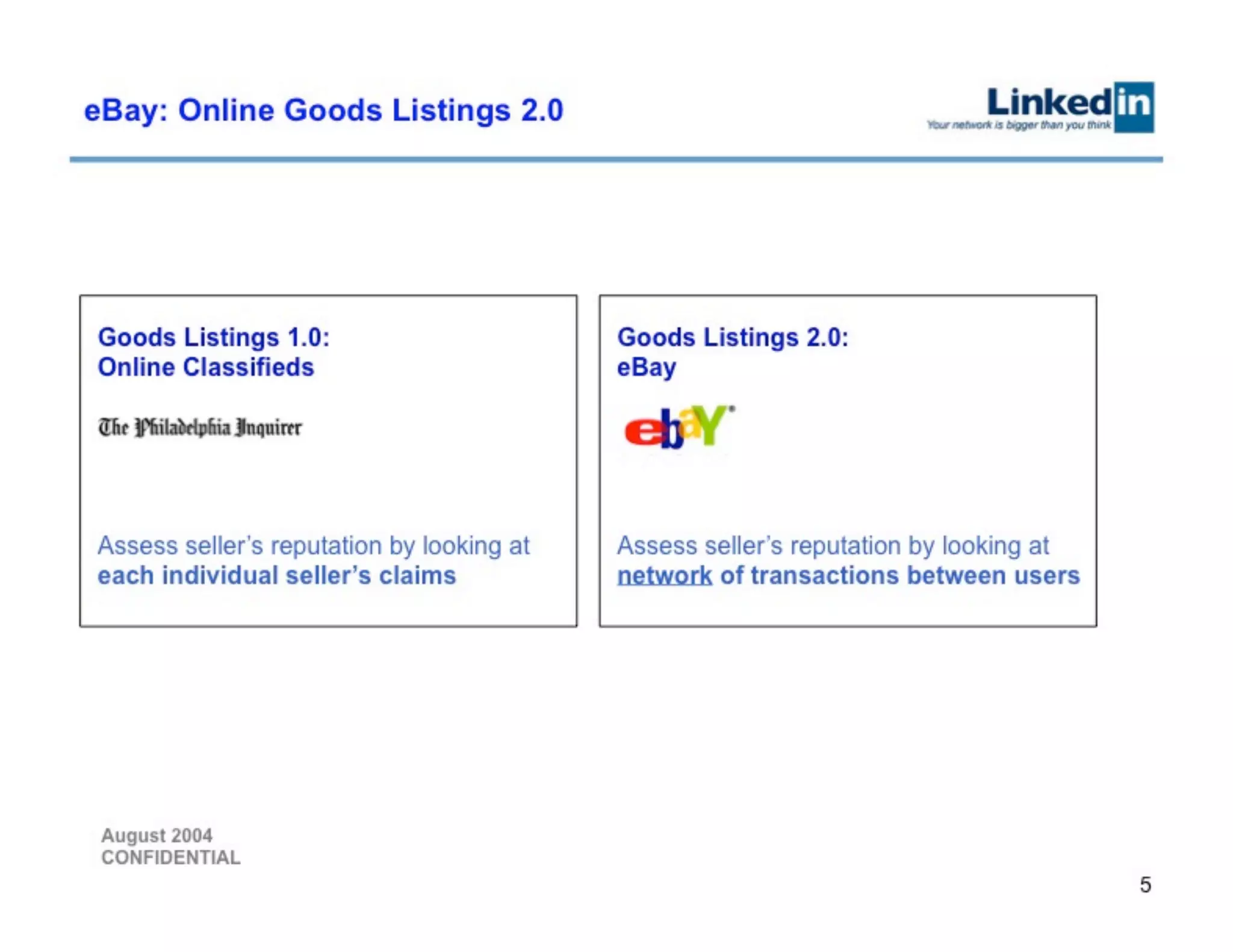
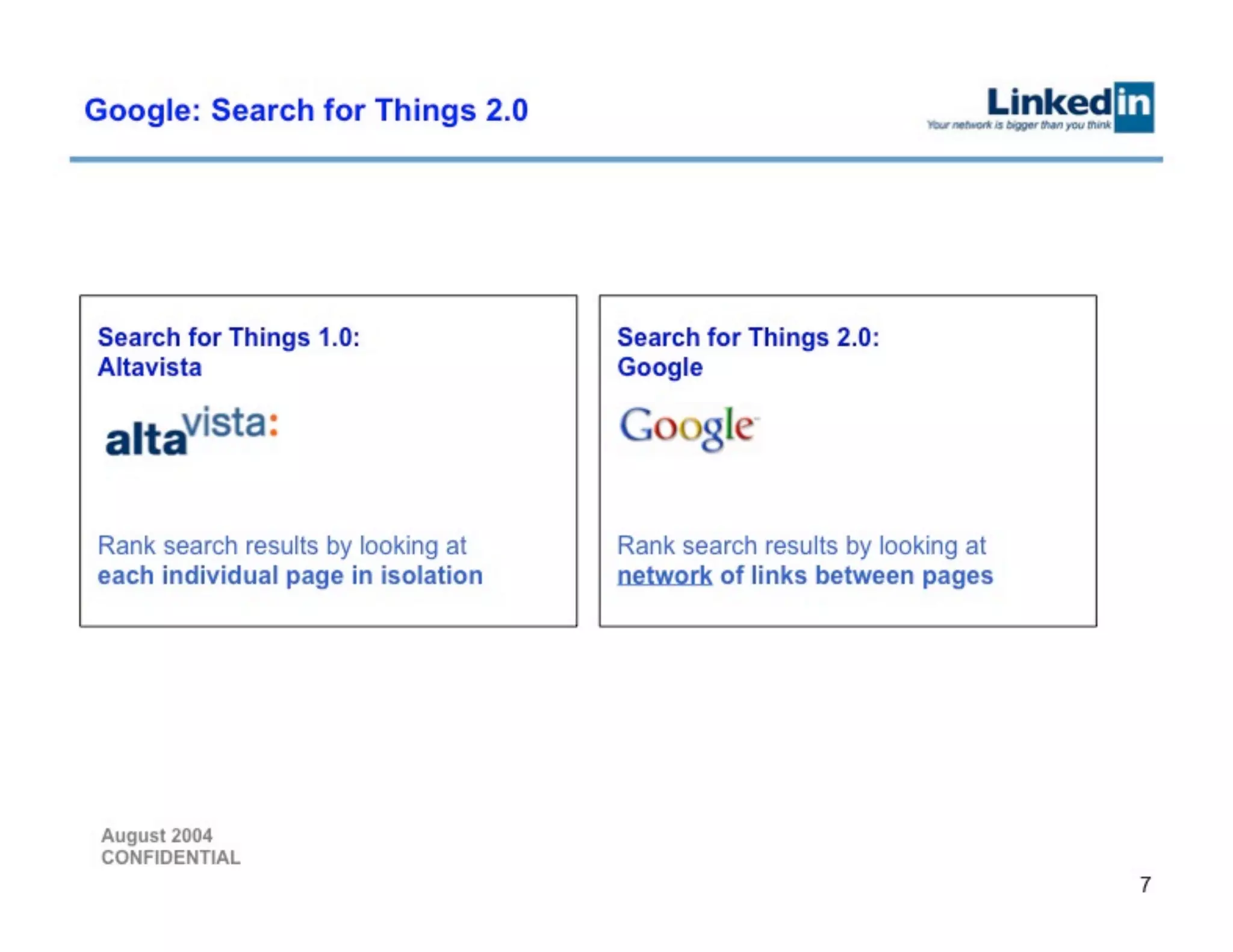
Slide 6 (PayPal: Online Payments 2.0) positions LinkedIn within a family of companies that replaced isolated signals with network-derived signals (e.g., eBay's feedback, PayPal's fraud detection, Google's PageRank). By aligning LinkedIn with companies investors already understand and have rewarded, the deck borrows credibility and explains how a network-reputation system creates economic value.

Founders should note how effective analogies can accelerate comprehension: pick 2–3 familiar winners with similar mechanics (reputation, network effects, data-driven ranking) and explain the parallel succinctly. This reduces investor cognitive load and converts abstract product claims into familiar business models.

Key Takeaway: Use analogies to well-known businesses to quickly convey mechanics and credibility for your network-driven approach.
Traction and the inflection: growth projections vs actuals

Traction and the inflection: growth projections vs actuals

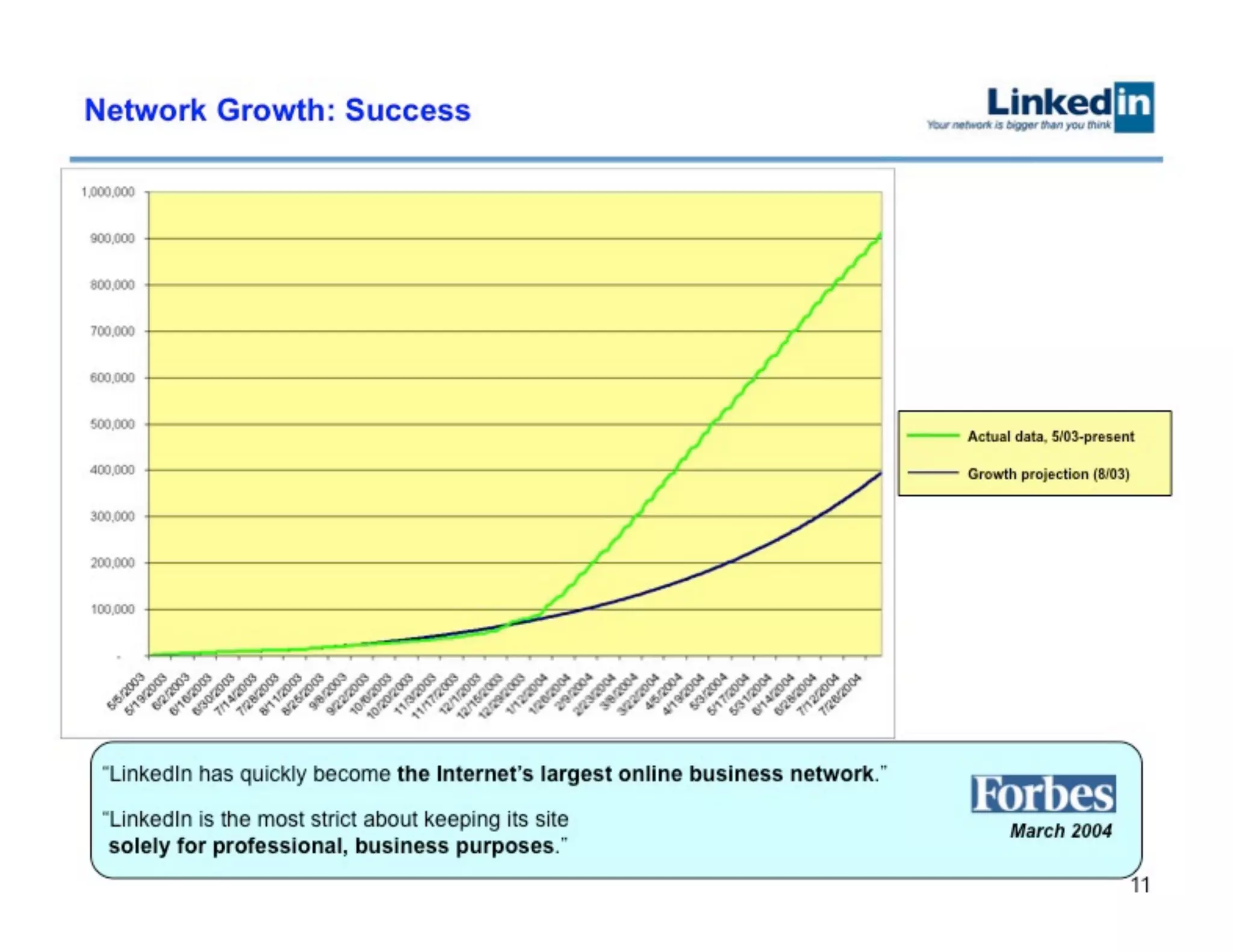
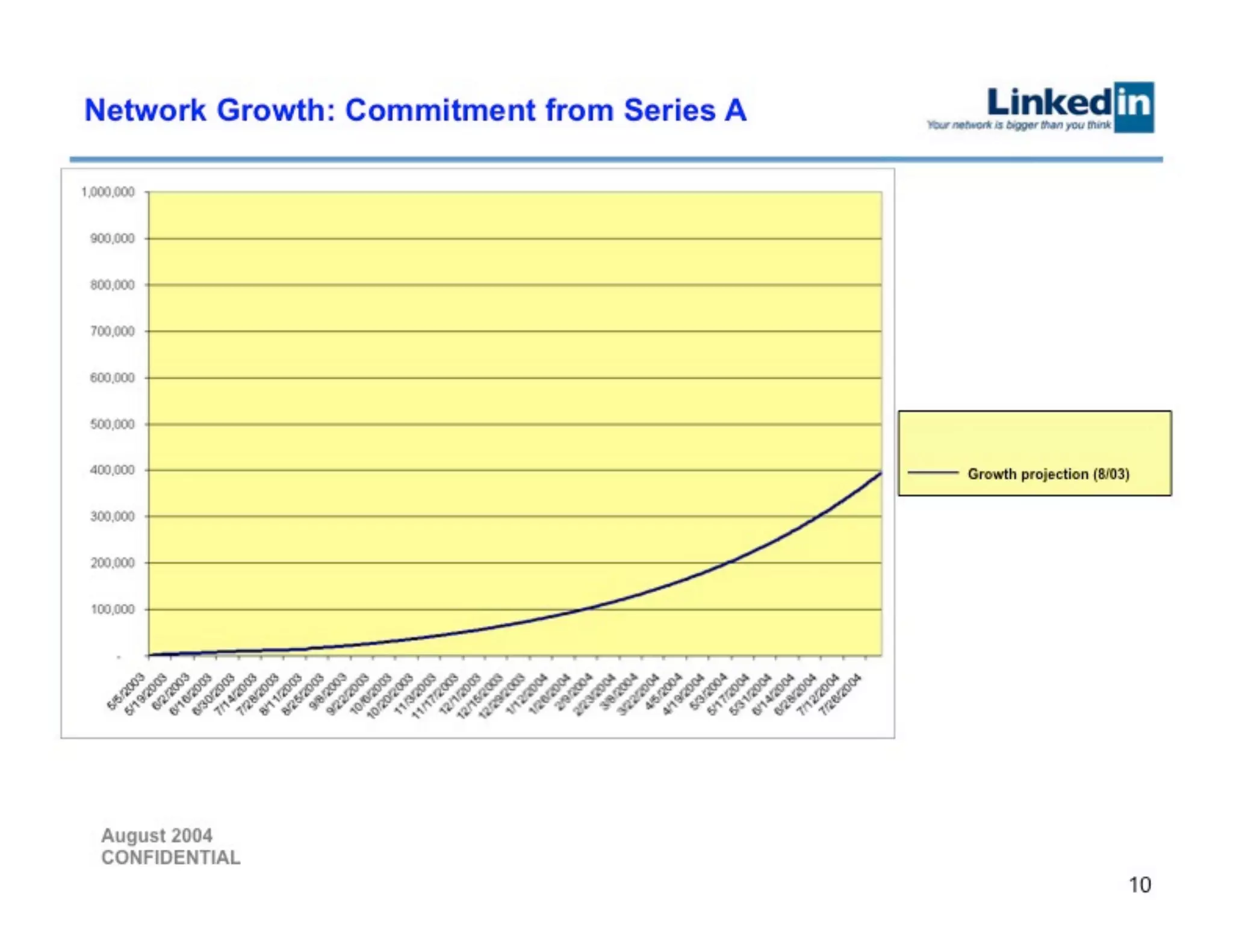
Slide 11 shows actual growth (green) well above the earlier projection (blue), presenting a clean, dramatic visualization of momentum. The slide combines a credible timeline with a third-party quote and positions growth as evidence that the product has reached viral lift-off and is approaching a tipping point. For investors, seeing realized outperformance versus plan is much more convincing than projections alone.

For founders, the lesson is to present growth transparently and contextually: use simple graphs that compare projections to actuals, highlight inflection points, and provide narrative color (e.g., partnerships, product launches) that explain why the curve moved. Demonstrating consistent overperformance builds trust and helps justify valuation increments.

Key Takeaway: Show real traction vs prior forecasts to demonstrate momentum and reduce reliance on hypothetical projections.
Market leadership and competitive map

Market leadership and competitive map

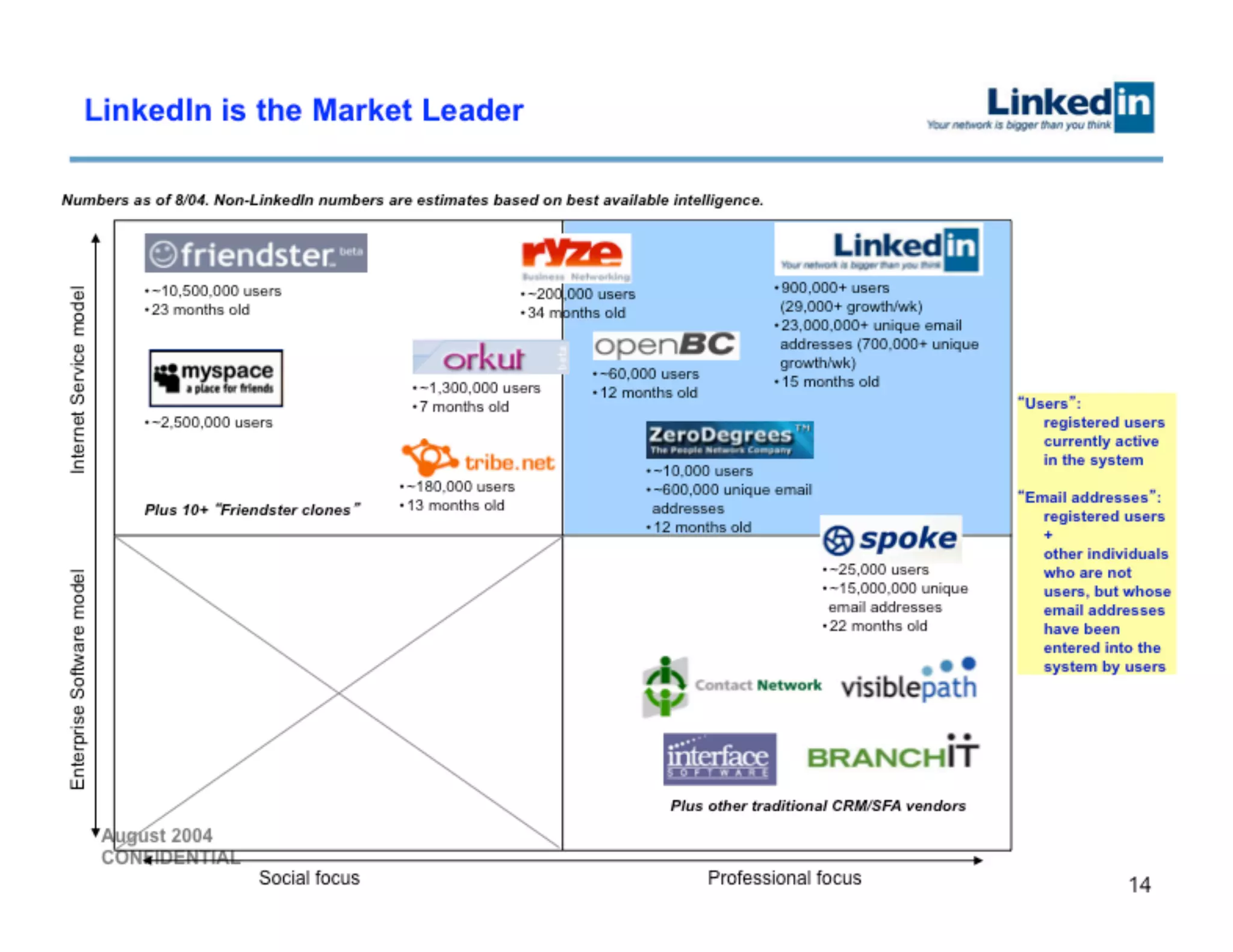
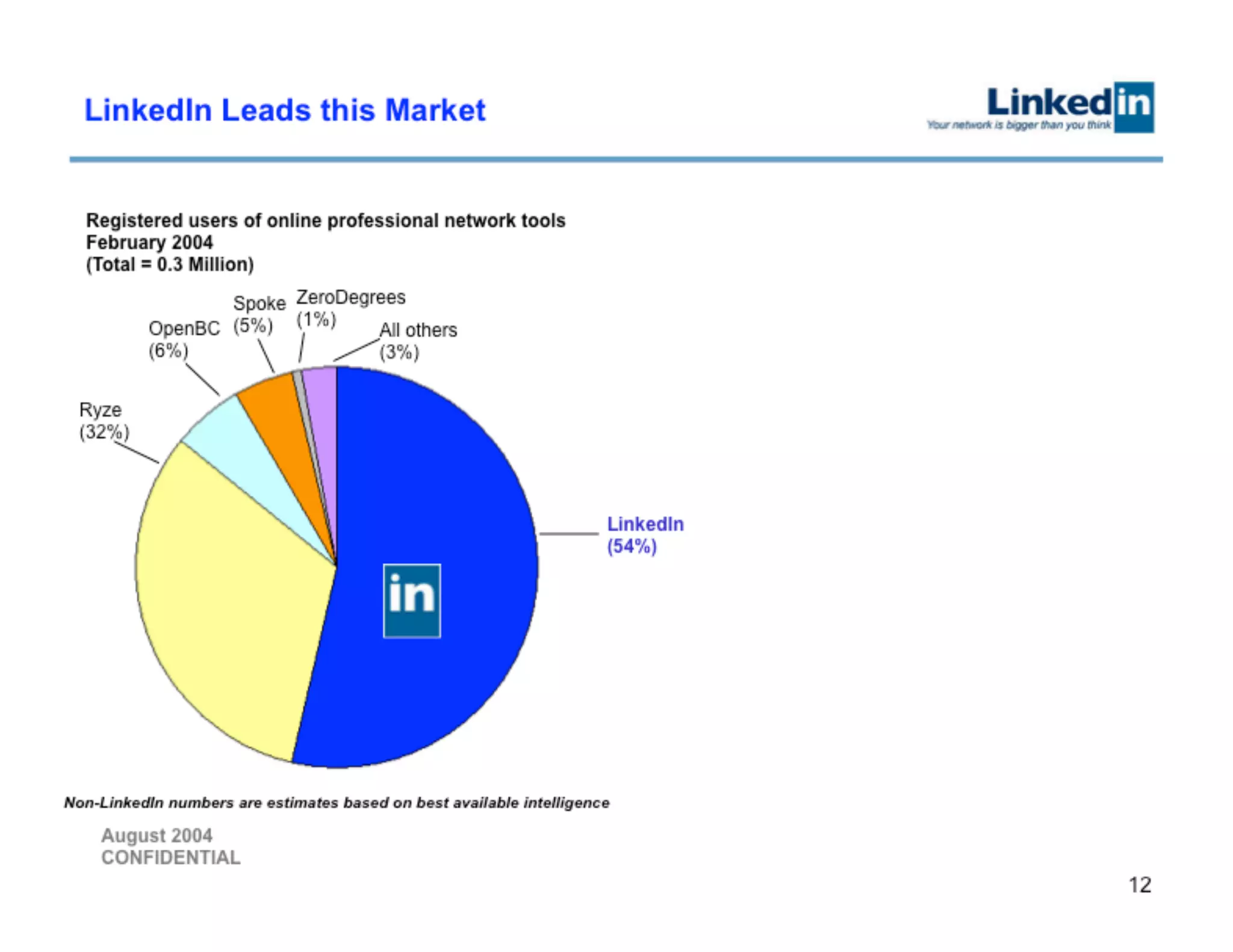
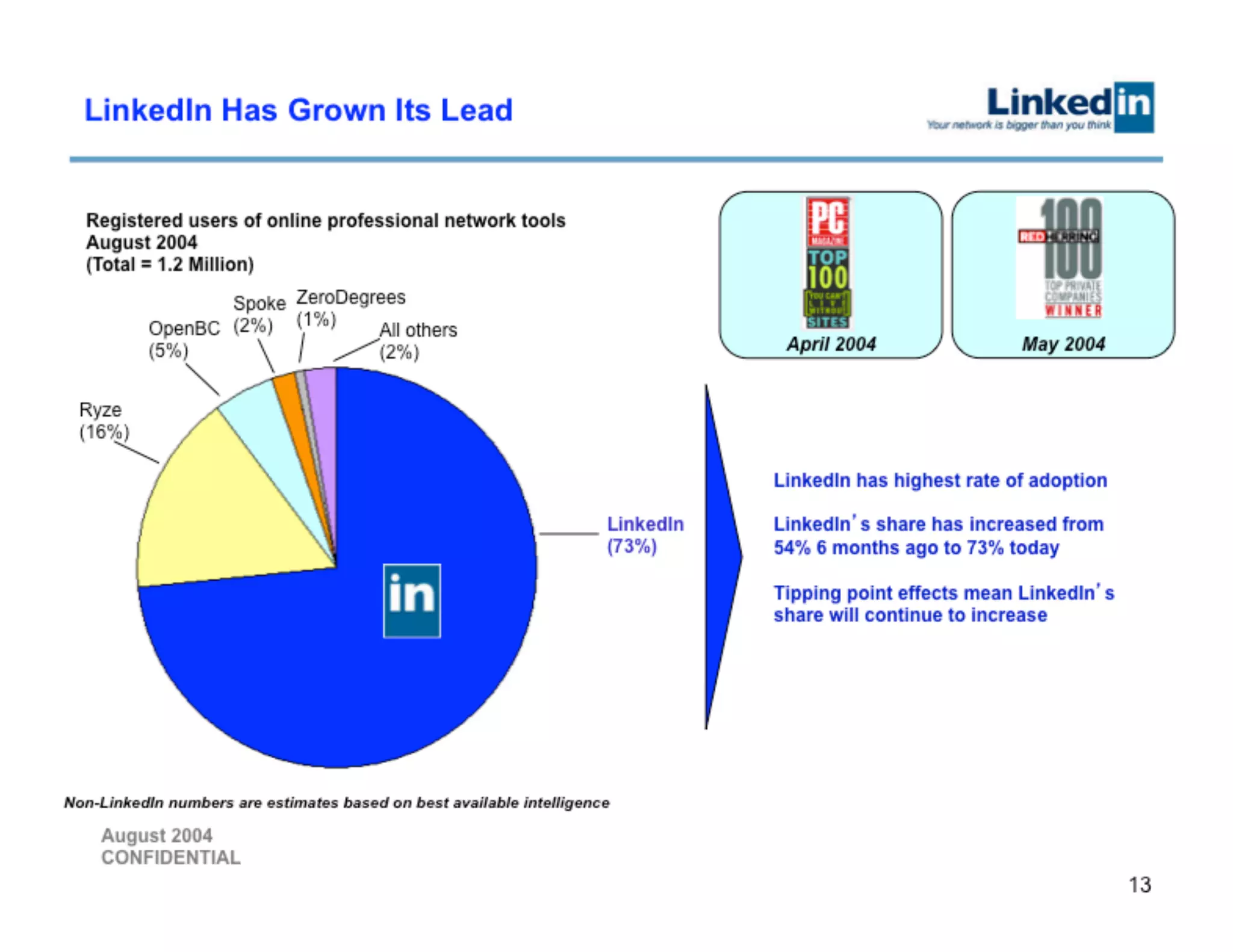
Slide 14 presents competitive positioning via a quadrant and pie charts that quantify LinkedIn’s share in the professional networking space, showing rapid share growth (from 54% to 73%). This visualization does three things: it shows category leadership, quantifies scale, and illustrates momentum relative to competitors. The inclusion of publication recognition (PC Magazine, Red Herring) further legitimizes the claim.

Founders should emulate the dual approach: combine qualitative positioning (who are the competitors and why you’re different) with quantitative share or usage data. When possible, show how your share has changed over time — growth in share is often as persuasive as absolute share because it signals adoption velocity.

Key Takeaway: Pair qualitative competitive positioning with concrete market-share or adoption metrics to demonstrate both leadership and momentum.
High-level revenue model: network enables revenue

High-level revenue model: network enables revenue

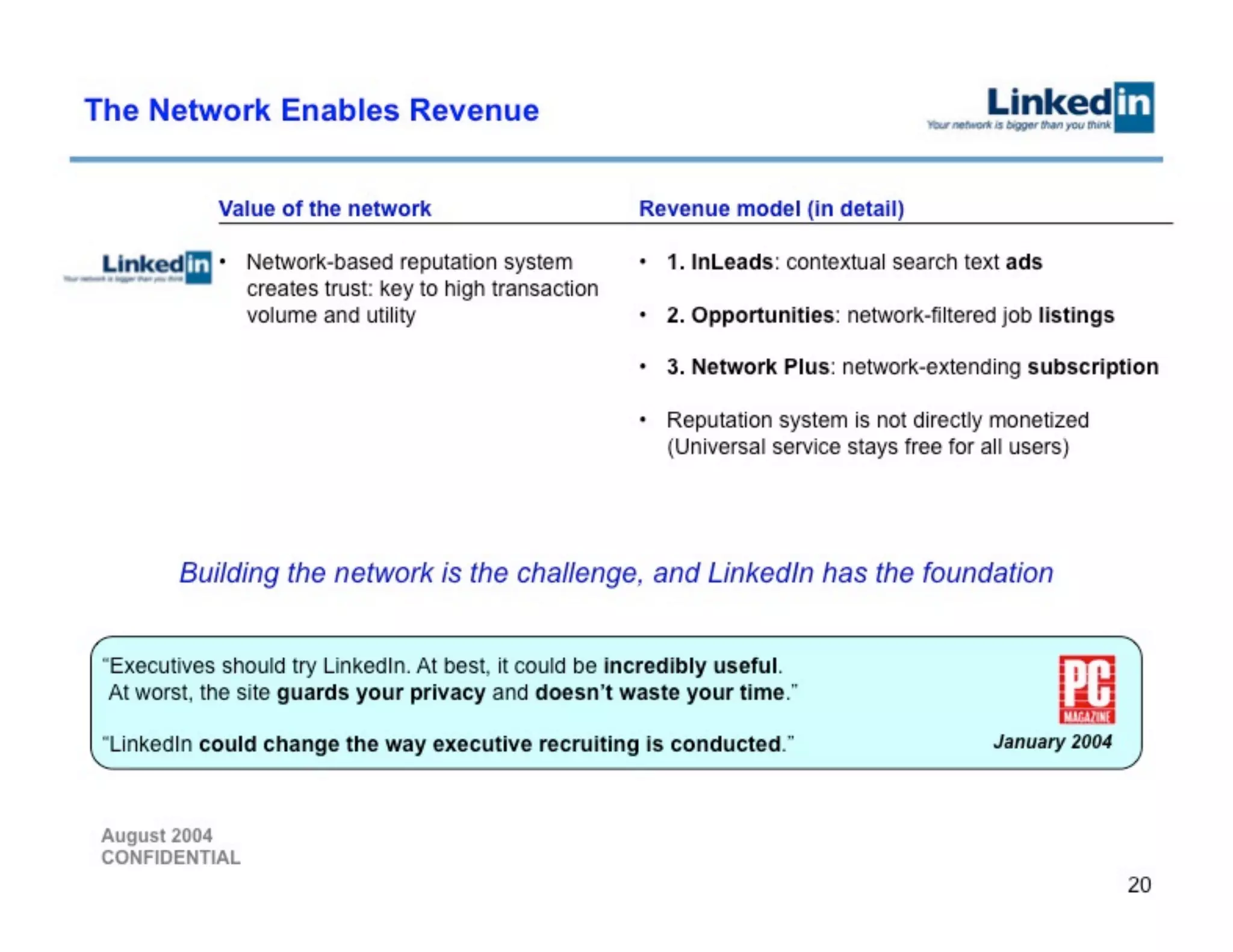
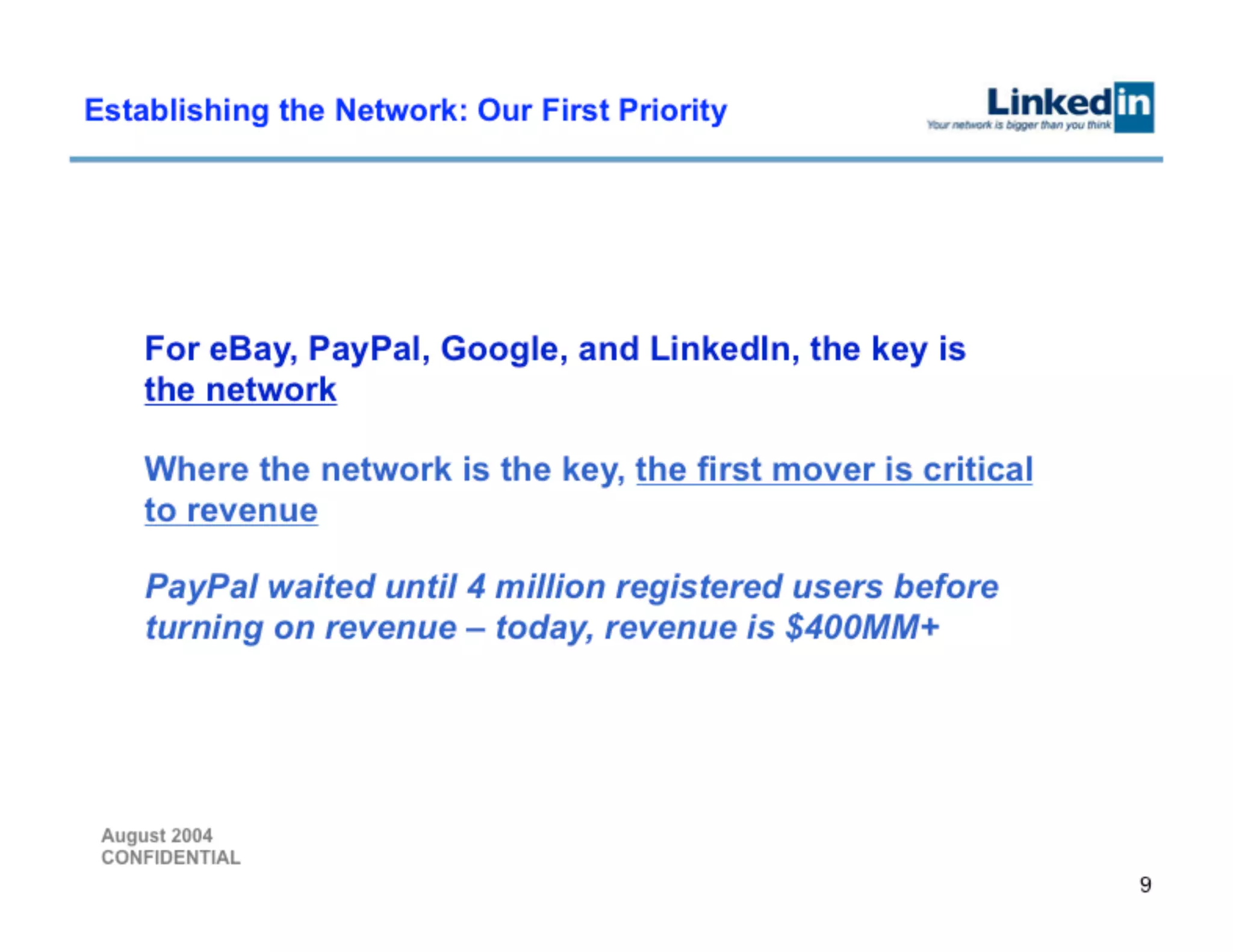
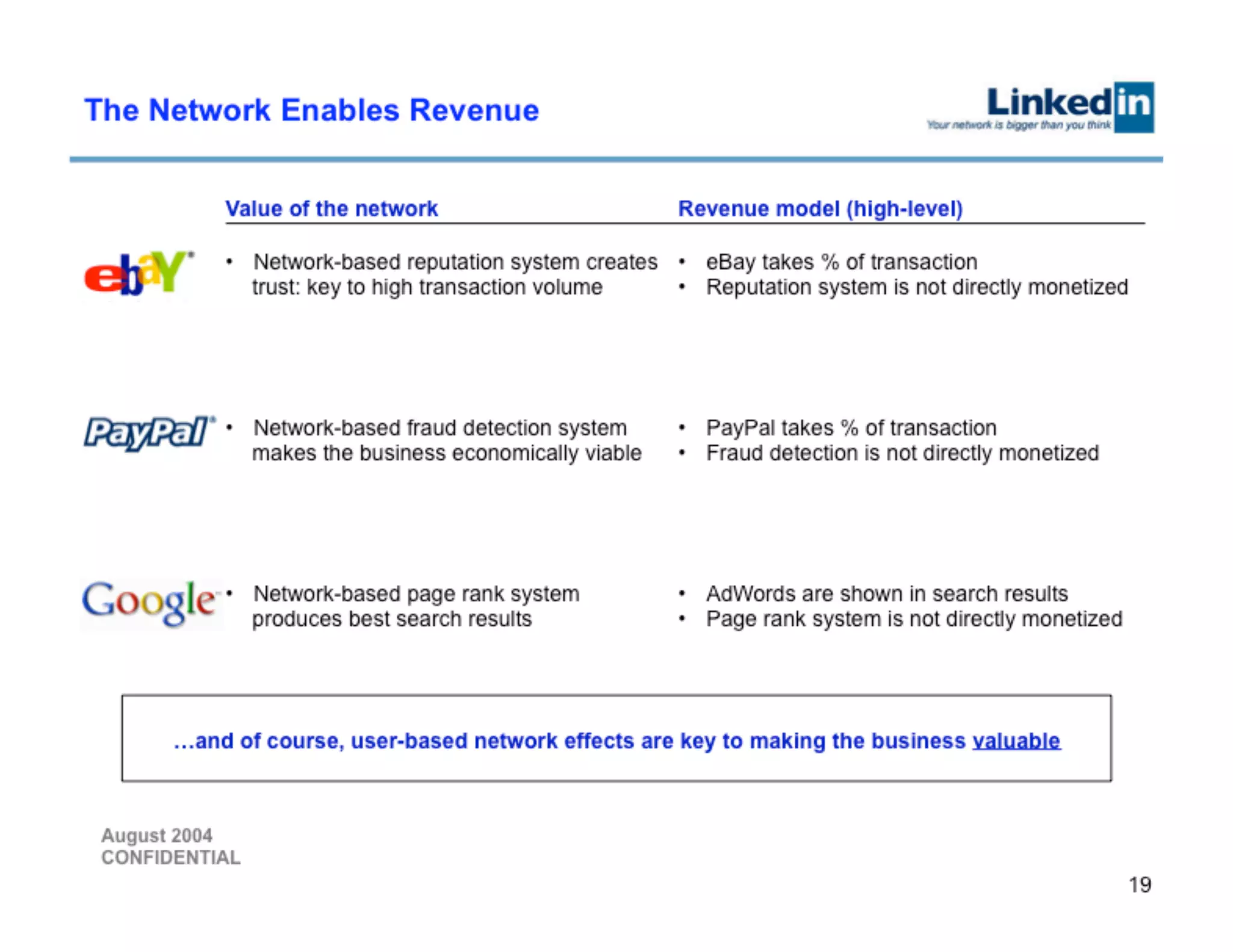
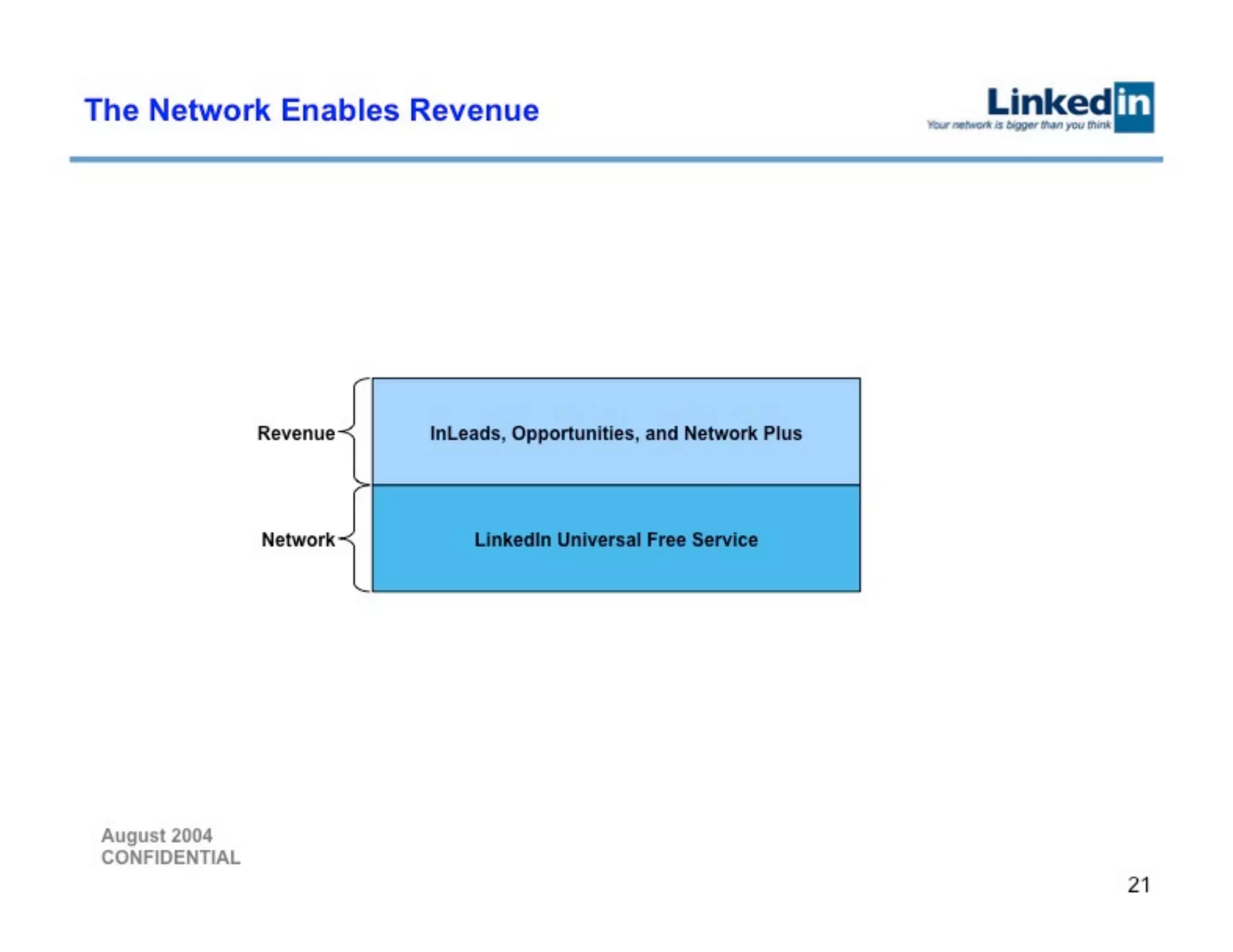
Slide 20 provides a concise mapping from the network's value to revenue models by comparing LinkedIn to eBay, PayPal and Google: reputation, fraud detection and PageRank are valuable but rarely monetized directly — instead these enable high-volume transactions or targeted advertising. LinkedIn’s three-pronged plan (InLeads ads, Opportunities job listings, Network Plus subscriptions) is presented as logical derivatives of network utility rather than ad-hoc monetization attempts.

This is a strong pattern for founders: show that monetization isn't divorced from product value; it follows organically. Present each revenue stream as a natural extension of the product's core utility and clarify which parts of the system are kept free (to grow the network) versus monetized (to capture value).

Key Takeaway: Tie each revenue stream directly to an aspect of product utility so monetization feels organic and scalable.
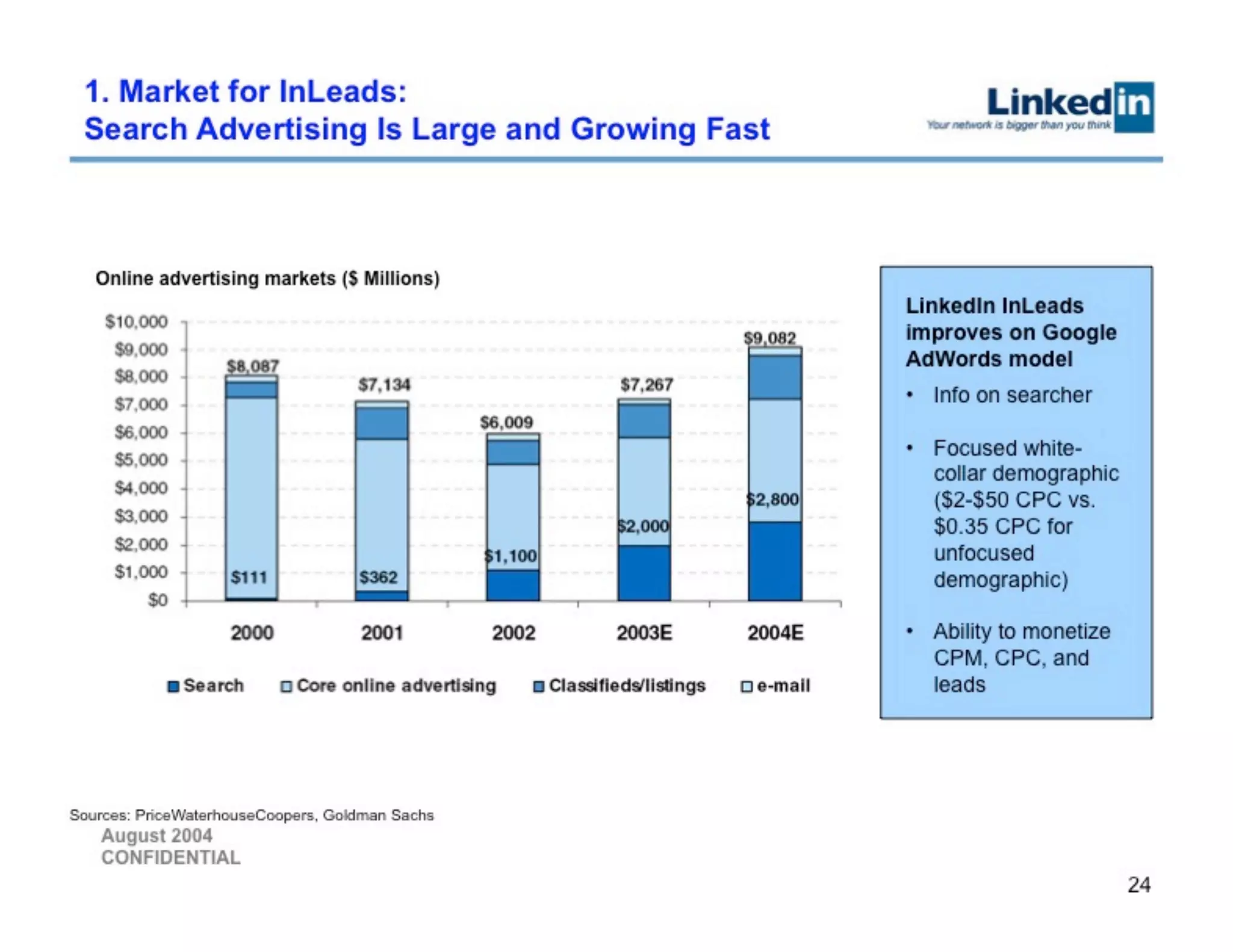
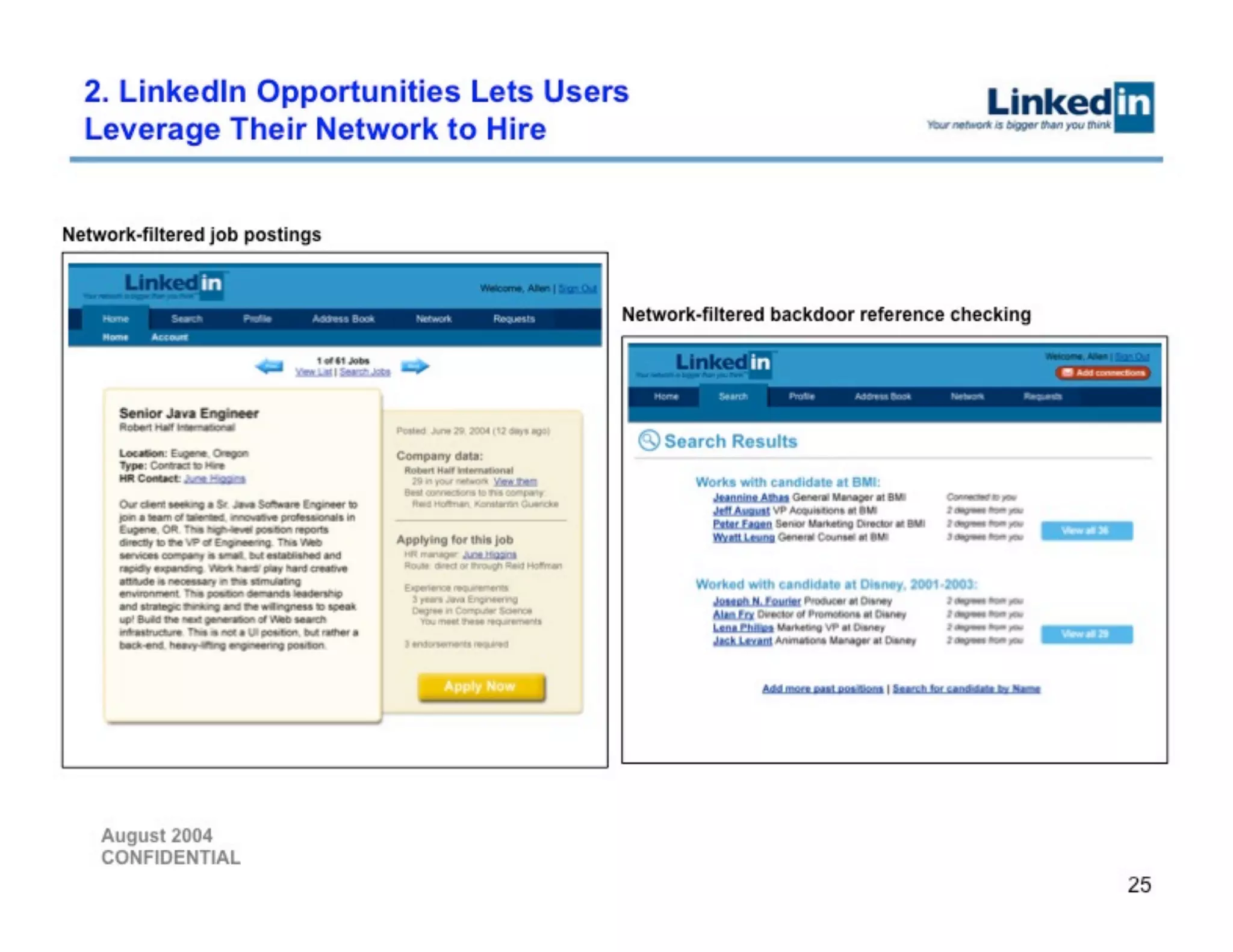
Product-level monetization: InLeads and job features

Product-level monetization: InLeads and job features

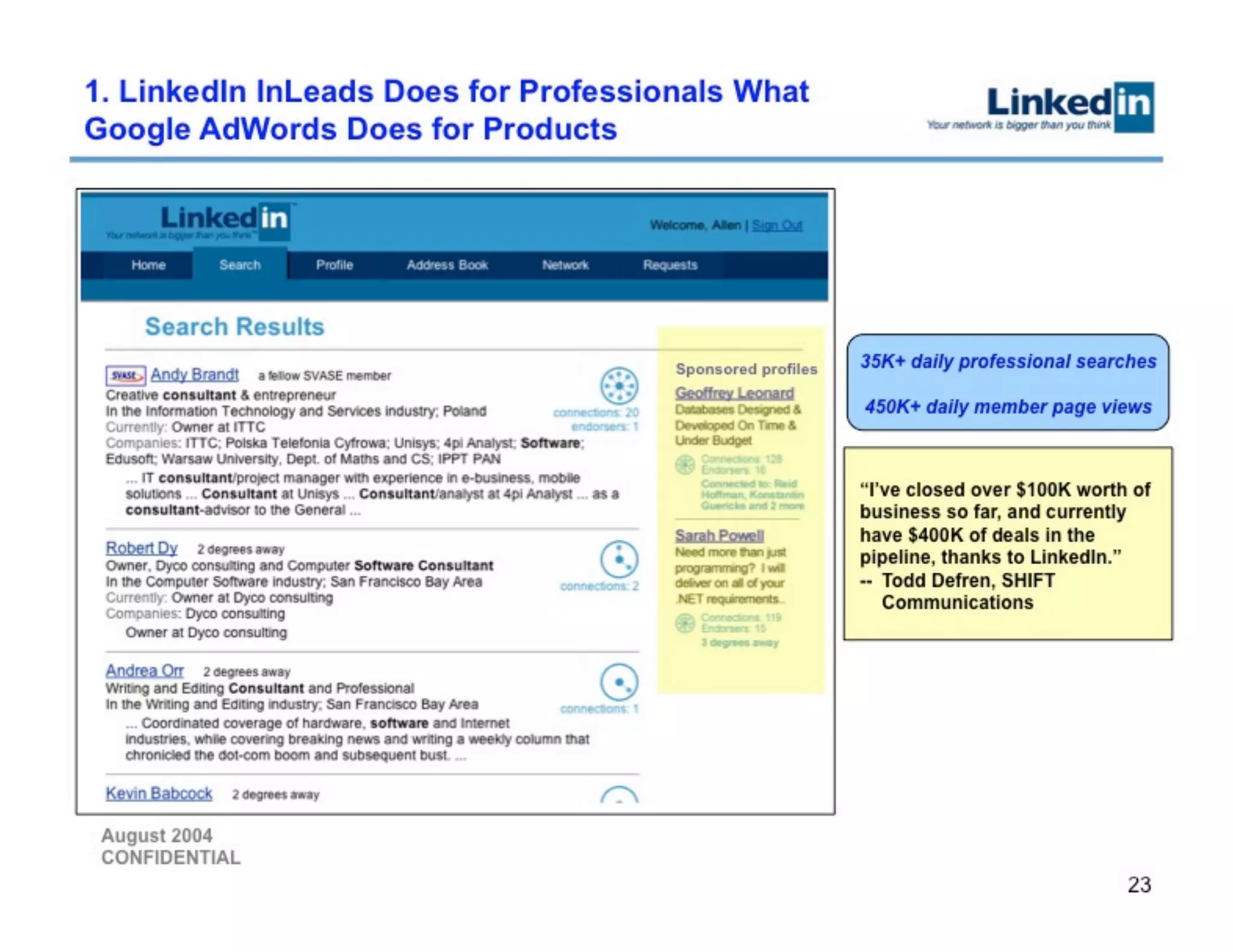
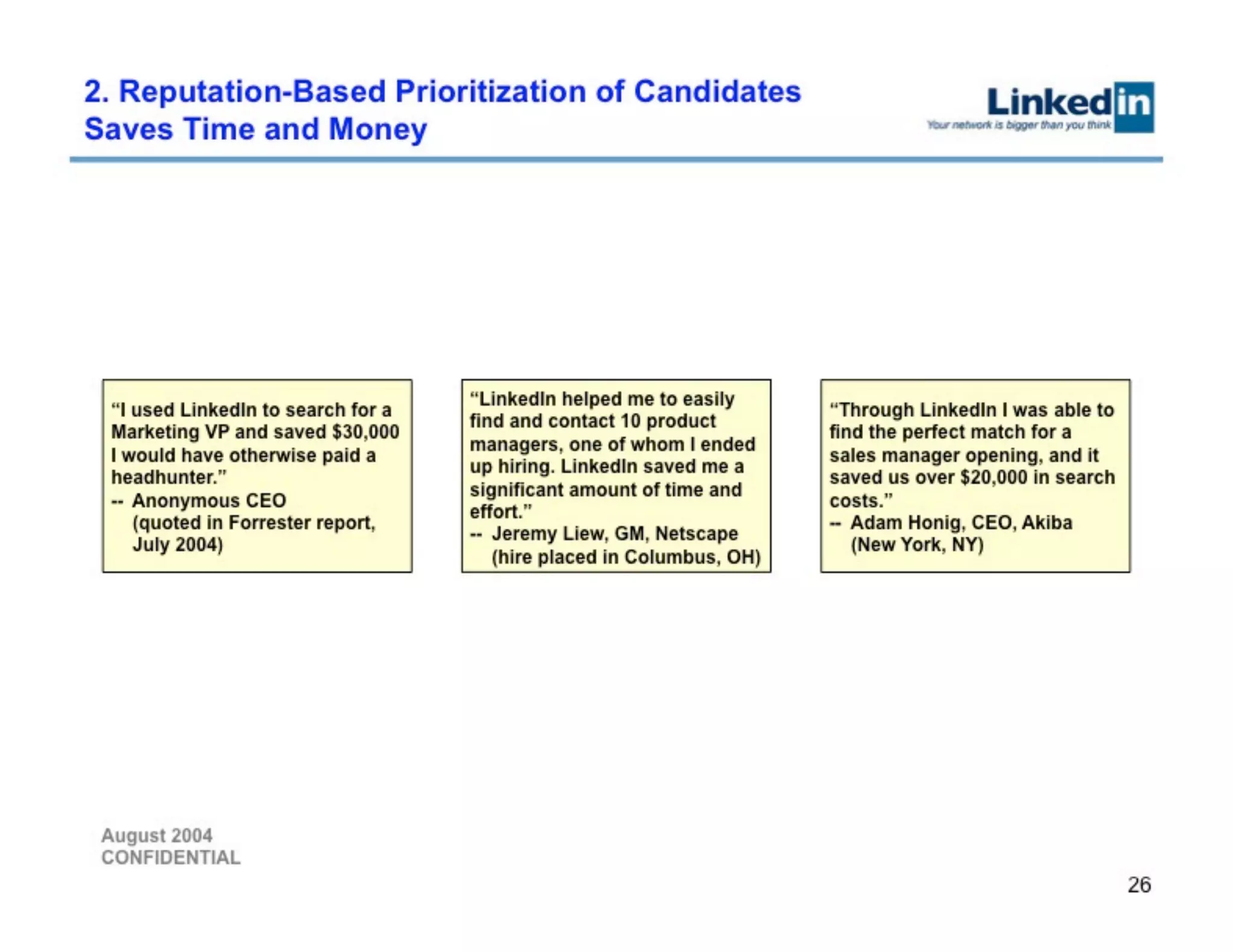
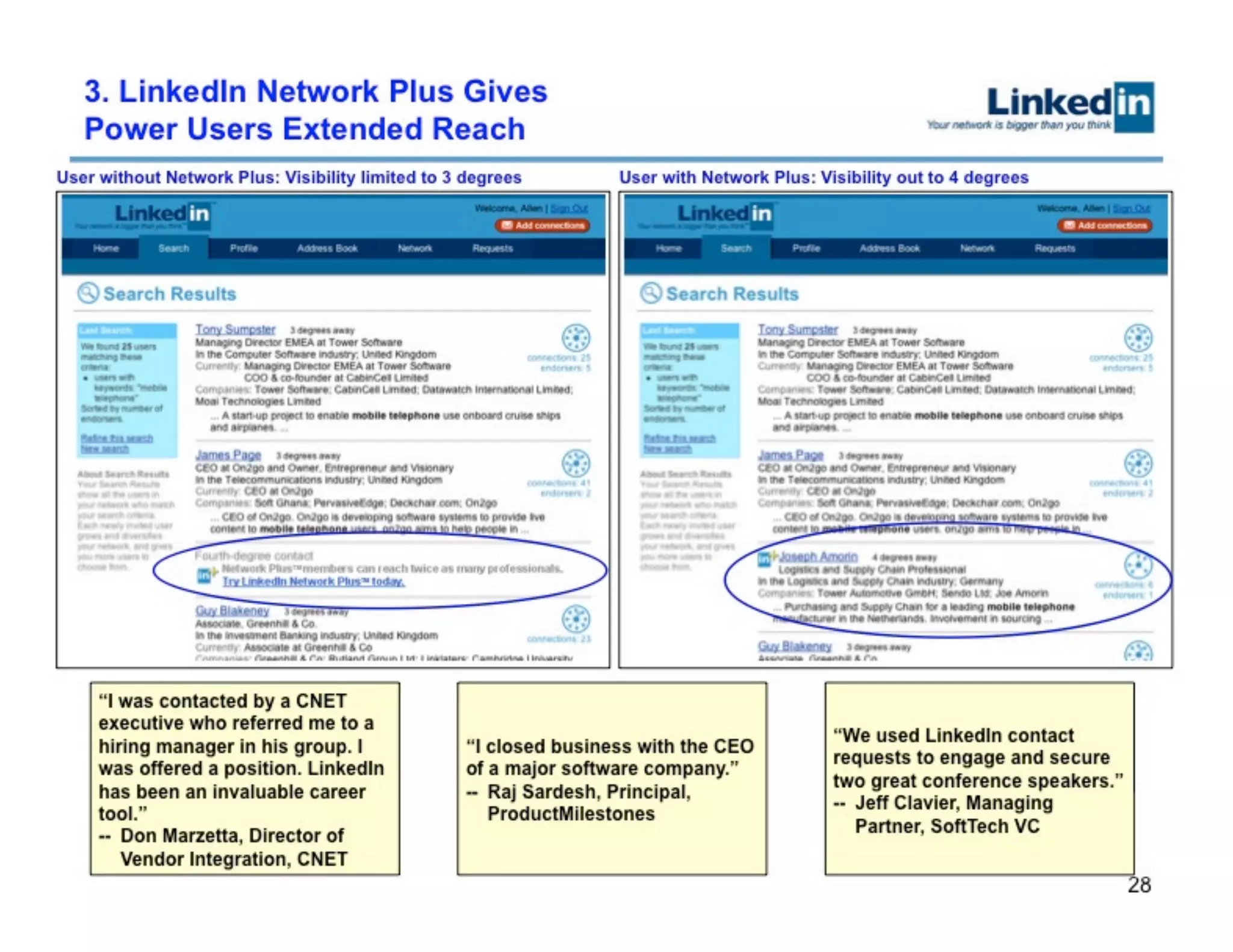
Slide 23 shows product mockups for InLeads (contextual search ads) and cites usage statistics (35K+ daily searches, 450K+ daily page views) plus customer testimonials about revenue impact. The slide is pragmatic: it visualizes how ads integrate into search results and offers evidence of early funnel metrics and business outcomes. That combination of UI example + usage + customer quote turns an abstract ad product into a credible revenue engine.

Founders should learn to demonstrate monetization pilots with real user metrics and UI examples. Investors want to see where and how dollars will appear in the product flow, early signal of willingness-to-pay, and customer stories that validate LTV or pipeline impact. A small pilot with clear KPIs is stronger than an elaborate long-term revenue model without product proof.

Key Takeaway: Present concrete product mockups plus early usage and customer evidence to validate each monetization path.
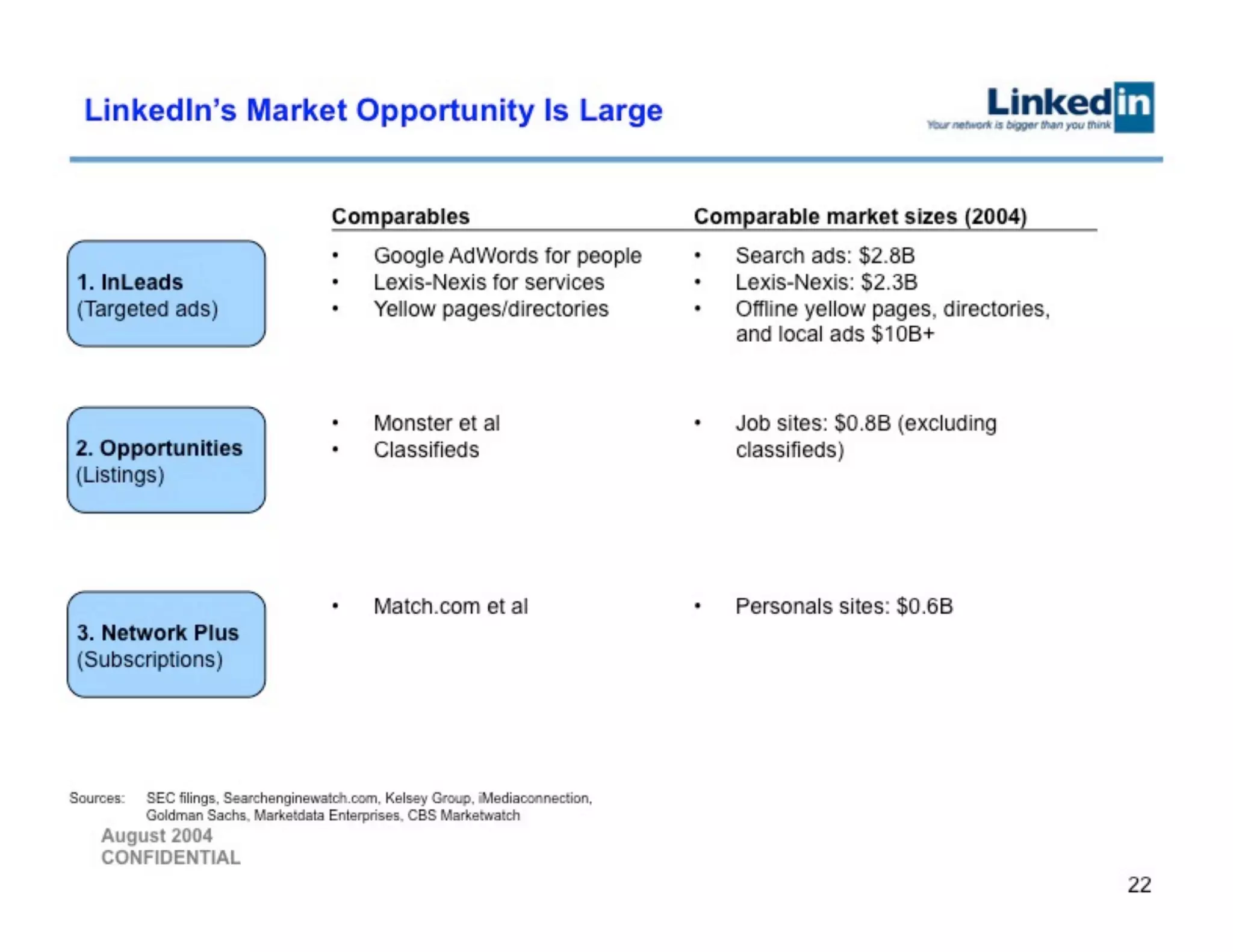
Market sizing & category opportunity (jobs & advertising)

Market sizing & category opportunity (jobs & advertising)

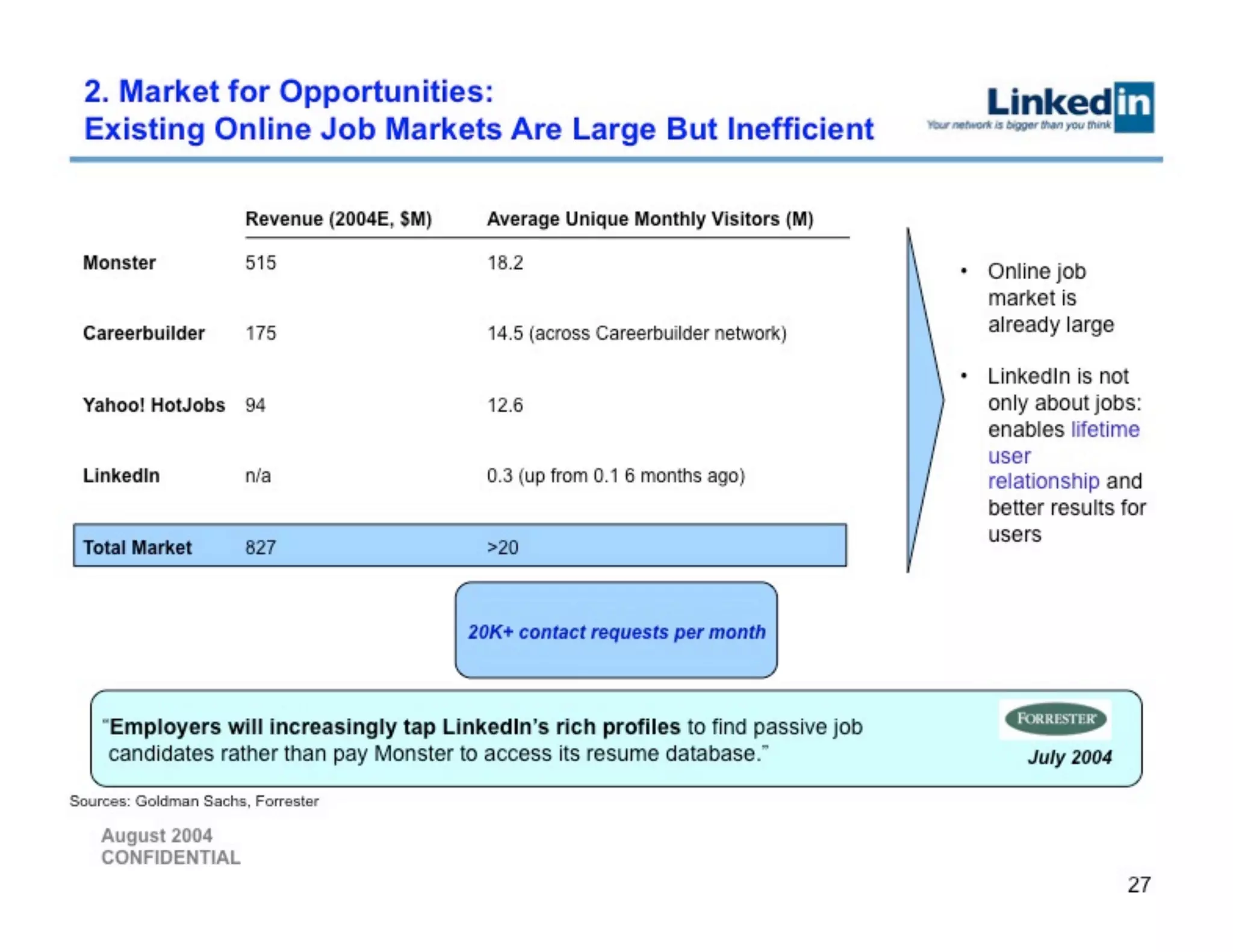
Slide 27 quantifies the existing job-market incumbents (Monster, Careerbuilder, HotJobs) and positions LinkedIn as a differentiated, high-value entrant that enables lifetime user relationships. The slide couples traditional TAM figures with operational signals (20K+ contact requests per month), bridging market size with early engagement metrics. It frames the opportunity as both large and inefficient — an opening for a networked product to capture share.

Founders should use this approach to make TAM credible: juxtapose market dollar estimates with real platform activity to show both why the market matters and that users are already demonstrating the behavior that will unlock revenue. Include both macro numbers and micro signals to make the case actionable.

Key Takeaway: Combine credible market sizing with platform engagement metrics to show both opportunity and early product-market fit.

Conclusion: Key Lessons

LinkedIn’s Series B deck is a model of clarity: it establishes a crisp product thesis (networked people search), explains why that thesis creates defensible advantages (reputation, trust, and network effects), benchmarks against familiar winners, demonstrates real traction, and lays out coherent, product-aligned monetization. The deck balances narrative, numbers and product visuals so each claim is supported by either theory (analogy), data (growth/market share), or product proof (mockups and customer quotes).

Actionable advice for founders: start with a single, defensible insight about why your product is structurally better; use well-chosen analogies to accelerate understanding; prioritize real traction visuals (actual vs projected growth, engagement metrics); link each revenue idea directly to product value; and show product UI or pilot evidence where possible. Above all, make it easy for investors to connect product, growth and monetization in a single unbroken line.