Stack up against Bumble

Compare Your Deck

Bumble's 2014 Pitch Deck

Social
Stage: Growth
Raised: Multiple
Year: 2014
Slides: 12
Outcome: IPO at $7.7B valuation

Pitch Deck

1 / 12
Slide 1
Click to expand

Deck Analysis

This deck for Bumble (2014, Growth stage) presents a marketing-driven growth plan rather than product specs or financials. It positions Bumble as a distinctive dating app — female-first and values-driven — and then pivots quickly to a concrete user acquisition strategy centered on content and Snapchat activations. Notable here is the focus on storytelling and distribution (content site + ephemeral social activation) to build brand and retention, which foreshadowed the app's later scale and cultural resonance leading to an eventual IPO.

Cover / Brand Positioning

Cover / Brand Positioning

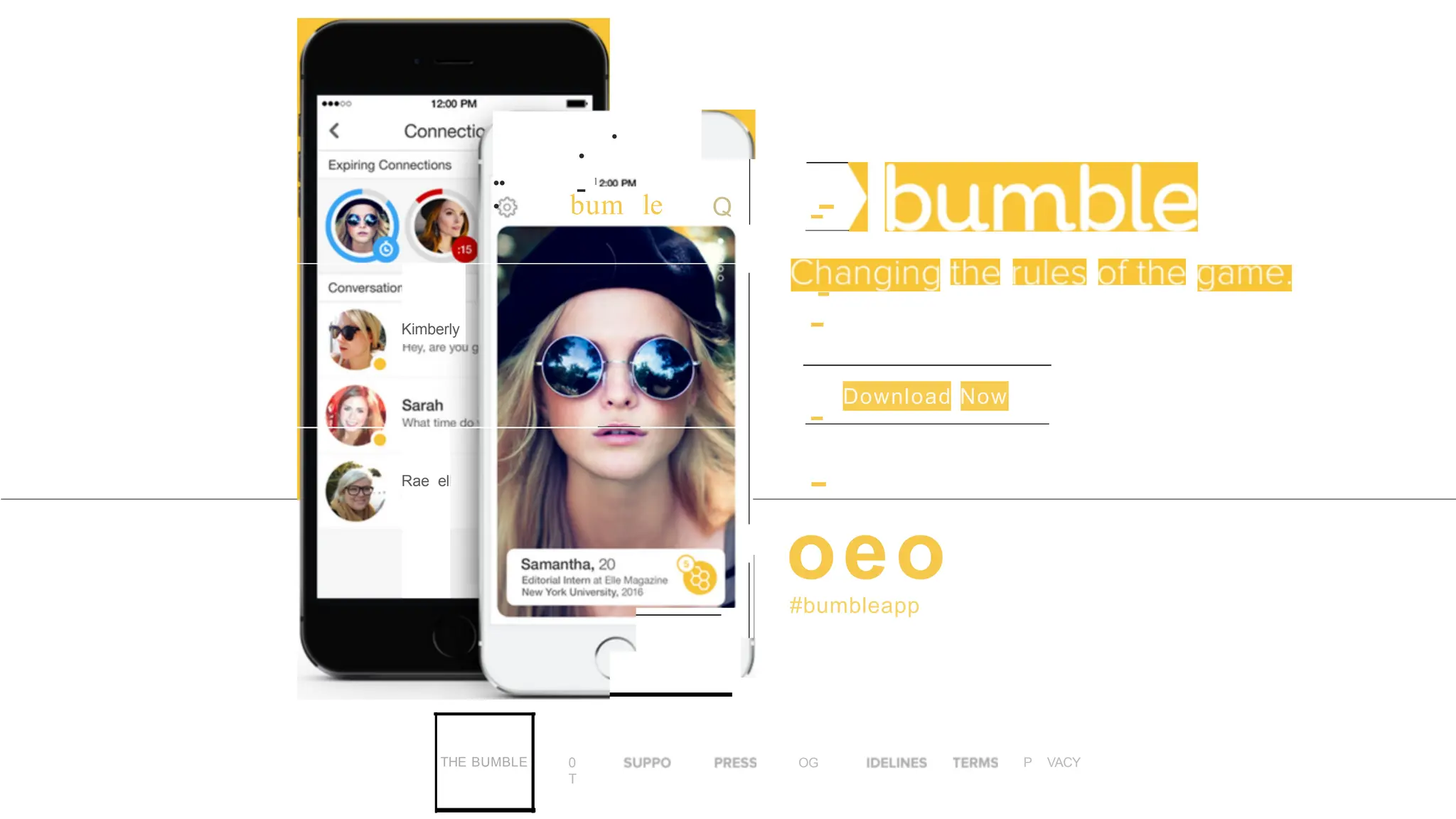
The opening slide (clean Bumble wordmark with phones showing the app) functions as a lightweight brand moment: it immediately establishes the product category (dating app), the visual identity (yellow, modern), and shows real UI and user photos. That combination of logo + UI gives investors instant clarity on what the company does and what the product looks like without needing text-heavy explanation.

This is effective because it trades exposition for visual clarity. Founders can learn that a strong, uncluttered cover that communicates category, brand, and product imagery builds immediate credibility and sets the tone for a marketing-focused pitch. It primes reviewers to focus on positioning and growth rather than technical complexity.

Key Takeaway: Use a single clear visual that shows brand + product immediately — let the audience know category and aesthetics in one glance.
Value Proposition: What is Bumble?

Value Proposition: What is Bumble?

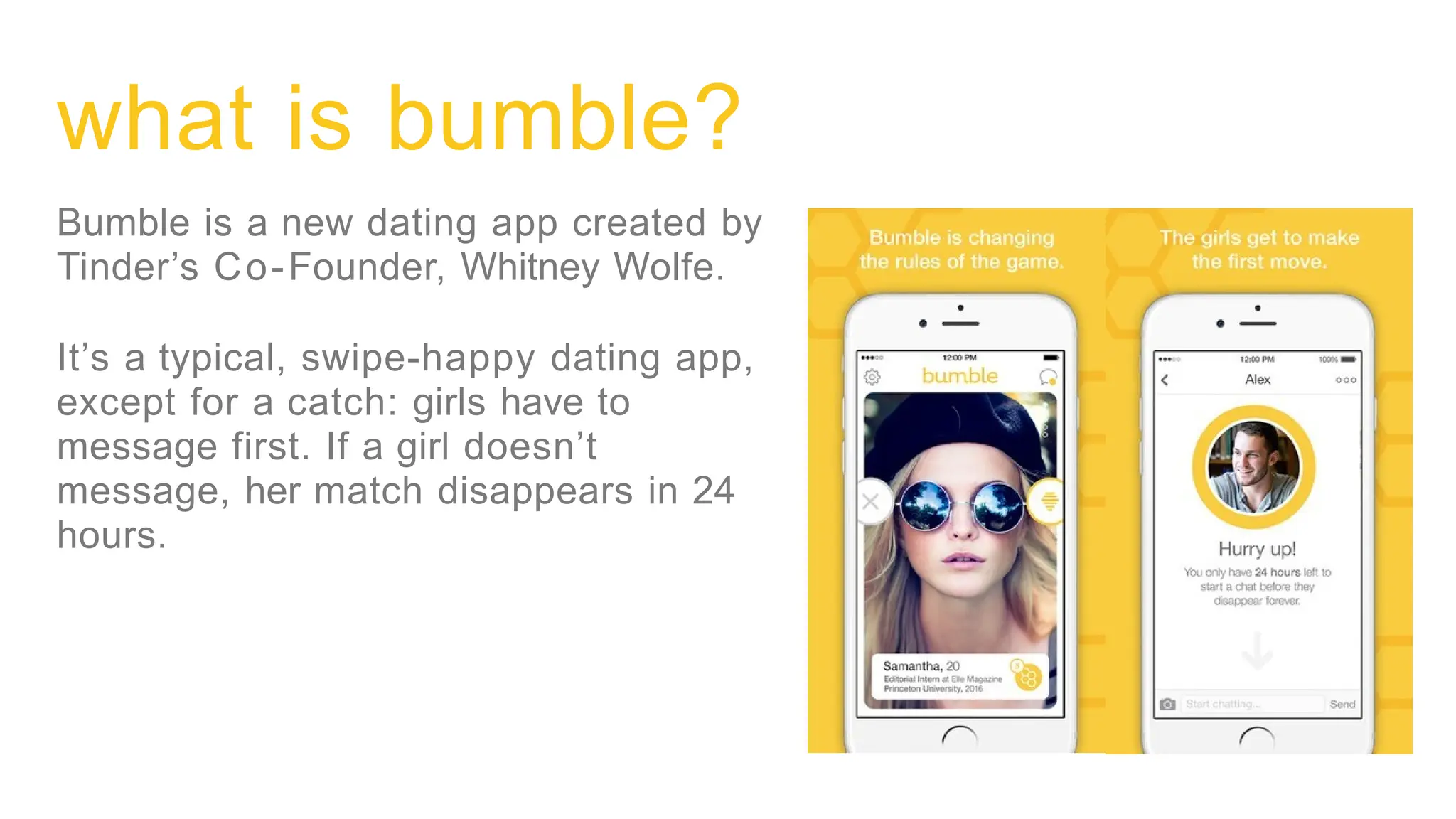
Slide 2 succinctly explains the product and its unique rule: women must message first and matches expire after 24 hours. It frames the product in plain language and highlights the behavioral mechanic that differentiates Bumble from competitors. The slide balances founder provenance (Whitney Wolfe, Tinder co-founder) with a crisp product differentiator, which helps justify both credibility and product-market fit.

This is a textbook example of leading with a one-line thesis plus a single supporting detail that illustrates defensibility. Founders should emulate this structure: name the category, state the one-line differentiator, then add a short operational detail that shows how the differentiator works in practice.

Key Takeaway: State the category, the single unique rule or mechanic that sets you apart, and a short how-it-works detail — in one slide.
Mission Framing: 'Not a dating app, it's a movement'

Mission Framing: 'Not a dating app, it's a movement'

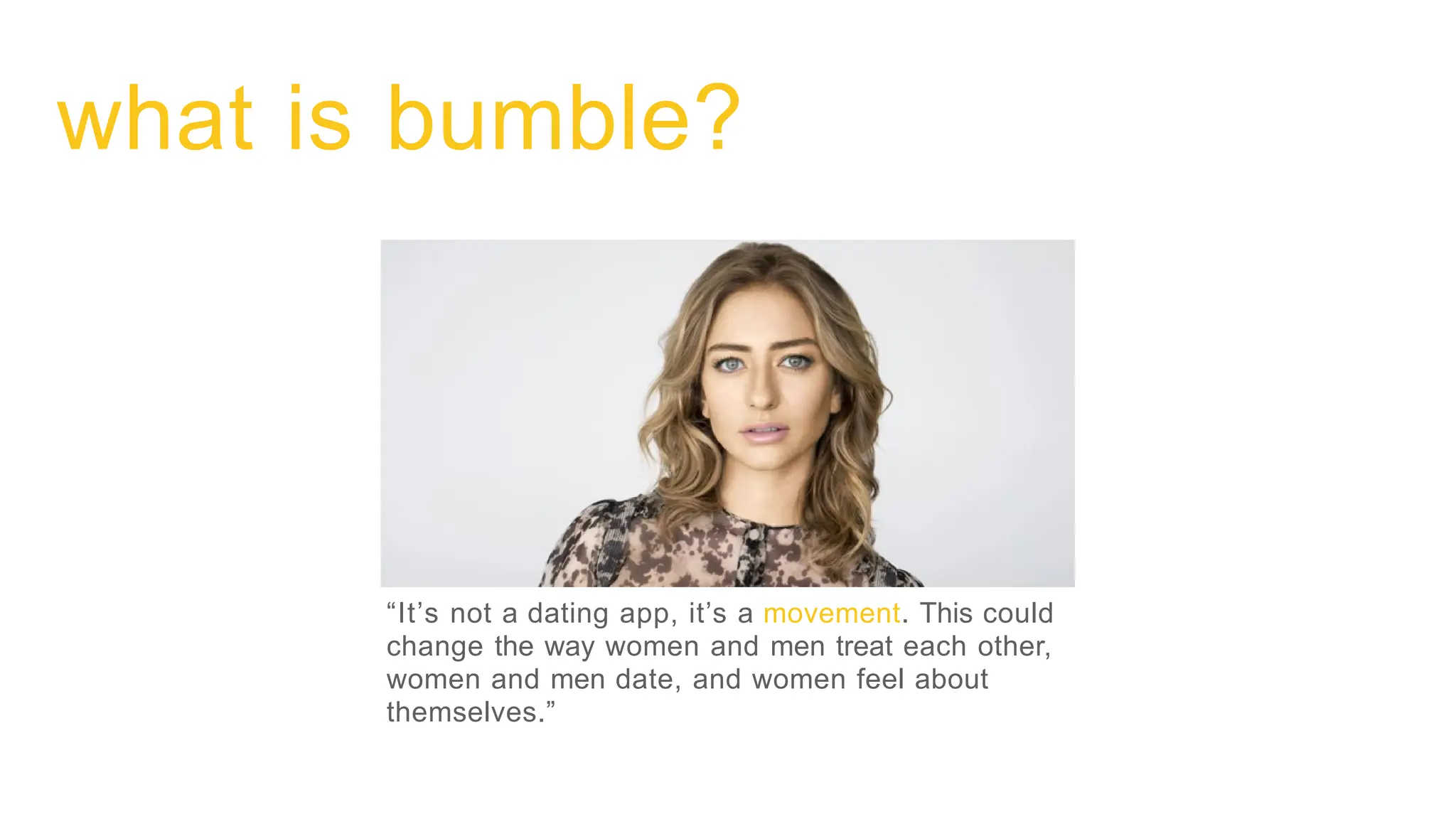
Slide 3 elevates the product to a movement, with a quote about changing how women feel and how people treat each other. This is an emotional framing play: it turns a utility product into a cultural project. For investors, that signals potential for brand loyalty, PR virality, and higher lifetime value from emotional engagement rather than mere transactional matching.

The lesson for founders is strategic: if your product can credibly claim social impact or empowerment, use that positioning to justify differentiated marketing channels, partnerships, and higher engagement expectations. But be prepared to back the claim with concrete programs and metrics — which the rest of the deck seeks to do via content and Snapchat activations.

Key Takeaway: If you can credibly claim cultural or mission-driven impact, make it a central positioning lever — but pair it with tactical plans to prove it.
Problem / Go-to-Market Gap: Low awareness

Problem / Go-to-Market Gap: Low awareness

Slide 5 states the core challenge plainly: the app is new and needs awareness beyond word-of-mouth. The slide introduces agency partners (Group SJR and Truffle Pig), which signals that the founders understand they need marketing infrastructure and outside creative expertise. The messaging is pragmatic: awareness first, then retention and growth.

This is effective because it acknowledges the real constraint (distribution) instead of hiding behind product features. Founders should be explicit about their biggest bottleneck — fundraising and partnerships are easier to justify when the problem is clearly articulated and paired with a proposed channel or partner.

Key Takeaway: Name your single biggest growth constraint and show you’ve engaged partners or a plan to tackle it — clarity about bottlenecks builds investor confidence.
Solution Overview: Content + Snapchat Activation

Solution Overview: Content + Snapchat Activation

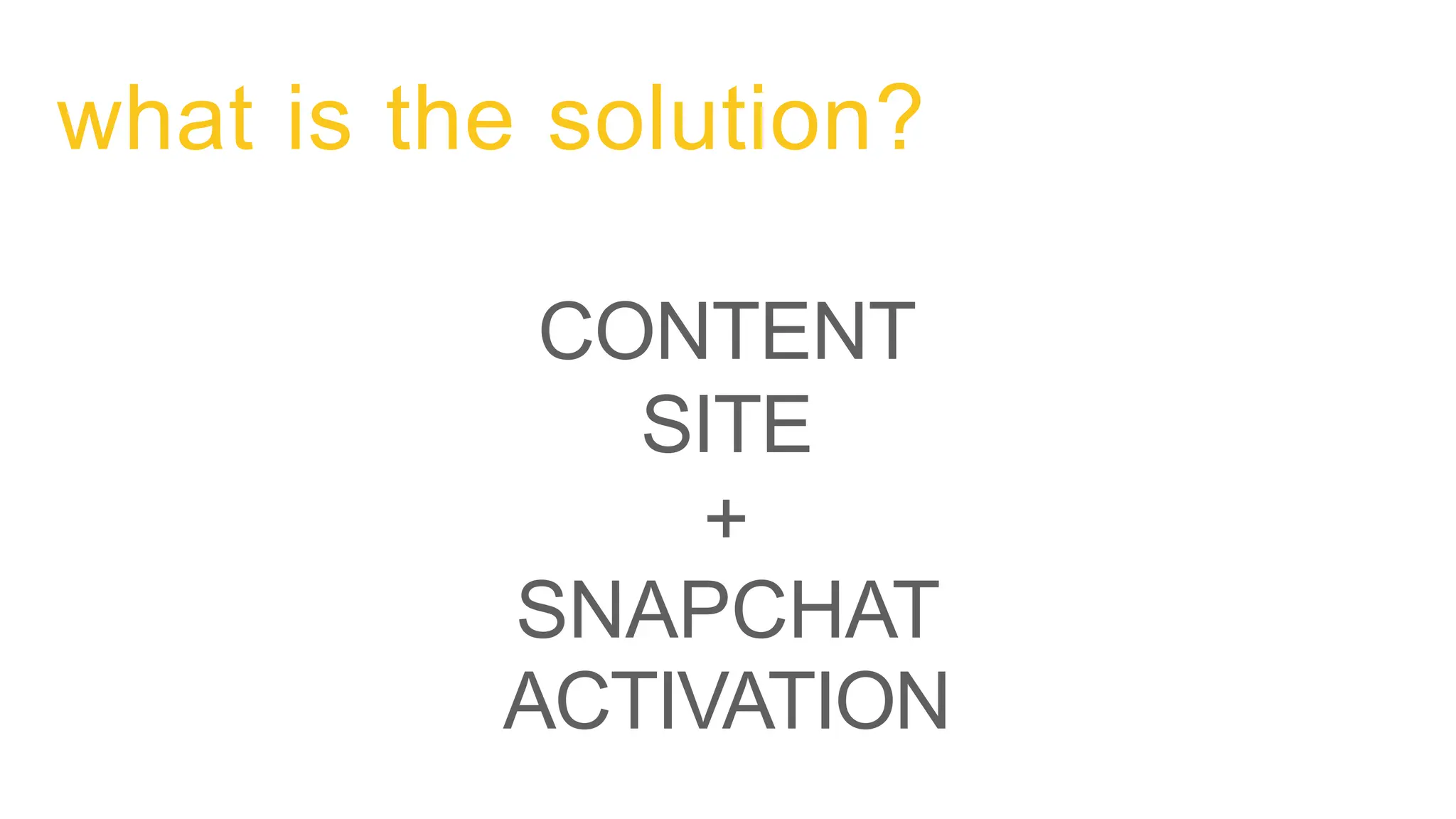
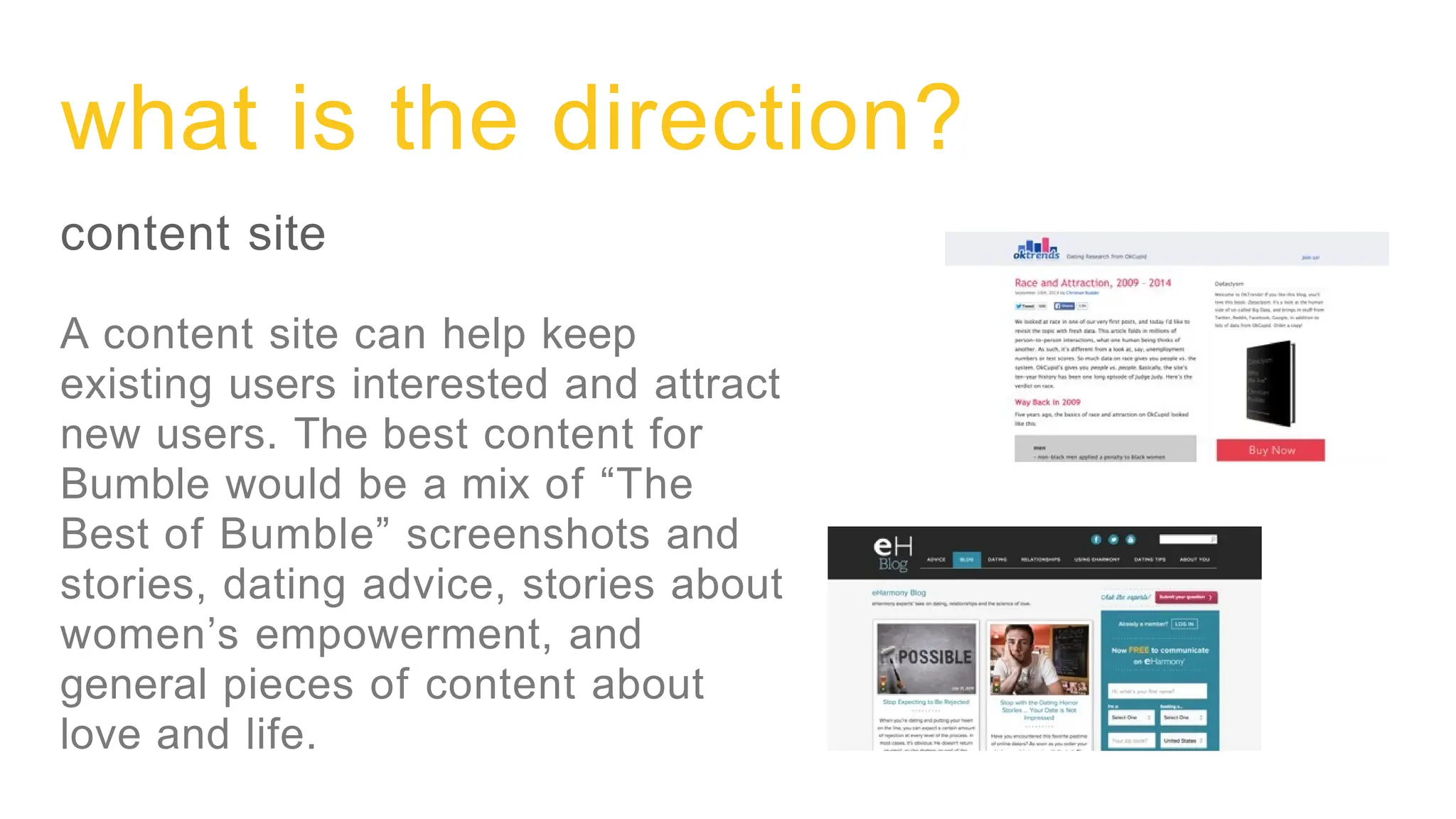
Slide 6 offers a clear, two-part growth solution: build a content site and run Snapchat activations. That combination ties owned media (content site to retain users and build SEO/brand authority) to paid/earned social distribution (Snapchat stories to reach young, mobile-first audiences). The simplicity of "CONTENT SITE + SNAPCHAT ACTIVATION" makes the strategy memorable and easy to evaluate.

Founders can learn the power of pairing an owned asset with a high-reach distribution channel. The owned asset drives retention and depth; the distribution channel drives acquisition and scale. The deck’s strength is its specificity — it doesn’t promise vague virality, it prescribes concrete channels.

Key Takeaway: Pair owned media (content hub) with a targeted social activation that reaches your audience — own the conversation and then amplify it.
Channel Tactics: Snapchat Featured Story & User-Generated Content

Channel Tactics: Snapchat Featured Story & User-Generated Content

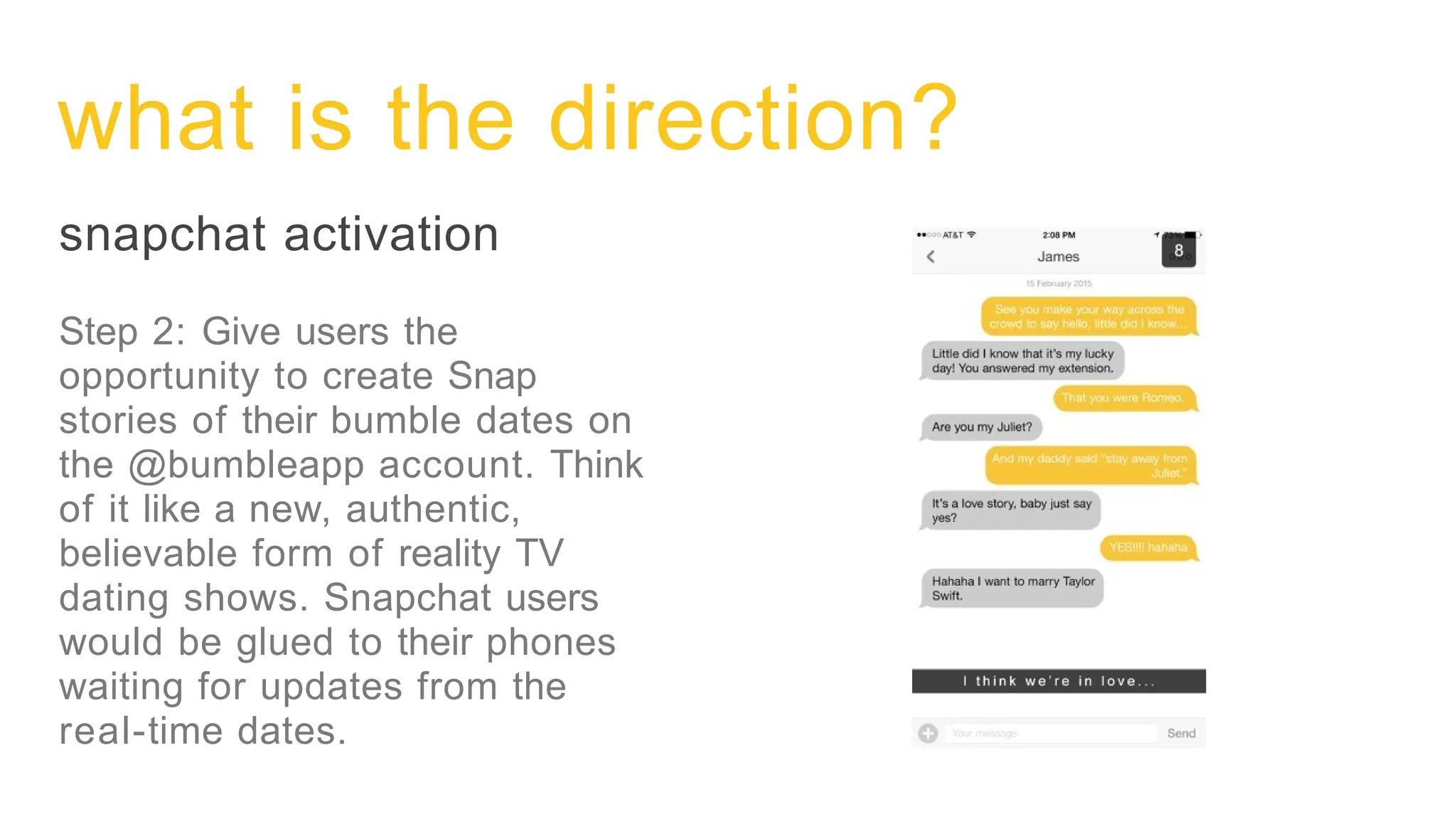
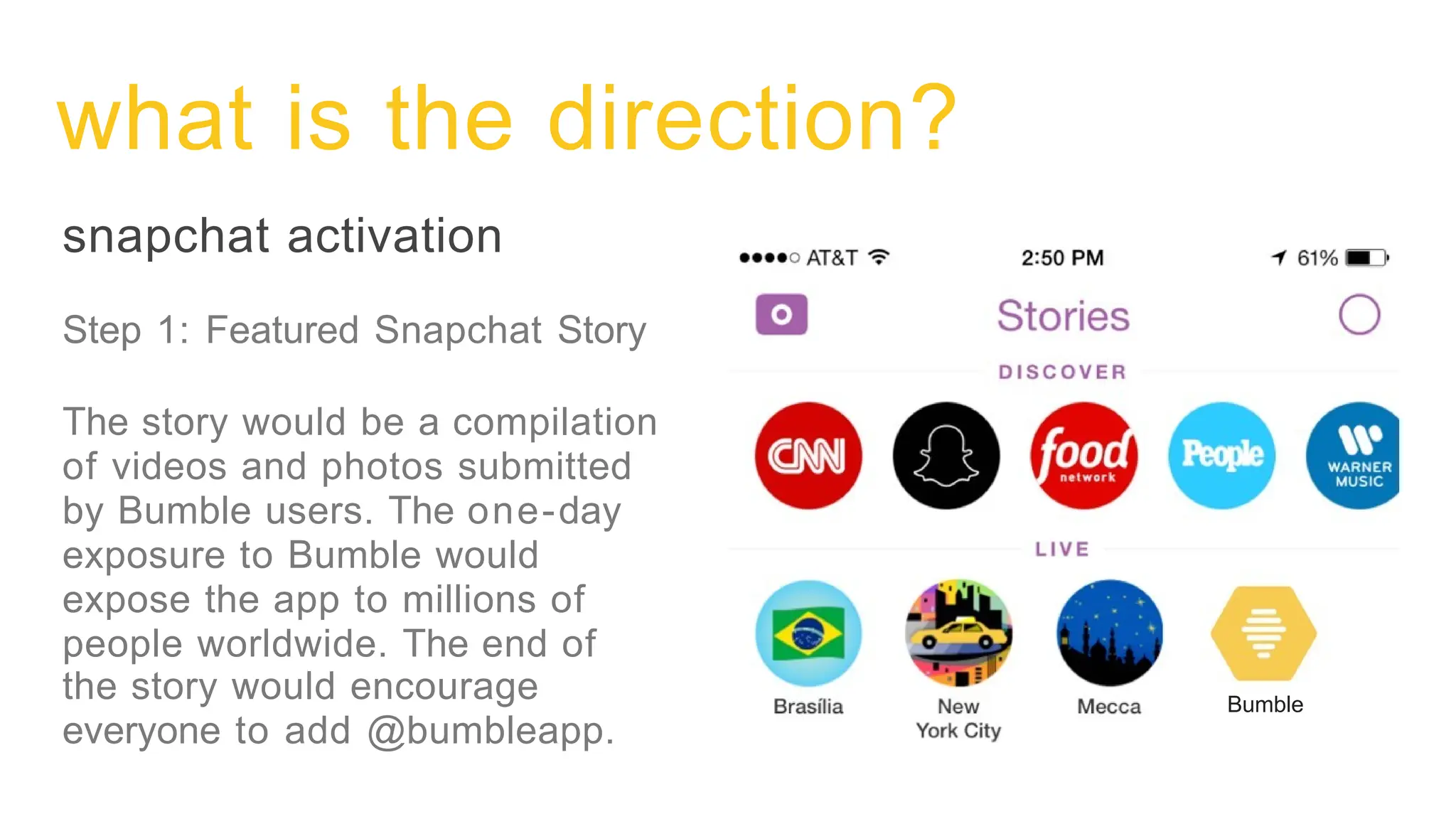
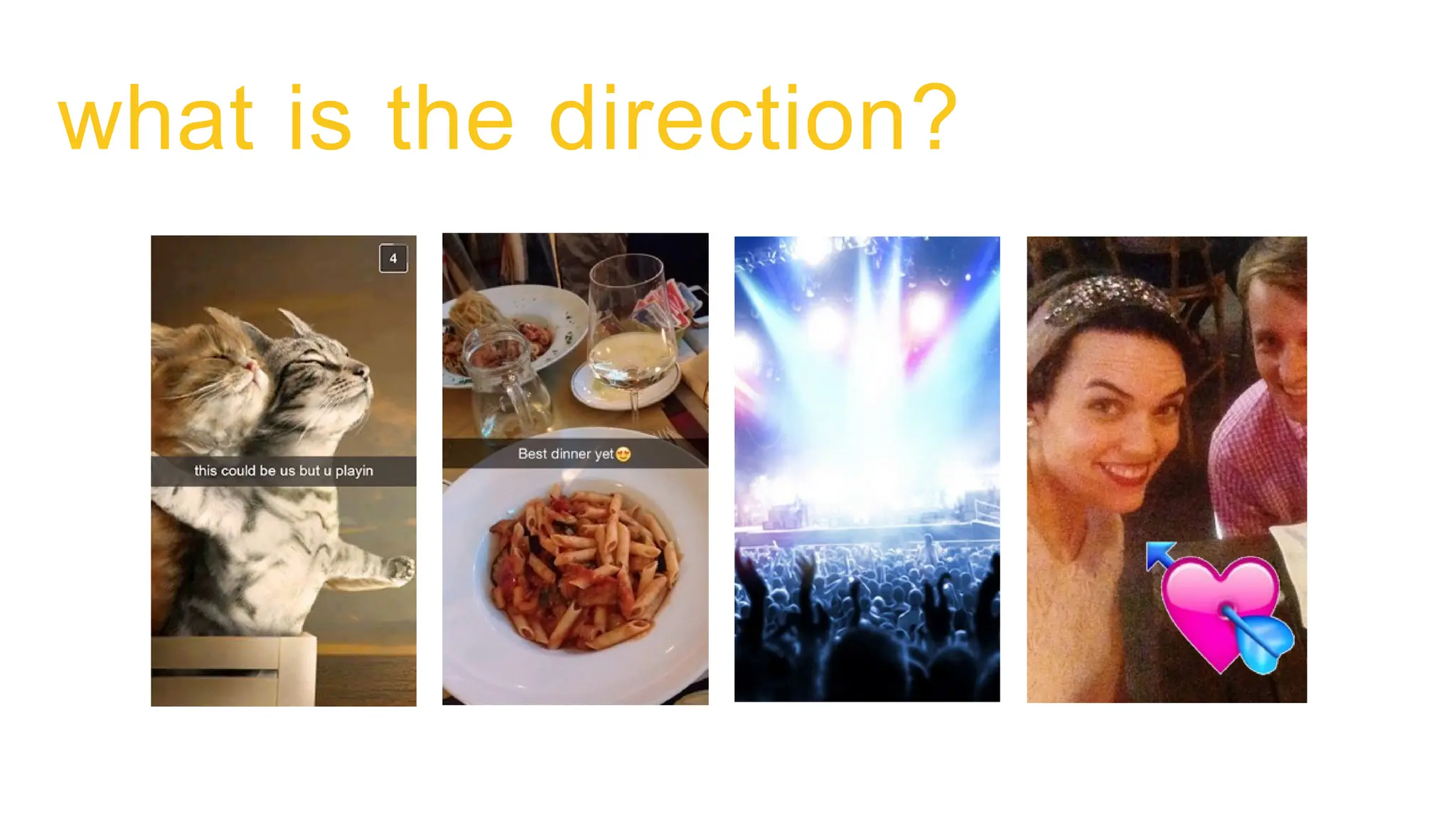
Slide 10 drills into the Snapchat plan: buy/earn a Featured Story slot to compile user-submitted videos/photos and push one-day exposure driving users to @bumbleapp. The follow-up slides (not selected here) expand on giving users the chance to create Snap stories of their Bumble dates, effectively turning ephemeral content into a serialized, reality-TV–style feed.

This tactic shows intelligent audience-first thinking: Snapchat’s user base matches Bumble’s demo and the ephemeral nature creates urgency and shareability. It also leverages UGC to scale content cheaply while increasing authenticity. For founders, the lesson is to design growth tactics that align product behavior with platform mechanics — a native approach beats generic ad buys.

Key Takeaway: Design campaign mechanics that are native to the chosen platform and that turn users into content creators — authenticity scales reach and reduces production cost.
Outcome & Positioning: From disposable app to destination brand

Outcome & Positioning: From disposable app to destination brand

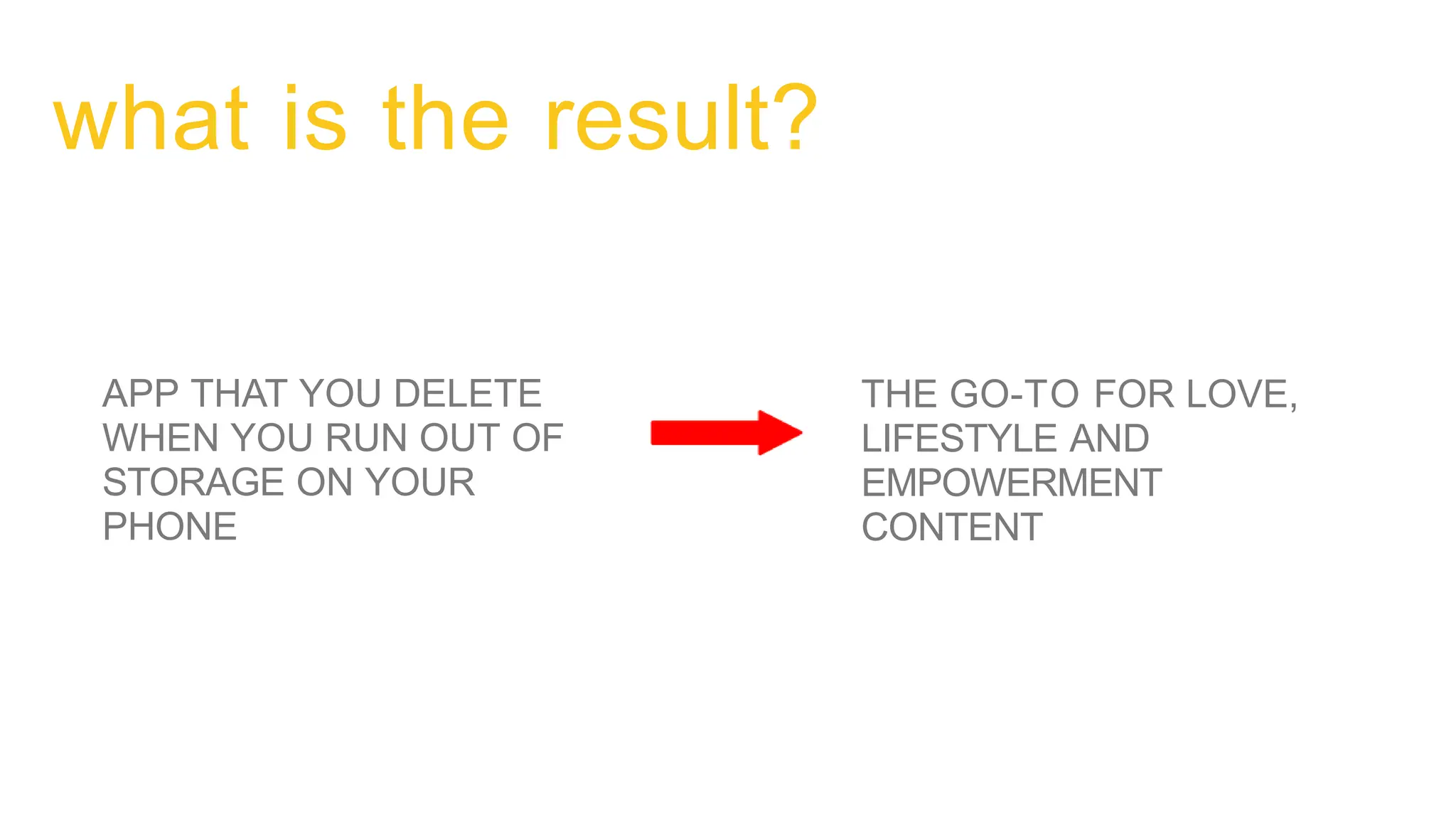
The final slide ("what is the result?") contrasts the app-as-disposable (deleted when you need storage) with the goal of becoming a go-to source for love, lifestyle, and empowerment content. This frames the desired long-term outcome — transform short-term app usage into an enduring brand and content destination. It’s a crisp articulation of retention and brand strategy rather than only acquisition.

That future-state framing helps investors imagine exit-path and defensibility beyond just downloads (i.e., content brand, partnerships, diversified revenue). Founders should similarly articulate how short-term product hooks will evolve into persistent value propositions — it’s a narrative that links early user acquisition to long-term monetization and brand equity.

Key Takeaway: Move beyond acquisition metrics and articulate the long-term brand vision and how retention/owned content will turn a transient user into a loyal audience.

Conclusion: Key Lessons

This deck succeeds because it is lean, visual, and marketing-focused: it establishes brand and product quickly, names a single differentiator, calls out the core growth constraint, and lays out a concrete, native-channel strategy (content + Snapchat) to solve it. The narrative moves logically from identity and mission to the practical tactics that will grow and retain users.

Actionable advice for founders: 1) Lead with one clear differentiator and back it with a simple mechanic that investors can understand instantly. 2) Identify the single biggest growth bottleneck and present a paired owned+distribution solution. 3) Design activations to be native to the chosen platform and to generate user-created content to lower costs and increase authenticity. Finally, frame short-term acquisition in service of a long-term brand destination — that’s how a product can evolve from an app people delete into a lasting media-enabled business.